renshuu - Japanese learning
- 1.42K
- 4.9
- Installs
- 1.00M
- Price
- Free

Screenshots

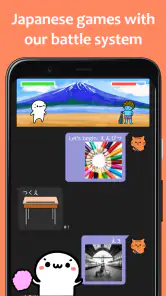
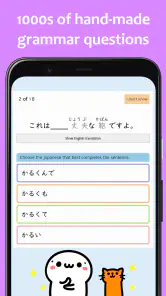
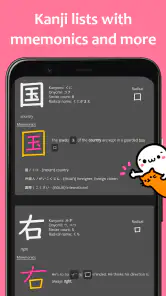
Analysis by Reviewed
I approached renshuu as someone who wanted a practical way to keep Japanese study moving without turning every session into a formal lesson. It is a free education app from renshuu.org, aimed at building a personal route through Japanese rather than forcing every learner into exactly the same sequence. After using it, my main impression is that it works best as a daily study companion: something I can open for a short review, return to when I have more time, and shape around the areas I actually need.
That flexibility is important because Japanese learners rarely have identical goals. One person may be preparing for a trip, another may be working through kana and basic vocabulary, while someone else may already read comfortably but need regular reinforcement. The app makes more sense when viewed as a flexible learning workspace than as a single linear course. I found that approach encouraging, although it also means the learner has to make a few decisions instead of simply following a fixed lesson list.
What it feels like to use renshuu for Japanese study
The first thing I noticed is that the app tries to make repetition feel less mechanical. Its focus is not just on showing a word once and moving on. The useful habit is to return regularly, answer what I can, notice where I hesitate, and let those weak points influence the next session. That makes it suitable for the small gaps in a normal day: a few minutes before leaving home, a quiet break at work, or a longer session when I want to review several areas together.
I would not describe it as a replacement for every part of Japanese learning. An app can help me recognize vocabulary, review writing systems, and build a dependable study rhythm, but it cannot by itself provide the full experience of conversation, extended reading, or personal feedback from a teacher. The strength here is consistency. When I do not have the energy to open a textbook, the lighter format gives me a realistic way to study something instead of abandoning the day completely.
The store presents it as a personal path to mastery, and that idea matches my experience more than a rigid course would. I can spend time on the material that matters to me rather than treating every topic as equally urgent. That is especially useful after the beginner stage, when learners often have uneven knowledge. I may recognize common vocabulary quickly but struggle with a particular grammar pattern, or read kana comfortably while still confusing similar kanji. A personalized approach can expose those gaps more clearly than simply completing chapters in order.
At the same time, freedom can become friction. Beginners sometimes need a firm starting point and a clear next step. If I were introducing Japanese to a friend who feels overwhelmed by choices, I would suggest beginning with one modest target instead of exploring everything at once. For example, I might choose a short daily review routine and one main subject for the week. That keeps the app from becoming a collection of interesting options without a stable learning plan.
Why the developer and public reception matter
renshuu.org is the developer behind the app, and the product has built a strong public response: it holds a 4.9 average from around fifteen thousand ratings, with roughly one and a half thousand written reviews. It has also passed one million installs. Those figures do not prove that every learner will enjoy the same workflow, but they do make the app worth considering when I compare Japanese-learning tools.
I also appreciate that the app is presented as free and without ads, paywalls, or timers in its store summary. That creates a calmer first impression than many study products that constantly interrupt a session or push urgency. There are in-app purchases, ranging from $3.99 to $129.99 per item, so I would still check the purchase screen carefully before confirming anything. The important distinction is that I can begin evaluating the learning experience without paying at the door.
The content rating is Everyone, which makes the app broadly approachable for families and younger learners. That does not remove the need for sensible account and purchase awareness, particularly if a device is shared. I would let a child explore the educational material with an adult nearby when purchases are possible, not because the learning content feels inappropriate, but because any optional transaction deserves a deliberate choice.
Controls and choices I pay attention to
My trust in a study app comes less from enthusiastic wording and more from how much control I have while using it. Here, the most visible choice is the ability to shape my learning path rather than being forced into a single pace. That matters for people who study in bursts. I can make a session fit the time available instead of feeling that I have failed because I could not complete a long lesson.
The no-ads and no-timer positioning also changes how I use the app. I am less likely to rush through an answer simply to protect a streak or avoid an interruption. For Japanese, that is a meaningful difference: recognizing a word quickly is not always the same as understanding how it behaves in a sentence. A slower review can be more useful than a fast score, especially when I am trying to distinguish similar readings or remember why a form is used.
There is a practical account question I would consider before investing heavily in any learning system: how much of my progress depends on an account, and what happens if I change devices? I would make a note of the sign-in method I choose and avoid treating a learning app as the only place where my study plan exists. Keeping a simple external record of current goals, textbooks, or vocabulary themes is good practice. It protects my overall routine even if I later reorganize my devices or decide to use another resource alongside this one.
I also recommend reviewing the purchase wording rather than assuming that “free” means every option is permanently included. The app can be started without an upfront price, but the listed purchase range is wide. Before accepting an upgrade, I would identify exactly what it changes, whether it is a one-time item or a recurring commitment, and whether it solves a problem I actually have. That is a small step, but it gives the learner control instead of letting curiosity make the decision.
Handling personal information with care
Japanese study can become personal surprisingly quickly. A learner may record goals, progress, weak areas, or notes connected to travel, work, school, or relationships. I avoid placing sensitive personal details into any optional profile or note field unless I understand why they are needed and who can see them. A language app does not need to know private life details for me to benefit from vocabulary practice.
My cautious approach is simple: use a distinctive password, keep the device protected, and review account settings when I first sign in. I would also look at the platform’s privacy and permission screens directly rather than relying on assumptions based on other education apps. Permissions can vary by operating system and app version, so I treat the visible choices on my own device as the deciding information.
The current version is 1.2.20260311 and supports devices running Android 7.1 or later. That broad operating-system requirement makes it accessible on older Android hardware, but I would still keep the app and operating system updated where possible. Updates can affect interface behavior, account screens, and permission prompts. When an app changes, I make a habit of checking whether any new choice is being requested instead of tapping through automatically.
I would be especially careful on a shared phone or tablet. Study history may reveal what someone is learning, and purchase screens may be available to anyone using the device. A separate device profile, a screen lock, and purchase authentication are sensible safeguards. These steps are not specific to Japanese study, but they matter here because a learning routine often continues for months and can accumulate more personal information than a quick trial app.
A realistic routine that makes the app useful
Imagine I am commuting and have twelve quiet minutes before arriving. I might use the first few minutes for a focused review, mark the items that repeatedly slow me down mentally, and stop before fatigue turns the session into guessing. Later that evening, I could return to the same weak area with more attention. The important part is not squeezing in the largest possible number of questions. It is creating a repeatable loop: short exposure, honest answers, and a later return to difficult material.
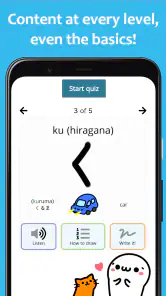
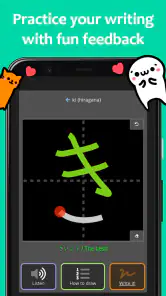
For a beginner, I would divide the week rather than trying to cover every Japanese skill in one sitting. One session could concentrate on kana recognition, another on basic vocabulary, and another on reviewing what has already appeared. I would pair that with handwriting practice on paper if writing is a goal. The app can support recognition and recall, but physically forming characters is a different task, and relying on screen recognition alone may leave that ability underdeveloped.
For an intermediate learner, I would use it as a maintenance layer beside authentic material. After reading a short article or watching a Japanese video, I could identify a small set of words worth reviewing, then return to the app later instead of trying to memorize everything at once. This creates a useful trade-off: the app supplies repetition, while real material supplies context. Neither side has to carry the entire learning process.
A less obvious advantage of this workflow is that it exposes the difference between recognition and confidence. I may answer a familiar-looking item correctly but still be unable to use it naturally. When that happens, I would write one original sentence outside the app and check whether I understand the word’s role, politeness level, and common combinations. That extra step prevents a high review score from giving me a false sense of fluency.
Where it beats familiar alternatives, and where it does not
Compared with a traditional textbook, the app is easier to open for a quick session and more responsive to uneven knowledge. A textbook usually gives me a carefully arranged explanation and a dependable narrative, which can be better when I need grammar taught in a deliberate order. I would choose the book when I want a lesson I can annotate from beginning to end, and use renshuu.org when I need repeated contact with material I have already encountered.
Compared with flashcard-only tools, this app feels more suitable for learners who want a broader study environment rather than building every review set themselves. The trade-off is that a highly organized flashcard user may prefer total control over card design, tagging, and scheduling. If my main goal were to import a carefully curated personal deck and manipulate every detail, a dedicated flashcard system could remain the better fit.
Compared with game-like language apps, the calmer presentation is a positive for me. I am less interested in collecting points than in remembering a word next week. However, someone who needs strong entertainment, constant animation, or a very obvious reward loop may find this approach less exciting. The app can make study approachable, but it cannot manufacture motivation on days when I have no clear reason to learn.
It also differs from a live class. There is no substitute for a teacher correcting pronunciation, explaining an unexpected sentence, or adapting an explanation to my exact confusion. I would choose a class or tutor when speaking accuracy and immediate feedback are central. I would choose this app when I need affordable, private repetition that I can fit around an unpredictable schedule.
Who should use it and who should skip it
I think it is a strong match for independent learners who want a flexible Japanese routine, people returning to study after a long break, and students who need more repetition than their course provides. It is also appealing for anyone who dislikes ad-heavy study tools and prefers to decide when a session ends. The Everyone rating and free entry point make it easy to try, while the available purchases leave room to decide later whether additional value is worth paying for.
I would hesitate to recommend it as the only resource for someone preparing for a specific exam on a strict schedule. Exam preparation needs a clear syllabus, timed practice, and targeted correction. The app may support that work, but I would not let a flexible review path replace official-style practice. I would also steer away from it as a sole solution for someone whose main goal is conversation. Speaking requires speaking, and no amount of silent recognition practice fully covers that need.
It may not suit learners who become anxious when presented with choices. In that case, I would begin with a written plan and use only the portion of the app connected to that plan. If even that feels too open-ended, a structured course with fixed chapters may be less frustrating. The best tool is not the one with the most possibilities; it is the one I can use consistently without spending the whole session deciding what to do.
My cautious verdict after using it
The real value of renshuu is the control it gives a learner over repetition. It is not a magic shortcut to Japanese, and I would not treat a strong public rating as proof that it replaces books, teachers, conversation, or authentic reading. What it does well is make regular review easier to maintain, especially when my available time changes from day to day.
I would start with the free experience, choose one clear learning goal, and test whether the review rhythm fits my habits before considering any in-app purchase. I would keep personal information limited, check account and purchase choices carefully, and maintain a simple backup of my broader study plan. Those habits let me evaluate the app on its actual usefulness rather than on promises.
My recommendation is cautious but positive. If you want a flexible Japanese-learning app that can sit between a textbook and a flashcard tool, it is worth trying. If you need a complete speaking course, a tightly scripted exam program, or total control over every card and lesson, another option may serve you better. For me, it works best as a dependable daily layer: focused enough to build progress, open enough to adapt, and most effective when I combine it with real Japanese outside the screen.
Pros
- Covers vocabulary
- kanji
- grammar
- and listening in one app.
- Spaced repetition helps reinforce difficult words over time.
- Lessons can be adjusted to different Japanese proficiency levels.
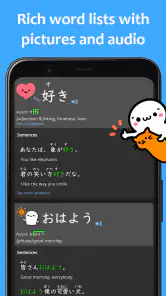
- Includes useful example sentences and native audio recordings.
- Progress tracking and daily goals make study habits easier to maintain.
Cons
- The large number of features may feel overwhelming for new users.
- Some advanced content and tools require a paid subscription.
- Grammar explanations may be too brief for learners needing deep detail.
- Audio playback and lesson navigation can occasionally feel inconsistent.
- Offline access may be limited compared with a fully downloadable course.

- Category
- Education
- Version
- 1.2.20260311