 About Bolt: Request a Ride
Bolt and the Shift from One-Tap Rides to More Legible Trips
Ordering a car used to feel like a small act of faith: enter a destination, accept a price, and hope the pickup works out. Bolt: Request a Ride makes that ritual feel brisk and ordinary, but its more important role is as a measure of what ride-hailing has become. The category is no longer judged only on whether a car arrives. People expect to see the trip take shape before they commit: the likely cost, the pickup point, the vehicle options, and the progress of the driver. Bolt is strongest when it makes those decisions feel manageable, and weakest where the service still asks riders to trust a system they cannot fully inspect.
That is the central shift in ride-hailing. The app is not merely a button connected to a fleet; it is the interface through which a city’s curbside logistics become understandable. The best products reduce the uncertainty around a journey without pretending to remove it. Bolt’s clean request flow and live trip information show the current baseline, while its emphasis on accessible fares and service choices points toward a more explicit bargain between rider and platform.
The ride is no longer just the ride
A contemporary ride-hailing app has a demanding minimum standard. It should make entering a destination quick, place the pickup accurately, show a fare estimate before booking, and give the rider a credible sense of when the driver will arrive. Once matched, it should make the car and driver easy to identify, provide a route view, and keep the important trip details close at hand. These features are not luxuries now. A clumsy pickup pin or an unexplained fare can make an otherwise successful ride feel like a failure.
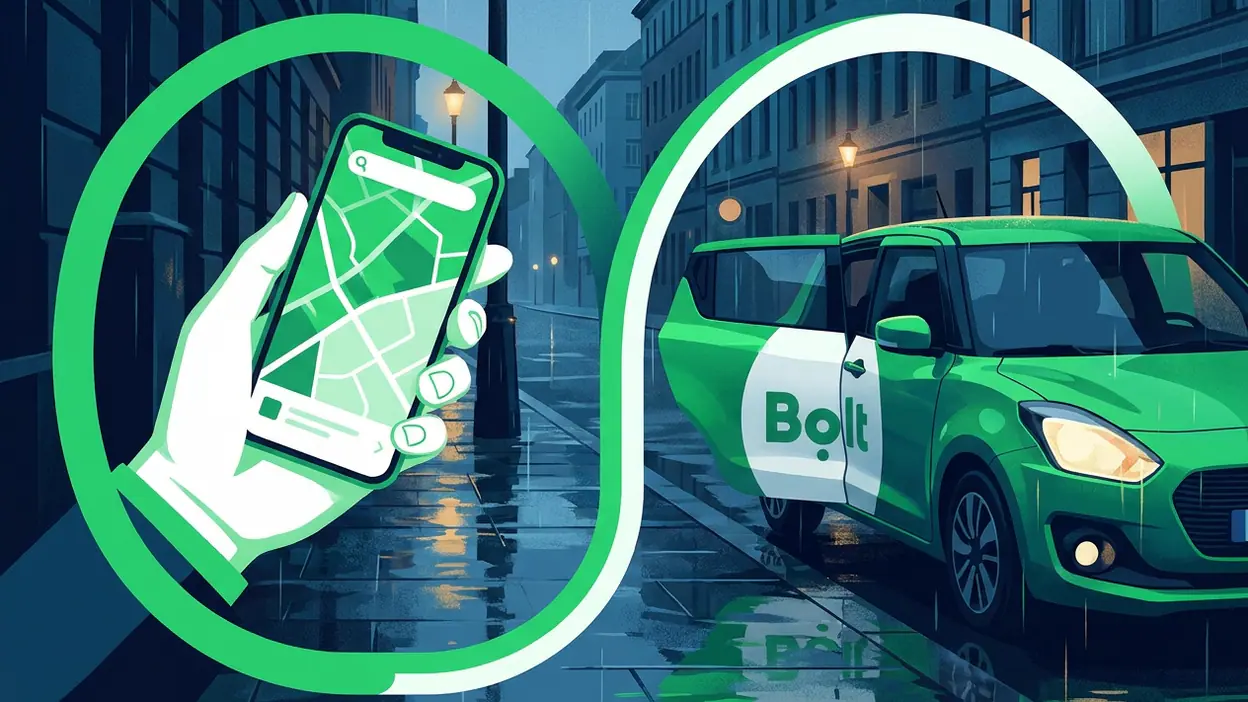
Bolt understands the value of a short path from intention to action. Open the app, set where you are going, review the available ride choices, and request one. The map does much of the practical work: it connects the pickup to the destination and turns the wait into something trackable. This is familiar by design. Riders should not have to relearn the basic grammar of a ride request every time they switch services.


Familiarity, though, is not enough. The standard has moved from “can I book a car?” to “can I make a sensible choice, and can I tell what is happening after I do?” That second question is where Bolt’s interface matters. The product’s most useful signal is its effort to make the service feel like a set of options rather than a single take-it-or-leave-it transaction. Availability and exact categories vary by city, but the premise is clear: different journeys call for different balances of price, comfort, and convenience.
That is a meaningful improvement over the oldest ride-hailing convention, in which the app presented a car as the answer and treated the rest as background. A rider heading across town in a hurry may value speed above all else; someone making a short trip may be more price-sensitive. Showing alternatives gives that judgment back to the user. The interface cannot guarantee a perfect match, but it can make the trade-off visible before the car is on its way.
What Bolt keeps, and what it questions
Bolt follows the conventions that have earned their place. The map remains the central surface; the pickup and destination anchor the booking; a fare estimate helps set expectations; and live driver progress makes waiting less opaque. These are now table stakes, not distinctive inventions. They work because they fit the way people think about a trip: where am I, where am I going, how much might it cost, and when will the ride arrive?
Latest News



The convention Bolt questions is the idea that the platform’s default offer should be treated as the natural choice. A fare-focused identity encourages riders to compare the price with the service they actually need, rather than assuming every ride must be the most premium or fastest option. That matters in a category where convenience can quietly become expensive. But price is not the whole story. A low estimate only earns trust if the final charge, pickup experience, and journey quality remain consistent with what the app led the rider to expect.
Here the comparison with Uber is useful. Uber has helped establish the expectation that a ride app should present several service tiers and keep the trip legible from booking through arrival. Bolt operates within that same vocabulary, but its appeal leans more heavily on the prospect of a value-conscious choice. Neither approach makes the other obsolete. The useful question is whether a rider can understand why one option costs more, and whether the added cost buys something that matters on this particular trip.
Waze sharpens a different part of the argument. It has trained drivers to expect traffic information and route changes to be surfaced as conditions change. A ride-hailing passenger is not choosing the route in the same way, but still cares about whether the journey is moving as expected. Navigation information should not stop at a decorative line on a map; it should help people understand delays and uncertainty. Bolt’s live trip view helps with orientation, yet the category as a whole still has room to explain disruptions in plain language rather than leaving riders to infer them from a slowly moving car icon.
InDrive brings another challenge into view: some riders want a more active role in the fare conversation. That model makes the price feel negotiable, whereas Bolt’s more conventional request flow keeps the decision quicker and more structured. The contrast points to an emerging expectation, not a universal preference. Riders want control, but they do not all want the work of bargaining. A strong app should make the economics understandable without turning every booking into a negotiation.
The gap between a good screen and a good service
Ride-hailing apps still struggle with the same physical realities: traffic, crowded curbs, confusing entrances, limited vehicle supply, and uneven service across neighborhoods. A precise map cannot always tell a driver which side of a large venue the rider is standing on. A time estimate can become stale as congestion changes. And a displayed fare is only reassuring if the rider understands what can make it change. The interface can soften these problems, but it cannot solve them on its own.
Bolt’s weakness, then, is not simply that a particular screen could show more detail. It is that smooth booking can create a stronger promise than the street can keep. The app may make a request feel effortless, while the pickup still requires messages, extra walking, or a last-minute adjustment. That gap is especially noticeable for visitors, people with mobility needs, or anyone waiting in a busy area where stopping safely is difficult. Better pickup guidance and clearer explanations of delays would improve the actual service, not just its polish.
There is also a wider trust problem. Riders need to know what they are paying for, how to get help if something goes wrong, and whether the app’s safety and support tools are easy to find before an emergency. Those details are less glamorous than a fast booking screen, but they shape whether people return. The category has become very good at compressing the request into a few taps; it has been less consistent at making exceptions, disputes, and uncomfortable moments feel equally well handled.
For users, the consequence is both liberating and demanding. Bolt can make local transport feel less like a hunt for a cab and more like a choice made with useful information. That is a real convenience, particularly when the alternative is uncertainty about availability or price. Yet the rider must still judge whether the estimate suits the journey, whether the pickup point makes sense, and whether a cheaper option is worth any added wait. The app supplies the frame; it does not make every decision for you.
The next standard for ride-hailing should be clear control without extra effort. That means estimates that explain their limits, pickup instructions grounded in the real street, meaningful distinctions between ride options, and timely reasons when a journey changes. It also means support and safety information treated as part of the main product rather than tucked away as afterthoughts. A better ride app will not merely reduce taps. It will reduce the number of things a rider has to guess.
Bolt: Request a Ride is a useful expression of where the category stands: quick to understand, built around the map, and increasingly shaped by a choice between cost and convenience. Its strongest contribution is not a radical break from the familiar booking pattern, but a nudge toward treating the rider as an active decision-maker. That shift is welcome, though the street still exposes the limits of an elegant interface. The category’s next test is straightforward: make the promise as clear as the request, and make the real journey live up to both.