 About Farm Land - Farming life game
Farm Land Review: A Small Island Farm with a Satisfying Loop
Some farming games ask you to settle in for the long haul. Farm Land - Farming life game makes a smaller, sharper promise: arrive on a sunny island, get your hands busy, and watch a patch of farmland grow into something worth circling back to. Its appeal is not a deep story or a complicated simulation. It is the clean pleasure of turning a few minutes of harvesting into visible progress, one field and one new corner of the island at a time.
That modest ambition is exactly why it deserves attention. Farm Land keeps the familiar farm-game routine light on its feet, with a bright, toy-like world and tasks that are easy to understand at a glance. The game is built for players who want the satisfaction of tending a farm without a wall of menus, long tutorials, or a punishing schedule. It feels less like running a business and more like taking a cheerful lap around a place that is always ready for one more improvement.
A tiny island with a reliable rhythm
The opening hook
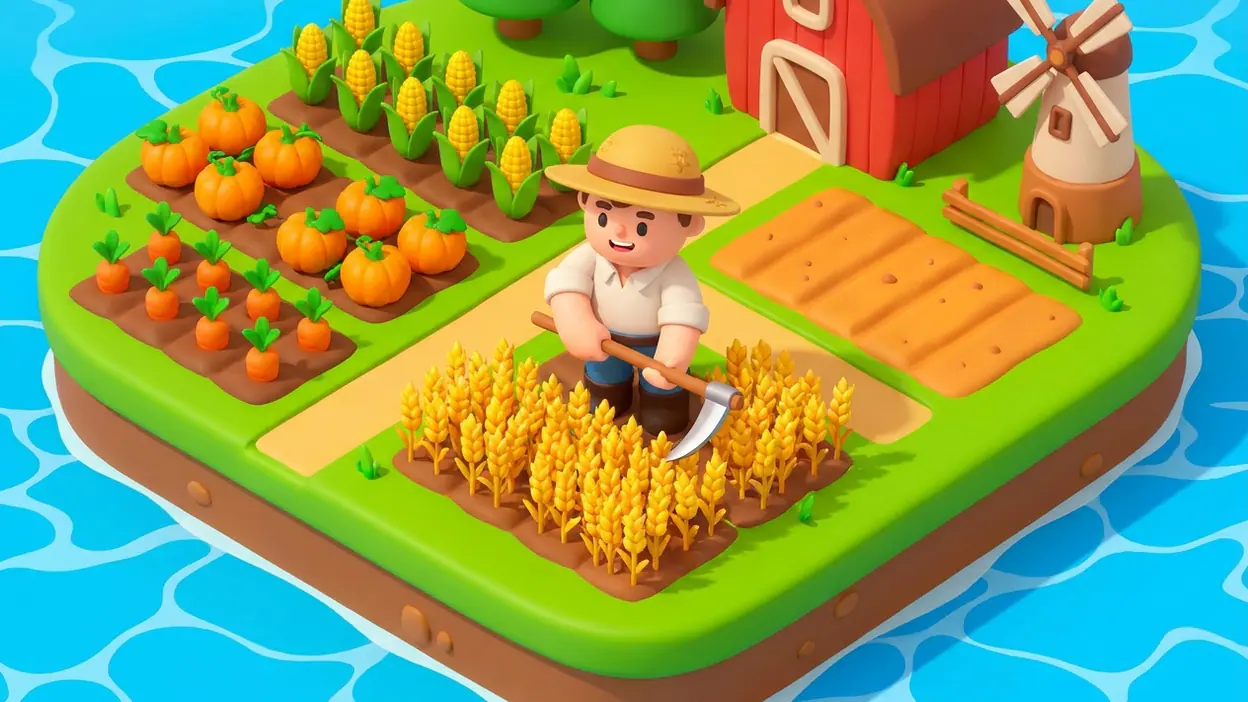
The opening is all about immediate activity. You step into a small, colorful farm, find crops ready to be gathered, and quickly learn the central promise: work the land, collect the proceeds, and use them to open up more possibilities. The first actions are simple enough to read without much explanation. Move through a plot, harvest, plant again, and follow the game’s prompts toward the next useful upgrade.
There is a satisfying sense of scale to this start. The farm is compact, so every new patch of ground feels close enough to matter. You are not staring at a sprawling landscape and wondering where to begin. The next task is usually in view, and the next reward is usually just beyond it. That tight framing gives the first minutes a gentle momentum: the island begins as a small worksite, then gradually starts to feel like yours.


The game also avoids making its hook depend on a dramatic plot twist. Its invitation is tactile and visual. Crops are waiting; a path can be cleared; a new area can be reached. The pleasure comes from seeing a once-empty space acquire purpose. If you enjoy games where progress is obvious before you even check a counter, Farm Land gets that part right.
How the core loop feels
The central loop is easy to summarize but has a pleasant hand-to-hand rhythm: harvest what is ready, tend the next crop, gather resources, and spend them on expansion or improvements. Each action feeds the next. Harvesting creates the means to keep working, while new space gives that work a fresh target. Rather than asking you to plan a complicated production chain, the game keeps the decisions immediate and readable.
That simplicity makes the physical rhythm more important than strategy. You move from one useful action to another, and the farm gradually fills with activity. A crop is not just a timer or an icon in a menu; it is part of a loop you can see and repeat. The pace rarely demands intense concentration. It is closer to a relaxed circuit: check what is ready, clear it, make the next small investment, then wander toward the next opportunity.
Latest News



For me, that is the game’s strongest design choice. Farm Land does not pretend its chores are profound, but it makes them feel crisp. The actions connect cleanly, so a short session can still contain a complete mini-arc: arrive with a task in mind, finish it, and leave the island a little more developed. That is a better fit for casual play than systems that make every visit feel like catching up on a backlog.
Progress you can see and feel
Progression is built around expansion and visible change. Earning resources matters because it opens the way to more land and more things to do, not because the game buries you under a spreadsheet of competing figures. A new area gives the farm room to breathe; an upgrade makes the place feel more capable. Those rewards are modest, but they arrive in a form the player can actually see.
This is where the game earns its easygoing charm. The reward is not only the currency gained from a harvest. It is the before-and-after of the island itself: a cleared stretch becoming useful, a working farm becoming busier, and a familiar route gaining another destination. The visual payoff gives even routine actions a purpose. You are not simply repeating a task to fill a bar; you are making a small place larger and more complete.
There is a limit to how much surprise that structure can sustain. Once the basic actions are familiar, the game’s long-term pull depends on whether you enjoy the steady act of opening space and repeating the cycle. Players looking for deep build customization or a dense economy may find the progression too straightforward. Farm Land is better understood as a compact stream of satisfying milestones than as a grand management sim.
Why one more visit is tempting
The sessions are hard to stop for a simple reason: the game keeps the next reward close. A crop may be ready, a little more currency may bring an expansion within reach, or a newly opened patch may suggest a fresh route through the farm. None of these prompts is especially forceful on its own. Together, they create the familiar “one more thing” effect that makes a relaxed game linger in the mind after you meant to put it down.
Its short-task structure is particularly suited to brief visits. You can come in with a clear objective, finish it, and feel that the session counted. But the same design can stretch a quick check into a longer wander, because finishing one task often makes the next nearby task more appealing. The game’s hook is not urgency; it is continuity. The island always seems to have one more useful corner to work on.
That is a gentler kind of retention than a game that depends on pressure. Farm Land’s appeal comes from the pleasant expectation that something will be ready to do, and that doing it will produce a visible result. If you like a calm game to dip into between other activities, this is a comfortable fit. If you need a strong narrative cliffhanger or demanding challenge to keep you engaged, its soft rhythm may feel too easy to drift away from.
Style, identity, and its place in the genre
Farm Land’s identity is built around color, clarity, and an almost miniature quality. The island looks friendly rather than rugged, and its farm tasks are presented with a lightness that keeps the work from feeling like labor. The visual language supports the game’s central promise: you should be able to spot what needs doing and enjoy watching the place change. It is not aiming for realism, and that is a sensible choice. A more detailed simulation would need deeper systems to justify the extra weight.
That also separates it from mobile adventures with a very different kind of pull. Pokémon GO sends players into the real world to explore and collect; Farm Land keeps its adventure contained in a small, cultivated space. Super Bear Adventure is built around character-led movement and exploration, while Farm Land makes progress through repetition and development. Those games sharpen the distinction: this is not about chasing a thrilling encounter or mastering a platforming route. It is about making a place steadily more productive and welcoming.
Nor does it aim for the creative openness associated with School Party Craft or the combat-driven momentum of Gym Heros: Fighting Game. Farm Land is quieter and more focused. Its main pleasure is not an expressive sandbox or a test of reflexes, but a dependable sequence of little improvements. That narrower identity helps it feel coherent, even if it also limits the kinds of players it can satisfy.
Who should plant a first crop, and who may get restless
Farm Land is a strong recommendation for players who like cozy progression, bright presentation, and tasks that are immediately understandable. It suits people who want a low-pressure game to pick up for a few minutes, as well as players who enjoy watching a small space evolve through repeated effort. If the satisfaction of clearing a plot, gathering a reward, and unlocking the next piece of land sounds appealing, the core loop is likely to land.
It is less convincing for anyone who wants farming to mean careful planning, complex crafting, or a lively social world. The available rhythm is deliberately simple, and the game’s charm depends on enjoying that simplicity rather than waiting for it to develop into something more demanding. Repetition is part of the design, not an occasional stretch between major events. If you tire quickly of repeated harvesting and incremental upgrades, the island may start to feel familiar before its growth has run its course.
There is also a certain lightness to the stakes. That is a positive if you want a game that never turns a missed session into a problem. It can be a drawback if you want every choice to carry weight. Farm Land is not trying to make you anxious about efficiency; it is trying to make small efforts feel worthwhile. Its best audience will welcome that trade.
Why it is worth installing now
The case for installing Farm Land - Farming life game is straightforward: it knows the mood it wants to create and gets there without demanding much from you. The game is welcoming from the start, its goals are legible, and the reward loop gives a brief session a satisfying shape. It is the kind of mobile game that can fill an idle pocket of time without turning that pocket into an obligation.
It is also a useful choice when you want a break from games that make exploration, competition, or combat the whole point. Here, adventure means discovering room for the farm to grow and taking pleasure in the work that gets it there. That may sound small, but a focused game can be more inviting than one that tries to offer everything. Farm Land’s best moments come from its modest scale: one more harvest, one more cleared patch, one more glimpse of an island becoming a proper farm.
The verdict is clear. Farm Land is not a deep farming simulation, and its uncomplicated loop will not satisfy players who need constant mechanical surprises. But as a bright, easy-to-enter farming game built around visible progress and soothing repetition, it does its job with confidence. Install it for the quick satisfaction of making a little island more alive, and stay if that quiet cycle of work and reward is exactly the kind of escape you want.