Mango Languages Learning
- 6.77K
- 4.8
- Installs
- 1.00M
- Price
- Free

Screenshots
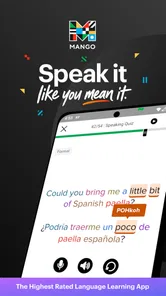
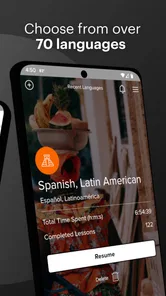
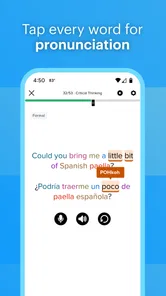
Analysis by Reviewed
I find Mango Languages easiest to understand when I treat it as a guided conversation practice tool rather than a complete language course. That distinction matters: it can help me get comfortable hearing and saying useful phrases, while learners who need a highly structured grammar syllabus or extensive writing practice may want to pair it with another resource. As an education app from Mango Languages, it focuses on practical spoken exchanges, and that gives its lessons a clear purpose from the start.
Readable lessons and straightforward navigation
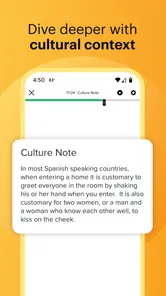
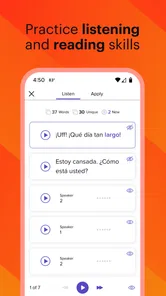
The lesson format is built around conversation, so I can follow a sequence of phrases and responses instead of facing a screen full of disconnected vocabulary. Cultural notes add context along the way, which helps explain why a phrase fits a particular situation rather than asking me to memorize it without a reason. I also appreciate that the learning path gives each session a recognizable shape; when I have only a short break, I can focus on a lesson rather than deciding what to study from scratch.
Mango Languages has an average rating of 4.8 from around 23,000 ratings, and it has been installed over a million times. Those figures suggest it has found an audience, though they do not tell me whether its conversational approach matches every learner. The app is free to download, with in-app purchases ranging from $0.99 to $199.99 per item, so I would check what access is available to me before building a long-term routine around a particular course.
Voice practice, memory, and motivation
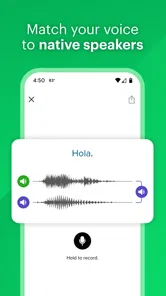
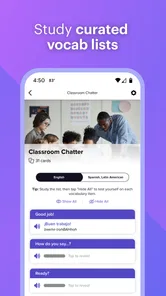
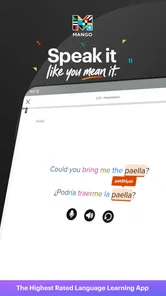
The voice comparison tool is one of the more useful parts of the experience for someone who wants to speak aloud, not just recognize phrases on a screen. I can record myself and compare my pronunciation with a native speaker’s, then repeat the line while its rhythm is still fresh in my mind. My practical tip is to listen once before recording and pay attention to the whole phrase, not only individual sounds: timing and emphasis can affect how natural a response feels.
Spaced repetition helps bring earlier material back into the learning routine, while progress tracking and goals make it easier to notice whether I am keeping up with my own plan. I would use these tools to set a modest, repeatable target rather than chase a streak or rush through lessons. The points and achievements can be encouraging, but they are best treated as a nudge; completing a session is not the same as being able to recall a phrase later in a real conversation.
Learning in ordinary situations
A realistic way to use the app is to study a short conversational lesson during a commute or a quiet moment before an appointment, then revisit the phrases later when I have enough privacy to speak them aloud. That split works better for me than trying to do every kind of practice in one sitting: listening and reviewing can fit a public setting, while recording my voice is more comfortable somewhere quiet. If I were preparing for a trip, I would focus on exchanges that match the situations I expect to face and practise answering as well as repeating the other speaker.
This conversational emphasis makes Mango a different choice from flashcard-first apps, where the main task is often recalling isolated words, and from grammar-led courses that explain rules in a more formal sequence. Neither approach is automatically better. Mango is appealing when I want guided listening and useful spoken patterns; a grammar-focused resource is a stronger fit when I need detailed explanations, while flashcards can be more efficient for drilling a vocabulary list I already chose. Combining approaches can make sense, but I would avoid adding several tools until I know what gap I am trying to fill.
More From Our News Desk

 Bolt: Request a Ride
Bolt and the Shift from One-Tap Rides to More Legible Trips
Bolt shows how ride-hailing is shifting from a one-tap taxi request toward a more legible, choice-driven trip, while leaving the hardest questions of price and reliability unresolved.

 Farm Land - Farming life game
Farm Land Review: A Small Island Farm with a Satisfying Loop
A bright, breezy island farm turns a few quick chores into a satisfying cycle of planting, harvesting, expanding, and deciding what to build next.

 Android Auto
’s Community Takes Shape in the Passenger Seat
Its most valuable network is not a public feed but a shared set of routes, voice habits, app integrations, and advice that make driving less isolating—and sometimes more complicated.

 My Talking Angela
 Makes the Virtual Pet Feel Personal
A polished pet-raising game built on small rituals, playful customization, and a character who gives everyday screen time a surprisingly personal rhythm.
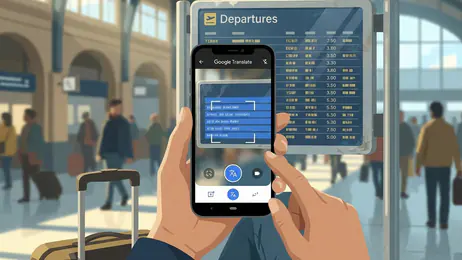
 Google Translate
 Review: A Pocket Tool for the Small Frictions of Travel
From menus and signs to quick conversations, Google Translate earns its place by cutting the little delays that make unfamiliar language feel like a barrier.

 Shazam: Find Music & Concerts
Shazam’s Best Trick Is Turning a Song Into a Night Out
A few seconds of recognition can settle an argument, rescue a half-remembered chorus, and point toward a live show. Shazam’s real trick is what happens after the match.
Latest News



Comfort, access, and realistic limits
The clear lesson structure can make it easier to stay oriented, but a language app still asks me to read, listen, tap through material, and sometimes speak into my device. That mix may not suit every person or every setting equally. If hearing audio is difficult, I would first check how well the lesson presentation works for my needs; if speaking aloud is uncomfortable or impractical, the pronunciation exercise may be less useful. I would not assume that one interaction style covers every access need.
There are also ordinary situational limits: background noise can make listening harder, and a shared space may not be the right place to record a response. I find it helpful to separate quiet review from speaking practice instead of judging a lesson by whether I can complete every activity at once. The app is intended for everyone, and its current version is 8.65.0, but that does not mean its format will suit every learner. Someone looking for intensive writing feedback, formal grammar instruction, or a fully self-directed study plan may prefer a different tool or use Mango as one part of a broader routine.
Who will get the most from it
I would recommend Mango Languages to beginners and returning learners who want a guided way to hear and practise everyday conversational language, especially if cultural context helps them stay interested. It can also suit a traveller who prefers rehearsing a useful exchange before needing it. I would be more cautious about recommending it as a sole resource to someone preparing for a writing-heavy exam or seeking detailed correction of written work; its strongest appeal is the conversational practice, not every possible form of language study.
The app is free to start, but optional purchases mean I would review the available access and costs before committing to a course over time. Mango Languages was released on April 18, 2012, and supports devices running iOS 8.0 or later. For me, the best way to judge whether it fits is to try a short lesson, see whether its pace and spoken practice feel comfortable, and decide from there whether its style makes me want to return.
First Impressions Matter
The first thing that caught my eye with Mango Languages was its vibrant and user-friendly interface. It's not just easy on the eyes but also incredibly intuitive. The app’s design is clean, making navigation a breeze. No clutter, no unnecessary distractions – just pure, focused learning. The app offers an array of languages, from the popular ones like Spanish and French to the less mainstream ones like Icelandic and Hawaiian. It’s like a buffet of languages!
Diving into the Learning Experience
Upon diving into a lesson, I was pleasantly surprised by the interactive approach Mango takes. The lessons are structured in a way that feels more like a conversation with a friend rather than a monotonous lecture. You're not just memorizing phrases; you’re actually understanding the context and cultural nuances, which is a huge plus in my book. The app emphasizes real-world conversations, ensuring that you’re not just learning words but also how to use them in actual situations. It’s like they’ve cracked the code on making language learning enjoyable!
Another feature I absolutely love is the voice comparison tool. You get to record yourself and compare your pronunciation with native speakers. It’s a game-changer! This tool helps you tweak your accent and sound more like a local. Plus, the app's spaced repetition system ensures that what you learn is cemented in your memory. Say goodbye to forgetting words after a few days!
What Keeps Me Hooked?
If you're anything like me, motivation can sometimes wane. But Mango has this nifty little feature of tracking your progress and setting goals. It’s like having a personal cheerleader motivating you every step of the way. You earn points and unlock achievements, which gives you that extra push to keep going. And who doesn’t love a little friendly competition?
The cultural notes scattered throughout the lessons are another cherry on top. They give you insights into the traditions and customs associated with the language you’re learning. It’s not just about speaking the language; it’s about understanding the people who speak it.
Making a routine that works
For a practical routine, I would choose one lesson and keep a small set of phrases in focus rather than trying to cover a whole unit in a single sitting. First, I would listen through the exchange to understand its situation, then practise the response without racing the audio. Later, I would return to the same material and see which lines come back without prompting. This turns the app’s review cycle into a useful check on recall, not just a way to accumulate completed sessions.
A busy day does not have to mean abandoning study, but it helps to choose the right kind of practice for the moment. On a noisy bus, I might review what I can read and listen to only when the surroundings allow; at home, I can speak the phrases and record a comparison without feeling self-conscious. The trade-off is that short, fragmented sessions are convenient but may leave little room to absorb the full context. When I have more time, I would finish a complete conversational sequence so the response feels connected to what came before it.
Access across different needs and settings
Readable organization and a predictable lesson flow are useful, but they are only part of inclusive design. Someone who relies on larger text, a screen reader, captions, or a particular input method should test the actual lesson screens and controls on their own device before relying on the app for daily study. I would also check whether audio and written prompts work together in a way that feels comfortable. A clear layout cannot compensate if a learner cannot comfortably perceive or operate a key activity.
Motor comfort matters too. Tapping through a sequence and making repeated recordings may be tiring for someone with limited dexterity, especially during a longer session. I would keep practice brief, take breaks, and avoid treating every prompt as something that must be completed immediately. If speaking is not an option, the conversational material may still offer listening and reading practice, but the voice comparison exercise loses much of its value. In that situation, a resource built around accessible text or alternative response methods may be a better primary tool.
For learners who process information more easily in small, predictable steps, the lesson sequence and return to older material can be reassuring. Still, the conversation format asks me to hold phrases in context, which may feel demanding when I am tired or distracted. I would pause after a short exchange and summarize its purpose in my own words before moving on. That simple habit helps distinguish understanding the situation from merely repeating sounds.
Questions to consider before relying on it
One practical question is whether it can work as a learner’s only resource. I would say yes for someone with a modest goal—getting more comfortable with everyday spoken exchanges—provided the available language course matches that goal. For broader fluency, especially reading and writing, I would add materials that give those skills direct practice rather than expecting conversation lessons to cover everything. The right balance depends on what the learner needs to do with the language, not on how many sessions they complete.
Another consideration is cost over time. The app is free to download, but optional in-app purchases mean access may depend on the course or option chosen. I would check the available terms before paying and decide whether I will actually use the material regularly. With a large range between the least and most expensive listed purchase, it makes sense to understand the specific offer rather than assume every course has the same cost or access arrangement.
It is also worth asking whether a learner needs an internet connection or can study offline, and whether a particular course has the exact topics they want. I would check those details in the app before planning a trip or building a study schedule around them. If a key lesson is unavailable in the intended setting, the otherwise convenient routine may fall apart. That small check is especially useful for anyone depending on the app while travelling or studying away from a stable connection.
Who should choose another approach?
I would steer learners toward a different main resource if they need detailed grammar explanations, substantial writing correction, or open-ended speaking with feedback on what they say. Mango’s guided exchanges give useful rehearsal, but rehearsing a prepared response is not the same as managing an unpredictable conversation. A tutor, conversation partner, or course designed around those skills will provide a different kind of practice. Flashcards also have an edge when the immediate task is memorizing a specific vocabulary list, though they offer less of the social context that makes Mango’s phrases easier to place.
It may also be a poor fit for someone who finds audio-led study uncomfortable, cannot speak aloud in their usual learning environment, or wants a completely self-directed path. The app’s structure is a benefit when I want to be guided, but that same structure can feel restrictive if I prefer to choose every topic and exercise myself. I would try a brief session before committing to a routine; the key test is whether the pace and interaction style feel usable, not whether the idea of learning a language sounds appealing.
Wrapping It Up
All in all, Mango Languages is a delightful companion for anyone eager to embark on a language-learning journey. Whether you’re a beginner or looking to brush up on your skills, this app has got you covered. It’s comprehensive, engaging, and most importantly, it makes learning feel like less of a chore and more of an adventure. So, if you’re itching to add a new language to your repertoire, why not give Mango a try? You might just find yourself speaking like a native in no time!
My more measured recommendation is to treat it as a strong option for guided listening and phrase rehearsal, not as a promise of instant fluency. Its conversation-led format, cultural context, voice comparison, and spaced review give me several ways to work with spoken material, while its limits around writing, grammar depth, spontaneous conversation, and access needs are worth taking seriously. I would start with a lesson that resembles a situation I actually expect to encounter, test whether the controls and audio suit me, and then decide whether it earns a regular place in my study routine.
Mango Languages Learning Frequently Asked Questions
Can Mango Languages Learning help me practice real-life conversations?
Yes. Mango Languages Learning is built around practical, real conversations, giving learners a way to encounter language in useful contexts rather than treating it only as isolated vocabulary. This style may suit people preparing to communicate while traveling or in everyday situations. Explore the available lessons for your chosen language to see whether their conversation focus matches what you want to practice.
Is Mango Languages Learning useful for travel preparation?
Its emphasis on practical conversations can make Mango Languages Learning relevant to people preparing for travel. Learning language in conversational contexts can help you focus on communication you may want to use in real situations. The app is also designed for broader language learning, so it can suit learners with goals beyond travel. Choose a course that aligns with the situations you expect to encounter.
Can I use Mango Languages Learning to study at my own pace?
Mango Languages Learning is a mobile education app, which makes it possible to access language-learning content on a compatible device. The practical conversation approach gives you material to work through as you build communication skills. Consider how the available lessons fit your routine and goals before downloading; a course that feels relevant to your needs is easier to return to consistently.
Who develops Mango Languages Learning?
Mango Languages Learning is developed by Mango Languages. The app focuses on helping people learn foreign languages through practical, real conversations, giving it a clear emphasis on usable communication. If you are comparing language-learning tools, the developer and the app’s conversation-based approach are useful points to consider alongside the course options that interest you.
Is Mango Languages Learning free to download, and are there in-app purchases?
Mango Languages Learning is a free education app, so you can download it without paying upfront. It also offers in-app purchases, with items ranging from $0.99 to $199.99. Check the options shown in the app before buying so you can decide whether any paid access or extras suit your learning needs and budget.
Pros
- Wide range of languages available.
- Interactive lessons with real-life scenarios.
- User-friendly interface design.
- Offline access for learning on the go.
- Cultural insights integrated into lessons.
Cons
- Limited advanced content for some languages.
- Subscription required for full access.
- Occasional app crashes reported.
- Some languages lack voice recognition.
- No option for direct tutor interaction.