Crossmath - Math Puzzle Games
- 8.03K
- 4.8
- Installs
- 10.00M
- Price
- Free
Screenshots
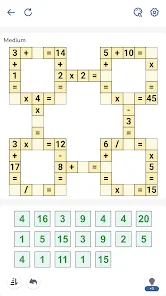
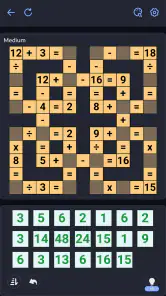
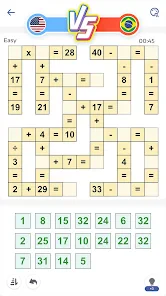
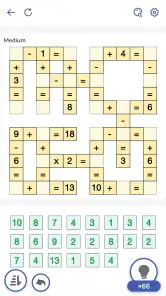
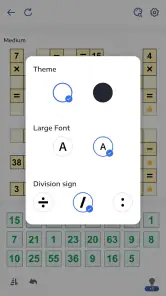
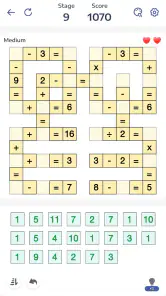
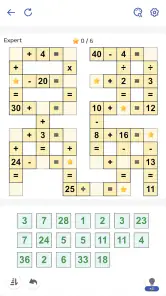
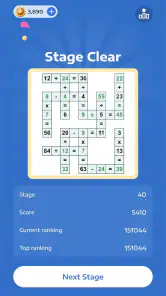
Analysis by Reviewed
I like math puzzles best when they give me a clear problem to work through rather than asking me to race a clock, and Crossmath is built around that kind of focused thinking. It’s a puzzle game from Guru Puzzle Game, and the basic idea is easy to grasp: use arithmetic and logic to make the equations in a grid work. My first session felt approachable, but the puzzles still gave me enough to think about that solving one was satisfying rather than automatic.
What to Expect from the Grid
The first thing I’d tell a new player is that this is not quite a standard number-placement puzzle. You are looking at connected equations, so a number that seems plausible in one direction also has to make sense where its row and column meet. That small difference changes the feel of each decision: instead of filling a grid by pattern alone, I have to keep track of arithmetic and use the crossings to narrow down what can fit.
That makes Crossmath a good fit for short stretches of deliberate attention. I can imagine opening it while waiting for an appointment or taking a quiet break at lunch, solving a little, then putting my phone away at a natural stopping point. It is less suited to a crowded commute, a conversation-heavy setting, or any moment when I know I’ll be interrupted repeatedly. Losing track of which equations I have already checked can turn a calm puzzle into unnecessary backtracking.
Compared with Sudoku, the main trade-off is clear: Crossmath asks me to calculate, while Sudoku leans more heavily on number-placement logic. Compared with a word puzzle, it offers a more definite, arithmetic route to a solution, but there is less room to rely on vocabulary or creative associations. If mental arithmetic is what I want to practice, that distinction is a strength. If numbers are exactly what I’m hoping to avoid, a word game or a simpler placement puzzle is likely a better choice.
Getting Started
First things first, the installation of Crossmath - Math Puzzle Games was a breeze. Available on both Android and iOS, I found it sitting pretty on the app store, just waiting for me to hit download. Once installed, I was greeted with a sleek interface that immediately got me excited to crunch some numbers. It’s free to play, rated for everyone, and the current version is 3.11.2; the game is available on Android devices running version 6.0 or later. Optional in-app purchases range from $0.99 to $10.99 per item, so I’d check the purchase prompts carefully if a child will be playing.
For a first-time user, I would keep the setup simple: install the game, open a puzzle, and give yourself permission to start slowly. You do not need to treat the opening session like a test of speed. The useful first goal is just to understand how the equations connect and to notice how one choice can help or rule out possibilities elsewhere in the grid. If you are setting it up for a younger player, it is worth agreeing on purchase expectations before handing over the device; the game is free to start, while optional purchases are available.
Gameplay Intricacies
The app is like a Sudoku puzzle but with a twist that’ll make math lovers giddy with joy. You’re presented with a grid, and your task is to fill it with numbers so that each row and column adheres to a specific mathematical equation. It’s a puzzle that tests your logic, arithmetic skills, and patience all at once. If you’re new to this style, I’d start by reading each equation carefully before placing numbers; solving one line at a time can make the crossing relationships easier to follow.
More From Our News Desk

Weather by Xiaomi Review: Clear at a Glance, Less Clear Up Close

X Under Pressure: Can It Recover When Posting Goes Wrong?

Clash of Clans Is Won Between the Battles

Android Auto Makes the Case for Quieter Car Software

MobiOffice: Transforming Mobile Productivity with Seamless Integration

EA SPORTS FC™ Mobile Soccer: Redefining Mobile Sports Gaming
My most reliable first move is to scan the equations before entering anything. I look for a line whose arithmetic seems easiest to reason through, then check the crossing line before committing to a number. That extra pause is useful because a choice can appear correct in isolation yet make a connected equation impossible. I also find it helpful to work in small passes: identify a promising line, test its intersections, and only then continue, instead of trying to solve the entire grid in my head at once.
What really caught my attention was how the difficulty levels ramp up. Just when you think you’ve got the hang of it, the game throws a curveball with more complex equations and larger grids. It’s addictive in the best way possible. The trade-off is that a small arithmetic slip can throw off several connected lines, so I find it more enjoyable when I’m alert than when I’m trying to play while distracted.
When I hit a wall, I try not to erase my reasoning mentally and start guessing. I go back to a line that looked settled and check the calculation from scratch; one early error can make later choices look confusing even when the rules are straightforward. This is also why the game works better for me in a quiet moment than during a task that keeps pulling my attention elsewhere. It rewards a steady method more than quick tapping.
Features That Count
One of the standout features is the hint system. Let’s face it, we all get stuck sometimes, and having the option to receive a small nudge in the right direction is a lifesaver. Plus, the app tracks your progress, so you can see how your skills are improving over time. I’d treat a hint as a way to get moving again, not as a substitute for checking the arithmetic: after using one, I like to work through the remaining equations myself.
A useful way to make a hint teach you something is to pause after receiving it and ask what made that suggestion fit. I try to connect it back to the crossing equations rather than immediately filling the rest of the grid by momentum. That turns a rescue into practice and makes it easier to recognize a similar deduction in a later puzzle. If I only want to finish quickly, I can miss that learning opportunity; if I want to improve, a hint is most valuable when I inspect the reasoning around it.
Another cool feature is the daily challenges. These keep the game fresh and give you a reason to come back each day. It’s a great way to keep your brain sharp and engaged. They also suit a short routine: I might open the game during a quiet break, attempt a puzzle, and stop once I’ve reached a natural pause rather than turning a quick session into a long one.
The daily format is especially useful if I don’t want to choose what to play next: I can make the challenge a small part of a routine instead of browsing for a puzzle when I only have a few minutes. I would not turn that into an obligation, though. If I’m tired or distracted, it is perfectly reasonable to leave a puzzle for later; the point is to enjoy the reasoning, not to make a relaxing game feel like another task on a checklist.
Engagement and User Experience
I’ve got to hand it to the developers; they’ve done a fantastic job with the user interface. It’s intuitive and easy to navigate, which is crucial for an app that requires a lot of focus and concentration. The colors are vibrant but not distracting, and the sound effects are subtle enough to keep you immersed without being annoying. Crossmath has earned a 4.8 average from around 628,000 ratings, and it has passed 10 million installs, which gives a new player a sense of how widely it’s been picked up. Guru Puzzle Game released it on March 7, 2023, and it has around 8,000 written reviews.
For a first-time player, the most useful early habit is to pause before committing to a number and check how it affects both the row and the column. That simple double-check makes the grid feel less like guesswork. If a puzzle stops making sense, I’d revisit the equations already completed rather than filling empty spaces at random; a mistaken value can make a correct-looking approach harder to untangle.
One small practical choice that helps me is deciding what I want from a session before I start. If I have only a short break, I focus on understanding a few intersections and stop when I reach a clear pause. If I have more time and attention, I’ll keep working through a harder grid. That way, I’m less likely to feel annoyed if I cannot finish immediately, and more likely to leave with a useful sense of progress.
My experience also suggests a simple rule for choosing between this and another puzzle: pick Crossmath when you want arithmetic to be part of the challenge, not merely decoration. A Sudoku app is better for a number puzzle that depends on elimination and placement without calculation; a word puzzle is better when you want language to do the work. Crossmath occupies a distinct middle ground, where each answer has to satisfy a calculation and fit the connected structure.
Now, I will admit, there were moments of frustration when I was stumped by a particularly challenging puzzle. But hey, isn’t that part of the fun? The satisfaction of finally solving a tough equation is worth every head-scratching moment. Still, this isn’t my pick when I want a fast, reflex-driven game or a puzzle that asks for no arithmetic. A classic Sudoku app is a better fit if I want number placement without calculations, while a word puzzle suits me better when I’m in the mood to work with language instead.
There is also a difference between being challenged and being in the right mood for a challenge. If I have just a minute and want something I can abandon without thinking, this is not always my first choice: I may be partway through a chain of calculations when I need to stop. For an unhurried break, that concentration is exactly the appeal. For a noisy setting or a day when I want effortless entertainment, I would choose something less demanding and come back when I can give the grid proper attention.
For parents considering it for a child, the all-ages rating makes the game broadly approachable, but it does not mean every puzzle will be equally easy for every age. A younger player may need help understanding the equations or keeping track of the crossings. I would sit alongside them for the first puzzle, ask them to explain why a number works, and let them take the lead rather than simply supplying answers. That makes the game more engaging and gives the arithmetic a practical purpose.
Who Will Enjoy It
I’d recommend this to anyone who enjoys mental arithmetic, cross-number-style challenges, or a calm game that rewards careful thought. It can also be a practical choice for someone who wants to make spare minutes feel more engaging: a waiting room or a quiet lunch break is a better setting than a busy commute where attention keeps shifting. Because it is rated for everyone, it can be suitable for different ages, though younger players may appreciate having someone nearby to help explain the equations.
It is also a good option for someone who likes to see a clear reason behind an answer. Each completed line gives me a concrete check: the arithmetic either fits or it does not. That can make the game appealing to players who find open-ended brainteasers frustrating, while still leaving enough uncertainty in the connected grid to make solving feel earned. I would start with the easier problems and treat each completed equation as a chance to build confidence before moving on.
If arithmetic itself feels stressful, or you mainly want a game you can play without concentrating, this may not be the right match. The difficulty increase is part of its appeal, but it also means a player who prefers a fixed, predictable challenge may find later puzzles less relaxing. I’d begin with the easier problems, get comfortable checking each crossing equation, and move up only when the basic rhythm feels natural.
Another reason to skip it is if you strongly prefer puzzles that can be solved by visual pattern alone. Crossmath asks you to do the calculation as well as reason about placement, so avoiding arithmetic will not make the central task disappear. If that sounds like homework rather than play, a classic logic grid, a visual matching game, or a word puzzle will probably be a better fit. I see that as a matter of taste, not a flaw in the game.
Final Thoughts
If you’re someone who loves a good brain teaser and wants to brush up on your math skills, I can’t recommend Crossmath - Math Puzzle Games enough. It’s educational, fun, and a fantastic way to pass the time. Just be prepared to get a little obsessed! For me, its best quality is the balance between a simple first step and room to think more deeply as the grids become trickier. I’d give it a try if you want a focused arithmetic puzzle, while keeping a different game handy for days when you’d rather switch your brain off.
My concrete suggestion is to make the first session small: open an easy puzzle, inspect the equations, and aim to solve one line while checking every crossing before entering a number. If you get stuck, use a hint as a nudge and then work out why it helped. That is a more reassuring first success than rushing through a grid, and it gives you a fair sense of whether this particular blend of arithmetic and logic is enjoyable for you.
Crossmath - Math Puzzle Games Frequently Asked Questions
Can beginners enjoy Crossmath - Math Puzzle Games, or is it only for people who are good at math?
Crossmath - Math Puzzle Games is built around arithmetic puzzles, so it can suit players who want to practice as well as those who already enjoy number challenges. Its crossword-style grid gives you a clear task: work through the equations and check how intersecting answers fit together. If you are new to this style of game, you can approach it at your own pace and see whether the calculations feel comfortable.
Who developed Crossmath - Math Puzzle Games, and what kind of game is it?
Crossmath - Math Puzzle Games is a math-focused puzzle game developed by Guru Puzzle Game. It turns arithmetic into a grid challenge, asking you to work through equations that intersect across and down. If you enjoy number puzzles or want a more active alternative to casual games, its central idea is straightforward: solve each part of the grid while checking how the answers fit together.
Will Crossmath - Math Puzzle Games work on my device?
Crossmath - Math Puzzle Games is available for Android devices running Android 6.0 or later. Before downloading, check your device’s operating-system version in its settings to make sure it meets that requirement. The game is also offered for iOS, so availability depends on your device and the relevant app store. Checking compatibility first can help you avoid starting a download your device cannot support.
What is Crossmath - Math Puzzle Games?
Crossmath - Math Puzzle Games is an engaging mobile application designed to challenge your mathematical skills through a variety of puzzles. It combines elements of crosswords with math operations, requiring users to solve equations across and down the grid. Ideal for math enthusiasts, it offers different difficulty levels to cater to all ages, making it an excellent tool for improving arithmetic skills while having fun.
Is Crossmath suitable for all age groups?
Yes, Crossmath - Math Puzzle Games is suitable for all age groups. It features varying levels of difficulty, from beginner to advanced, allowing users of any age to enjoy and benefit from the app. Whether you're a student looking to practice math or an adult wanting to keep your mind sharp, Crossmath offers a challenging yet accessible experience for everyone. Its Everyone content rating also makes it a broadly approachable choice for families.
Pros
- Enhances logical thinking and problem-solving skills.
- Offers a variety of puzzles for all skill levels.
- User-friendly interface and easy navigation.
- Provides a fun way to practice math.
- Regular updates with new puzzles.
Cons
- Limited free puzzles available.
- In-app purchases can be pricey.
- Ads can be intrusive during gameplay.
- Requires internet for some features.
- No multiplayer mode available.
- Category
- Puzzle
- Version
- 3.11.2