 About Spotify: Music and Podcasts
How Spotify Turns Endless Choice Into a Daily Listening Habit
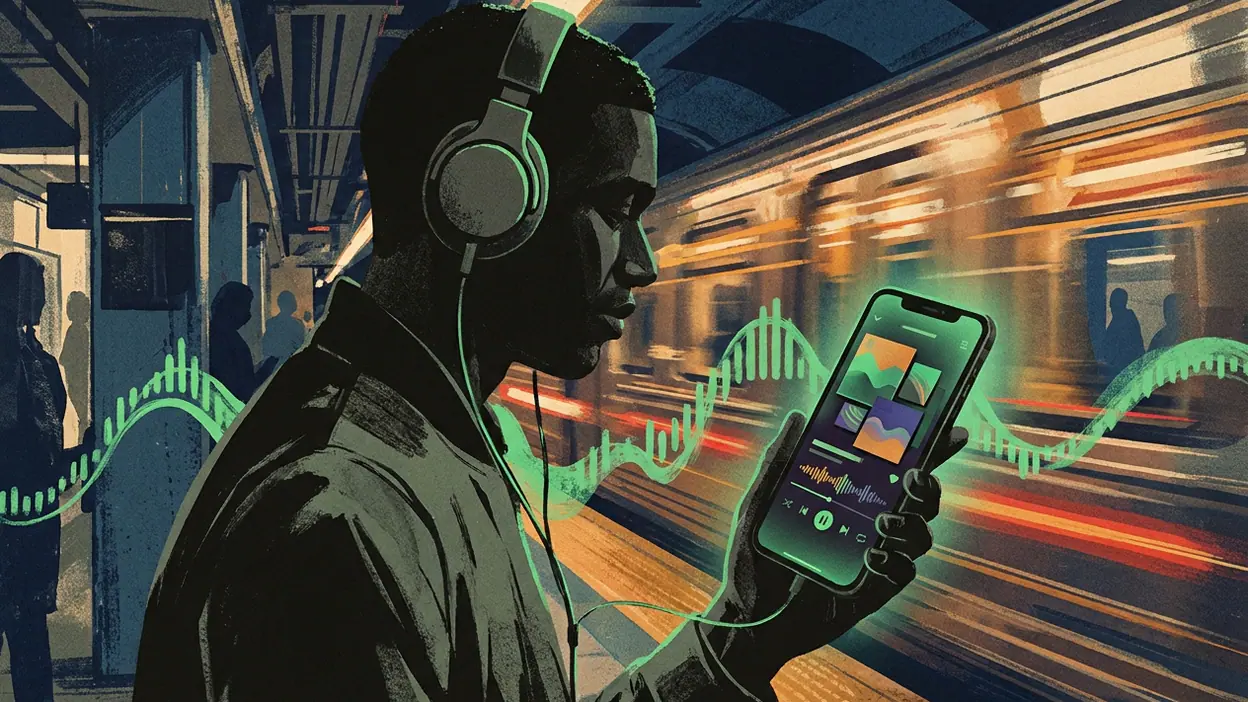
Spotify’s advantage is not that it has every song, or that every recommendation is right. It is that the app makes choosing what to hear feel like less work than opening anything else. That small convenience compounds: a familiar playlist is ready for the commute, a new mix arrives without being requested, and the queue can keep going long after the original mood has passed. Spotify: Music and Podcasts has become a habit machine by making discovery feel both personal and effortless, then giving listeners enough control to forgive the moments when its guesses, pricing, or design fall short.
How Spotify turned choice into routine
Scale was the opening move
Spotify grew by solving a practical problem at a useful moment. Music fans were moving between downloads, file libraries, and scattered streaming services; Spotify put a huge licensed catalog behind a search box and made playback feel immediate. The app’s familiar dark interface, green accents, and recognizable controls helped it become easy to learn, while support across phones, computers, speakers, cars, and televisions made an account travel with its owner.
That breadth matters more than raw catalog size. A song is valuable when it is available where a listener wants it, and a listening session is easier to continue when the same queue can move from phone to laptop or a connected speaker. Spotify’s Connect feature makes that handoff especially practical: the phone can act as a remote while another device plays. The service is not merely a library; it is a layer that follows people through ordinary spaces.
Free access also widened the entrance. Listeners can try the service without first committing to a subscription, though the free tier places limits on control and inserts advertising. That trade makes the app accessible while making its paid plan legible: pay for fewer interruptions, more freedom, and offline listening. The exchange is simple enough to understand, even if the value calculation changes from person to person.


Recommendations do the tiring work
The most consequential product decision is what happens after someone finishes searching. Spotify turns listening history, saved tracks, skips, and other signals into personalized shelves, mixes, and playlists. Discover Weekly and Daily Mixes give people a reason to return without requiring them to arrive with a specific song in mind. The strongest recommendation is not necessarily a startling discovery; often it is a track that fits the moment well enough to keep the session moving.
That system beats a conventional music player at a particular job. Samsung Music and Lark Player are useful when the listener already has audio files and wants a straightforward local library. Spotify’s strength is the opposite: it reduces the effort of finding something to play across a large streaming catalog. Shazam is excellent at identifying a song heard in the world, but recognition is only the start of a listening journey. Spotify is designed to continue that journey, with saved tracks, related listening, and playlists close at hand.
There is a subtle emotional payoff in this arrangement. A listener can feel that the app knows their tastes, even though the recommendations are statistical guesses shaped by repeated behavior. When the match is good, the system feels attentive. When it is wrong, a skip is cheaper than a search from scratch. That low cost of correction keeps people experimenting.
Latest News



The interface creates a soft loop
Spotify’s home screen is built around the next plausible action. It presents recent listening for quick resumption, then offers mixes, editorial playlists, new releases, and other suggestions. The result is a loop with little friction: open the app, recognize a familiar option, start playback, and let the recommendations take over. A listener who came in to hear one album may leave with a longer queue assembled almost accidentally.
The app also gives routine a place to accumulate. Liked Songs can become a personal catch-all; playlists mark moods, activities, and periods of life; podcasts add another reason to open the same service when music is not the task. Wrapped, the annual listening recap, turns private habits into a shareable cultural moment. It is marketing, certainly, but it also gives users a neat story about their own year in audio.
These features are sticky because they combine familiarity with variation. A saved playlist is predictable, while a refreshed mix offers the possibility of surprise. People do not have to choose between the comfort of repetition and the pleasure of finding something new. The app keeps both within a tap or two.
What listeners forgive
Spotify’s users tolerate a surprising amount because the core service is dependable. They forgive a recommendation that misses, an occasional interface change, and the fact that a desired album or track may be absent in a particular market. The catalog depends on licensing agreements, which can shift, and no streaming service can promise that every release will remain available forever. If the next track starts quickly and the rest of the library is easy to reach, many listeners simply move on.
They also forgive a crowded home screen when a familiar playlist remains easy to find. Spotify has expanded beyond music into podcasts, audiobooks in some markets, video features, and other audio formats. That ambition can make the app feel busy, but it reinforces the company’s broader bet: become the default place to start listening, whatever the format. For a user who wants one app to cover several habits, that breadth is a real convenience.
There is a limit to that goodwill. Free listeners may find ads and playback restrictions frustrating, while subscribers can question whether the monthly fee still feels worthwhile as prices and bundles change. Artists and rights holders have their own concerns about streaming economics, and listeners increasingly notice the tension between a polished consumer product and a complicated business model. Spotify’s ease does not resolve those questions; it can only make them easier to set aside during a commute.
Where the cracks show
Personalization can become repetition. The more a listener plays a narrow range of familiar music, the more confidently the service may serve similar tracks. That can turn a useful feedback loop into a rut. Spotify provides tools to explore outside the usual pattern, but the responsibility often lands on the user: search deliberately, follow different artists, or choose an editorial playlist that breaks the feed’s assumptions.
There is also a difference between a strong recommendation and an understandable one. Spotify can surface an appealing track without making clear why it appeared, and its shelves sometimes feel like competing priorities rather than a carefully edited listening space. Interface changes can shift familiar controls or give podcasts and promotional content more prominence than a music-first listener wants. The app is good at keeping options close; it is less consistently good at deciding which options deserve attention.
Creators face a different kind of limitation. StarMaker makes singing along and performance the point, while Spotify centers listening and discovery. Neither replaces the other, but the contrast is revealing: Spotify’s dominance comes from being a broad, convenient utility, not from being the best specialist tool for every musical activity. A dedicated local player can feel simpler, and a karaoke app can feel more participatory.
Who gets the most from it
Spotify is at its best for listeners whose music lives across devices and moods. It suits people who want a large streaming library, dependable playlists, and recommendations that improve with use, as well as podcast listeners who prefer to keep their audio in one place. Commuters, home listeners, and anyone who moves between speakers and headphones benefit from the continuity. Premium makes the strongest case for people who value ad-free playback, offline downloads, and more control over what plays next.
It is less compelling for someone with a carefully managed collection of owned files, a strong preference for listening without algorithmic suggestions, or little interest in paying for a subscription. In those cases, a local player such as Samsung Music or Lark Player may be the more direct tool. Spotify can still serve as a discovery companion, but it need not become the center of every listening life.
Why the lead may last
Spotify’s competitors can match pieces of the experience: catalog access, high-quality playback, curated stations, or device support. The harder part is matching the whole habit. Years of saved music and playlists create switching costs that are emotional as much as practical. Recommendations also get more useful as a person’s listening history grows, while familiar controls and device connections make the service feel already installed in daily life.
That lead is durable, not guaranteed. Better curation, clearer discovery controls, fairer-feeling subscription value, and a less cluttered interface could strengthen loyalty. Conversely, a worsening free tier, repeated price increases, or a sense that the app serves promotion ahead of listening could make users reconsider. Spotify’s advantage depends on trust that the next open will be worth the small effort.
After using it as a daily listening service, I understand why the habit holds. The app is rarely perfect, but it is unusually good at removing the pause between wanting audio and hearing it. Search when you know what you want; tap a mix when you do not; move the session to another device when the room changes. That combination is more persuasive than any single feature, and it explains why rivals can be excellent without replacing it.
Spotify: Music and Podcasts remains dominant because it makes listening feel continuous: across devices, genres, routines, and the small gaps in a day. Its cracks are real, especially around repetition, interface clutter, and the value of paid access. Still, the central promise works. Spotify gets people to press play quickly, gives them reasons to stay, and makes coming back tomorrow feel natural. That is not the same as being the best choice for everyone, but it is a strong reason the app keeps winning attention.