 About Word Search Explorer
Word Search Explorer Makes One More Grid an Easy Choice
The best thing about Word Search Explorer is how quickly it turns a spare minute into a small, complete task. A grid appears, a theme gives the hunt a little direction, and the first word is usually easy enough to find before you have decided whether you meant to play. That gentle entry is the game’s central feature: themed word-search puzzles that make familiar letter hunting feel like a journey rather than a stack of disconnected boards. It is a modest idea, but its value comes from the way it shapes the rhythm of a session.
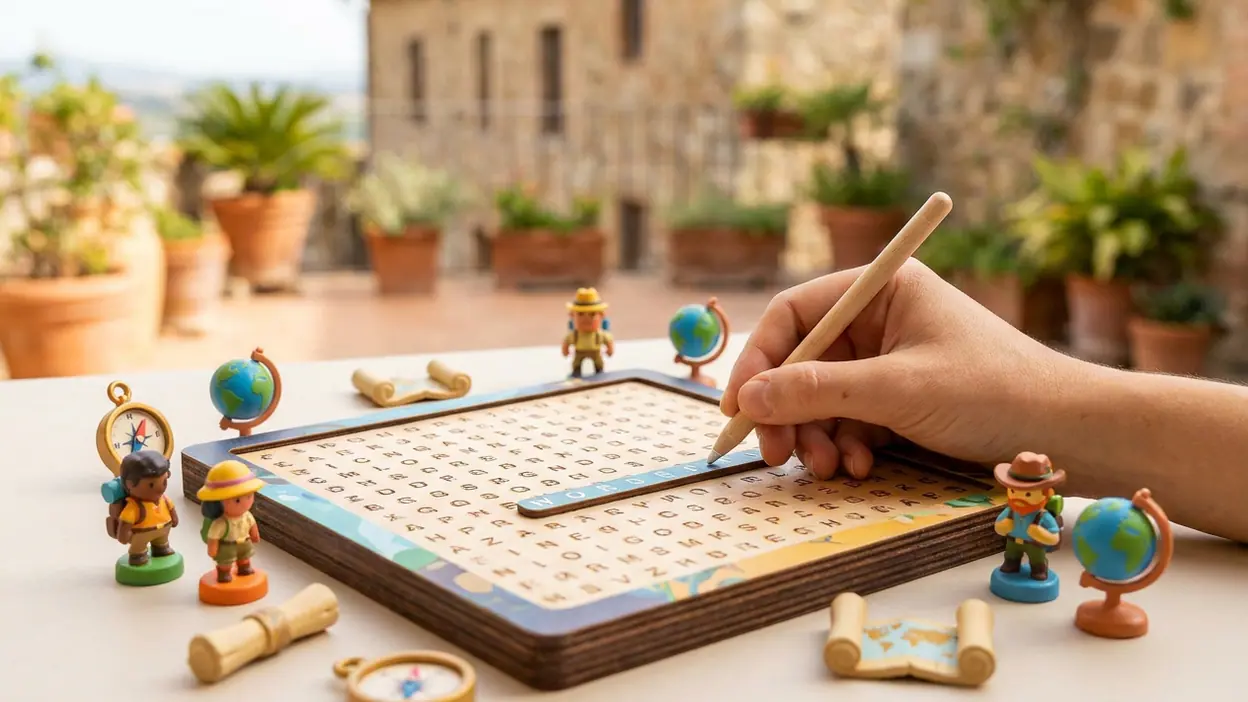
This is not a word game built around spelling tests, timed rounds, or elaborate rules. You scan a field of letters for the words associated with the current puzzle, tracing each find across the grid. Words can run in different directions, so the task is not simply to read rows from left to right. You compare the word list with the letter patterns in front of you, spot likely starting points, and follow a promising line until it either resolves into a match or falls apart.
A small puzzle with a useful sense of direction
The theme is more than decoration. It gives the list a shared context, which makes each search feel a little less arbitrary. When several target words belong to the same subject, one answer can put your mind in the right neighborhood for the next. You are not only checking letters; you are building a loose mental map of what might belong in the puzzle. The theme does not solve anything for you, but it gives the hunt a reason to hang together.
That structure matters because word-search puzzles can easily become visual busywork. A grid without a frame is just a field of competing letter shapes. A theme narrows the mental space, while the word list supplies concrete goals. The player moves between broad scanning and close inspection: glance over the board, catch a promising cluster, then trace it carefully. When a word appears, the reward is immediate and legible. One item leaves the list, the board looks a little less crowded, and attention shifts to the next target.


The pleasure is small-scale, but not empty. Finding a word asks for concentration without demanding much setup or memory. There is no long narrative to recall after a day away, and no complex system to relearn. The puzzle can occupy the mind while leaving room for a quiet room, a waiting line, or a few minutes between other tasks. That makes it a particularly effective kind of low-pressure play: enough engagement to hold attention, not so much that it takes over the day.
The best use is the pause you already have
Word Search Explorer fits most naturally into short breaks. I can imagine opening it while waiting for a kettle, sitting in a lobby, or winding down before sleep: moments when a demanding game would feel like another obligation, but doing nothing can feel oddly restless. A single grid has a clear beginning and a visible endpoint. Even if I do not finish immediately, the remaining words make it easy to see where I left off.
That convenience changes the meaning of replay. The game does not need to persuade you to commit to a long session. Instead, it makes returning feel frictionless. A completed puzzle provides closure; another themed board offers a fresh little problem. The loop is a familiar one, but its pacing is well suited to the format: scan, recognize, trace, clear, repeat. Each successful find creates a tiny beat of momentum, and the disappearing targets provide a steady sense of progress.
Latest News



There is also a welcome difference between this and games that turn every idle minute into a performance. A word search does not require quick reflexes, a perfect streak, or constant attention to a changing screen. You can slow down, reconsider a pattern, and take the puzzle at your own speed. For players who want a compact mental warm-up rather than a challenge that escalates aggressively, that restraint is part of the appeal.
Smart design, with a familiar ceiling
The strongest design choice is the clarity of the central task. The board and target words work together without requiring a tutorial-heavy introduction. The theme helps organize the hunt, while the grid keeps the player’s attention on one immediate question: where does this word begin, and which direction does it travel? The interface has a practical job, not a theatrical one. In a game about visual search, readable letters and a clean relationship between target and board matter more than spectacle.
The game’s rhythm also benefits from the fact that a word search is self-explanatory. A player can make progress almost as soon as a puzzle loads. There is no elaborate chain of menus or upgrade systems to get between the idea and the activity. That directness gives the game a pick-up-and-play quality, and it helps make the themed format feel approachable to a broad range of players.
But the same simplicity sets a ceiling. Once you understand the search pattern, many boards ask for variations on the same action. The theme changes the flavor of the word list, but it cannot radically change the underlying loop. Players who want new mechanics, evolving strategy, or a strong narrative arc may find that the novelty wears thin. The satisfaction comes from finishing and from the moment of recognition, not from a system that keeps transforming beneath you.
The visual-search part can also become less relaxing when a remaining word is hard to see. A dense grid can turn a calm break into a prolonged scan, particularly if several targets remain and none jumps out. That is not a defect unique to this game; it is built into the genre. Still, the design has to balance legibility against challenge. If the board stops feeling like a puzzle and starts feeling like an eye test, the game’s easygoing promise loses some force.
Replay value depends heavily on the player’s appetite for repetition. Someone who enjoys the satisfying neatness of clearing a list can keep returning to the loop. Someone who needs every session to introduce a new rule may not. The game is strongest when treated as a small ritual, not as an endlessly unfolding adventure. That distinction helps set fair expectations: its appeal is consistency, and consistency can look like sameness if you ask it to do too much.
What other apps reveal about its niche
The contrast with other mobile experiences makes the game’s purpose clearer. Duolingo: Language Lessons makes words part of a structured learning routine, with lessons and ongoing progress as the point. Word Search Explorer is not trying to teach vocabulary in that deliberate way; it turns recognition into a relaxed puzzle instead. Google Play Books & Audiobooks asks for a longer stretch of attention, while a word grid can be picked up and put down with little ceremony. Those differences are not shortcomings. They show that this game is designed around a narrow, useful slice of downtime.
Even a quick round of 8 Ball Pool has a more competitive shape: another player, a shot to judge, and the possibility of winning or losing. A foodpanda order solves a practical need rather than offering a puzzle. Against these alternatives, the value of a word search is its low stakes. It gives a brief sense of accomplishment without asking you to coordinate with anyone, make a purchase, or study a lesson. That makes it a credible choice when the goal is simply to give wandering attention something orderly to do.
Who should keep it installed?
The game is best suited to people who enjoy word puzzles but do not necessarily want a crossword’s clues or a vocabulary app’s teaching agenda. It also makes sense for players who prefer calm, bite-sized sessions and like seeing visible progress as a list clears. The themed boards add just enough identity to keep the searches from feeling entirely interchangeable, while the basic rules keep each return easy.
It is a less convincing fit for anyone looking for deep progression, a strong story, or a big change in mechanics from one session to the next. There is no need to pretend that a familiar grid search becomes a radically different game because the word set changes. The honest case for it is simpler: the format is quick to understand, satisfying to complete, and easy to fit around real life.
The value is in the clean little finish. A theme gives each board direction, a found word gives each search a reward, and the short loop makes another round feel available rather than demanding. Word Search Explorer does not reinvent word searches, and it does not need to. It works when you want a calm, focused break with a clear endpoint; its limits show when you expect a deeper game to emerge from the same familiar grid. As a pocket-sized puzzle habit, it knows exactly what it is doing.