Candy Crush Saga
- 2.09M
- 4.6
- Installs
- 1.00B
- Price
- Free

Screenshots
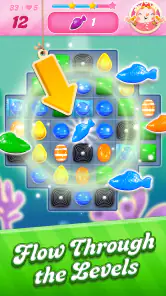
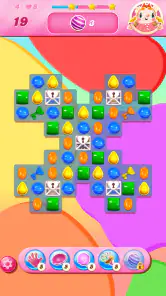
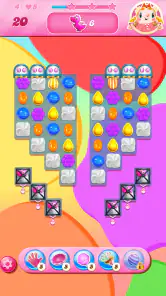
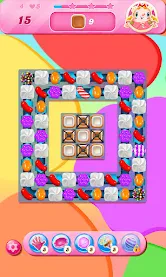
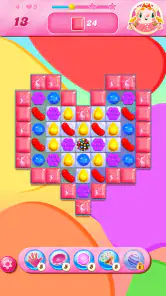
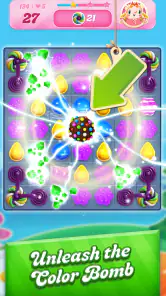
Analysis by Reviewed
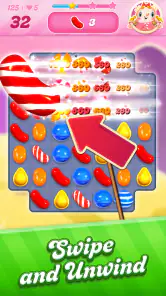
I reach for this game when I have a small pocket of spare time and want something I can understand immediately. A board of candies, a clear objective, and a handful of moves make the first moments easy to follow; working out the best sequence gives the session its little puzzle. That balance is why Candy Crush Saga can feel satisfying without asking me to learn a complicated control scheme.
Why a quick round works
The basic match-three idea is simple, but the changing objectives give each board a different focus. I might be clearing jelly, collecting ingredients, or aiming for a target score before my moves run out. Those limits help a short session feel complete: I can try a level, see whether my plan worked, and decide whether I have time for another.
My most useful habit is to scan the whole board before making the first move instead of matching the first obvious trio. A match near the bottom can shift more candies and create a chain reaction, while a move that looks impressive may not help with the level’s actual goal. Special candies are worth planning around too; saving a striped candy or combining it with another special can be more useful than spending it as soon as it appears.
Reads About Candy Crush Saga
That opening scan is especially useful when the objective involves more than simply clearing a visible cluster. I first identify what the level asks me to finish, then look for moves that affect the relevant area of the board. A large match can be satisfying, but if it leaves the target untouched, it may be a poor trade for a limited move. When I am unsure, I prefer a modest move that advances the goal over a flashy one that only clears space.
Good in short bursts, with a few catches
The rhythm suits a bus ride, a quiet wait, or a short break between tasks. If I get interrupted, the game is easy to put aside and return to later; I don’t need to remember a long story or a complicated sequence of controls. Still, a level can take more attention than its bright, casual presentation suggests, especially when the move limit is tight. I wouldn’t start a tricky board if I needed to switch focus every few seconds.
There is also a familiar stop-and-try-again loop. When a level does not go my way, replaying it offers another chance to use what I noticed, but the board’s changing candy layout means the same opening plan may not always play out identically. That uncertainty keeps retries from feeling entirely mechanical, though a long run of attempts can become frustrating. I treat a stuck level as a cue to take a break rather than keep tapping without a plan.
The game works best when I can give a board a little attention, rather than trying to play through every interruption. If I am on a crowded train or expecting a call, I stick to a level that feels manageable and accept that I may need to stop mid-session. For a more demanding puzzle, I wait until I have a calmer few minutes. That simple choice makes the short-session appeal more reliable: the game is quick to understand, but a close level still deserves focus.
More From Our News Desk

Weather by Xiaomi Review: Clear at a Glance, Less Clear Up Close

X Under Pressure: Can It Recover When Posting Goes Wrong?

Clash of Clans Is Won Between the Battles

Android Auto Makes the Case for Quieter Car Software

MobiOffice: Transforming Mobile Productivity with Seamless Integration

EA SPORTS FC™ Mobile Soccer: Redefining Mobile Sports Gaming
Gameplay and Features
So, what makes Candy Crush Saga stand out in the crowded world of mobile games? Well, first off, the game is all about matching three or more candies of the same color to clear them off the board and rack up points. Sounds simple, right? Trust me, as you progress through the levels, the puzzles get more intricate and challenging, keeping you on your toes.
One of the coolest features is the variety of levels. Each level presents a unique challenge, whether it's clearing jelly, collecting ingredients, or achieving a specific score within a limited number of moves. I love how each level feels like a new adventure!
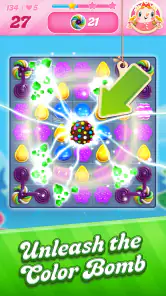
And let's not forget about those sweet power-ups! The game offers special candies like striped candies, color bombs, and wrapped candies that help you clear the board faster. Combining these power-ups can create massive explosions and score-boosting cascades that are oh-so-satisfying.
There is a small strategic trade-off here: setting up a combination can take moves, and the board may change before the payoff is available. I do not chase every possible special-candy combo. I check whether it helps with the objective first, because a well-timed ordinary match can be more valuable than spending several turns arranging a spectacular effect. When a combination does line up, though, the cascade gives the game its most immediate burst of pleasure.
Visuals and Sound
The visuals in Candy Crush Saga are bright, colorful, and downright delightful. It's like stepping into a candy wonderland where each level is a treat for the eyes. The animations are smooth, and the little touches, like the candies popping or the cheerful voiceovers, add to the overall charm.
And let's talk about the sound effects—they're just as sweet as the visuals. The satisfying "crunch" when you match candies, the cheerful music, and the encouraging voiceovers make the experience even more enjoyable. It's like a mini celebration every time you complete a level!
The strong visual feedback also makes the board easy to read at a glance, which matters when I only have a few minutes. At the same time, the colorful movement can make it harder to stay focused on the objective if I start reacting to every cascade rather than planning the next move. I find it helpful to let the animations finish, then reassess the board before tapping again. That brief pause turns the spectacle into useful information instead of a distraction.
Social Interaction and Challenges
What I love about Candy Crush Saga is the social aspect. You can connect the game to your Facebook account and see how your friends are doing on the leaderboard. It's always fun to have a little friendly competition and try to beat your friends' scores.
There are also daily challenges and events that keep the game fresh and exciting. Participating in these events can earn you boosters and extra lives, which are super handy when you're stuck on a particularly tricky level.
I see those activities as optional variety, not a checklist I need to complete. If I have time for one focused level, I would rather play at my own pace than let a challenge dictate when I open the game. The leaderboard can add a light social reason to return, but it is most enjoyable when comparing progress feels playful rather than like another score I must chase.
Keeping a session under control
A useful way to enjoy the game is to treat each level as a complete unit rather than opening it with the vague intention of playing “for a minute.” The move limit gives a natural endpoint, but a loss can make an immediate retry feel irresistible. I find it helps to decide before starting whether I have time for one attempt or several, especially during a commute where a stop or change of attention is likely.
When a board becomes stubborn, I try changing the question I ask myself. Instead of looking only for the biggest possible match, I check which move advances the objective and whether clearing a lower row could rearrange the board in my favor. This is a small shift, but it makes retries feel like experiments rather than identical guesses. It also helps me notice when luck is doing more work than strategy, which is a good moment to pause instead of spending more effort on the same plan.
Another useful boundary is to decide what counts as a successful session before opening the game. Sometimes that is finishing one level; sometimes it is simply trying a difficult board once and learning where the bottleneck is. If I lose, I can leave with a concrete observation—perhaps I spent too many moves away from the objective—instead of treating the loss as a demand to keep going. This makes the game easier to fit around errands or a work break without relying on willpower at the last moment.
Who will enjoy it, and what to consider
I’d recommend it to anyone who likes clear, bite-sized puzzles and doesn’t mind repeating a level to find a better approach. The casual format is especially handy when I want a small, self-contained activity rather than a game that demands a long session. If you prefer open-ended play, a story-driven adventure, or puzzles that never use limited moves as pressure, this probably isn’t your best fit.
Compared with many casual puzzle games, its appeal is the familiar match-three board paired with objectives that change the way I prioritize moves. A quieter logic puzzle may be better if you want deliberate deduction without cascades, while a more creative puzzle game may suit you if you want to build or explore. Here, the pleasure is immediate pattern-spotting and the chance that one smart move will set off a satisfying chain.
For an everyday example, I might open it while waiting for a meeting to start, play one level, then put my phone away when my name is called. If I’m close to finishing, it can be tempting to squeeze in another attempt, so I try to decide beforehand whether I have time for a full round. That small boundary helps keep a casual diversion from turning into an unintended longer break.
It is also a better fit for people who enjoy visual feedback and quick decisions than for players who want every move to have a provably best answer. A chain reaction can be delightful, but it can also make a carefully planned turn behave differently from what I expected. If I want calm, predictable concentration, I reach for a conventional logic puzzle instead; if I want a quick burst of color and tactical choices, this is the more inviting option.
For someone deciding whether it suits a younger player, I would separate the simple matching rules from the habits around play. The board is easy to grasp, but repeated retries and optional spending are worth discussing before the phone is handed over. For an adult looking for a waiting-room diversion, those same considerations are personal: I can keep it casual by choosing a stopping point and not treating every blocked level as a problem that must be solved immediately.
When I compare it with other match-three games, the key distinction is not that the basic action is unfamiliar; it is how much the changing goal redirects attention. A score-focused puzzle rewards clearing efficiently, while a jelly or ingredient objective asks me to think about position and progress in a different way. If I want a game with a calm, fixed puzzle and no cascade surprises, another style is a better fit. If I enjoy learning a board’s priority and adapting as pieces fall, this is more engaging than a simple repeat-the-same-match loop.
Who makes it and what it costs
King’s game is free to download, and its Everyone age rating makes it broadly accessible. It has a 4.6 average from around 39 million ratings and more than a billion installs, which helps explain how familiar its candy-matching style has become. The current version is 1.329.0.1, and it needs Android 6.0 or later.
Optional in-app purchases range from $0.99 to $149.99 per item, so I’d keep that in mind if I’m choosing a game for myself or a younger player. The game can be enjoyed without treating every difficult level as a reason to spend: I’d first pause, look for a different opening move, and come back later if a board keeps resisting. That approach suits the game’s strongest quality, which is making another short attempt feel easy to start.
For a younger player, the practical question is less about understanding the matching rules and more about the optional purchases and the temptation to keep retrying. I’d set expectations about spending before handing over a device, rather than assuming that a free download means there is nothing to manage. For my own play, I treat boosters as a convenience, not a requirement, and prefer to save them for a board where they can address the actual obstacle instead of using one simply because I am impatient.
That also answers a common practical concern: do I need to spend to enjoy it? I do not treat a purchase as the default answer when a level is difficult. First I revisit the objective, look for a move that reaches it sooner, or leave the board and return with fresh eyes. Spending may appeal to someone who values convenience, but anyone who dislikes optional purchases or prefers a fully unpressured progression loop should factor that into the choice before getting invested.
My casual verdict
As a casual game released in 2012, it still works best for me as a bright, low-commitment puzzle with enough variation to make familiar matching feel purposeful. The cheerful presentation and quick-to-grasp rules make it welcoming, while the limited moves and repeated attempts can test patience. If you want a friendly game for spare moments and enjoy spotting patterns, I think it’s worth trying. If you dislike retries, purchase prompts, or games that can nudge you toward “one more round,” I’d choose something less persistent. I enjoy it most when I set my own stopping point and let each completed level be the end of that little session.
My recommendation is conditional in a useful way: try it when you want a compact puzzle with an immediate goal, not when you need a game that will reliably stay in the background or reward patient deduction every time. Its easy entry and changing board objectives make returning simple, while the retry loop is the part that asks for self-restraint. With a clear stopping point, it remains a satisfying casual choice; without one, its “just one more” appeal can turn a brief pause into a longer stretch than intended.
Candy Crush Saga Frequently Asked Questions
What does Candy Crush Saga involve, and is it easy to learn?
Candy Crush Saga is a casual puzzle game centered on matching colorful candies to meet the goals in each level. Its basic idea is straightforward, so newcomers can get started quickly, while advancing through the levels brings tougher challenges. The bright presentation and short puzzle sessions make it a natural choice for players looking for an accessible game to pick up in their spare time.
How much storage space does Candy Crush Saga need?
The amount of space a game needs can vary with the device and the version being installed. Before downloading Candy Crush Saga, check the available storage on your phone or tablet and make room if needed. Keeping some free space can also make it easier to install updates and use other apps. Once installed, you can decide whether the game fits comfortably alongside your other content.
Does Candy Crush Saga contain ads?
Candy Crush Saga is a free casual game, and it also offers optional in-app purchases. If you prefer to know how a free game is supported before installing it, take a look at the app’s store page and the game’s settings after opening it. The central experience is matching candies and progressing through puzzle levels, so you can judge whether that style suits you before spending money.
Can I play Candy Crush Saga on both Android and iOS?
Candy Crush Saga is a mobile game, but device compatibility depends on the platform and its requirements. On Android, the game requires version 6.0 or later. If you use an iPhone or iPad, check its app store for the compatible version offered for your device. Confirming compatibility before downloading helps avoid installing a game that your device cannot run.
Will my Candy Crush Saga progress carry over if I change devices?
If you expect to switch phones or play on more than one device, consider how you want to access your game progress before getting started. Candy Crush Saga includes social features, and players can connect the game to Facebook to share progress with friends. Check the available account and sync options in the game so you know how your progress is associated with your play.
Pros
- Highly addictive gameplay
- Vibrant and colorful graphics
- Regular updates and events
- Offline play available
- Easy to learn
- hard to master
Cons
- In-app purchases can be expensive
- Some levels are very challenging
- Requires internet for updates
- Ads can be intrusive
- Limited lives can hinder playtime
- Category
- Casual
- Version
- 1.329.0.1