Rain Gauge & Dark Sky Tech
- 1.87K
- 3.9
- Installs
- 100.00K
- Price
- Free
Screenshots
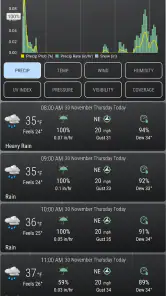
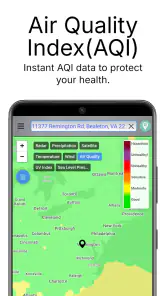
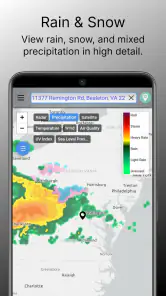
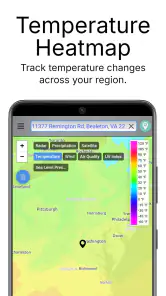
Analysis by Reviewed
I tested Rain Gauge & Dark Sky Tech as a focused weather app rather than as a replacement for every forecasting tool on my phone. Its purpose is narrower and, in the right situation, more useful: it helps me look back at how much rain fell and check the timing of rain ahead. That makes it particularly interesting for people who need practical rainfall information instead of a crowded screen full of unrelated weather details.
The app comes from Hyperlocal Weather App and sits in the weather category. It is free to start, rated for Everyone, and has reached over one hundred thousand installs. Its average rating is 3.9 from around eight thousand ratings, with roughly two thousand written reviews. Those figures suggest a product with a meaningful user base, but also one that will not satisfy every weather habit equally. I found its value depends heavily on whether rainfall is the detail I care about most.
How Rain Gauge works for different users and situations
Readability and navigation for rainfall-focused checks
The strongest part of the experience is its direct subject. Instead of making me dig through a general forecast to answer a question such as “How wet was yesterday?”, the app puts rainfall at the center. That focus can help anyone who finds conventional weather apps visually busy or mentally tiring. A person checking conditions quickly before leaving home does not necessarily need a long hourly forecast, radar layers, air-quality panels, and promotional cards competing for attention.
I especially liked the distinction between looking backward and looking forward. Yesterday’s rainfall total answers a record-keeping question, while a minute forecast answers an immediate planning question. Those are different needs, and treating them separately makes the app more practical than a simple rain icon. If I am deciding whether to water plants, inspect a leaky area, walk to a nearby shop, or postpone outdoor work, recent rainfall and near-term timing can be more useful than a broad daily prediction.
The short description, “Rain Gauge,” is a fair description of the app’s identity, but it does not fully convey the usefulness of combining a rain gauge with minute-level forecasting. I approached it as a specialist tool: open it when precipitation is the issue, rather than expecting it to be my only source for every weather question.
For readability, a rainfall-first design has an important advantage: the information hierarchy is easier to understand. I can usually begin with one question—how much rain, or when will it rain—and decide what to do from there. That is helpful for users who prefer predictable routines. Someone with attention difficulties may also appreciate not having to interpret several unrelated weather indicators before reaching the relevant answer.
There is a trade-off, though. A focused interface can feel incomplete when I want broader context. If I need a full multi-day outlook, detailed wind information, or a wider picture of changing conditions, a conventional weather service may be easier. Rain Gauge is clearest when the task is specifically connected to precipitation.
More From Our News Desk

Clash of Clans Is Won Between the Battles

Android Auto Makes the Case for Quieter Car Software

MobiOffice: Transforming Mobile Productivity with Seamless Integration

EA SPORTS FC™ Mobile Soccer: Redefining Mobile Sports Gaming

How Microsoft OneDrive Became a Mobile Productivity Giant

How Google Translate Breaks Language Barriers Effortlessly
Motor and sensory considerations in everyday use
Rainfall information is often checked while I am already doing something else: standing near a doorway, carrying groceries, preparing a bicycle, or trying to decide whether to take an umbrella. That context makes simple navigation more important than decorative design. The app’s narrow purpose reduces the number of decisions I need to make, which can be useful for people who find repeated scrolling or dense menus physically and cognitively demanding.
It can also support users who prefer to read rather than interpret visual weather symbols. A quantified rainfall view and a time-based rain outlook give more concrete information than a single cloud or umbrella icon. For someone who has difficulty distinguishing similar colors, relying on the meaning of the information rather than a color-coded map may be more comfortable. I would still check the display under the user’s own phone settings, because text size, contrast, screen brightness, and system accessibility options can change how easy any app is to read.
For users with limited dexterity, the best workflow is to decide on one repeatable check instead of exploring every screen. For example, I would open the app, review the recent total, then check the next short period before leaving. That routine avoids unnecessary taps and makes the app more manageable when one hand is occupied. It is a small habit, but it turns a specialist tool into something easier to use in real conditions.
Sensory comfort is another reason to favor a focused weather app. A screen dedicated to rain can be less overwhelming than a general forecast packed with animation, icons, and changing panels. On the other hand, users who need strong spoken feedback, highly explicit labels, or specialized navigation support should test the app carefully on their own device. I would not assume that a clean-looking weather screen automatically provides every accessibility feature a person may need.
The app is free to download, although in-app purchases range from $1.99 to $99.99 per item. That matters for users who need to avoid unexpected spending or who share a device with family members. I would explore the free experience first and review any purchase prompt before confirming it. A weather tool should be easy to evaluate without pressure, especially when the user is choosing it for a specific access need rather than entertainment.
Situational access: where the app becomes genuinely useful
The most convincing use case for me is a wet morning after uncertain overnight weather. Imagine waking up with outdoor plans and wanting to know whether the ground is merely damp or whether substantial rain fell while you slept. A general weather app may show a rain symbol for the previous day, but a rainfall total gives a more useful starting point. I can then check the minute forecast to decide whether to leave now, wait briefly, or change the plan.
That same workflow can help someone who manages a garden, checks outdoor surfaces, or coordinates a small activity that depends on dry conditions. The app does not remove the need for judgment—the local result may not describe every part of a large area—but it gives a more relevant piece of information than a generic “rain likely” label. I found this especially helpful when the decision depended on timing rather than on the entire day’s forecast.
Another practical situation is commuting with sensory or mobility considerations. If rain is expected soon, a person may need extra time to put on protective clothing, arrange transport, or choose a route with fewer exposed sections. A minute forecast can support that preparation better than a broad daily percentage. It can also reduce the stress of repeatedly checking several apps, because the immediate question is simply whether rain is approaching.
For people who work outdoors, the historical rainfall view has a different role. It can help create a simple personal record: compare how wet recent days have been before deciding whether a task is sensible. I would not treat it as an official measurement for technical, legal, or safety-critical decisions, but as an everyday planning aid it is more informative than memory alone.
Situational access also includes the moment when a user cannot comfortably spend time learning a complicated interface. The app’s specialization works in its favor here. I can approach it with a clear intention—recent rain or immediate rain—and avoid the broad exploration required by a full-featured weather platform. That makes it a reasonable companion app even for someone who keeps another service for long-range planning.
How it compares with ordinary weather alternatives
Most standard weather apps try to cover everything: temperature, wind, forecasts, alerts, maps, and sometimes unrelated extras. Their advantage is breadth. If I want one place for a general picture of the week, I would usually choose that kind of service. It is more convenient when rainfall is only one detail among many.
Rain Gauge takes the opposite approach. It gives precipitation more attention, which can make the relevant information easier to find. The historical rainfall question is also a useful point of difference. Many ordinary apps emphasize what is happening now and what is expected next, while this app encourages me to consider what already happened. That is valuable for gardening, outdoor maintenance, and deciding whether recent conditions explain a muddy or saturated area.
The minute forecast is another reason to keep it alongside a general weather app. I would not expect it to replace a full forecast for planning a trip several days away, but I would open it before a short walk or outdoor errand when the exact timing of rain matters. In that role, its limited scope is not a weakness; it is the reason I can reach the relevant information quickly.
The compromise is that I may need two tools. Someone who dislikes switching between apps could find that inconvenient. A person who wants radar, extended forecasts, severe-weather information, or broad environmental details may be better served by a more comprehensive alternative. My recommendation is therefore conditional: use Rain Gauge as the precipitation specialist, not automatically as the only weather app on the phone.
Remaining barriers and practical limitations
The biggest barrier is expectation. The name and description make the app sound simple, but a user may still expect a complete weather service after installing it. If the main need is temperature trends, wind planning, or long-range forecasting, the focused design may feel too narrow. I would decide based on the question I ask most often: if it is “Will it rain soon?” or “How much rain did we get?”, this app makes sense. If it is “What will the whole week feel like?”, another option is likely better.
Location can also affect how confidently I interpret rainfall information. Rain is local, and a reading that is useful for one neighborhood may not perfectly represent another nearby area. I would use the app as a guide for personal planning rather than as a precise substitute for a dedicated measuring instrument. That distinction is important for anyone making decisions involving property damage, professional operations, or safety.
There is also a financial-access consideration. The app is free, but optional purchases extend from a low single-digit amount to a much higher price point. Because the range is wide, I would pay attention to what each purchase unlocks and whether the free version already covers the user’s main task. For a family member who only needs occasional rain checks, paying may not be necessary. For a frequent user, the decision should still be based on a clearly useful improvement rather than on impulse.
People who depend on particular accessibility behaviors should also test the app directly. I can describe the rainfall focus and the practical value of a less cluttered task, but I would not treat that as proof of compatibility with every screen reader, magnification setup, switch-control method, or alternative input device. The safest approach is to install the free version, adjust the phone’s normal accessibility settings, and try the exact routine the user expects to perform.
Finally, minute forecasts can encourage false precision if I read them as guarantees. Weather changes, and a short-term estimate is still an estimate. I use it to make a flexible choice—leave now, wait, or bring protection—not to assume that a dry interval will remain perfect. That mindset makes the app more reliable in practice and prevents its most detailed feature from becoming misleadingly absolute.
Who should use it, and who should skip it?
I would recommend Rain Gauge to people whose daily decisions revolve around rain. Gardeners, walkers, cyclists, outdoor workers, parents arranging short activities, and anyone checking whether recent weather was substantial enough to affect plans can all find a clear reason to keep it installed. It is also a sensible companion for users who feel overwhelmed by general weather dashboards and want one focused task.
I would be more cautious for someone seeking a single all-purpose weather app. If the user wants detailed conditions across many categories, a longer forecast, or a broad travel-planning view, the narrow rainfall emphasis may create more app switching than convenience. Likewise, anyone needing official or highly precise measurements for professional decisions should use an appropriate authoritative source rather than relying on this app alone.
The Everyone age rating makes it suitable for a broad household audience, but suitability is not the same as universal accessibility. A child may find the simple purpose approachable, while an older adult may appreciate the direct question-and-answer workflow. Still, the actual comfort of reading and navigating the screen depends on the device and the person, so I would judge it through a short hands-on trial.
My inclusive verdict after using the rainfall specialist
Rain Gauge & Dark Sky Tech succeeds because it treats rain as a decision-making problem rather than just another weather icon. I found the combination of recent rainfall information and near-term timing more useful than a generic forecast when I needed to decide what to do within the next few hours. Its focused purpose can also reduce visual and mental clutter, which supports a range of users and situations without requiring the app to pretend it replaces every other weather tool.
Its limitations are just as clear. It is not the best choice for a complete weather overview, and users with specific assistive-technology needs should verify the actual experience on their own phone. The optional purchase range also deserves attention before spending. These are not reasons to dismiss it; they are reasons to use it in the role where it is strongest.
Hyperlocal Weather App has made a free weather app for a very particular need, and that specialization is its main advantage. I would install it beside a broader forecast service, build a short routine around checking yesterday’s rain and the immediate outlook, and use the result as practical guidance rather than absolute measurement. For anyone who regularly asks when rain will arrive or how wet the previous day really was, it is a focused, approachable addition worth trying.
Rain Gauge & Dark Sky Tech Frequently Asked Questions
Is Rain Gauge & Dark Sky Tech suitable for someone who only wants a simple rainfall check?
Yes. Its focus is rainfall information, including totals and a rain drop gauge, so it may suit someone who mainly wants a quick way to check precipitation rather than a broad set of weather tools. The store description also highlights minute forecasts. Whether that information is useful day to day will depend on the weather coverage available for your location.
What is Rain Gauge & Dark Sky Tech used for?
Rain Gauge & Dark Sky Tech is designed to help users monitor rainfall and check local weather conditions from a mobile device. It can be useful for planning outdoor activities, gardening, commuting, travel, or simply keeping track of changing weather patterns. The app’s usefulness depends on the availability and accuracy of weather data in your location.
Does Rain Gauge & Dark Sky Tech provide accurate rainfall and weather forecasts?
The app can provide helpful rainfall measurements, precipitation information, and forecast details, but accuracy is not guaranteed in every situation. Weather data may vary according to your location, the provider’s coverage, update frequency, and local conditions. Rainfall can also change quickly, so the app should be treated as a planning aid rather than a replacement for official weather warnings.
Does the app require location access to work?
Rain Gauge & Dark Sky Tech may request location permission to show weather information and rainfall data for your current area. You can often choose whether to allow access while using the app, allow it continuously, or enter a location manually, depending on the platform version. Reviewing these permissions is recommended if you are concerned about privacy or battery usage.
Is Rain Gauge & Dark Sky Tech free to download and use?
Rain Gauge & Dark Sky Tech is free to download, and it offers in-app purchases ranging from $1.99 to $99.99 per item. This means the initial download does not necessarily include every paid option. Check the purchase details in the relevant app store before paying, and review any terms shown there so you understand what you are buying.
Pros
- Simple rainfall tracking with clear
- easy-to-read measurements.
- Useful for gardeners
- farmers
- and outdoor activity planning.
- Historical data helps compare rainfall across different periods.
- Dark-sky information can support nighttime observation planning.
- Lightweight design should be easy to use on most modern devices.
Cons
- Accuracy may vary depending on the selected weather station or sensor.
- Some advanced weather details may require an internet connection.
- Forecast and rainfall data can differ from local real-world conditions.
- Dark-sky readings may be less useful in brightly lit urban areas.
- Background location or weather access may affect battery and data usage.
- Category
- Weather
- Version
- Varies with device