OSHA NIOSH Heat Safety Tool
- 287.00
- 3.1
- Installs
- 100.00K
- Price
- Free

Screenshots

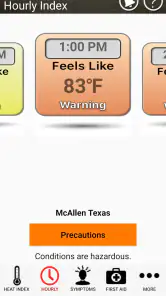
Analysis by Reviewed
When heat becomes a workplace hazard, I would rather use a focused safety calculator than rely on a vague weather forecast. The OSHA NIOSH Heat Safety Tool is built for that narrow decision: it helps estimate the heat index and connects the result with a related risk level and worksite guidance. After using it, my overall view is clear: this is a practical reference tool for heat-exposure planning, not a complete weather app or a replacement for professional judgment.
That distinction matters. A general weather application may tell you the temperature, humidity, chance of rain, and hourly forecast, but it usually leaves you to interpret what those conditions mean for people working outdoors. This app puts the emphasis somewhere else. It is aimed at the moment when a supervisor, worker, coach, event organizer, or caregiver needs to ask, “How dangerous could this combination of heat and moisture be, and what should we change?”
It is a free weather app from the Centers for Disease Control and Prevention, with OSHA and NIOSH safety guidance at its center. The app is rated for Everyone, runs on Android starting with version 8.0, and its current version is 3.5. It was released on May 23, 2017, and has passed 100K installs. Those details make it feel less like a novelty and more like a specialized public-health utility, although its average rating of 3.1 from around 554 ratings suggests that the experience is not perfect for every user.
What the tool does well in real heat-planning situations
A focused answer instead of a distracting forecast
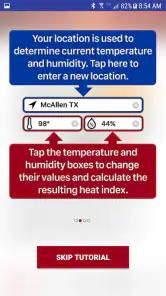
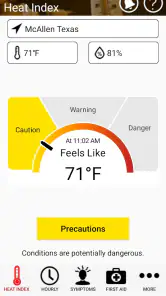
The strongest part of the app is its focus. I do not open it expecting radar maps, storm alerts, pollen counts, or a polished seven-day forecast. I open it to evaluate heat stress. That limited purpose is actually useful because it keeps the decision in front of me: enter or review the relevant conditions, see the resulting heat-index risk, and consider the worksite recommendations attached to that level.
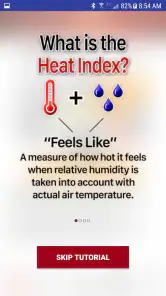
For someone responsible for outdoor work, this is more helpful than simply reading a thermometer. Air temperature alone can give a misleading impression. Humidity changes how effectively the body can cool itself, so a hot day with heavy moisture can be more dangerous than the temperature reading suggests. The tool encourages the user to consider that combined effect rather than treating temperature as the whole story.
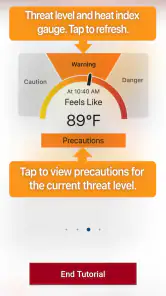
I also appreciate that the result is framed around risk and action. A number without context is easy to dismiss or misread. The associated recommendations make the output more practical: they point the user toward changes in how work is organized, rather than presenting the heat index as an interesting weather statistic.
Useful for supervisors who need a repeatable routine
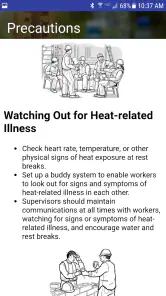
A small business, construction crew, landscaping team, delivery operation, or outdoor maintenance group could use this app as part of a daily heat check. Before work begins, one person can review the conditions and use the risk level to start a conversation about breaks, hydration, shade, clothing, workload, and signs of illness. The value is not that the app makes the safety decision automatically; the value is that it gives the discussion a consistent starting point.
More From Our News Desk

Clash of Clans Is Won Between the Battles

Android Auto Makes the Case for Quieter Car Software

MobiOffice: Transforming Mobile Productivity with Seamless Integration

EA SPORTS FC™ Mobile Soccer: Redefining Mobile Sports Gaming

How Microsoft OneDrive Became a Mobile Productivity Giant

How Google Translate Breaks Language Barriers Effortlessly
That repeatability is one of the less obvious strengths. Without a tool like this, heat planning can become informal: someone looks outside, checks a normal weather app, and decides the day “doesn’t seem too bad.” A dedicated heat-safety screen makes it harder to forget humidity and easier to build a simple routine. I would use it before a shift, after a major weather change, and whenever the work becomes more strenuous than originally planned.
There is also a useful communication benefit. A supervisor can show workers why a schedule or task plan is changing instead of presenting the adjustment as an arbitrary rule. The app does not replace a safety briefing, but it can make that briefing more concrete. In a workplace where people are tempted to push through discomfort, a shared risk category can help move the conversation away from personal toughness.
A realistic example: changing an outdoor workday
Imagine I am helping organize a morning of roof repairs. The forecast looks manageable when I first check it, but the crew will be wearing protective clothing and working above ground with limited shade. I would use the tool before the shift to assess the heat-index conditions, then compare the result with the worksite recommendations. If the risk is elevated, I might move the heaviest tasks earlier, arrange more frequent recovery periods, make cool water easy to reach, and assign someone to watch for symptoms.
The important point is that the app does not tell me that a single number makes the job safe or unsafe in isolation. The roof, clothing, physical effort, acclimatization, age, health, and access to cooling all matter. The tool is most valuable when it prompts me to account for those factors. Used that way, it becomes a planning aid rather than a permission slip to continue working.
More useful than a normal weather app for this specific question
Compared with a typical weather application, this tool has a narrower but more relevant purpose for heat exposure. A general app is better if I need a forecast, location search, wind information, rain timing, or a broader picture of the day. It may also be more convenient for checking conditions while traveling. The OSHA NIOSH tool is better when the central question is how heat and humidity affect worksite risk.
That comparison also explains why some users may be disappointed. If I want one app to manage all weather decisions, this is not the right choice. It does not compete with a full forecast service on breadth. Its advantage comes from interpretation and safety guidance, not from trying to cover every type of weather information.
Three practical habits that make the tool more useful
First, I would check conditions at the actual work location rather than assuming that a nearby city’s weather tells the whole story. Heat can vary between an open field, a shaded residential area, and a dense paved site. The app can support the calculation, but the quality of the input still depends on where and when I observe the conditions.
Second, I would treat the risk level as a trigger for preparation, not as a boundary between danger and safety. Conditions below a prominent threshold can still be difficult for a new worker, someone wearing heavy protective equipment, or anyone experiencing illness. Conversely, a risk category does not describe every individual equally. The best workflow is to combine the app’s result with the job’s physical demands and the workers’ condition.
Third, I would record the result alongside the day’s plan if I were using it for a recurring operation. Even a simple note about the time checked, the work planned, and the precautions chosen can improve consistency. The app itself is quick to consult, but the surrounding routine is what turns a calculator into a useful safety process.
Where the experience falls short
The main weakness is that the app’s focused design can feel limited once I move beyond the calculation. It is not a complete heat-management system. I still need to gather local conditions, understand the worksite, communicate the plan, and monitor people during the job. A user looking for automatic, location-based convenience may find the process less seamless than expected.
I also would not use it as my only source during rapidly changing weather. A heat-index assessment is only one part of outdoor risk management. Sudden storms, strong wind, poor air quality, direct sun, and other hazards may require different information. A normal forecast app or an official alert service is a better companion for those questions.
The rating of 3.1 indicates that the app has room to improve from a user-experience perspective. I can understand why: a specialized safety tool is judged not only by whether its calculation is useful, but also by how quickly and clearly people can use it under pressure. If the interface feels dated or requires more manual attention than a modern weather app, that friction matters, especially when a supervisor is checking conditions before a busy shift.
Another limitation is the risk of false confidence. Because the app presents a defined risk level, an inexperienced user might interpret the result too literally. The recommendations are most valuable when they support an existing safety culture. They are not a substitute for training, emergency procedures, medical awareness, or direct observation of workers. I would be cautious about anyone using the tool to justify pushing through symptoms or delaying a needed break.
Who should use it and who should choose something else
I think this app is a strong fit for outdoor workers, crew leaders, site supervisors, athletic staff, camp organizers, school personnel, and families caring for people who spend long periods outside. It is especially appropriate for someone who wants a simple heat-risk reference without paying for a specialized service. Because the content rating is Everyone and the app is free, it is accessible to a broad audience, although adults should still explain the safety advice when using it with children.
It is also a sensible choice for people who do not need constant weather information. If my only concern is whether a planned task could expose someone to dangerous heat, the focused design is an advantage. I can use it as a quick checkpoint rather than sorting through a large weather dashboard.
I would skip it as a primary app if I need detailed forecasts, automatic alerts, maps, or a broad set of environmental measurements. A conventional weather app will serve that role better. I would also avoid treating it as sufficient for a formal occupational-safety program. In that setting, the app can be one small part of a larger process, but it cannot replace written procedures, trained supervision, appropriate equipment, and emergency planning.
Answers to the questions I would have before installing
If I were wondering whether the app costs anything, the answer is straightforward: it is free. That makes it easy to add as a specialist tool even if I already use another weather service. I would not expect a subscription-style experience; the reason to install it is the heat-safety function itself.
If I were asking whether it works on an older Android phone, it supports Android 8.0 and later. That is helpful for workplaces where not everyone has a recent device. The current version is 3.5, so I would still keep the app updated when updates are available through the normal platform, particularly for a tool used in safety-related routines.
If I wanted to know whether it replaces a weather forecast, I would say no. I would pair it with a regular forecast source when planning outdoor work. Use this tool for heat-index interpretation and risk guidance, then use the other service for timing, storms, wind, and the rest of the day’s conditions.
If I were unsure whether the result alone tells me that work can continue, I would be very clear: it does not. The risk level should influence the plan, but the final decision must consider the people, task, clothing, shade, water, breaks, acclimatization, and symptoms. Anyone who feels unwell should be taken seriously regardless of what the screen displays.
Finally, if I were deciding whether the app is worth keeping alongside my usual weather app, I would keep it if I supervise outdoor activity or regularly work in hot conditions. The two tools answer different questions. I would remove it only if I never need heat-specific guidance and want a single general-purpose forecast application instead.
My final assessment
The OSHA NIOSH Heat Safety Tool succeeds because it takes a common but easily underestimated hazard and gives it a dedicated place on the phone. Its strongest contribution is not visual polish or a large collection of weather features; it is the connection between heat-index conditions, risk level, and worksite recommendations. That makes it more actionable than a temperature reading alone.
At the same time, I would not describe it as a complete solution. The narrow scope, possible interface friction, and dependence on responsible interpretation mean that it works best in the hands of someone willing to think beyond the displayed result. It should support observation and planning, not replace them.
My recommendation is therefore specific: install it if you manage, perform, or organize outdoor work and want a free, focused heat-safety reference. Keep a broader weather app beside it for everything else. For that audience, the app is a worthwhile practical check that can improve daily decisions when used as part of a larger safety routine. For casual users seeking a full weather forecast, it is too specialized to be the only app on the phone.
In my experience, that is the fair way to judge OSHA NIOSH Heat Safety Tool. It is not trying to be the most complete weather application, and it should not be judged as one. Its value comes from helping people pause, interpret heat more responsibly, and make sensible adjustments before an ordinary outdoor task becomes a preventable health risk.
OSHA NIOSH Heat Safety Tool Frequently Asked Questions
Is OSHA NIOSH Heat Safety Tool free to download, and which devices can run it?
The app is free and is rated for everyone, making it accessible to a broad range of users. It requires Android or iOS 8.0 or later, so check your device’s operating system before downloading. The app focuses on calculating the heat index and presenting associated worksite risk recommendations, which can be useful to review before a shift in hot conditions.
What is the OSHA-NIOSH Heat Safety Tool, and what does it do?
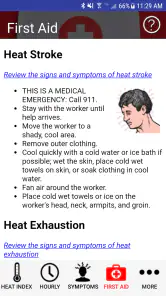
The OSHA-NIOSH Heat Safety Tool is a workplace safety app designed to help users understand and manage the risk of heat illness. It provides heat index or workplace heat-risk information based on weather conditions, along with practical recommendations for hydration, rest, acclimatization, and protective measures. It is especially useful for outdoor workers, supervisors, and anyone working in hot or humid environments.
Does the app provide accurate, real-time heat safety information?
The app uses current weather information and recognized OSHA and NIOSH heat-safety guidance to estimate heat risk. Its recommendations can be helpful for planning work activities, but conditions may change quickly because of direct sunlight, physical effort, clothing, wind, and local weather variations. Users should treat the app as a guidance tool, not a replacement for workplace measurements, professional judgment, or an established heat-illness prevention program.
Can OSHA-NIOSH Heat Safety Tool be used without an internet connection?
Some app functions may require an internet connection or location services to obtain updated weather and heat-risk information. If the connection is unavailable, the app may not be able to refresh conditions for the selected location, and its information could become outdated. Before entering a remote worksite, users should check conditions in advance and ensure that supervisors have a separate plan for monitoring heat, water, rest breaks, and emergency response.
Who should use this heat safety app?
The app is intended for workers, employers, safety managers, and supervisors who need quick heat-risk guidance. It can be useful in construction, agriculture, landscaping, delivery, roadwork, outdoor events, and other physically demanding jobs. It may also help people exercising or spending extended time outdoors. However, individual health conditions, medications, age, fitness, and acclimatization can affect heat tolerance, so the app should supplement—not replace—medical or occupational-safety advice.
Pros
- Provides heat index and risk-level guidance for outdoor work.
- Offers practical hydration and rest recommendations.
- Useful for workers
- supervisors
- and safety training sessions.
- Simple interface makes heat checks quick in the field.
- Includes prevention guidance based on recognized safety information.
Cons
- Requires location services for the most accurate weather readings.
- Forecast accuracy depends on available local weather data.
- Does not replace a formal workplace heat-safety assessment.
- Some recommendations may feel broad for specialized job sites.
- Limited usefulness without regular access to current weather updates.
- Category
- Weather
- Version
- 3.5