Lippincott Review for NCLEX-PN
- 24.00
- 4.7
- Installs
- 10.00K
- Price
- Free
Screenshots
Analysis by Reviewed
I found Lippincott Review for NCLEX-PN most useful as a focused practice companion rather than as a complete nursing course. It is a medical study app from Skyscape Medpresso Inc, built around a large bank of NCLEX-PN-style questions with explanations. That narrow purpose matters: if you already have textbooks, class notes, or a structured review plan, it can give your study time a practical testing layer. If you are looking for lessons that teach every topic from the beginning, I would not treat it as a replacement for those resources.
The app is free to install and is suitable for Everyone, which makes trying the basic experience relatively easy. Its average rating is 4.7 from 121 ratings, and it has passed 10K+ installs. Those figures suggest a small but positive user base rather than a mass-market study platform. I would read that as encouragement, not proof that it will suit every nursing student. The real question is whether its question-and-rationale format matches the way you need to prepare.
How the question bank works in real study sessions
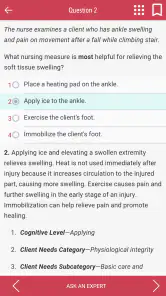
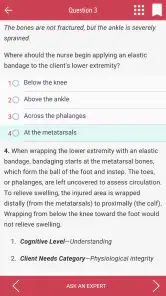
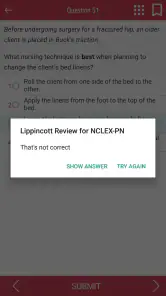
The central promise is straightforward: 2000 questions with rationale. In practice, that gives the app a very different feel from a medical reference library. You are not opening it primarily to browse a long explanation of a disease or procedure. You are opening it to make a decision, commit to an answer, and then examine the reasoning behind the result.
That sequence is valuable because NCLEX-PN preparation is not only about remembering isolated facts. It also involves recognizing priorities, separating expected findings from warning signs, and choosing the safest response when several options sound reasonable. A rationale can expose the thinking gap behind a wrong answer, which is often more useful than simply seeing a red mark beside your choice.
I recommend treating each question as a short clinical reasoning exercise instead of a quick quiz. Before looking at the explanation, say to yourself why the selected option is safest. Then compare your reasoning with the rationale. This small habit turns passive answer checking into a form of self-assessment and helps reveal whether you missed a fact, misunderstood the wording, or used the wrong priority.
The app is especially convenient for short sessions. I could imagine using it during a commute, between classes, or at the end of a study block when I did not have the energy to open a full textbook. A single question can become a five-minute review if I examine every option, while a longer session can provide a more deliberate run through several clinical scenarios.
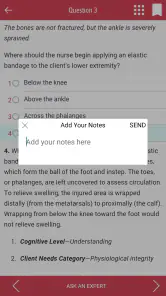
One practical tip is to keep a separate list of mistakes by reasoning pattern, not only by subject. For example, “missed the first assessment,” “chose an intervention before checking safety,” or “confused an expected side effect with a complication” is more actionable than simply writing down a disease name. The rationale becomes much more useful when it helps you identify a repeatable error in your test approach.
Why the rationales matter more than the raw question count
A large question bank can look impressive, but volume alone does not guarantee better preparation. The lasting value here comes from what you do after answering. If you rush through questions and memorize letters, the app becomes a score counter. If you study the reasoning, it becomes a tool for building judgment.
I would read the explanation even when my answer was correct. A correct choice can still be based on a lucky guess, and the rationale may clarify why the other options are less appropriate. That is particularly important in nursing questions, where multiple answers may be clinically relevant but only one fits the timing, priority, or scope of the situation.
Another useful workflow is to revisit questions after a delay instead of immediately repeating them. Immediate repetition can create a false sense of mastery because the wording is still fresh. Returning later forces you to reconstruct the reasoning. I would use the app for first-pass practice, then use notes or another study resource to fill the actual knowledge gaps it exposes.
This is also where the app’s limitations become clear. A rationale can explain the answer to one question, but it may not provide the broad lesson needed to understand an entire topic. If you repeatedly miss medication safety, fluid balance, or delegation questions, you may need a textbook, lecture, or instructor explanation alongside the app. The question bank can point to weakness; it should not be expected to repair every weakness by itself.
Free access, paid value, and the decision to spend
The app itself is free, so there is no upfront purchase required to see whether its approach works for you. That is a meaningful advantage for students who want to test the interface and study style before committing money. However, in-app purchases range from $22.99 to $44.99 per item, so the word “free” should not be interpreted as meaning that every part of the experience costs nothing.
I would make the purchase decision based on actual use rather than on the headline number of questions. First, install it and determine whether you can study comfortably with the available access. Then ask whether the explanations are helping you correct mistakes and whether you are returning often enough to justify paying for additional material. If you only want occasional practice, the paid options may be difficult to justify. If you are preparing seriously and the app becomes part of a regular routine, the price may be more reasonable in relation to the time it can save.
Because each purchase is listed per item rather than as one universally stated package, I would inspect the exact option shown in the app before paying. Check what the purchase unlocks and whether it matches your intended study period. This is a better approach than assuming that the most expensive option automatically offers the right value for your needs.
The important distinction is between access and learning value. Paying for more questions does not automatically improve preparation if you are already answering without reviewing rationales. Conversely, a smaller amount of well-analyzed practice may be more useful than a larger amount completed carelessly. I would spend only after establishing a repeatable workflow: answer, explain your choice, read the rationale, record the lesson, and revisit the error later.
Where it fits beside textbooks, classes, and other study tools
Compared with a traditional NCLEX-PN review book, this app is quicker to open and easier to use in fragmented pockets of time. A book is usually better for sustained reading, diagrams, reference material, and a carefully organized explanation of a subject. The app is better when I want to test whether I can apply information under question pressure.
Compared with lecture notes, it offers a more active form of recall. Notes can be excellent for learning what an instructor emphasized, but rereading them may feel productive without proving that I can make a safe clinical choice. Questions expose that difference quickly. On the other hand, class materials remain important because they provide context and may explain local expectations or terminology that a general question bank does not cover.
Compared with a broad medical reference app, this one has a clearer exam-preparation focus. A reference tool is useful when I need to look up a condition, drug, or procedure directly. Lippincott Review for NCLEX-PN makes more sense when I want to practice deciding among answer choices. I would not replace a reference source with it, and I would not use a reference source as my only substitute for question practice.
It also differs from a tutoring service. The app can show a rationale, but it cannot observe my thought process, ask why I chose an option, or adapt a lesson through conversation. Students who need immediate clarification and accountability may gain more from an instructor, study group, or tutor. The app works best for independent learners who can turn an incorrect answer into a follow-up study task.
Realistic ways to use it without burning out
Imagine a practical nursing student with a clinical day in the morning and an hour available in the evening. Instead of trying to read an entire chapter while tired, the student could complete a short set of questions, review every rationale, and write down two patterns of error. The next day, those notes could guide a targeted review before another practice session. That workflow makes the app a diagnostic tool rather than another source of overwhelming content.
For a student several weeks away from the exam, I would use it to identify broad weaknesses and then return to foundational resources. For a student close to the exam, I would use it to practice pacing, careful reading, and priority decisions, while avoiding the temptation to measure readiness by a single session’s score.
A useful advanced habit is to explain why each wrong option is wrong. This is slower, but it helps prevent distractors from remaining vague. In a question about a deteriorating patient, for instance, the key lesson may not be the chosen intervention itself; it may be recognizing why another action is premature, unsafe, or outside the immediate priority. That kind of comparison is where the rationales can deliver more value than the short description suggests.
I would also avoid doing every session in the same setting. Practice at a desk when you want careful analysis, but occasionally use shorter sessions in ordinary conditions so you can see whether distractions affect your reading. This does not reproduce the exam, but it can reveal whether you are making careless errors because of fatigue rather than lack of knowledge.
Friction points and situations where I would skip it
The biggest trade-off is its narrowness. A question bank can tell me what I got wrong, but it does not automatically create a complete curriculum. Beginners who still need basic explanations may feel lost if they rely on practice questions before learning the underlying material. In that situation, I would start with a structured NCLEX-PN review course or textbook and add this app later.
It is also not the right choice for someone who dislikes self-directed study. There is no substitute for discipline when using a practice app. Without a plan for reviewing rationales and tracking recurring mistakes, it is easy to tap through questions and confuse activity with progress.
Students who need highly personalized feedback should also look elsewhere or use this only as a supplement. The app can support independent practice, but it is not a conversation with a teacher. If a rationale leaves you unsure about a safety principle, scope-of-practice issue, or clinical priority, you should consult a qualified instructor or trusted course resource rather than guessing.
Device requirements are relatively approachable: the current version is 4.16.0 and it supports Android 5.0 or later. That makes it usable on older compatible devices, although the experience will still depend on the phone or tablet itself. I would keep the app as one part of a wider study system rather than storing all preparation inside a single mobile tool.
Who will get the most from the free and paid options
I think the strongest fit is a practical nursing student who already understands the basics and needs more deliberate question practice. The app is also useful for a graduate who wants to refresh clinical reasoning, provided they use the rationales actively instead of treating the questions as trivia.
It may be particularly helpful for people with irregular schedules. Short, focused sessions are easier to fit around work, family responsibilities, and clinical placements than long reading sessions. The ability to return to question-based practice without setting up a full study desk gives it a practical advantage over a book in those moments.
The free access is best viewed as a trial and a low-risk way to judge fit. I would not pay simply because the app contains a large bank. I would pay only if the available experience demonstrates that the explanations are clear, the questions match my level, and I am using the app consistently enough to benefit from expanded access. That is the fairest way to evaluate the $22.99-to-$44.99 purchase range.
Students who are already confident with questions but weak in content should spend their time differently. They may gain more from reviewing pharmacology, anatomy, health alterations, or instructor-provided material before adding more practice. Likewise, someone seeking patient-care guidance for real-time clinical decisions should not use an exam-preparation app as a substitute for professional protocols or supervision.
My buy-or-skip verdict
My view is positive, with a clear condition: the value is in the rationales and your review process, not in collecting completed questions. As a free medical study app with a focused NCLEX-PN purpose, it is worth trying for anyone who wants mobile practice and already has, or plans to build, a broader study foundation.
I would keep it if the questions reveal useful gaps and the explanations help me understand why an answer is safest. I would consider a paid item only after using the free access long enough to prove that it fits my routine. The purchase can make sense for a committed candidate who needs more practice, but it is not automatically worthwhile for occasional users or students who need teaching rather than testing.
Developed by Skyscape Medpresso Inc, the app has a strong average rating of 4.7 and an Everyone age rating, but those details should support—not replace—your own trial. My final recommendation is to use it as a focused practice layer beside a textbook, course, instructor, or other authoritative resource. If you want a compact way to challenge your clinical reasoning and learn from explanations, I would recommend giving it a chance. If you need a complete guided NCLEX-PN curriculum, I would skip making it your main resource and choose a more comprehensive option instead.
Pros
- Focused specifically on NCLEX-PN preparation and practical nursing topics.
- Practice questions include explanations to clarify correct and incorrect answers.
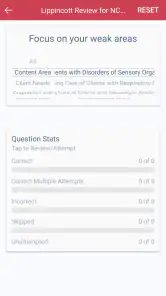
- Useful for identifying weak areas through repeated quizzes and review sessions.
- Concise content makes it convenient for short study periods during a busy schedule.
- Can complement classroom instruction and other nursing exam preparation resources.
Cons
- Some content may feel repetitive after extended study sessions.
- The app may not replace comprehensive nursing textbooks or clinical practice.
- Advanced features or full question access may require an in-app purchase.
- Users may need internet access for certain content or app functionality.
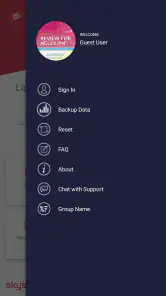
- Interface and question navigation may feel less engaging than modern study apps.
- Category
- Medical
- Version
- 4.16.0