CNA Exam Practice Tests | 2026
- 24.00
- 4.8
- Installs
- 10.00K
- Price
- Free
Screenshots
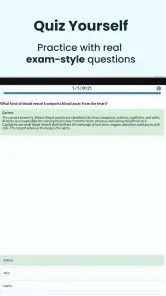
Analysis by Reviewed
Preparing for a certified nursing assistant exam can feel less like ordinary studying and more like learning how to think under pressure. CNA Exam Practice Tests | 2026 takes a focused approach: instead of trying to be a complete nursing textbook, it gives me a practice-centered place to check what I know, spot weak areas, and get used to answering certification-style questions. That narrow purpose is its biggest strength, but it also explains why it will not suit every learner.
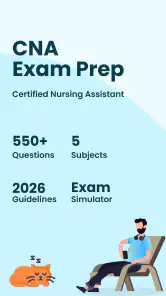
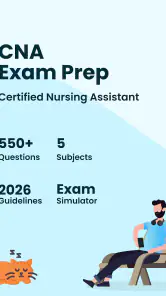
After using it as an education app, my view is clear: this is most useful when I treat it as a regular testing companion rather than my only source of instruction. The collection of more than 550 CNA practice questions, an exam simulator, and a study guide gives the app enough range for repeated revision. I would recommend it to someone who already has class notes or training and wants a convenient way to turn passive reading into active recall.
What the app does well in real study sessions
The most valuable part of this app is the shift from reading about CNA topics to making decisions. A study guide can explain a procedure, but a practice question forces me to distinguish between several plausible actions. That difference matters because certification preparation is not only about remembering definitions. It is also about recognizing priorities, following safe routines, and choosing the response that best fits the situation described.
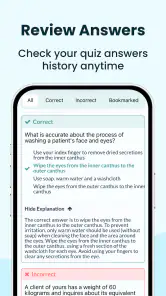
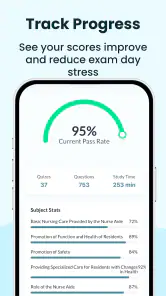
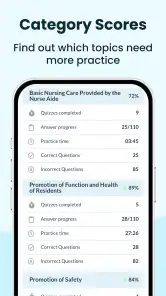
I found the question-based format particularly useful after a class session. Rather than rereading an entire chapter, I could work through a short practice block and use mistakes as a map. If I missed questions involving infection control, resident safety, communication, or daily care, that result told me where to return to my notes. The app works best as a feedback loop: answer, examine the weak point, then test the same skill again later.
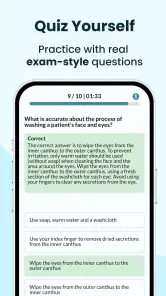
The exam simulator adds a different kind of value from ordinary quizzes. A casual quiz lets me pause whenever I want, while a simulated exam encourages a more disciplined rhythm. I have to read carefully, resist changing answers without a reason, and manage uncertainty. Even without treating one session as a prediction of my final result, that practice can make the real testing experience feel less unfamiliar.
The size of the question library also supports repetition without making every study session identical. With over 550 questions available, I can divide preparation into smaller rounds instead of trying to finish everything in one sitting. That matters for students balancing clinical training, work, family responsibilities, or commuting. A short session on a phone is easier to maintain than a large study plan that depends on finding a quiet evening every day.
Another strength is portability. This is a free app in the education category, so the initial barrier to trying it is low. I can use it during a spare moment without carrying a workbook, and the content is aimed at one clearly defined goal rather than broad medical education. The content rating is Everyone, which makes the presentation approachable for a wide range of adult learners and students.
More From Our News Desk

Clash of Clans Is Won Between the Battles

Android Auto Makes the Case for Quieter Car Software

MobiOffice: Transforming Mobile Productivity with Seamless Integration

EA SPORTS FC™ Mobile Soccer: Redefining Mobile Sports Gaming

How Microsoft OneDrive Became a Mobile Productivity Giant

How Google Translate Breaks Language Barriers Effortlessly
A practical workflow for getting more from the questions
I would not begin by racing through the full question bank. A better method is to take a small set when I am fresh, record the subjects behind my mistakes, and then return to those subjects in the study guide. On the next session, I would mix familiar and difficult topics instead of studying only the area that feels uncomfortable. This prevents a common trap: becoming very confident in one narrow section while neglecting the rest of the exam.
It also helps to separate knowledge errors from reading errors. If I chose the wrong answer because I did not understand the underlying CNA principle, I need review. If I knew the principle but skimmed a word such as “first,” “best,” or “except,” I need slower question reading. The app cannot replace that self-check, but its practice format makes the distinction visible if I take a moment to analyze each miss.
For a realistic everyday routine, I would use the app on the bus after class for a short question session, then reserve a longer evening block for reviewing the related material. At the weekend, I would use the simulator to test whether the week’s learning holds together when topics are mixed. This three-part rhythm—quick retrieval, targeted review, and broader simulation—is more effective than repeatedly tapping through questions without reflection.
There is also a useful trade-off between speed and learning. Answering quickly can build confidence and make practice feel productive, but moving too fast may train careless habits. I would rather spend extra time explaining to myself why the correct option is safer or more appropriate than simply chasing a higher completion count. The app becomes more valuable when I use each question as a miniature case study.
Where it fits beside classes, books, and free resources
I would place this app between formal instruction and general online searching. A CNA course remains better for demonstrations, instructor correction, hands-on technique, and the context behind procedures. A textbook is better when I need a sustained explanation of a topic. General web searches can help clarify a single term, but they often produce scattered material that is difficult to organize around exam preparation.
This app’s advantage is concentration. It keeps the study experience close to the decisions I am likely to practice for certification, rather than sending me through unrelated medical content. That makes it more efficient than a broad learning platform when my immediate goal is exam preparation. On the other hand, the same focus becomes a weakness if I need a deep lesson, a visual demonstration, or personal feedback on physical skills.
I would also avoid treating a practice question as permission to memorize a phrase without understanding it. CNA work depends on respectful communication, observation, safety, and correct procedure. A question bank can reinforce those ideas, but it cannot watch me perform a transfer, position a resident, wash my hands, or respond to a real person’s concern. Anyone using the app should keep practical training at the center of preparation.
The main limitation: practice is not the same as instruction
The app’s narrow design is its most meaningful limitation. If I am encountering a topic for the first time, a question may tell me that my answer is wrong without giving me the full teaching experience I need. I may understand the correction in the moment but still lack the broader framework that would help me handle a differently worded situation later.
That is why I would not rely on it alone, especially early in a CNA program. Someone who has not yet learned basic terminology, safety principles, or the reasoning behind common care tasks may feel as if they are guessing through the bank. The study guide can support preparation, but the app should complement instruction rather than replace a qualified course, skills practice, or an instructor’s explanation.
There is also a motivational limitation to consider. Practice apps make it easy to confuse activity with progress. Completing many questions can feel satisfying even when I am repeating familiar material or remembering answers from a previous attempt. I would judge improvement by whether I can explain the reasoning and apply it to a new scenario, not merely by how quickly I can finish a quiz.
The free entry point is helpful, but the app includes optional in-app purchases ranging from $7.99 to $59.99 per item. That means I would check exactly what is included before paying and decide whether the additional material fits my study plan. A learner who only needs occasional practice may find the free experience sufficient, while someone seeking a more complete preparation package may consider an upgrade only after using the available material and identifying a genuine need.
Because the app is relatively focused, it may also feel repetitive to students who already have strong exam preparation resources. If I am attending a well-structured course, using instructor-provided tests, and studying from a trusted manual, another question bank may add less value than a skills lab or a review session. The right choice depends on the gap in my preparation, not on collecting as many study tools as possible.
Who should use it, and who should choose something else
I think this app is a strong fit for a CNA student who wants frequent, low-friction practice on a phone. It is especially suitable for learners who know the basics but need more repetition, people who struggle to organize revision, and students who want to become more comfortable with exam-style decisions. The simulator is useful for anyone who has studied individual topics but has not yet tested their concentration across a broader session.
It can also help a learner returning to the material after a break. Instead of guessing which chapter to reopen, I can use questions to reveal what has faded. That makes the app a practical diagnostic tool, not just a final-week cramming aid. I would still leave enough time to review weak subjects properly, because discovering a gap is only helpful if I have time to repair it.
I would be more cautious about recommending it to a complete beginner who expects step-by-step teaching. That person may need an instructor-led course, demonstrations, and a structured textbook first. I would also steer away from using it as the only preparation method for someone who needs accessibility features, highly detailed explanations, or individualized coaching. A dedicated course or printed resource may be better in those cases.
The app comes from Prepia Inc and has built a 4.8 average from around 387 ratings, with more than 10K installs. Those figures suggest that it has found a clear audience among people looking for CNA exam practice, but they do not change the practical question I would ask before installing: do I need more testing opportunities, or do I need to learn the material from the ground up? If the answer is testing, this app makes sense. If the answer is foundational teaching, it should be secondary.
Small details worth checking before committing
Compatibility is straightforward for many Android users because the app requires Android 7.0 or later. I would still check the device before planning a study routine, particularly if I am using an older phone. The current version is 2.1.020, so I would also keep the app updated through the normal store process to avoid missing improvements or fixes that may affect everyday use.
I would plan my study around consistency rather than a single marathon. Ten or fifteen focused minutes can reveal a recurring weakness, while a longer simulator session can show whether I lose accuracy when topics change. Keeping a separate notebook with three columns—missed concept, reason for the mistake, and next review date—turns the app into a more complete system without requiring complicated tools.
One overlooked benefit of this approach is that it helps expose confidence gaps. Sometimes I answer correctly but cannot explain why. I would mark those items for later review instead of treating them as fully mastered. Conversely, a question I miss because of a careless reading mistake should not lead me to relearn an entire topic. This distinction saves time and makes the practice bank more precise.
I would also use the exam simulator sparingly enough that it remains a meaningful check. If every session is treated like a mock exam, I may become tired and stop learning from the results. Shorter targeted sessions are better for building knowledge; occasional full simulations are better for checking readiness. That balance is particularly important for students who are already exhausted by classes or clinical work.
My final verdict on CNA Exam Practice Tests | 2026
My overall impression is positive, with one important condition: I would use this as a practice partner, not as a substitute for CNA education. Its focused question bank, study guide, and exam simulator give me a clear way to turn spare moments into purposeful revision. The free starting point makes it easy to test the routine, while the optional purchases mean I would review the available content before deciding whether to spend more.
The strongest case for installing it is simple. When I already have lessons, notes, or practical training and need to check whether the knowledge is sticking, this app gives me repeated opportunities to make decisions and find weak areas. That is more useful than passively rereading the same material, and it fits naturally into a busy student schedule.
The strongest reason to look elsewhere is equally clear. If I need detailed teaching, hands-on correction, or personalized explanations, a course, instructor, or comprehensive study book will do more. No question bank can fully prepare me for the human and physical side of CNA work.
For the right learner, I would recommend it without hesitation: use the questions diagnostically, review every uncertain answer, mix short practice with occasional simulations, and keep real instruction at the center. It is a focused exam-preparation tool with practical value, provided I use it to strengthen understanding rather than merely collect correct answers.
CNA Exam Practice Tests | 2026 Frequently Asked Questions
Is CNA Exam Practice Tests | 2026 free to download?
The app is free to download, with optional in-app purchases for additional content or features. Before making a purchase, review the available options and terms in the app store so you know what is included. You can begin exploring the study app without paying upfront, then decide whether any paid offering suits the way you plan to prepare.
What does CNA Exam Practice Tests | 2026 include?
CNA Exam Practice Tests | 2026 is an education app from Prepia Inc, with a store summary describing more than 550 CNA practice questions, an exam simulator, and a study guide for CNA certification. Those tools offer several ways to review and practise. It is intended as a preparation aid rather than a replacement for an approved CNA course or official testing information.
What is CNA Exam Practice Tests | 2026?
CNA Exam Practice Tests | 2026 is a study app designed to help Certified Nursing Assistant candidates prepare for certification exams. It typically includes practice questions, simulated tests, explanations, and topic-based review material covering areas such as patient care, safety, infection control, communication, and basic nursing skills. It is intended as a preparation aid rather than a replacement for an approved CNA course or official testing information.
Does the app cover the topics included in the CNA exam?
The app is built around common CNA examination subjects, including personal care, vital signs, resident rights, infection prevention, emergency procedures, mobility, nutrition, documentation, and communication. However, the exact content and exam requirements can vary by state or testing organization. Before relying on the app, compare its study topics with your local CNA handbook and the official examination outline to identify any differences.
Can beginners use CNA Exam Practice Tests | 2026?
Yes, beginners can use the app as an introduction to CNA exam concepts, especially when they need a simple way to review terminology and common patient-care situations. New learners may benefit most from reading every explanation instead of focusing only on their score. The app works better alongside classroom instruction, demonstrations, textbooks, and supervised clinical practice because quizzes alone cannot teach hands-on nursing techniques.
Pros
- Covers key CNA topics
- including safety
- hygiene
- and patient care.
- Practice questions help identify weak areas before the exam.
- Useful for studying in short sessions on a mobile device.
- Updated 2026-focused content supports current exam preparation.
- Simple layout makes questions easy to read and answer.
Cons
- Some explanations may be too brief for difficult nursing concepts.
- Question difficulty may not fully match every state’s CNA exam.
- Full access may require payment or include in-app purchases.
- Repeated practice can feel limited after completing the question bank.
- It should supplement
- not replace
- hands-on CNA training.
- Category
- Education
- Version
- 2.1.020