Bloons Adventure Time TD
- 8.46K
- 4.5
- Installs
- 10.00M
- Price
- Free

Screenshots
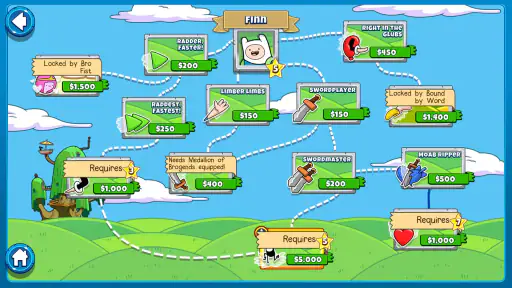
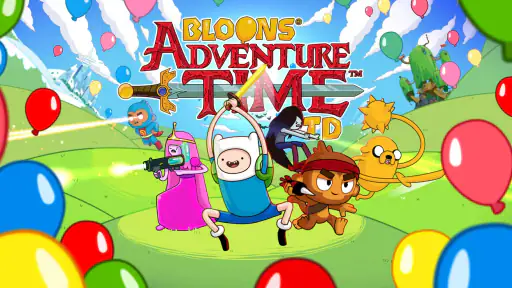
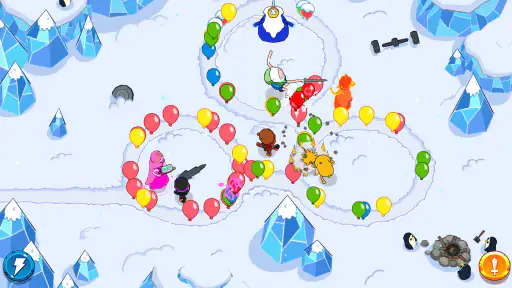
Analysis by Reviewed
Bloons Adventure Time TD is the kind of strategy game I can open for a short break and still find myself planning several rounds ahead. It combines the lane-defense structure associated with Bloons with the colorful setting and characters of Adventure Time, creating a playful crossover that is easy to understand but more thoughtful than its bright presentation first suggests. I found the appeal strongest when the cheerful art and quick humor were working alongside the mechanics rather than distracting from them.
Developed by ninja kiwi, this free strategy game is available for players rated Everyone. It has reached over 10 million installs and holds a 4.5 average from around 99 thousand ratings, which fits my impression that it has a broad audience without feeling designed only for complete beginners. The current version is 1.7.7, and it runs on Android 5.0 or later. Optional purchases range from $0.99 to $99.99 per item, so the free entry point is welcoming, although players who want to collect or accelerate everything should keep the purchase structure in mind.
A cheerful world with a surprisingly focused defensive rhythm
I find the game’s best quality is how its bright crossover style makes a familiar defense loop feel welcoming without making decisions feel automatic. In this section, I’ll look at how the setting helps me read the action, where its lively presentation can compete for attention, and why a little patience with each wave pays off. That balance is also what shapes who I think will enjoy it most.
The first few minutes make the crossover easy to read
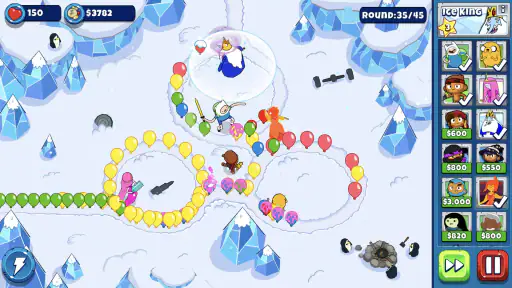
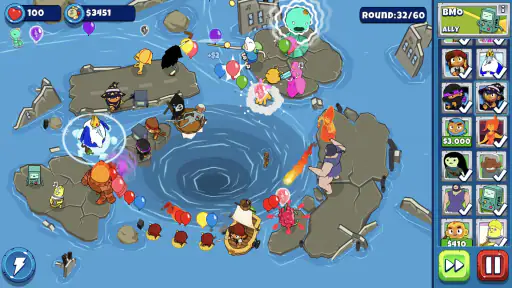
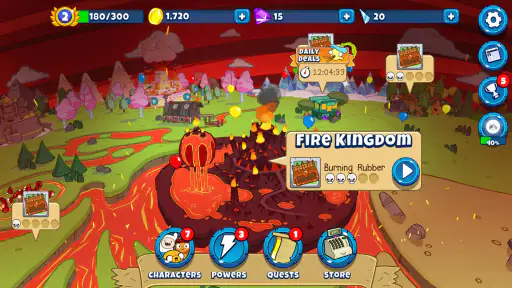
My first impression was that the game communicates its identity quickly. The scenery, character designs, colors, and enemies all belong to the same playful world, so I never felt as if a standard tower-defense game had simply received a cosmetic character swap. The Adventure Time influence gives the battlefield a sense of place, while the familiar Bloons-style objective keeps the interaction immediately understandable: stop the incoming balloon enemies before they get through.
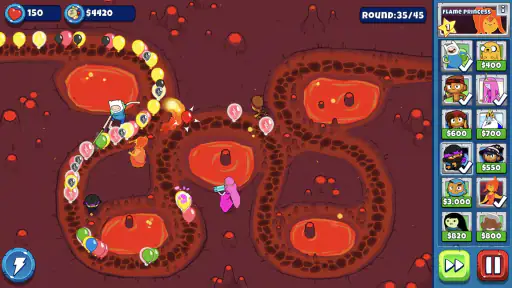
That clarity matters on a phone. I do not need a long explanation before making my first useful decision, but I also do not feel that the game is playing itself. The opening experience is approachable because the visual language tells me what deserves attention. Enemies are easy to distinguish from friendly units, the route is readable, and the bright presentation makes the action feel inviting rather than severe.
What I especially liked is the contrast between the relaxed setting and the pressure of a crowded path. The world looks friendly, but a careless placement can still leave a weak section in the defense. That contrast gives the early rounds personality. It also prevents the game from becoming merely decorative: the setting supports the mood, while the path and enemy flow remain the practical focus.
For someone who has never played a tower-defense game, this is a comfortable starting point. For a player already familiar with the genre, the crossover presentation is the main reason to stay, but the strategic decisions still need to carry the experience. I would not recommend it to someone looking for a serious military simulation or a grim fantasy campaign. Its charm is deliberately light, and that tone shapes nearly every part of the game.
More From Our News Desk

Weather by Xiaomi Review: Clear at a Glance, Less Clear Up Close

X Under Pressure: Can It Recover When Posting Goes Wrong?

Clash of Clans Is Won Between the Battles

Android Auto Makes the Case for Quieter Car Software

MobiOffice: Transforming Mobile Productivity with Seamless Integration

EA SPORTS FC™ Mobile Soccer: Redefining Mobile Sports Gaming
Art direction turns familiar defense into a character-driven experience
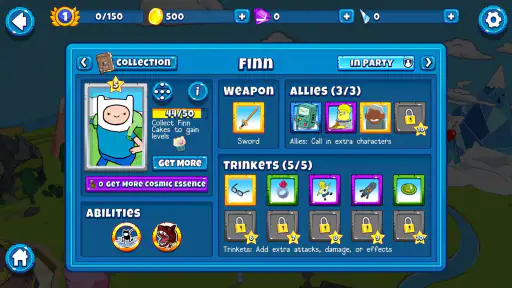
The strongest visual choice is the way the game uses recognizable personalities to make defensive decisions feel less anonymous. A unit is not just a colored icon with a damage role; it feels connected to the world around it. That makes experimenting with a different setup more enjoyable because I am thinking about which characters belong in the plan, not only which abstract statistic is most efficient.
The art also helps with pacing. During calmer moments, the scenery and character animation give the board a playful sense of life. When the route becomes busy, the same strong silhouettes help me read the situation without having to inspect every detail. This is important on a small screen, where excessive visual noise can make a strategy game tiring.
There is a trade-off, though. The lively presentation can make the battlefield feel less dangerous than it really is. I sometimes caught myself watching the action instead of checking whether a particular section of the route was properly covered. The game rewards attention to the path, not passive appreciation of the animation. Players who prefer extremely minimal interfaces may find the personality appealing at first but slightly distracting once the rounds become more demanding.
A useful habit is to treat the background and character humor as a reset between decisions rather than as the main event. I place or improve a defender, watch the next wave long enough to see the result, and then return my attention to the route. That small rhythm keeps the visual charm from turning into lost concentration.
Sound gives the rounds an upbeat pulse
The audio contributes to the game’s coherent mood in a way I noticed most during longer sessions. The setting feels energetic and playful rather than tense or oppressive, and the sound helps maintain that feeling when the screen becomes crowded. Instead of making every wave feel like a crisis, the presentation gives the game a breezy momentum that suits short mobile sessions.
That does not mean the sound is merely background decoration. Audio cues help mark the movement of a round and make successful defensive moments feel more satisfying. The combination of visual reactions and sound feedback gives my decisions a clear result, which is valuable when I am testing whether a placement or upgrade is doing enough work.
I would still recommend using the game’s visual information as the final authority. In a busy wave, several effects can happen close together, and relying only on sound would not be enough for careful play. The best experience comes from letting the audio establish the rhythm while watching the route to judge coverage and timing.
This makes the game a good fit for a casual evening session, especially when I want something more active than a puzzle but less demanding than a long role-playing game. If I am in a place where sound would be inconvenient, the visual design carries much of the mood on its own, although the game loses some of its bounce when played silently.
Why the setting improves the mechanical loop
The world works because it gives the repeated defense cycle a reason to feel fresh. Tower-defense games naturally ask me to perform related actions again and again: inspect the route, choose a position, improve a unit, watch the next wave, and adjust. Here, the Adventure Time setting makes that loop feel like a continuing journey through a particular world instead of a sequence of interchangeable diagrams.
That distinction is important for players who usually lose interest once they understand a game’s basic pattern. The crossover does not remove repetition, but it gives the repetition a stronger emotional wrapper. I am more willing to retry a difficult section when the presentation makes the attempt feel like another episode in the same playful adventure.
At the same time, players should not expect the setting to replace strategy. The game still asks for sensible positioning and resource judgment. A favorite character is not automatically the correct answer for every route, and a visually exciting setup can still leave a practical weakness. The best results come from letting the world encourage experimentation while allowing the battlefield to decide whether the plan works.
Where the strategy feels satisfying
The core pleasure comes from turning a limited defensive arrangement into a system that handles increasingly awkward enemy movement. I enjoy the moment when a placement covers an important bend or protects a section that previously caused trouble. The satisfaction is not only in surviving; it is in understanding why the defense survived and knowing which decision made the difference.
One concrete approach I found useful is to avoid spending everything immediately after a comfortable wave. Holding back enough flexibility gives me room to respond when the route exposes a new problem. This is especially helpful for players who tend to upgrade the first successful unit repeatedly. A strong early defender can feel reassuring, but concentrating too much of the plan in one place may leave another section exposed.
Another practical habit is to watch the first pass of a new wave before making a major change whenever the situation allows it. The game’s bright effects can make a wave look chaotic, yet the actual weakness is often specific: one corner, one gap in coverage, or one unit that is not contributing where I expected. Identifying that exact weakness is usually more efficient than changing the whole arrangement.
I also like treating each map as a lesson in route geometry. A long straight segment invites a different plan from a tight turn, and a position that looks powerful may be less useful if enemies spend little time within its reach. This is the sort of detail that separates the game from a purely casual tap-and-wait experience. The interface is friendly, but the board still rewards observation.
How it compares with other mobile tower defense games
Compared with more abstract tower-defense titles, this game is more characterful and immediately welcoming. The art and setting do a lot of work to make the first session feel personal, and the crossover gives it a stronger identity than a generic collection of towers and lanes. I would choose it over a stripped-down alternative when I want strategy with a playful atmosphere and recognizable personalities.
Compared with more complex strategy games in the same broad category, it feels less intimidating. That is an advantage for a phone game I may play in short bursts, but it can also be a limitation for players who want dense customization, a severe learning curve, or a highly competitive structure. The lighter presentation and approachable entry point are part of the appeal, not signs that it is trying to be the most demanding game in the genre.
The free price makes it easy to test without committing money at the start. However, the in-app purchase range means that completion-minded players should approach the game with a personal spending limit. I am comfortable recommending it as a free download for sampling the gameplay, but I would not advise buying optional items impulsively just because a difficult round creates temporary frustration.
The game is also a better choice for fans of animated crossover worlds than for players who care only about mechanical efficiency. If the setting means nothing to you, the defense loop still has value, but one of its biggest sources of personality will be missing. In that case, a more system-heavy tower-defense game may offer better long-term satisfaction.
A realistic way to fit it into everyday play
I found the game particularly suitable for a short evening break. After finishing another task, I can play a few rounds, make one or two meaningful adjustments, and stop without needing to remember a complicated control scheme. The bright art makes the session feel lighter than a demanding strategy title, while the route still gives me something concrete to think about.
It also works for a parent and child who want to discuss simple planning together, provided the child is comfortable with the pace and understands that the goal is not just to tap the most colorful option. One person can watch the path while the other suggests where a defender should go. That kind of shared play uses the game’s readable presentation without pretending that every decision is automatically correct.
On the other hand, I would skip it when I want a completely passive experience. The game is not at its best if I am barely watching the screen, because small weaknesses can grow into a failed defense. I would also skip it if I dislike repeated wave-based play, cartoon crossover aesthetics, or optional purchase systems. Those are not minor details here; they define the experience.
Small habits that make the game more enjoyable
I recommend starting each new section by identifying the most dangerous part of the route instead of placing units wherever there is open space. This sounds simple, but the colorful board encourages quick reactions. Looking for the point where enemies spend the most useful time, or where a gap would be hardest to repair later, produces better plans than filling every available position.
It is also worth judging a defender by its contribution to the entire route rather than by how impressive it looks during one moment. A unit may appear active because it produces frequent effects, yet another placement may quietly protect more of the path. Watching the full wave helps reveal that difference. This is one of the game’s less obvious lessons: visual excitement and strategic value are not always the same thing.
When a round goes badly, I prefer changing one variable at a time. I might move a unit, alter the upgrade priority, or reserve resources for a later point, then observe the result. Rebuilding everything at once can produce a win without teaching me why the previous plan failed. Small experiments make the game feel more like strategy and less like guessing.
Finally, I would keep the purchase system separate from the question of whether the core game suits me. Play enough free content to decide whether the art, sound, pacing, and defensive loop are enjoyable first. If the basic rhythm already feels repetitive, spending more will not solve that problem. If the rhythm works for you, optional purchases can remain a personal choice rather than a requirement for discovering the game’s appeal.
My atmosphere verdict
What stays with me is the consistency between the setting and the way the game asks me to play. The art is bright without making the board unreadable, the sound keeps the action buoyant, and the pacing supports short sessions while leaving room for careful decisions. The cheerful world does not erase the need to plan; it makes planning feel more inviting.
Bloons Adventure Time TD is at its best when its playful mood and defensive mechanics reinforce each other. I recommend it to fans of Adventure Time, approachable strategy games, and mobile players who want a game that can be enjoyed casually but still rewards attention. The 4.5 average and large player base reflect its accessibility, while the free download gives curious players a straightforward way to see whether the rhythm fits them.
My final recommendation is positive, with clear boundaries. Choose it if you want a colorful, character-led tower-defense experience that feels comfortable on a phone and gives each round a lively sense of motion. Look elsewhere if you want a stark interface, an intensely competitive strategy environment, or a game with no optional spending to consider. For me, the crossover succeeds because it is not only a meeting of two brands: it creates a playable mood in which every defensive decision feels like part of the same cheerful adventure.
Bloons Adventure Time TD Frequently Asked Questions
Does Bloons Adventure Time TD include a story or campaign?
Yes. The game’s premise is to defend Ooo from the Bloon invasion, and its levels give that tower-defense challenge an Adventure Time setting. You progress through battles by placing defenders, responding to incoming waves, and improving your options as you play. It suits players who want strategy stages tied to a recognizable cartoon world rather than a purely abstract tower-defense setup.
Can I adjust the challenge as I get better at the game?
The experience begins with straightforward tower-defense ideas, while later stages call for more careful planning and stronger teams. You can experiment with where defenders are placed and which characters or abilities to use, then adjust your approach when a wave proves difficult. That gradual increase makes the game approachable for newcomers but gives strategy fans reasons to keep refining their choices.
Does Bloons Adventure Time TD have in-app purchases?
Yes. Bloons Adventure Time TD is free to download, and it also offers optional in-app purchases, with items priced from $0.99 to $99.99. You can play without making an initial purchase, but it is sensible to check your device’s purchase controls before letting a child play. That way, you can decide whether purchases should require approval or be restricted.
What is the main objective in Bloons Adventure Time TD?
Your goal is to defend Ooo from the Bloon invasion by stopping waves of Bloons before they reach the end of their paths. You do this by placing heroes and other defenders strategically, then adapting your team as the challenge changes. The tower-defense format makes positioning and choosing the right abilities central to each battle.
Can I play Bloons Adventure Time TD on my device?
Bloons Adventure Time TD is available for Android and iOS, and the Android version requires Android 5.0 or later. Before downloading, check that your device meets the operating-system requirement and has enough available storage for the game and its updates. The game is free to download, but device compatibility can vary, so confirm that it appears as installable in your platform’s app store.
Pros
- Familiar Adventure Time characters add personality to tower defense.
- Dozens of towers and heroes allow varied defensive strategies.
- Short levels work well for quick mobile gaming sessions.
- Special abilities can turn difficult rounds in your favor.
- Colorful visuals and humorous animations suit younger players.
Cons
- Some upgrades and powerful items require significant grinding.
- Later stages can feel repetitive once familiar strategies are mastered.
- The small battlefield may make unit placement feel cramped.
- Performance may dip on older phones during busy rounds.
- Limited story depth may disappoint players seeking a full Adventure Time adventure.
- Category
- Strategy
- Version
- 1.7.7