Word Line: Word Puzzle Game
- 121.00
- 4.6
- Installs
- 10.00K
- Price
- Free
Screenshots
Analysis by Reviewed
I found Word Line: Word Puzzle Game most enjoyable when I wanted a small word challenge that could begin immediately and demand just enough attention to keep me engaged. Its central idea is easy to understand: I swipe across letters to connect them, form words, and work through puzzles. That simplicity is the game’s biggest strength, but it also sets a clear limit. This is a focused word game rather than a huge language-learning system or a deep strategy title.
After spending time with it, my overall view is positive but measured. The controls are approachable, the puzzle format suits short sessions, and the game has the kind of low-pressure structure I can imagine opening while waiting for an appointment or taking a break from work. At the same time, players who need extensive explanations, advanced competitive systems, or a large variety of modes may find the experience too narrow. Word Line works best as a quick mental reset, not as an all-purpose word-game replacement.
How the swipe-based puzzles feel in everyday play
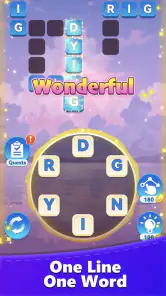
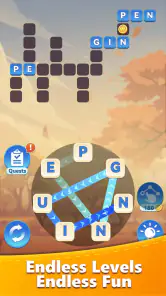
The first thing that stands out is how little time is needed to understand the basic interaction. Instead of typing answers, I trace a path through the available letters. That makes each puzzle feel physical and visual: I am not merely guessing a word, but looking for a route that joins letters in the right order. The gesture is simple enough for casual players, while the board still asks me to slow down and inspect possible combinations.
This design creates a useful rhythm. I usually begin by spotting obvious short words, then look again at the remaining letters with a different perspective. A word that was easy to miss becomes visible once I stop reading the letters as a random collection and start considering their positions. That shift is where the game earns its place among casual word puzzle games. It encourages observation without requiring a complicated rulebook.
The format is particularly comfortable on a phone. A swipe is faster than entering letters one at a time, and it keeps the action centered on the puzzle rather than on menus or text fields. I also like that the basic premise can be explained in one sentence to someone who has never played this kind of game. If you are introducing it to a family member who prefers straightforward mobile games, the learning curve should feel gentle.
There is a difference, though, between being easy to learn and being endlessly interesting. Swipe-to-connect puzzles can become familiar quickly if the available challenges do not keep changing in meaningful ways. For me, the enjoyment depends on whether I am still discovering new word paths rather than repeating the same visual routine. That makes the game a good companion for short bursts, but I would not approach it expecting the variety of a large puzzle collection with several distinct rule sets.
Why the simple format has more depth than it first appears
The most useful habit I developed was to avoid committing to the first word I noticed. I would scan the board for longer routes, then check whether a promising path blocked another likely answer. This turns the puzzle into a small planning exercise. The game remains accessible, but I am making choices about order and space rather than simply tapping every familiar word.
That approach also makes the experience more satisfying for players who enjoy language patterns. A person who likes anagrams, crossword clues, or letter searches may appreciate the moment when several possible words compete for attention. The challenge is not only vocabulary. It is also visual tracking, patience, and the ability to reconsider a board after an initial assumption proves unhelpful.
One practical tip is to read the board in more than one direction before swiping. I found that a quick horizontal scan often made me overlook diagonal or curved possibilities. Another is to pause after finding an obvious answer instead of immediately clearing it from my mind. The remaining letters may reveal a related pattern, and thinking about the whole board is usually more productive than treating each answer as an isolated task.
This is where the game can be useful during a short break. I can play one puzzle with full attention, then stop without feeling that I have abandoned a long campaign. That makes it different from word games built around extended rounds, timed competition, or a persistent social ladder. The compact interaction is a strength for people who want a contained activity, although it may feel lightweight to anyone looking for a more demanding long-term progression system.
The strongest reasons to try it
Accessibility is the clearest advantage. The game is free, carries an Everyone age rating, and is presented as a word title from SATORISYS PLAY. Its current version is 0.0.3, so I see it as an early, compact experience rather than a mature platform with years of accumulated systems. That context matters: I would recommend trying it because the entry cost is low, while keeping expectations realistic about its scale.
The public response is encouraging without being a reason to ignore personal taste. It holds a 4.6 average from around two thousand ratings, and the listing shows over a hundred written reviews. I read that as a sign that the basic concept is connecting with a meaningful group of players, not as proof that every player will find enough variety. Word puzzles are personal; some people enjoy gentle repetition, while others need constant novelty.
Another strength is the absence of a complicated setup in the core idea. I do not need to learn a fictional world, memorize character abilities, or understand a resource economy before I can judge whether the game suits me. The value is concentrated in the act of finding words. For a casual player, that clarity is refreshing. For a parent choosing an age-appropriate game, the Everyone rating also makes the title easier to consider alongside other simple mobile activities.
I also think the gesture gives the puzzles a more natural feel than a plain text entry system. Typing an answer can make a word game feel like a test form. Drawing through letters feels closer to solving a visual maze. That distinction is small, but it affects how relaxed the session feels. When I am tired, I prefer a game that lets me inspect and experiment rather than forcing me to remember an exact spelling before I can make progress.
There is a useful middle ground here for language enthusiasts. Someone who already enjoys English word patterns can use the game as a light daily exercise, while a less confident player can focus on recognizing familiar words. I would not treat it as a substitute for structured vocabulary study, because solving a puzzle is not the same as learning definitions, pronunciation, or usage. Still, it can encourage attention to spelling and letter order in a way that feels more playful than a study app.
Where the experience may lose momentum
The main weakness is not a broken control or an unclear premise. It is the risk of repetition. The game’s identity is tightly tied to one central action, and that action has limited room to surprise unless the puzzle design keeps introducing fresh forms of difficulty. I enjoyed the directness, but I could also imagine reaching a point where the swipe itself no longer feels new.
That limitation affects different players in different ways. If you like relaxing word searches, repetition can be part of the appeal. The familiar format lets you settle into a calm routine. If you prefer games that constantly add mechanics, unlockable systems, or competitive pressure, this may feel underpowered. I would choose a broader word-game collection for longer sessions or for evenings when I want several types of challenge rather than one focused interaction.
The early version also shapes my expectations. At 0.0.3, I would give the game room to develop, but I would not judge it as though it were a fully expanded flagship title. Early software can feel lean, and a lean design is not automatically a flaw. The important question is whether the basic loop is enjoyable enough on its own. In my experience, it is, provided I approach it as a concise puzzle game instead of expecting a large progression journey.
Another point to consider is the difference between solving and learning. The game may sharpen my awareness of letter combinations, but it does not turn every unfamiliar word into a lesson simply because I encounter it. Players whose main goal is vocabulary growth should pair it with a dictionary or a dedicated language-learning tool. A crossword-style app may be better for clue interpretation, while an anagram game may be better for generating many word combinations. Word Line has a narrower purpose: tracing letters into answers.
I would also be cautious about recommending it to someone who dislikes visual searching. The central challenge asks me to inspect the arrangement and find a usable path. If I prefer direct clues, typed guesses, or number-based logic, the swipe mechanic may not provide enough satisfaction. The game is not trying to be a crossword, a spelling course, or a traditional board game, and choosing it works best when that distinction is understood from the beginning.
Who will get the most from it
I would recommend this game first to casual players who want a word activity that fits into spare minutes. Imagine waiting for a coffee order with a few minutes to fill. A large strategy game may take too long to settle into, while a competitive multiplayer match may be inconvenient to leave. A swipe puzzle is easier to start, pause, and resume mentally. That makes the game a practical choice for fragmented parts of the day.
It also suits people who enjoy quiet concentration. There is a satisfying difference between mindlessly scrolling and spending a short period looking for a word path. The game can give a break some structure without turning it into a demanding commitment. I especially see it working for players who like word searches but want a more active gesture than simply highlighting a list.
Families may find the Everyone rating reassuring, but I would still treat the game as a shared puzzle rather than assume it will teach children language skills by itself. An adult can help a younger player discuss unfamiliar words, look at spelling, and think about alternative paths. That turns a quick game into a small conversation about language. Without that extra interaction, the experience remains entertainment first.
Players with older or less capable devices may also be interested because the minimum operating-system requirement is Android 7.1. That gives the game a relatively broad device range on Android, although the actual comfort of play will still depend on the phone’s screen and responsiveness. The important practical point is that someone does not need a recent flagship device simply to consider trying this word title.
I would skip it if my priority were deep progression, extensive competitive features, or a large collection of unrelated modes. I would also look elsewhere if I wanted explicit definitions, pronunciation practice, or carefully structured lessons. A dedicated vocabulary app would serve those goals better. Likewise, a crossword app may be the stronger choice for anyone who enjoys clues and general knowledge more than visual letter paths.
How it compares with familiar alternatives
Compared with a standard crossword, this game gives me less help from clues and more help from the visible letter arrangement. That makes it easier to enter, but potentially less rich in subject matter. A crossword asks me to interpret a prompt and retrieve an answer; Word Line asks me to discover a route through letters. I prefer the latter when I want immediate play and the former when I want a more layered test of knowledge.
Compared with a traditional word search, the swipe mechanic adds a sense of movement and decision-making. I am not only locating a word in a fixed grid; I am actively drawing through it. However, the experience may feel less open-ended than a large word-search book if the puzzles follow a consistent structure. The choice comes down to whether I value guided interaction or a broad page full of hidden possibilities.
Compared with an anagram game, the emphasis here is spatial. In an anagram title, I may rearrange or type letters until a word appears. Here, the arrangement on the board matters just as much as the letters themselves. That gives the game a distinct identity, but it also means a player who enjoys pure word generation may find the board layout more restrictive than rewarding.
Finally, compared with a vocabulary-learning app, this is much more relaxed and less instructional. I can play without feeling as though I am completing a lesson, which is precisely why it works well during a break. The trade-off is that progress in the game should not be confused with measurable language development. I see it as a pleasant supplement for word lovers, not a replacement for deliberate study.
My practical recommendation before downloading
Because the game is free, trying it is a straightforward decision for anyone curious about swipe-based word puzzles. I would begin with short sessions rather than immediately expecting a long evening of content. That approach makes it easier to judge the central loop on its own terms: do I enjoy scanning letters, planning a route, and finding a word without a clue doing all the work?
If the answer is yes, the game can become a handy low-commitment habit. I would play when I want something more engaging than passive phone use but less demanding than a full game session. I would also keep a note of unfamiliar words that catch my attention and look them up afterward if vocabulary matters to me. That small habit adds educational value without pretending the game is a formal course.
If the answer is no, more content will probably not solve the basic mismatch. Someone who dislikes searching for paths is unlikely to be won over by the same mechanic repeated across many puzzles. In that case, I would choose a clue-based crossword, a timed spelling game, or a vocabulary app depending on the kind of mental challenge I actually want.
The developer, SATORISYS PLAY, has built the title around a clear and understandable idea. Its early presentation makes the game feel approachable rather than overloaded, and that is exactly why it can work for casual players. The same simplicity means the long-term appeal depends heavily on how much variety a player personally needs from a word game.
My final verdict is that Word Line: Word Puzzle Game is worth trying if I want free, accessible letter puzzles that fit naturally into short breaks. Its best qualities are the immediate swipe control, the visual satisfaction of tracing words, and the gentle concentration it encourages. Its meaningful drawback is a limited central loop that may not satisfy players seeking deep systems or constant novelty.
I would recommend it to casual word-game fans, families looking for an Everyone-rated puzzle activity, and anyone who enjoys discovering words through letter placement rather than clues. I would point serious vocabulary learners and dedicated crossword players toward more specialized alternatives. For the right audience, this is a clean little game with a clear purpose: open it, inspect the letters, trace a promising path, and enjoy a few minutes of focused play.
Pros
- Simple rules make it easy to start playing immediately.
- Short levels are convenient for quick gaming sessions.
- Word challenges can help improve spelling and vocabulary.
- Clean interface keeps the focus on solving each puzzle.
- Progressive difficulty offers a steady sense of achievement.
Cons
- Some puzzles may feel repetitive after extended play.
- Later levels can depend on guessing uncommon words.
- Hints may be limited or tied to in-app purchases.
- Ads can interrupt the experience between completed levels.
- The game may offer little variety beyond its core word mechanic.
- Category
- Word
- Version
- 0.0.3