Spades Ace
- 43.00
- 4.7
- Installs
- 10.00K
- Price
- Free

Screenshots


Analysis by Reviewed
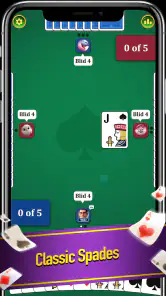
Spades Ace is the kind of card game I open when I want a focused match rather than a complicated collection of modes. It presents itself as a four-player team trick-taking experience, so the appeal is familiar: choose a bid, read the table, support a partner, and try to finish the hand with better coordination than the opposing pair. I like that basic format because it rewards decisions instead of reflexes, and it gives even a short session something to think about.
My first impression is that this is aimed at people who already understand the rhythm of Spades or are willing to learn it through practice. It is a free game from SATORISYS PLAY, listed in the card category, with a Teen content rating. The current release is version 0.0.7, and it requires Android 9 or later. That combination makes it easy to approach for many Android players, although the relatively early version number is worth keeping in mind when deciding how much polish and depth to expect.
How the table feels in everyday play
The best way to understand the game is to imagine a normal evening break. I might have ten or fifteen minutes before doing something else, and a team-based hand gives me a clear beginning, middle, and end. I am not managing a large deck-building collection or waiting for a long campaign to load. I am looking at the cards in my hand, estimating what I can win, and trying to avoid promising more than my cards can deliver.
That makes the game especially suitable for players who enjoy quiet concentration. A strong hand is helpful, but it does not remove the need to plan. A player still has to notice which suits have already been played, decide when to spend a high card, and judge whether a partner’s play suggests strength or caution. Those small choices are where the game earns its place on my phone.
The four-player team structure also changes the mood compared with a solitaire card app. I am not only trying to maximize my own tricks. I have to think about the partnership as a whole. Sometimes the correct move is deliberately modest because taking an extra trick could damage the overall bid. Other times, I need to use a valuable card early to protect the team from a dangerous suit. That tension is more interesting than simply collecting the most tricks possible.
For someone new to Spades, the central idea is straightforward but the judgement takes time. Players make bids based on the tricks they expect to win, then play through the hand while spades act as the powerful suit. The important lesson is not to treat every strong-looking card as an invitation to attack. A hand can contain impressive cards and still be awkward if the suits do not cooperate or if the bid is too ambitious.
Why the team format matters more than the card graphics
In my experience, the lasting appeal here comes from reading the table, not from visual decoration. A card game can look attractive and still become forgettable if every round feels automatic. Spades has a useful advantage: each play gives information. When a player cannot follow a suit, that changes what I expect from later tricks. When a partner wins with a certain card, I can reconsider how much control our side has left.
This creates a practical habit that improves results more than simply playing faster. I try to remember the suits that have been exhausted and the high cards that are no longer threats. Even without writing anything down, tracking those details helps me decide whether to lead a suit, hold back a spade, or let an opponent take a trick. It is a small mental exercise, and it gives the game more depth than its simple rules suggest.
A useful tip for new players is to separate the bid from the wish. Before the first card is played, I ask what my hand can realistically support, not what I hope will happen. That distinction prevents many avoidable failures. Another good habit is to watch the partner’s choices instead of assuming that a winning card is always welcome. In a team game, communication is indirect, so the order and timing of plays matter.
Progress without turning every hand into pressure
The game works best for me when I treat each hand as a decision puzzle rather than a test that must be passed. A poor round can happen because of the deal, but repeated mistakes usually reveal a pattern: overbidding, spending spades too early, or failing to count what remains. That makes losses useful. I can identify one decision to improve in the next hand instead of simply blaming bad luck.
At the same time, players who expect a large progression system may find the experience more limited than a broader card-game collection. The confirmed release is still early, and I would approach it as a focused Spades title rather than a huge platform filled with unlocks and long-term activities. That is not automatically a weakness. Some people want a clean match and nothing more. Others need constant rewards, varied modes, or a strong sense of advancement to stay interested.
There is also a difference between healthy pressure and exhausting pressure. A close team score makes every decision meaningful, but a game becomes less enjoyable if I start treating every hand as a personal judgement. I recommend setting a small goal for a session, such as improving bid accuracy or learning when to preserve a trump card. That keeps the experience relaxed while still giving practice a purpose.
For a casual player, the free price removes the most obvious barrier to trying it. I can test whether the rules and pace suit me without committing money at the start. That is useful for people who have played physical Spades with friends and want a phone-based alternative. It is less compelling for someone who wants a broad card library, collectible rewards, or a game built around spending and customization.
Fairness is mainly about decision quality
Because this is a team trick-taking game, fairness matters in a very particular way. The core question is whether the outcome feels connected to bidding, card management, and table reading rather than to spending advantages. I do not see a confirmed purchase price or a verified paid advantage to describe, so I would not claim that money changes the balance. The responsible conclusion is narrower: the game is free to start, while the available purchase details are not established here.
That distinction is important. “Free” tells me I can install and try the game without an upfront charge, but it does not by itself explain every possible spending decision inside an app. I would therefore judge the experience by what appears during actual use: whether a match can be played normally without pressure, whether any optional offer is clearly separated from the table, and whether a player who spends nothing can make the same strategic decisions as everyone else.
In a game like this, even small design choices can affect perceived fairness. A clear hand layout helps me evaluate my cards honestly. A readable trick history helps me track what has happened instead of losing information because of presentation. Consistent timing matters too, since a player should not feel rushed into a poor bid simply because the interface is unclear. These are practical fairness issues, not just cosmetic preferences.
The team format adds another layer. A player can make a sensible move and still lose because the partner’s interpretation differs from theirs. That is frustrating, but it is not necessarily unfair; partnership card games naturally contain uncertainty. I find the experience fairest when I accept that I control my own choices but not every result. The right comparison is not whether every hand is winnable, but whether the rules give me meaningful ways to respond.
Where it fits among other card-game choices
Compared with a solitaire app, this game offers more social and tactical tension because the hand is shaped by four seats and two partnerships. Solitaire is better when I want complete control, a slower pace, or a puzzle that does not depend on another player’s decisions. Spades Ace is better when I want the uncertainty of a shared table and the satisfaction of correctly reading a sequence of plays.
Compared with a collectible card game, it is also a very different proposition. Collectible games often ask me to build a deck, learn special effects, and manage a long-term roster. Here, the challenge comes from the hand I receive and how intelligently I use it. That makes the entry point simpler and the strategy easier to explain, but it may feel less rewarding to players who enjoy building an identity through cards and upgrades.
Against a traditional physical deck, the phone version is convenient but cannot fully replace the social atmosphere of sitting around a table. A physical game lets friends discuss house rules and react to one another directly. A mobile version is more practical when nobody has a deck nearby or when I want a quick solo phone session. The trade-off is that the quality of the digital experience depends heavily on the interface and the way the match handles the other seats.
Players should also decide whether they want a dedicated Spades experience or a general card hub. If I only want to play Spades and appreciate a focused menu, this title makes sense. If I regularly switch between several trick-taking games, poker variants, and board games, a larger collection may offer better value even if each individual mode is less focused.
Small habits that make the game more enjoyable
My most useful practical advice is to slow down at the bidding stage. I look at the number of likely winners, but I also inspect how safely those winners can be reached. A high card in a long suit is not the same as a high card in a short suit. A hand with several possible winners may become dangerous if opponents can force me to spend them in the wrong order.
I also try not to reveal all of my strength immediately. Holding a trump card can protect a later trick, especially when the table begins to run out of a suit. Spending it simply because it wins the current trick may leave the team exposed later. This is one of the clearest ways the game rewards patience over speed.
Another non-obvious lesson is to judge a successful trick by its cost. Winning is not always progress if I used a card that was needed for a more important situation. After a hand, I like to ask whether I won the right tricks, not just whether I won enough. That review turns a short match into useful practice and helps separate a lucky result from a genuinely good decision.
For a quick everyday session, I would play a small number of hands with one specific focus. I might concentrate on avoiding overbids, then on remembering which suits have disappeared. This approach is more effective than playing repeatedly without reflection, especially when the game is being used as a short break rather than a long evening activity.
What I would check before settling in
The early version number makes me cautious about treating the app as a finished, feature-rich destination. Version 0.0.7 suggests that the experience may still be developing, so I would install it with realistic expectations. I would first examine how clearly the cards are presented, how easy it is to understand the score, and whether the match flow feels comfortable on my particular phone.
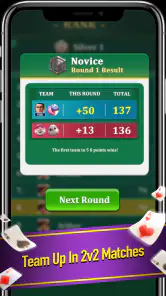
I would also pay attention to the practical questions that affect trust. Does the game explain its rules in a way a new player can follow? Are bids and tricks easy to review? Can I tell why a hand was scored as it was? These details matter more to me than decorative effects because confusion at the table can look like unfairness even when the underlying rules are sound.
The Teen rating is another reason I would consider the audience before recommending it to a younger child. For adult card players and older teens, the rating is a straightforward part of the app’s positioning. Parents choosing a game for a child should use their own judgement rather than assuming that a simple card format automatically makes every mobile presentation suitable.
The game has an average rating of 4.7 from around eight hundred ratings, with over forty written reviews, and it has passed ten thousand installs. Those figures suggest that it has attracted a real early audience and that many players respond positively to it. I still would not treat popularity as proof that it will suit everyone. A person who dislikes trick-taking rules, partner uncertainty, or repeated strategic hands may not enjoy it regardless of the reception.
Who should play it, and who should skip it
I would recommend this to someone who likes classic card logic, wants a free way to try a team-based Spades game, and enjoys improving through repeated hands. It is particularly suitable for a player who likes making decisions with incomplete information. The game can also work well for someone who wants a calm alternative to action-heavy mobile titles, provided that the digital table feels comfortable on their device.
I would be more hesitant to recommend it to a player who needs a substantial campaign, frequent content changes, or a large selection of unrelated modes. The focused concept is a strength when I want Spades, but it becomes a limitation when I expect a complete card-game suite. I would also suggest caution for anyone who finds partner mistakes especially irritating, since team play naturally includes outcomes I cannot fully control.
It is not the first choice for a child simply looking for a colorful, instantly understandable game. The Teen rating should be respected, and the strategic rules require more patience than a quick matching game. Likewise, competitive players who need extensive documented systems and a mature tournament environment may prefer a more established alternative with a longer track record.
My trust verdict after weighing the trade-offs
I see Spades Ace as a focused, approachable card game with a strong reason to exist: it turns a familiar four-player partnership format into a convenient mobile activity without requiring an upfront payment. Its best moments come from careful bidding, remembering played suits, and understanding that the right trick is not always the easiest one to win.
My recommendation comes with sensible limits. I would try it for the core game, not for promises of a large progression system or a broad catalogue. I would also judge the spending experience in practice, since the fact that the game is free to start does not answer every question about optional purchases. What I can say confidently is that the free entry makes experimentation easy, while the early version means I would keep expectations measured.
For me, the deciding factor is whether I want a dedicated Spades table on my phone. If the answer is yes, this is a reasonable title to try, especially when I value strategy over spectacle. If I want richer customization, several card formats, or a highly developed competitive ecosystem, another option will probably be a better fit. The fairest way to approach this game is to value its decisions, inspect its presentation, and spend nothing unless the experience clearly earns that trust.
Overall, I would recommend giving it a chance as a free, team-oriented card game rather than presenting it as something it is not. SATORISYS PLAY has a clear foundation here, and the combination of simple rules with deeper table reading gives the game genuine replay appeal. Whether it becomes a regular part of my phone depends less on the basic Spades formula and more on how comfortably the current release supports that formula from hand to hand.
Pros
- Smooth
- responsive controls make card selection quick and comfortable.
- Clear rules and helpful hints make it accessible to new players.
- Multiple difficulty levels provide a suitable challenge for different skills.
- Offline play lets you enjoy matches without Wi-Fi or mobile data.
- Short rounds are convenient for quick games during spare moments.
Cons
- The free version may include frequent advertisements between rounds.
- Limited visual customization can make the experience feel repetitive.
- Higher difficulty can sometimes depend heavily on the cards dealt.
- Online features may be limited compared with dedicated multiplayer apps.
- Some advanced scoring options may not be available in every mode.

- Category
- Card
- Version
- 0.0.7