Gin Rummy King
- 497.00
- 4.8
- Installs
- 100.00K
- Price
- Free
Screenshots
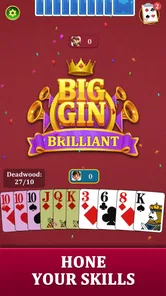
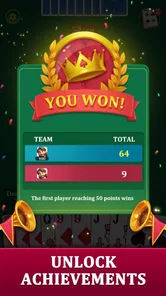
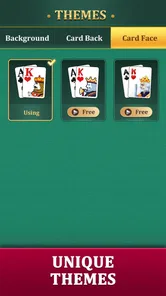

Analysis by Reviewed
The appeal of a gin rummy game is easy to understand: sort a hand, make a few careful choices, and see whether your plan holds up when the round ends. Gin Rummy King is a free card game from SATORISYS PLAY, built around that familiar pursuit. I’d consider it when I want a focused card session rather than a sprawling game, though its appeal depends on enjoying gin rummy itself; it is not a substitute for a broader collection of card games.
Who will enjoy this focused card game
I’d put this game on the shortlist for someone who knows gin rummy, wants a convenient way to play on a phone, and is happy to concentrate on one familiar ruleset. It can also suit a newcomer who likes learning through repeated hands rather than reading a long explanation before starting. Each round naturally gives you a small question to work on: which cards are worth keeping, and when is it better to let a plan go?
That focus is a real advantage if you often open games for only a few minutes. You do not need to commit to a campaign or remember where you left off in a story. On the other hand, it is a poor fit if you want a phone game to provide a changing menu of challenges. This is a gin rummy experience, not a collection of unrelated card games, so the core decisions remain familiar from hand to hand.
It is also worth separating interest in cards from interest in this particular kind of card play. Someone who mainly enjoys solitaire may prefer the private puzzle of arranging a layout, while a fan of trick-taking games may want the shifting partnerships and play of a table game. Gin rummy sits between those moods: you shape your own hand while keeping an eye on what discards might mean. If that balance sounds appealing, the narrow scope is easier to appreciate.
From the first hand to the next round
I find the first hand is easiest to enjoy when I treat it as a small sorting problem, not a race to make the perfect move. I’ll look for the cards that already belong together, then consider what I’m willing to release; that simple routine makes the choices feel clearer without pretending luck disappears. Once the basic action settles in, the next useful question is how each draw and discard changes the rhythm of a round.
What you do with the cards
Gin rummy gives each decision a useful tension: a card can help complete a set or run, but keeping it may also leave awkward cards in your hand. On a turn, I’d look at what is already close to fitting together, then weigh whether a new card improves that arrangement enough to be worth the trade. The satisfaction comes less from a flashy move than from gradually making a hand easier to finish.
That makes the game approachable if you already know the basics, but it also means the first few hands can feel less obvious than they do in a simple matching game. New players should treat early rounds as practice in recognizing patterns, not as a test of speed. A helpful habit is to identify the pairs or sequences you are actively building and avoid holding on to a card only because it might become useful someday.
More From Our News Desk

Weather by Xiaomi Review: Clear at a Glance, Less Clear Up Close

X Under Pressure: Can It Recover When Posting Goes Wrong?

Clash of Clans Is Won Between the Battles

Android Auto Makes the Case for Quieter Car Software

MobiOffice: Transforming Mobile Productivity with Seamless Integration

EA SPORTS FC™ Mobile Soccer: Redefining Mobile Sports Gaming
The title is a sensible fit for short breaks: one hand gives you a clear task, and you can decide after the result whether you have time for another. It also suits a quiet routine, such as playing while waiting for an appointment, when a puzzle with a little uncertainty feels more engaging than passively scrolling. If you want a story, action, or a changing set of objectives, this narrow card-game focus will likely feel too restrained.
Reading the rhythm of a round
The feedback in gin rummy is naturally tied to your decisions. A useful draw makes a plan more plausible; a poor one asks you to reconsider what you are holding. When a hand ends, the result gives you a reason to review whether your choices reduced deadwood or left too much value stranded. That back-and-forth—act, assess, adjust—is the core of the experience, rather than a steady stream of unrelated rewards.
One practical way to make each hand more instructive is to pause before discarding and ask two questions: what does this card contribute to my own hand, and what might it reveal about the direction of the round? You cannot know another player’s plan from a single move, but noticing repeated choices can help you avoid casually passing along a card that seems useful. This makes attention more valuable than frantic play.
There is a trade-off here. Gin rummy rewards patience and pattern recognition, but card draws introduce luck that no amount of careful planning can remove. A strong decision can still be followed by an unhelpful draw, and a round that goes badly is not automatically proof that you played poorly. I find that distinction important: the game is more satisfying when I judge a choice by what I knew at the time, rather than only by the final hand.
What counts as a reward
The main reward is the clean feeling of turning an untidy hand into something coherent and then seeing the round resolve. That may sound modest, but it is exactly why this format works for people who enjoy small strategic wins. A completed sequence or set gives a hand structure, while a close result can prompt a quick mental replay: which card was the turning point, and would a different discard have kept more options open?
Its audience reception is encouraging: the game has a 4.8 average from around 9,200 ratings, with roughly 497 written reviews. It has also passed 100,000 installs. Those figures suggest that the straightforward card-game premise has found an audience, but they do not guarantee that every player will enjoy the pace. Someone who prefers quick reactions or frequent visual changes may find a traditional gin rummy loop repetitive, even if the game is well liked by others.
For an everyday use case, I’d play a hand or two during a short wait, then stop if I needed to return to something else. The useful boundary is that each round has a natural point to put the phone down. If I were trying to fill a longer evening, I’d want to be sure I was in the mood for repeated decisions of the same kind; the game’s strength is focused repetition, not variety across different modes.
Why a new session begins
A completed hand resets the problem. The next one gives you a fresh arrangement to interpret, so the reason to continue is not necessarily a new feature or a dramatic change in scenery; it is the chance to make a better plan with different cards. That reset can be appealing when I want a low-friction game I can enter and leave without needing to remember a long campaign.
It can also become the main limitation. Because the appeal rests on repeating the same kind of hand, players who tire quickly of familiar rules may run out of reasons to continue. I would choose this over a casual matching game when I want decisions that build on one another, but choose a broader card collection if I wanted to switch between solitaire, trick-taking, and other styles without changing apps. For a social table experience, playing with people in person may be better than any single-player digital routine.
It is worth setting expectations before installing: this is specifically a gin rummy game, not a general-purpose card hub. If you enjoy learning how to manage a hand and can accept the luck involved in drawing cards, the repeated reset is part of the charm. If you dislike losing a round despite making sensible choices, or want a constant sense of progression, a different genre is likely a better match.
Playing with a little more intention
A useful way to keep the loop from feeling automatic is to give each session one narrow purpose. On one occasion, I might focus on letting go of a weak combination sooner; on another, I might pay closer attention to what the other player appears not to take. This is not about turning every hand into homework. It simply gives repeated rounds a small learning thread, so a loss can still leave me with a decision to reconsider instead of only a disappointing result.
There is a second trade-off in that approach: trying to improve can make a casual break feel more demanding. If I am tired or distracted, I would play without keeping score in my head and accept that I may miss a better discard. If I want a more thoughtful session, I would slow down before choices that affect several cards at once. Matching the level of attention to my mood makes the game easier to return to without expecting every round to be productive.
For a realistic daily routine, imagine having a few minutes before a bus arrives. I could start a hand, make decisions at a relaxed pace, and use the result as a natural stopping point if the bus comes soon. If the wait runs longer, another hand offers a fresh problem rather than requiring me to resume a complicated sequence. That flexibility is the kind of practical value I’d look for here; it is less suited to a commute where I must keep stopping mid-turn or pay attention to frequent interruptions.
Fit, access, and practical expectations
The game is listed as Teen-rated and free, and its current version is 1.2.1. It was released on December 19, 2025, and supports devices running Android 7.1 or later. That makes the basic decision fairly simple for Android users: check that your device meets the minimum system requirement, then decide whether gin rummy is the kind of repeatable puzzle you want. The free price removes an upfront purchase decision, but it does not by itself tell you what every in-game detail will be like.
SATORISYS PLAY is the developer behind it. I would approach the game as a focused way to play gin rummy rather than assume it includes extras that are not part of the core promise. In particular, anyone choosing an app for a specific feature—such as a certain multiplayer setup, a particular difficulty range, or a specific tournament format—should make sure that exact feature is available before making it the reason to install. For someone who simply wants a gin rummy hand on a phone, the central idea is much clearer.
A second useful habit is to use the end of each round as a stopping checkpoint. If I have only a few minutes, I can finish the current hand rather than risk becoming absorbed in an open-ended activity. If I’m playing to improve, I can instead pick one decision to review—perhaps whether I held a card too long—and carry that lesson into the next hand. Those two approaches keep the game useful both as a casual diversion and as a small practice exercise.
Choosing it over other card games
Compared with a solitaire app, this game asks me to think about the possible value of discarding a card, not just how to arrange the cards already in view. Compared with a broad card-game bundle, it removes the choice of what to play and keeps attention on one ruleset. That can be welcome when I want to get into a hand quickly, but it also means the app is not the efficient choice for someone who likes changing games according to the time available or who wants several familiar formats in one place.
It is also different from sitting around a physical table. A face-to-face game brings conversation, shared timing, and the pleasure of reading people as well as cards. A phone version is more convenient when nobody else is available or I only have a short gap, but it should not be mistaken for the social occasion itself. I’d choose the digital option for a solo pause and arrange an in-person game when interaction is the point.
Before installing, I’d ask myself whether I want gin rummy specifically, whether I’m comfortable with luck affecting a hand, and whether I expect to play in short bursts or settle in for repeated rounds. Those questions are more useful than looking for a long list of extras. The game makes the most sense when the basic card decisions are the reason to open it; if the answer is that I need variety, competition with friends, or a strong progression system, another kind of game would serve that need better.
My verdict on the loop
I’d recommend Gin Rummy King to someone who already likes gin rummy or wants a straightforward way to spend short stretches thinking through a hand. Its strongest quality is the compact cycle: arrange, choose, respond to the draw, see the outcome, and begin again with a fresh puzzle. The restraint is also real: if you need varied modes, a strong narrative, or guaranteed control over outcomes, this is not the right kind of game.
As a card game, it asks for attention without demanding that every session become a major commitment. I like that its next round has a clear reason to exist: a new hand gives you another chance to make better choices, while the previous one is already complete. That can be satisfying in small doses, but repetition is not for everyone. If you want gin rummy rather than a broad card-game collection, and you are comfortable balancing strategy with luck, this is a reasonable one to try.
Gin Rummy King Frequently Asked Questions
What is Gin Rummy King, and how do you play it?
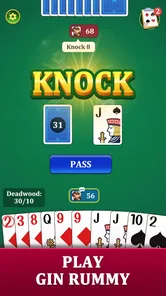
Gin Rummy King is a digital take on the classic two-player card game. Players draw and discard cards to form sets of matching ranks or runs of consecutive cards in the same suit, aiming to reduce the value of unmatched cards, known as deadwood. The exact rules, scoring, and available game modes can vary by version, so check the in-game instructions before starting a match.
Can I play Gin Rummy King offline or without an account?
Offline play and account requirements depend on the version of Gin Rummy King you download. Some releases may offer matches against computer-controlled opponents, while online features generally require an internet connection and may ask you to sign in or create a profile. Review the app’s store listing and its settings after installation to confirm which options are available and whether guest play is supported.
Does Gin Rummy King include online multiplayer?
Gin Rummy King may provide online matches against other players, but multiplayer features can differ between editions and may depend on your connection, region, or current app support. Before downloading, look at the store description for details about matchmaking, friends, and private games. If online play is available, a stable connection is helpful; disconnects or waiting for an opponent can affect the experience.
Is Gin Rummy King free to download, and does it include ads or in-app purchases?
The price and monetization model depend on the particular Gin Rummy King listing and platform. A game may be free to install but use advertisements, optional purchases, or both, while another edition may have different terms. Check the current Google Play or App Store page for pricing and purchase information, and review any payment prompts in the game before confirming a transaction.
What should I check before downloading Gin Rummy King?
Confirm that the listing is the Gin Rummy King edition you intend to install, since similarly named games may come from different publishers and have different features. Check device compatibility, the latest update date, user reviews, and the developer’s privacy information. Also review requested permissions and whether the game’s online or offline modes meet your needs before downloading.
Pros
- Clear card layouts make melds easy to spot during play.
- Quick rounds suit short breaks.
- A familiar ruleset is approachable for casual card-game fans.
- Turn-based play gives you time to consider each move.
- Useful for practicing discards and hand organization.
Cons
- The game’s strategy can feel repetitive over longer sessions.
- Random card draws may make some rounds feel luck-driven.
- Small cards can be harder to distinguish on compact screens.
- New players may need time to learn when to knock or lay off.
- Online play depends on a stable internet connection.