Rithmm: AI Sports Betting
- 133.00
- 4.3
- Installs
- 100.00K
- Price
- Free

Screenshots

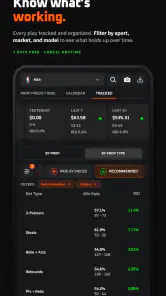
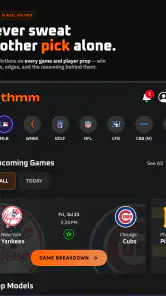

Analysis by Reviewed
I approached Rithmm: AI Sports Betting as a sports companion for people who enjoy studying player props and predictions before making a decision. The app is free to install, but its subject matter is firmly aimed at adults, with a Mature 17+ rating and optional purchases that can range from less than a dollar to a much higher amount. That combination tells you something important right away: this is not a casual scores app. It belongs to a more serious, risk-aware part of the sports category.
My first impression was that the app makes the most sense when I treat it as a research aid rather than a shortcut to guaranteed results. The focus on player props and predictions gives it a narrower purpose than a normal sports-news app, and that can be useful if I already know which games or athletes I want to examine. At the same time, I would not recommend opening it with the expectation that an automated prediction removes the need for judgment. Sports remain unpredictable, and the app is best used to organize a thought process, not replace one.
How the prediction experience depends on being connected
The most noticeable part of using a prediction-focused app is how much of the experience depends on current information. I expect to connect before checking available matchups, reviewing player-related suggestions, or refreshing what may have changed around a sporting event. That makes the app feel more like a live research desk than a static reference tool. If I open it while moving between places, the useful moment is usually the one when the app can retrieve fresh material and present it in context.
This matters because player props are sensitive to timing. A player’s situation can change close to a game, and a prediction viewed much earlier may not deserve the same confidence later. I found it more sensible to use the app in two passes: first for browsing and forming an initial shortlist, then again nearer to the event for a fresh look. That workflow is more responsible than saving an old screen and assuming it remains equally relevant.
Connectivity also affects patience. When the network is busy or unreliable, the app’s value is harder to judge because the information I want may take longer to appear or require another refresh. I would avoid making a rushed decision during that gap. A delayed screen is not a reason to treat an incomplete view as a signal, and this is one of the clearest differences between a prediction service and an offline notes app.
For a realistic everyday scenario, imagine checking the app during a lunch break before an evening game. I might scan the available player angles, note which ones deserve further thought, and close it rather than immediately acting. Later, when I have a steadier connection and the event is closer, I can revisit the same research. That two-stage habit reduces the temptation to act simply because the first interesting suggestion appears on screen.
Why the timing of a refresh matters
I would especially avoid treating the first loaded view as final. A connected prediction app can be helpful precisely because it brings information together, but that also means the experience is tied to whatever is currently available. If I am on a weak mobile signal, I prefer to wait until the interface has finished loading before comparing anything. Partial information can create a false sense of certainty, particularly when several player options look similar at a glance.
More From Our News Desk

Clash of Clans Is Won Between the Battles

Android Auto Makes the Case for Quieter Car Software

MobiOffice: Transforming Mobile Productivity with Seamless Integration

EA SPORTS FC™ Mobile Soccer: Redefining Mobile Sports Gaming

How Microsoft OneDrive Became a Mobile Productivity Giant

How Google Translate Breaks Language Barriers Effortlessly
Another useful habit is to separate discovery from confirmation. During discovery, I can explore the app’s suggestions and decide which player props are relevant. During confirmation, I check whether the information still fits the event I am considering and whether I understand the underlying selection. This is a more disciplined use of Rithmm than scrolling through predictions as if they were a feed of ready-made answers.
The app’s popularity gives it some reassurance for a prospective user. It has passed one hundred thousand installs and holds an average rating of 4.3 from roughly five hundred ratings, while the published review count is a little over one hundred. Those figures suggest that many people find the concept worthwhile, but they do not turn every prediction into a reliable outcome. I read the rating as evidence of a useful product experience, not proof of betting success.
Using it in short mobile sessions
On a phone, the strongest use case is a focused check rather than a long research marathon. I can imagine opening it before commuting, during a break, or shortly before a game to narrow my attention to player props that interest me. The smaller screen encourages quick comparisons, but it also makes it easier to skim without fully understanding what I am seeing. I would keep sessions deliberate and avoid making a decision while distracted.
That is particularly important when the app is used outdoors or while traveling. A mobile connection can vary from one location to another, and a screen that looks complete may still need a refresh after the signal improves. I would not rely on a single glance from a crowded station, a moving vehicle, or a place where the connection keeps dropping. The better approach is to use those moments for browsing, then do the serious review when I can concentrate.
Rithmm is also more appealing to a user who follows individual athletes and likes specific statistical angles than to someone who simply wants scores, schedules, or headlines. A conventional sports app is usually better for broad coverage and quick updates. This one has a more specialized role: helping me examine prediction-oriented information around player performance. If my main need is a general sports dashboard, choosing a broader alternative would probably be less frustrating.
I would also be careful about screen fatigue. Prediction apps can encourage repeated checking, especially when an event is approaching. Constantly reopening the app does not necessarily improve a decision; it can simply increase anxiety and make every new change feel urgent. I get more value by deciding in advance what I want to investigate, checking it with a stable connection, and then stepping away instead of refreshing without a clear purpose.
What happens when the connection fails
The most practical limitation is that a network interruption can break the rhythm of research. If a page does not load, a prediction view takes too long, or a refresh stalls, I would not assume the previous screen is still current. The correct response is to pause, confirm that the app has loaded properly, and only then continue. That sounds obvious, but it is easy to overlook when I am focused on an approaching game.
I would prepare for this by writing down only my own questions before opening the app, not by treating an old prediction as a permanent record. For example, I might note that I want to compare two players or understand why a particular prop caught my attention. If the connection fails, I can return later and answer those questions rather than trying to reconstruct a decision from a half-loaded session. This simple workflow keeps the app from becoming the sole memory of what I intended to examine.
Recovery is also easier when I avoid making several decisions at once. If the app needs to reconnect, I would close the loop on the current thought instead of jumping between multiple games. That limits confusion about which information was current and which was seen earlier. It is a small but valuable distinction for an app whose usefulness depends on timely content.
There is a broader trade-off here. A traditional paper note or a basic spreadsheet is more dependable for recording personal reasoning once I have gathered it, but neither offers the same prediction-centered starting point. Rithmm is stronger at helping me discover angles; a separate note-taking method may be stronger at preserving my own analysis. I would use the app for the former and remain cautious about assuming it replaces the latter.
Keeping mobile data use sensible
Because the experience is built around changing sports information, I would use it thoughtfully on a mobile connection. I would avoid repeatedly refreshing just to see whether something has changed, especially when I am not ready to make a decision. A single purposeful check is more efficient than leaving the app open and returning every few minutes without a specific question.
When I have access to a stable connection, I would do the deeper comparison there and reserve mobile sessions for targeted follow-ups. This is not only about conserving data; it also improves concentration. A stronger connection gives me a better chance of seeing a complete, coherent view instead of piecing together information from several interrupted loads.
Another data-conscious habit is to limit the number of events I investigate. The app can be tempting for users who want to scan everything, but a large list can turn useful research into noise. I prefer choosing one sport, one event, or a small group of player props and then asking whether the information actually helps me understand the decision. If it does not, more scrolling is unlikely to solve the problem.
Users should also pay attention to the purchase model. The application itself is free, while in-app purchases are listed from $0.99 to $999.99 per item. That is a very wide range, so I would review any purchase screen carefully and set a personal spending boundary before exploring paid options. Someone looking only for a free way to browse may be comfortable with the initial download but should not assume every part of the experience carries no cost.
Who will get the most from it
I think the best audience is an adult sports follower who already understands the difference between a projection and a promise. This person may enjoy comparing player props, wants a more focused tool than a general sports app, and is willing to spend time checking context rather than blindly following a suggestion. The Mature 17+ rating reinforces that the app should be approached with appropriate judgment.
It can also suit someone who likes a repeatable pre-game routine. I would open the app, identify the event I care about, review the relevant player angles, write down my reasoning, and return later only if I have a clear reason. That structure makes the technology serve the user instead of encouraging endless checking. The app is most useful when it supports a process I already control.
On the other hand, I would skip it if I only want live scores, team news, or a simple schedule. A conventional sports app is likely to be clearer and faster for those needs. I would also avoid it if I am looking for certainty, guaranteed returns, or an entirely passive experience. Predictions can inform a choice, but they cannot remove uncertainty, and no interface should be treated as a substitute for a personal limit.
What the current app details mean in practice
Rithmm Inc. is the developer behind the app, which was released in early September 2022. The current version is 3.4.11 and it supports Android 7.0 or later, making it accessible to people using older compatible devices as well as newer phones. I would still keep the operating system updated where possible, particularly for an app that relies on active online content and regular interaction.
The product’s store summary, “Player Props & Predictions,” accurately points to its central purpose without explaining how much discipline the user needs around it. I appreciate the narrow focus because it makes the app easier to place in my routine. I do not open it expecting a complete sports-media replacement; I open it when I want to examine prediction-oriented possibilities connected to players.
The free entry point lowers the barrier to trying the app, but the purchase range means I would treat the monetization as part of the evaluation. Before paying for anything, I would ask whether the added information genuinely improves my understanding or merely gives me more material to browse. More predictions are not automatically better predictions, and a larger selection can make it harder to stay selective.
The rating profile is encouraging without being definitive. A 4.3 average and a user base above one hundred thousand installs indicate that the app has found an audience, but I would still judge it by whether its workflow fits my own habits. A person who values focused player research may appreciate it much more than someone who wants a broad, low-effort sports utility.
My connectivity verdict
After looking at the app through the lens of mobile use, I see connectivity as central to its practical value. The best moments happen when I have enough signal and attention to load current information, compare player props, and think through what I am seeing. The weakest moments are rushed checks on an unstable connection, where incomplete loading can encourage conclusions that the app itself has not fully presented.
My recommendation is to use it in planned sessions: browse when convenient, revisit important information with a reliable connection, and keep personal notes about why a prediction interests you. Do not confuse a refreshed screen with a guarantee, and do not let a failed connection push you into acting quickly. Those habits make the experience more measured and reduce the pressure that can come from constant mobile checking.
Overall, I find this a specialized sports app with a clear audience. It is worth trying for adults who genuinely want a player-prop and prediction tool, especially if they are comfortable treating it as research rather than an answer machine. I would choose a general sports app for news and scores, and I would choose a simple note system for recording my own reasoning. But for connected, focused exploration of player predictions, Rithmm: AI Sports Betting offers a distinct role—provided I remain selective, patient, and fully aware that the final judgment is still mine.
Rithmm: AI Sports Betting Frequently Asked Questions
Is Rithmm: AI Sports Betting suitable for beginners?
Rithmm can be useful for beginners who want sports predictions and matchup insights presented in one app, but it still helps to understand basic betting terms such as moneylines, spreads, totals, and player props. Model recommendations are tools for research rather than instructions to wager. Take time to understand each market and the risks involved before deciding whether to place a bet.
What should I know about the app’s age rating and responsible use?
Rithmm is intended for a mature audience and is rated 17+. Its focus on sports betting predictions makes responsible use especially important: keep any wagering within your means, follow the age and gambling laws where you live, and avoid treating predictions as a reliable source of income. The app’s analytical features do not remove the financial risks of betting.
What is Rithmm: AI Sports Betting, and how does it work?
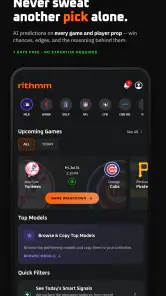
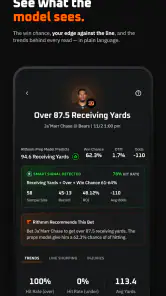
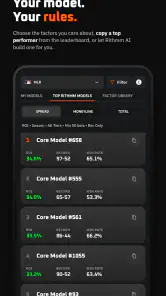
Rithmm is a sports analytics and betting-research app that uses statistical models and artificial intelligence to generate predictions, recommended bets, and matchup insights. After selecting a sport, league, or betting market, users can review model-based projections, confidence indicators, and supporting data. It is designed to help organize research, not to guarantee winning wagers.
Which sports and betting markets are supported in Rithmm?
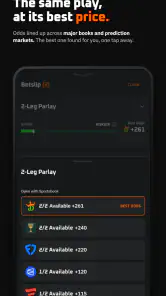
Coverage can vary depending on your location, subscription, and the current version of the app, but Rithmm generally focuses on popular American sports and leagues. Available markets may include moneylines, spreads, totals, player props, and other sportsbook lines. Before downloading, check the app’s current listing and in-app coverage because supported competitions and markets may change throughout the season.
Does Rithmm guarantee winning bets or provide risk-free predictions?
No. Rithmm’s predictions are based on models, historical statistics, team and player information, and available betting lines, but sports outcomes remain uncertain. Even a high-confidence recommendation can lose because of injuries, lineup changes, officiating, weather, or unpredictable game performance. Treat the app as an analytical tool, set a budget, and never wager money you cannot afford to lose.
Pros
- AI-generated picks are easy to browse by sport and betting market.
- Personalized insights help users compare bets with different risk levels.
- The app presents data-driven reasoning instead of only listing selections.
- Useful for tracking betting ideas and reviewing past recommendations.
- Clean interface makes complex sports data more approachable for beginners.
Cons
- Predictions are not guaranteed and can still lead to significant losses.
- Some advanced features may require a paid subscription or premium access.
- AI explanations may feel too brief for users wanting detailed statistical analysis.
- Coverage and pick quality can vary between sports
- leagues
- and markets.
- Betting availability depends on location
- sportsbook access
- and local regulations.
- Category
- Sports
- Version
- 3.4.11





