EMRA Antibiotic Guide
- 94.00
- 2.4
- Installs
- 10.00K
- Price
- Free
Screenshots
Analysis by Reviewed
When I first opened EMRA Antibiotic Guide, I understood its appeal immediately. It is a focused medical reference app from the Emergency Medicine Residents' Association, built for one practical need: helping clinicians reach antibiotic recommendations while working. The idea is much more useful than a general medical library when the department is busy and I need a concise starting point rather than a long search through unrelated material.
My overall impression is mixed but worthwhile. The app can earn a place on the phone of a medical student, resident, or emergency clinician who regularly needs an antibiotic reference, especially during the first weeks of using it. However, its modest average rating of 2.4 from around 130 ratings suggests that the experience has not worked equally well for everyone. I would treat it as a point-of-care reference, not as an automatic prescribing authority.
It is free to install, carries an Everyone age rating, and has passed the stage where it is merely a new release: it first appeared on September 22, 2018. The current version is 1.0.1.30, and it runs on Android 5.1 or later. Those details matter because this is an older, specialized tool rather than a constantly changing general-purpose health app. Its audience is narrow, and its value depends heavily on whether its recommendations fit the user’s clinical setting.
What the first week feels like
The first-week appeal comes from its narrow purpose. Instead of opening a broad search engine and trying to judge which result is appropriate, I can approach the app with a clinical question in mind and look for an antibiotic recommendation. That directness is valuable during a shift, when the problem is not a lack of information but too much of it.
A realistic example would be a busy emergency department where I have assessed a patient with a suspected infection and want to review an empiric antibiotic option before discussing the plan with a senior clinician. In that situation, the app can serve as a quick checkpoint. I would use it to orient myself, verify the relevant section, and then combine it with the patient’s allergies, renal function, local resistance patterns, pregnancy status, severity of illness, and the department’s own protocol.
That workflow is the important distinction. The guide is most useful before the final decision, not instead of clinical reasoning. A recommendation that looks suitable in a reference screen may need adjustment for a patient’s history or for local microbiology. I would never use a short entry as permission to prescribe without checking those factors.
The app’s design goal also makes it more approachable than a full textbook. A resident preparing for a shift can browse it briefly and become familiar with its organization without committing to a long study session. A student can use it to connect common emergency presentations with the antibiotic choices discussed during teaching. Even when I already know the usual treatment, checking a reference can help expose an assumption that deserves a second look.
More From Our News Desk

Clash of Clans Is Won Between the Battles

Android Auto Makes the Case for Quieter Car Software

MobiOffice: Transforming Mobile Productivity with Seamless Integration

EA SPORTS FC™ Mobile Soccer: Redefining Mobile Sports Gaming

How Microsoft OneDrive Became a Mobile Productivity Giant

How Google Translate Breaks Language Barriers Effortlessly
There is a useful psychological benefit here: a dedicated guide reduces the temptation to rely on memory alone. Antibiotic decisions often involve details that are easy to blur together when tired. A compact reference encourages a pause, and that pause can be clinically valuable. The app does not need to replace a hospital guideline to be useful; it can act as a convenient reminder that prompts a more careful review.
Still, the first week is also when the limitations become visible. A focused guide feels efficient only when I know what I am looking for. If the clinical question is broad, unusual, or dependent on current local policy, I may spend more time deciding whether the app’s recommendation applies than I would with a trusted institutional resource. That is not a reason to dismiss it, but it does define the app’s proper role.
Who benefits most from the focused format
I see the strongest fit for emergency medicine learners and clinicians who want a portable companion during study or shifts. The developer’s connection with emergency medicine gives the app a clear identity, and that is preferable to a vague medical reference trying to cover every specialty equally. Someone building confidence with common emergency presentations may appreciate having antibiotic information grouped in a form that matches the pace of acute care.
It may also help a clinician who works across different locations and wants a personal reference available without carrying a printed guide. The free entry point makes it easy to test without a financial commitment, while the optional in-app purchases, listed at $9.99 per item, mean that the full experience may not be entirely cost-free. I would check what is included before depending on it as my only reference.
The app is less suitable for a patient choosing an antibiotic, a family member looking for treatment advice, or anyone without clinical training. Its subject matter is inherently easy to misuse when separated from examination, diagnosis, and follow-up. The Everyone rating describes the app’s general accessibility, not the complexity of applying medical recommendations safely.
I would also hesitate to recommend it as the primary resource for a specialist service, a hospital with strict antimicrobial stewardship rules, or a setting where local protocols must take priority. In those cases, an institutional guideline, pharmacist consultation, or a current evidence database may be the better first stop. The guide can still be a backup, but it should not outrank the system that governs the patient’s care.
Does it keep earning space after the novelty?
The first month is where a medical reference either becomes a habit or gets forgotten. For me, the recurring value of this app depends on repeated small checks rather than long reading sessions. It is not the kind of tool I would open for entertainment or casual browsing. I would keep it installed only if it consistently shortens the path from a clinical question to a sensible discussion.
That can happen in several ways. A learner may use it before a shift to refresh commonly encountered infections. A resident may open it during case preparation, then compare the recommendation with the hospital’s protocol. An experienced clinician may use it as a memory aid when a familiar presentation has an unusual complication. These are modest uses, but they are realistic and more sustainable than expecting the app to become a complete antimicrobial education platform.
The recurring value is strongest when I create a clear habit around it. For example, I might use the guide during preparation, identify the relevant recommendation, and then immediately check the patient-specific factors that could change the plan. That turns the app into one step in a repeatable workflow instead of a shortcut. The non-obvious advantage is that the guide can help structure my thinking even when I do not follow its recommendation exactly.
Another useful habit is to compare the app’s entry with the local guideline whenever the two seem different. Rather than treating disagreement as a failure, I would use it as a prompt to ask why the recommendations diverge. The difference may reflect local resistance, formulary restrictions, a different patient population, or a distinction between empiric and targeted treatment. That comparison makes the app more valuable as a learning aid, while also preventing overconfidence.
However, month-to-month usefulness is vulnerable to change. Antibiotic practice evolves, institutional policies change, and patient-specific guidance can become more important than a general recommendation. Because the app was released in 2018 and its current version remains 1.0.1.30, I would not assume that every entry reflects the newest local or international practice. I would check for update information and use a current authoritative source when the decision is high-risk or the clinical situation is unusual.
This is where the app differs from a subscription medical database. A larger reference service may offer broader coverage, more visible updating, detailed citations, or stronger integration with clinical systems. Those alternatives can be worth the cost for professionals who need comprehensive, regularly maintained information. The guide’s advantage is simplicity and focus, not breadth or guaranteed replacement of a formal knowledge platform.
The practical maintenance burden
The maintenance burden is not just about downloading updates. It is also the mental work of remembering that a convenient reference must be checked against current practice. If I install the app and then stop questioning its context, the very convenience that makes it attractive can become a weakness.
I would maintain a safe routine by checking three things before acting on an entry: whether the patient’s condition matches the scenario, whether patient-specific factors alter the choice, and whether the local policy agrees. This takes longer than simply copying a recommendation, but it is the responsible way to use any antibiotic guide. The app can reduce searching; it cannot remove the need for interpretation.
There is also a practical cost to using a tool with optional purchases. A free installation is helpful for evaluation, but I would not assume that every section or resource needed for regular use is included without payment. Since individual items are priced at $9.99, a user should decide whether the added material justifies the expense compared with an existing hospital resource or another reference service.
For students, the maintenance burden may be manageable because the app can sit alongside lecture notes and supervised clinical teaching. For a working department, the standard should be higher: the guide needs to be easy to consult, sufficiently current for its intended role, and compatible with local antimicrobial stewardship. If it becomes one more screen to cross-check without saving meaningful time, it will probably lose its place on the phone.
The app’s modest install base of over 10,000 suggests a specialized audience rather than universal adoption. That is not automatically negative. A niche tool can be excellent for the people it serves. It does mean I would be cautious about assuming a large community, extensive support ecosystem, or broad compatibility with every emergency department’s workflow.
Where fatigue begins
The first source of fatigue is repetition. If I already know a hospital’s preferred guideline and can reach it quickly, opening a separate app may feel unnecessary. A reference earns recurring use only when it offers a clearer route, a useful second opinion, or a learning benefit that the local system does not provide.
The second is uncertainty about authority. Antibiotic recommendations are not ordinary lifestyle tips. When the stakes are high, I want to understand how a recommendation fits the patient, the local formulary, and current stewardship practice. If the app presents a concise answer without enough surrounding context for my question, I may need to leave it and consult another source anyway.
The third is the friction created by paid content. Even a reasonable price can interrupt a quick workflow if I discover that the section I need requires a purchase at the moment of use. I would explore the available material during a calm period, not during an urgent case, and decide in advance whether the app’s paid items add enough value to justify keeping them accessible.
There is also a fatigue factor in older software. An app that runs on Android 5.1 or later is accessible to many devices, but compatibility alone does not tell me how comfortable the interface feels on a modern phone. If navigation is dated, text is difficult to scan, or returning to a previous topic takes too many steps, the guide may lose against a familiar browser search or a hospital app.
That comparison is important. A web search is broader but noisier. A large medical database is deeper but can be slower and more expensive. A printed antibiotic handbook is dependable in a low-tech sense but cannot be updated on the phone. A local hospital guideline is usually more relevant to prescribing within that institution, though it may not travel well between workplaces. EMRA Antibiotic Guide sits between these options: more focused than a search engine, less comprehensive than a full database, and potentially more portable than a local document.
My long-term verdict
I would keep this app installed if I were an emergency medicine learner or clinician who wanted a compact antibiotic reference for orientation, revision, and quick cross-checking. Its strongest quality is focus. It addresses a real point-of-care need without pretending to be a complete medical library, and its free installation makes trying it straightforward.
I would not make it my sole source for antibiotic decisions. The average rating of 2.4 and the presence of optional $9.99 purchases make me approach it with realistic expectations rather than automatic enthusiasm. More importantly, antibiotic guidance must be interpreted through patient factors, local policy, and current clinical judgment. A concise recommendation is useful only when I understand its limits.
The app earns lasting space when I use it deliberately: as a preparation tool, a memory aid, and a prompt to verify the plan. It loses that space when I expect it to replace a hospital protocol, pharmacist advice, or a comprehensive and actively maintained medical database. That distinction is the key trade-off.
My recommendation is therefore qualified but positive for the right audience. Try it during a quiet study period, learn how quickly it answers the questions you actually face, review any paid sections before relying on them, and compare its guidance with your workplace standard. If it fits that workflow, it can remain a useful small tool after the initial novelty fades. If you need exhaustive coverage, transparent ongoing updates, or institution-specific prescribing guidance, choose the more authoritative alternative and keep this guide only as a secondary reference.
In short, I see it as a practical companion rather than a final decision-maker. Its value is recurring but conditional: it survives month to month when it helps me think faster without encouraging me to think less carefully. For emergency medicine learners and clinicians who understand that boundary, that is enough to make it worth considering.
EMRA Antibiotic Guide Frequently Asked Questions
Is EMRA Antibiotic Guide free to download, and are there any in-app purchases?
EMRA Antibiotic Guide is a free medical app from the Emergency Medicine Residents' Association. It also offers in-app purchases priced at $9.99 per item, so check the purchase details in the app before buying anything. The app is aimed at quick access to antibiotic recommendations on shift, making it most relevant to people who want a clinical reference rather than a general infection self-care tool.
Which devices can run EMRA Antibiotic Guide?
The Android version requires Android 5.1 or later. Before downloading, check your device’s operating-system version and confirm that the app is available for your device in its app store. EMRA Antibiotic Guide is a medical reference, so it is worth making sure it can be opened on the device you expect to use during clinical work or study.
What is the EMRA Antibiotic Guide, and who is it designed for?
The EMRA Antibiotic Guide is a clinical reference app focused on antimicrobial selection and infectious-disease treatment considerations. It is primarily designed for emergency medicine professionals, residents, students, and other healthcare workers who need quick access to antibiotic information while evaluating patients. It should be viewed as a point-of-care aid, not as a replacement for clinical training, specialist advice, or local treatment protocols.
What type of information can I find in the EMRA Antibiotic Guide?
The guide generally provides practical information to support antibiotic decision-making, such as coverage characteristics, commonly used agents, indications, dosing considerations, and treatment approaches for selected infections. Its emergency-medicine orientation can make it useful when a rapid reference is needed. However, users should still confirm details such as renal adjustment, allergies, interactions, pregnancy considerations, and local resistance patterns before prescribing.
Can the EMRA Antibiotic Guide be used to diagnose or treat a patient by itself?
No. The EMRA Antibiotic Guide is a reference tool rather than an autonomous diagnostic or prescribing system. It cannot assess a patient’s examination findings, cultures, medical history, severity of illness, or individual risks. Antibiotic decisions must be made by a qualified healthcare professional using current guidelines, institutional policies, microbiology results, and clinical judgment. In urgent situations, patient safety should always take priority over consulting an app.
Pros
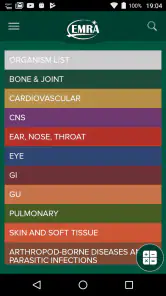
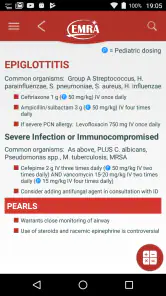
- Clear antibiotic recommendations organized by infection type.
- Useful dosing and treatment-duration details for clinical decisions.
- Includes guidance on allergies
- renal impairment
- and special populations.
- Fast reference format suitable for use during consultations.
- Helps support antimicrobial stewardship and reduce inappropriate prescribing.
Cons
- Content may not reflect the latest local resistance patterns.
- Primarily designed for healthcare professionals
- not general patients.
- Some recommendations require clinical judgment and additional references.
- Coverage may be limited for uncommon infections or specialist cases.
- Access and usefulness can vary depending on regional guideline settings.
- Category
- Medical
- Version
- 1.0.1.30