ChoreReward: Family Habits
- 0.00
- 5.0
- Installs
- 50.00K
- Price
- Free

Screenshots






Analysis by Reviewed
I found ChoreReward: Family Habits most useful when I stopped treating it as a simple chore checklist and started using it as a shared family routine. The idea is straightforward: children work toward rewards by completing agreed tasks, while parents get a clearer view of how everyday responsibilities are progressing. That combination makes the app feel more practical than a paper chart, especially in homes where reminders, allowances, and repeated negotiations tend to blur together.
This is a free parenting app from Kidslox, Inc., designed for families rather than for children to use in isolation. Its store summary focuses on chores, rewards, routines, allowance, and family progress, and that description matches the way I would position it: it is a structure for turning vague expectations into visible actions. The app is available to Everyone, has passed the early discovery stage with over 50K installs and a perfect 5.0 average from 93 ratings, and currently sits at version 1.5.0. Those figures suggest a small but enthusiastic user base rather than a mature, universally established platform.
How ChoreReward fits into real family life
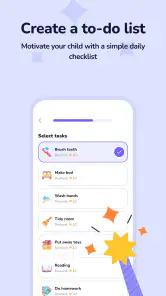
The strongest use case is a household that already knows what needs doing but struggles with consistency. “Clean your room” is easy to say and difficult to measure. A defined task such as putting clothes away, feeding a pet, or preparing a school bag gives a child a finish line. I like that this approach can shift the conversation from parental nagging to a visible agreement: the task is either complete or it still needs attention.
A realistic weekday example would be a child returning from school with a short list of responsibilities before screen time or another agreed reward. The parent can use the routine as a reference instead of repeating the same instructions several times. After dinner, the family can check progress together and decide whether the reward has been earned. The important benefit is not the digital tick itself; it is the shared expectation around it.
I would recommend setting up only a few meaningful tasks at first. Loading the family space with every minor action can make the system feel like paperwork, particularly for younger children. A compact routine is easier to remember and gives the child a better chance of seeing a direct connection between effort and reward. Once that rhythm feels natural, additional responsibilities can be introduced without turning the app into a second job for the parent.
Rewards work best when they are concrete
The reward element is more useful when it represents something the child actually values and the parent can reliably provide. That might be choosing a family activity, having extra time for a preferred hobby, or receiving an agreed allowance. The app can help make the agreement visible, but it cannot solve a reward system that is vague, constantly changing, or too large to maintain.
One practical tip is to separate regular responsibilities from occasional bonuses. A child should not have to wonder whether an everyday task is suddenly worth less because a special job was added. Keeping those ideas distinct makes the routine more predictable and reduces arguments about fairness. It also helps parents avoid promising rewards they later regret.
Allowance deserves particular care. Digital tracking may make payments easier to remember, but it does not replace a family discussion about what the allowance means. Some parents may want to connect every task to money, while others may prefer non-financial rewards. ChoreReward is better viewed as a framework for either approach than as a lesson in money management.
Routines are more valuable than isolated chores
The routine side is where the app can become genuinely helpful. A single completed chore is easy to forget, while a repeated sequence gives a child a sense of what happens before school, after school, or before bed. I found this especially relevant for families who are trying to reduce last-minute instructions. The goal is not to monitor every minute, but to make the next expected action easier to recognize.
Parents should resist the temptation to make routines too ambitious. A morning plan containing every ideal behavior may look impressive during setup and collapse during a rushed school day. A better approach is to include the few steps that most often cause friction. In practice, that might mean focusing on getting dressed, packing essentials, and completing one household responsibility rather than attempting to document the entire morning.
This is also an area where age matters. A younger child may benefit from a small number of simple, visible goals. An older child may respond better to broader responsibilities and less parental checking. The app can support the conversation, but parents still need to adjust the level of supervision instead of expecting one setup to suit every child indefinitely.
Family progress can change the tone at home
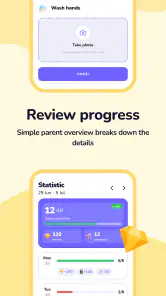
Progress tracking has a subtle advantage: it can make improvement visible even when the week is not perfect. A child who usually forgets a responsibility may be encouraged by seeing several successful completions together. Parents can also notice patterns, such as tasks that are routinely missed because they are poorly timed, unclear, or simply too demanding.
I would use progress as a conversation starter, not as a scoreboard between siblings. Comparing children too aggressively can turn cooperation into competition and create resentment around different ages or responsibilities. A fairer approach is to compare each child with their own previous routine and to acknowledge effort as well as completion.
For families with more than one child, clarity becomes essential. Each child should know which tasks belong to them and which responsibilities are shared. If the family treats the app as a common pool where ownership is unclear, the result may be more disputes rather than fewer. The tool is strongest when the rules are agreed before anyone begins checking items off.
What the current version means for users
Version 1.5.0 is the current release, so I would approach ChoreReward as an actively shaped product rather than a finished household operating system. The release position matters because families often build routines around an app and then expect every edge case to be covered. Here, the sensible expectation is a focused tool for organizing chores, rewards, habits, allowance, and family progress, not a replacement for parental judgment.
The app’s public reception is encouraging, with a 5.0 average across 93 ratings. I would still read that result in context: the rating count is modest, and early adopters are often more motivated than casual users. It tells me that the people who have rated it are highly satisfied, but it does not prove that every family structure or parenting style will find the same fit.
The free entry point lowers the barrier to trying the system. That is important because chore frameworks are personal; a method that works beautifully for one household can feel unnatural in another. At the same time, in-app purchases range from $3.99 to $49.99 per item, so I would review any purchase screen carefully before committing to a longer-term setup. A family should first decide whether the basic workflow actually changes behavior before paying for expanded access.
The minimum operating-system requirement is iOS or Android 12, which is reasonable for families using relatively recent phones but may exclude an older spare device. If a child is expected to interact with the app directly, device compatibility should be checked before making it central to the routine. Otherwise, the parent may end up maintaining a system the child cannot conveniently access.
Where it beats familiar alternatives
The usual alternative is a paper chart on the refrigerator. Paper is cheap, visible, and surprisingly effective for young children, but it does not naturally connect completed tasks with allowance or a broader family view. ChoreReward has an advantage when parents want one place to coordinate those elements and review progress without rewriting a chart every week.
A general to-do app is another common substitute. Generic task managers can handle checklists, but they usually treat chores like ordinary work items. ChoreReward is more focused on the relationship between a child’s responsibility, a parent’s expectation, and a family reward. That focus is useful because it reduces the amount of interpretation needed to turn a task list into a parenting routine.
On the other hand, a family that already has a stable paper system may not gain much from moving everything onto a phone. Digital organization introduces its own friction: devices need to be available, entries need to be maintained, and parents may feel tempted to check progress constantly. If the physical chart is working and the family enjoys talking through it, the app is not automatically an improvement.
It is also not the right choice for parents looking for a full parental-control platform. ChoreReward’s identity is centered on motivation and family habits, not on replacing every other tool used for device supervision, communication, or household scheduling. Choosing it for the wrong problem would lead to disappointment even if the chore features themselves are well suited.
Small workflow choices make a big difference
My first non-obvious recommendation is to create a weekly reset conversation. Rather than changing tasks whenever someone becomes frustrated, use a predictable moment to review what worked, what was unrealistic, and which reward still feels motivating. This keeps the app from becoming a record of old promises and allows the family to refine the system without making every missed task an argument.
Second, use completion history to diagnose the task, not just the child. If one responsibility is repeatedly skipped, ask whether it is too broad, scheduled at the wrong time, or dependent on an adult’s help. “Tidy the room” may need to become a smaller action. This turns the progress view into a planning aid instead of a tool for assigning blame.
Third, keep rewards close enough to the behavior that the connection remains understandable. A reward that is delayed for too long can feel unrelated to the effort, especially for younger children. A smaller, dependable reward structure may teach consistency better than a large reward that is difficult to deliver or frequently renegotiated.
A fourth useful boundary is to avoid checking every task in real time. Parents can agree on one or two review points during the day, allowing children some ownership between them. Constant observation may undermine the independence the routine is meant to build. The app should reduce repeated reminders, not simply move those reminders onto a screen.
Where the experience may still feel limited
The focused design can also be a limitation. Families with complicated schedules, multiple caregivers, or responsibilities that change daily may need more flexibility than a routine-based chore app naturally provides. If grandparents, separated parents, or other adults all need to coordinate the same expectations, the family should test whether the workflow remains understandable for everyone involved.
There is also a human limitation that no interface can remove: children may complete a task mechanically without developing the habit behind it. A checked item is evidence that something was marked complete, not proof that the work was done thoughtfully. Parents still need occasional spot checks and conversations, particularly when the task affects safety, hygiene, or care of another person.
Some children may respond poorly to reward-centered motivation. They might prefer autonomy, praise, or a clear explanation of why a responsibility matters. In that situation, I would use the app to define expectations while gradually reducing the reward emphasis. If the digital system creates bargaining over every action, a simpler family agreement may be healthier.
Privacy and device habits are also worth considering in practical terms. A child who already spends too much time on a phone may not benefit from another reason to check it. Parents can keep the app primarily on their own device and use family check-ins rather than requiring constant child interaction. That preserves the organizational benefit without making the routine dependent on screen time.
Who should try it and what to watch next
I see ChoreReward as a good match for parents who want a clearer bridge between chores, routines, rewards, allowance, and family progress. It is particularly promising when the household has recurring disagreements about what was expected or whether something was completed. The free price makes experimentation sensible, provided the family is comfortable with the device requirement and reviews in-app purchase choices carefully.
I would skip it if your family already has a reliable, low-conflict method, if your children strongly resist digital tracking, or if you need a broad household-management platform rather than a focused parenting tool. I would also avoid making it the sole authority in disputes. The best results are likely to come from using it as a shared reference while keeping flexibility for illness, school pressure, travel, and ordinary bad days.
For existing users, the most important thing to watch is whether version 1.5.0 continues to support a simple setup as families grow more ambitious. Product evolution should ideally preserve the quick daily workflow while making unusual family arrangements easier to handle. I would pay attention to how smoothly the app accommodates changing routines, different children, and rewards that do not fit a single pattern, without allowing setup to become more complicated than the problem it solves.
I would also watch how the product’s small but enthusiastic audience develops. The current reception is a positive signal, but broader adoption will test whether the approach works beyond families who are already motivated to organize chores digitally. Future improvements should be judged by whether they make family conversations easier, not merely by how many options are added.
My overall view is favorable, with realistic expectations. This is not a magic solution for cooperation, and it cannot replace consistent parenting. What it can do is give a family a shared language for responsibilities and rewards, which is often enough to remove some daily friction. The best reason to install it is not to track children more closely, but to make expectations clearer and gradually help them manage more for themselves.
Because it is free to start, I would try it with a small routine, one or two meaningful rewards, and a review after the first week. If the family spends less time arguing about what should happen next, the app is earning its place. If everyone spends more time negotiating the system than completing responsibilities, return to a simpler chart or conversation. In my experience, ChoreReward is most effective when the technology stays in the background and the family agreement remains at the center.
Pros
- Turns everyday chores into motivating
- game-like challenges.
- Parents can tailor tasks to each child’s age and abilities.
- Reward settings encourage consistency without relying only on reminders.
- A shared family system makes responsibilities easier to track.
- Helps children build routines and understand accountability.
Cons
- Some reward features may require in-app purchases or a subscription.
- Younger children may need help reading tasks and managing the app.
- Too many rewards can make children expect payment for every chore.
- Family members may need regular updates to keep tasks accurate.
- The app may feel less useful for families with already established routines.

- Category
- Parenting
- Version
- 1.5.0