5-Minute Clinical Consult
- 44.00
- 4.6
- Installs
- 50.00K
- Price
- Free

Screenshots
Analysis by Reviewed
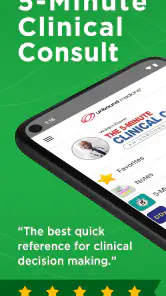
When I need a quick clinical refresher, I usually want something more focused than a general medical search and less cumbersome than opening a large reference book. That is where 5-Minute Clinical Consult fits best. It is a medical app from Unbound Medicine, Inc, built around fast access to clinical information rather than long-form reading. I see it as a practical reference for moments when speed, structure, and a familiar medical workflow matter more than a broad collection of educational material.
The app is free to install, carries an Everyone age rating, and has earned a 4.6 average from around 578 ratings. It has also passed the 50K+ install mark, which gives it a useful level of real-world visibility without making it feel like a general-purpose consumer health app. The store identifies the current release as version 2.8.52 and describes it as a 2026 Edition with Bonus Features. Those details matter because this is not simply a symptom checker aimed at casual users; its appeal is much closer to that of a compact clinical reference.
How the app feels in everyday clinical use
My first impression is that the name describes the intended rhythm well: open the app, identify the condition or topic, scan the relevant section, and move on with the rest of the task. That makes it particularly suitable for short study sessions, ward preparation, office reference, or a quick review before discussing a case with a supervisor. I would not treat it as a replacement for clinical judgment, local protocols, formal prescribing resources, or a complete textbook. Its usefulness comes from helping me orient myself quickly.
A realistic example would be preparing for a busy clinical day. Instead of searching the wider internet and sorting through patient-facing pages, advertisements, and unrelated results, I can use a focused medical reference to refresh the framework of a condition. That distinction is important. The time saved is not necessarily the time spent reading; it is the time avoided when filtering irrelevant material.
The short-description wording, “5-Minute Clinical Consult,” also sets a reasonable expectation. This is not an app I would choose when I want a detailed lecture, a deep review of pathophysiology, or a complete course in a specialty. I would choose it when I already understand the basics and need a concise, clinically oriented reminder. Students may use it to reinforce learning, while practicing professionals may value it as a compact second reference during routine work.
What the free starting point means
The app is listed as free, which lowers the barrier to trying it. That does not mean every useful part should automatically be assumed to be available without payment. In-app purchases are listed from $0.99 to $99.99 per item, so the free installation and the paid value are separate questions. I appreciate that distinction because a reference app can be worth installing for its accessible material while still requiring a careful look at which additional content or functions fit a particular budget.
For me, the sensible approach would be to install it, explore the free experience, and decide whether the workflow genuinely matches my needs before considering any purchase. A low-cost item may be easy to justify for occasional study, while a higher-priced item deserves a more deliberate decision, especially for someone who only needs a reference a few times each month. The listed price range is broad enough that users should avoid assuming the app is either completely free or automatically expensive.
More From Our News Desk

Clash of Clans Is Won Between the Battles

Android Auto Makes the Case for Quieter Car Software

MobiOffice: Transforming Mobile Productivity with Seamless Integration

EA SPORTS FC™ Mobile Soccer: Redefining Mobile Sports Gaming

How Microsoft OneDrive Became a Mobile Productivity Giant

How Google Translate Breaks Language Barriers Effortlessly
That pricing structure also changes how I judge the app. I would not evaluate it like a free symptom checker. I would ask whether the organization, speed, and clinical focus save enough effort to justify optional spending. If I only want general health information, the purchase route would probably offer poor value. If I repeatedly need concise clinical consultation material, the calculation may be very different.
The strongest value is organization, not novelty
The biggest benefit is the way a dedicated reference can reduce the noise found in ordinary web searches. A search engine is excellent when I do not know what I am looking for, but it can be inefficient when I already have a clinical topic in mind. Search results vary in quality, may be written for different audiences, and often require several pages to reconstruct a usable overview. A focused app gives me a more intentional starting point.
This is especially helpful when I am studying several related conditions. Instead of opening separate browser tabs and losing track of where a key point appeared, I can keep the reference task inside one medical tool. That does not guarantee that every answer will be complete for every situation, but it supports a cleaner workflow. I find that valuable because clinical revision is often interrupted: a short break between tasks is more useful when the material is easy to approach and leave.
Another less obvious advantage is cognitive consistency. When I use the same reference repeatedly, I become familiar with its presentation and learn where to look first. That familiarity can make short reviews more efficient than switching between unrelated websites. The benefit is cumulative rather than dramatic. The app does not need to transform the way I study; it needs to make repeated small consultations less frustrating.
Where it fits beside books, browsers, and larger medical tools
Compared with a printed clinical handbook, the app is more convenient to carry and easier to consult when I do not want another physical volume nearby. A book can still be better for uninterrupted reading, annotation, and building a broad conceptual understanding. I would choose the book when I want to spend an hour studying a subject in depth. I would choose this app when I want a compact checkpoint before returning to a larger source.
Compared with a general web search, the advantage is focus. The disadvantage is that a search engine may expose a wider range of current guidance, specialist resources, and local information. The app is therefore not automatically the best first step for every question. If the issue involves a local protocol, a rapidly changing recommendation, or a highly specialized decision, I would verify it elsewhere rather than relying on a short reference entry alone.
Compared with a broad medical database, the likely trade-off is scope versus speed. A large database may provide more depth, citations, and specialist detail, but it can also demand more time and familiarity. This app makes more sense for a user who wants a quick clinical orientation than for someone searching for an exhaustive evidence review. That difference should guide the purchase decision more than the app’s rating.
Practical ways I would use it
I would use the app in three distinct situations. First, I would use it as a pre-study primer: spend a few minutes reviewing a condition before opening lecture notes or a textbook. This gives the later material a structure, making unfamiliar terminology easier to place. Second, I would use it for quick recall after a teaching session, checking whether I can reconstruct the main clinical pattern without rereading an entire chapter. Third, I would use it as a conversation-preparation tool before discussing a case, while keeping the final clinical decision anchored to appropriate professional sources.
A useful habit is to search with a specific question in mind rather than browsing aimlessly. For example, I might decide that I want to refresh the presentation, differential considerations, or general management approach of a known topic. After reading, I would write down what remains uncertain and then move to a more detailed source. This prevents the app from becoming a false endpoint and turns it into the first layer of a broader workflow.
I also think it can work well for spaced review. Instead of waiting until an exam or difficult shift, I could revisit a small number of topics regularly and compare what I remember with the reference. The short-consult format suits that pattern better than a large textbook, because the psychological cost of opening the app is lower. The trade-off is that short sessions can create an illusion of mastery, so I would still test myself and study the underlying reasoning separately.
Limitations that matter before paying
The most important limitation is that concise clinical information can never replace context. A short entry may help me recognize the shape of a problem, but real patients bring comorbidities, medication histories, examination findings, laboratory results, preferences, and local standards. I would be uncomfortable using any quick-reference app as the sole basis for a high-stakes decision. That is not a criticism unique to this product; it is a fundamental limit of compressed medical information.
The second limitation is audience fit. A member of the public looking for reassurance about a new symptom may find the clinical style too dense or may misinterpret reference material without professional context. The Everyone rating describes who can access the app, not who will benefit most from it. I would recommend it more readily to medical students, trainees, nurses, clinicians, and serious healthcare learners than to someone seeking a simple explanation of everyday symptoms.
The third issue is value uncertainty around optional purchases. The app costs nothing to install, but the available purchase range means the financial decision depends on what a user wants to unlock and how often the material will be used. I would not buy an expensive item simply because the app has a strong rating. I would first confirm that its coverage and format match my specialty, study goals, and preferred reference habits.
There is also a practical trade-off between speed and completeness. The more concise a reference tries to be, the more likely I am to need another source for nuance. That is acceptable when I understand the role of the app, but disappointing if I expect a full medical library. Users who want extensive research literature, detailed guideline comparison, or specialty-level depth may be better served by a dedicated database or institutional resource.
Who is most likely to get real value
I think the strongest audience is someone who already has a foundation in medicine and needs a dependable way to refresh topics. A student preparing for clinical placements could use it to turn a long list of conditions into manageable review sessions. A trainee could use it before teaching or when revisiting a familiar diagnosis after time away from it. A practicing clinician might appreciate the convenience for routine orientation, provided the app is treated as one reference among several.
The app may also suit learners who dislike studying exclusively from large textbooks. Its compact purpose can make it easier to begin, especially on a phone when a full desk setup is unavailable. That convenience is not trivial. A reference that I actually open during small gaps can be more useful than a more comprehensive resource that I postpone using because it feels demanding.
I would be more cautious recommending it to a person who needs patient-friendly communication. Medical learners often need to translate technical information into plain language, and a clinical reference is not necessarily designed to do that work for them. I would also steer away from it as the only tool for urgent symptoms, emergency decisions, medication safety, or rapidly changing recommendations. In those situations, professional assessment and authoritative, current guidance take priority.
How I would decide whether an in-app purchase is worthwhile
My decision would depend on frequency and purpose rather than on the free label. If I use the app only once to answer a curiosity, I would stay with the free access unless a specific paid item clearly solves a recurring problem. If I consult it weekly for study or clinical preparation, paid content may offer better value, but only if it improves the exact workflow I use. The listed purchase range makes it especially important to distinguish a small convenience purchase from a substantial reference investment.
I would also compare the cost with alternatives I already have. If my school, employer, or library provides a comprehensive medical database, paying for overlapping material may not be sensible. On the other hand, if those resources are slow to access or too broad for quick revision, this app may earn its place as a faster companion. The right question is not “Is it cheap?” but “Will I use this format often enough to justify the item I am considering?”
The developer, Unbound Medicine, Inc, gives the app a clear medical-reference identity, and the current version suggests that it remains maintained as a product rather than being an abandoned download. Still, maintenance alone does not tell me whether it is the best resource for a particular specialty. I would judge it through actual use: how quickly I can find a topic, whether the writing suits my level, and whether the available material supports the decisions I regularly need to prepare for.
My verdict for students and working professionals
My overall view is positive, with a clear boundary around what I expect from it. This is a useful compact medical reference for people who want fast clinical orientation, structured revision, and a more focused alternative to random web searching. The free installation makes it easy to test, while the optional purchases mean that serious users should evaluate the paid value carefully instead of assuming that every feature is included.
I would recommend trying it if you are a medical student, trainee, nurse, clinician, or healthcare learner who often needs a short refresher between larger study sessions. I would skip it if you want a patient-facing symptom guide, a complete evidence database, or a substitute for local clinical guidance. In my experience, the best way to use this app is as a first-stop clinical refresher, not a final authority.
The 4.6 average and 50K+ installs suggest that it has found a meaningful audience, but those figures should support—not replace—your own test of the workflow. Install it, see whether its concise approach matches the way you study, and only then consider an in-app purchase. For the right user, 5-Minute Clinical Consult can make repeated clinical revision more practical. For someone seeking exhaustive depth or simple public health advice, another kind of resource will probably deliver better value.
5-Minute Clinical Consult Frequently Asked Questions
Who publishes 5-Minute Clinical Consult, and what does the current edition offer?
5-Minute Clinical Consult is a medical reference app published by Unbound Medicine, Inc. Its current edition is described as the 2026 Edition with Bonus Features, and the app’s focus is quick access to clinical information. If you are considering it for regular study or point-of-care use, check the edition and access options shown in the app before relying on particular features.
Which devices can run 5-Minute Clinical Consult?
The app is available for Android and iOS devices, with operating-system compatibility depending on your device’s software version. The minimum operating system requirement is version 9. Before downloading, check your device settings and the app-store compatibility details to make sure your phone or tablet can install it. The app is rated Everyone, though its medical subject matter is primarily relevant to healthcare learners and professionals.
Is 5-Minute Clinical Consult free to download, and what might I pay for?
The app is free to download, but it also offers in-app purchases, with listed prices ranging from $0.99 to $99.99 per item. The amount you pay can depend on the access option you choose and the content or features included. Review the purchase screen carefully before confirming anything, and check whether an institutional or other access arrangement is available to you.
What is 5-Minute Clinical Consult, and who is it designed for?
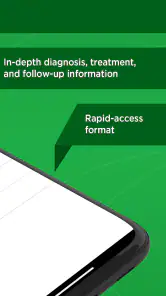
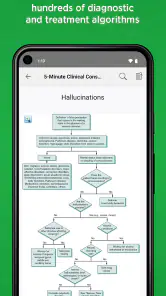
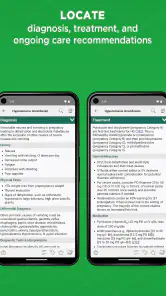
5-Minute Clinical Consult is a point-of-care medical reference designed primarily for healthcare professionals, including physicians, residents, medical students, nurse practitioners, and physician assistants. It provides concise information on diseases, disorders, symptoms, diagnostic approaches, treatment options, and follow-up considerations. It is intended to support clinical decision-making and study, not to replace professional training, institutional protocols, or a complete patient evaluation.
What kind of medical information can I find in the app?
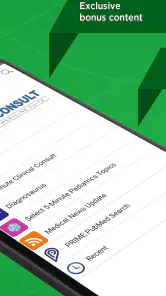
The app typically offers quick access to a broad range of clinical topics, including diagnosis, signs and symptoms, laboratory and imaging considerations, treatment recommendations, medications, and patient education points. Its format is focused on rapid consultation, making it useful when you need a structured overview rather than a lengthy textbook chapter. Coverage and available tools can vary depending on the subscription or edition you access.
Pros
- Concise clinical summaries support quick point-of-care reference.
- Covers a broad range of common diseases and medical conditions.
- Includes practical sections on diagnosis
- treatment
- and follow-up.
- Useful search tools help locate topics and symptoms efficiently.
- Regular updates can help keep clinical information current.
Cons
- Primarily designed for healthcare professionals
- not general users.
- Full access may require a paid subscription or institutional login.
- Some content may be too brief for complex clinical decision-making.
- Internet access may be needed for certain features or updated content.
- Medical information should be verified against local guidelines and policies.
- Category
- Medical
- Version
- 2.8.52