Brainy Master Tricky Story
- 381.00
- 4.6
- Installs
- 10.00M
- Price
- Free

Screenshots







Analysis by Reviewed
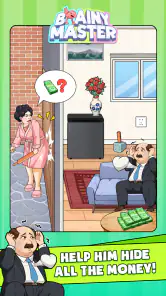
I went into Brainy Master Tricky Story expecting a quick collection of puzzle challenges, and that is exactly where this game makes its strongest impression. It is a free Android puzzle game from Metagame.Ltd that uses misleading situations, playful traps, and short problem-solving moments rather than long, traditional logic exercises. The central appeal is simple: the obvious answer is often the wrong one, so I have to stop treating each screen like a normal question and start examining what the game is trying to make me assume.
That style makes it easy to pick up during a short break, but it also creates an important distinction from more conventional puzzle apps. This is not mainly about building a large board, planning several moves ahead, or gradually mastering a formal system. It is about noticing the joke hidden inside the setup. If you enjoy being surprised by a puzzle’s wording or visual trick, the format can be very entertaining. If you prefer transparent rules and purely logical solutions, some challenges may feel more like guessing the designer’s intention.
How I Judge Whether This Puzzle Game Is Worth Your Time
My first decision criterion is the kind of thinking the game rewards. Brainy Master focuses on lateral thinking: tapping something unexpected, questioning the instruction, or looking beyond the most visible object. That makes it a good fit for players who enjoy brain teasers with a humorous edge. It is less suitable for someone looking for a serious training tool, a deep strategy puzzle, or a calm number-based experience.
The second criterion is session length. I find this type of game most useful when I want something I can open without preparing for a long play session. A tricky prompt can be approached on its own, which suits a commute, a waiting room, or a few minutes after finishing another task. The short-form design also makes it approachable for casual players who normally avoid puzzle games because they expect complicated controls or a steep learning curve.
The third thing I consider is how much patience a player has for surprise-based design. A fair puzzle gives me enough information to reach the answer, even if the solution is unusual. A prank-style puzzle may deliberately encourage a wrong interpretation first. That is part of the entertainment here, but it can also be the main source of frustration. I am more forgiving when the trick feels clever and connected to the scene; I am less forgiving when success depends on tapping around without a clear reason.
The game is marked for Everyone 10+, which matches the light, accessible tone I experienced. I would still judge it by the personality of the person playing rather than the label alone. Younger players who enjoy playful riddles may find it inviting, while adults who want demanding abstract puzzles may outgrow the format quickly. The important point is that the age guidance does not tell me whether the humor or trick structure will suit an individual player.
It also helps to know what the game is not trying to replace. It is not a digital crossword, a traditional sudoku collection, or a physics puzzle built around precise control. Those alternatives usually give me a clearer framework and let improvement come from learning a repeatable method. Brainy Master instead asks me to challenge the wording and the presentation of each situation. That difference should guide the download decision more than the broad “puzzle” label.
The kind of player who gets the most from it
I would recommend it first to people who like sharing amusing puzzle solutions with friends. The best moments are often not just about clearing a challenge; they are about explaining why the obvious interpretation was a trap. It can work well as a casual conversation game, especially when one person is stuck and another notices a detail that has been ignored.
It is also a reasonable choice for someone returning to mobile games after a long break. The concept is immediately understandable, the price removes the need to commit financially, and the controls are built around interacting with a puzzle rather than learning a complex interface. I can imagine handing it to a family member who wants something more active than passive scrolling but does not want an elaborate adventure game.
On the other hand, I would steer away from it if your main goal is measurable mental practice. The game’s solutions are shaped by humor and surprise, so success does not always mean I have learned a general reasoning technique. Likewise, players who dislike being intentionally misdirected may interpret the same design as unfair rather than funny. That is not a small preference issue; it determines whether the core loop feels rewarding or irritating.
Where Brainy Master Has Its Best Moments
The biggest strength is its ability to turn a familiar-looking prompt into a question about attention. I often begin by searching for the expected answer, then realize that the important clue is somewhere I had mentally dismissed. That change in perspective gives the game a lively rhythm. Even when a puzzle is simple after the solution is revealed, the reveal can still feel satisfying because it exposes the assumption that caused the mistake.
The humorous presentation also helps reduce the pressure that can come with puzzle games. I do not feel as though every failed attempt is a serious test of intelligence. The prankster tone makes mistakes part of the experience, which is useful for casual play. I can try an unconventional action without feeling that I am abandoning a carefully designed strategy.
One practical strength is that the game invites experimentation. My useful habit is to inspect the entire screen before tapping the most obvious answer. I look for objects that seem decorative, wording that sounds oddly specific, and instructions that may be asking me to interpret a phrase literally. This approach is more effective than repeatedly pressing the same target, and it turns the game into a small exercise in observation rather than random tapping.
Another good workflow is to separate the puzzle into two questions: what is the stated task, and what assumption is the screen encouraging me to make? That distinction helps when the scene is designed to make the first answer feel automatic. I also try gestures or interactions that match the situation rather than limiting myself to the largest visible button. I do not treat this as a guaranteed formula, but it gives me a sensible process before I consider using help or restarting.
The game’s free price is important in this category. Many casual puzzle titles compete for attention with a large amount of similar content, so being able to try this one without paying lowers the risk of discovering that its humor is not for me. I can judge the actual feel of the puzzles instead of relying on screenshots or a short description. For a quick, low-commitment game, that is a meaningful advantage.
Its audience size also suggests that the concept has broad appeal: the game has passed ten million installs and carries an average rating of 4.6 from roughly fifty-five thousand ratings. I read those figures as evidence that many players find the format approachable, not as a guarantee that every puzzle will suit me. Ratings are especially limited for games built around personal tolerance for trick questions. A player who loves the surprises and a player who dislikes them can experience the same design very differently.
Small habits that improve the experience
I get better results when I resist the urge to solve every challenge at maximum speed. Fast tapping is useful in some mobile games, but here it can hide the clue. I pause long enough to read the wording twice, check whether an object can be moved or selected, and consider whether the instruction contains a double meaning. That brief pause often saves more time than a string of guesses.
I also recommend treating a failed attempt as information. Instead of repeating the same action, I ask what the game has ruled out. If the obvious target does not work, the next step should be a change in interpretation, not merely a faster tap. This is one of the more valuable lessons in the game: a puzzle can be solved by changing the question I am asking, not by applying more force to the original answer.
A third useful habit is to play with the sound and visual context in mind, while remembering that not every detail must be a clue. Trick games can encourage overthinking, and I have occasionally searched for meaning in elements that were simply part of the scene. The best balance is to inspect unusual details without assuming that every pixel contains a secret. That keeps the experience playful instead of turning it into exhausting trial and error.
What may slow you down
The same unpredictability that creates the fun can weaken the sense of fairness. When I solve a puzzle because I understand the intended joke, the result feels excellent. When I solve one only after trying unrelated actions, the satisfaction drops. This is the main limitation I would explain to a friend before recommending it: the game sometimes measures how well I anticipate the developer’s prank rather than how well I can derive an answer from stable rules.
That can make progress uneven. One challenge may be solved immediately, while the next may require a completely different way of thinking. Players who enjoy variety will see that as freshness. Players who prefer a consistent difficulty curve may find it disruptive. I would not choose this as my only puzzle game if I wanted a structured sense of improvement from beginner techniques to advanced ones.
There is also a trade-off between accessibility and depth. The approachable format is a benefit when I want quick entertainment, but it means the game may not hold my attention as long as a larger logic title with layered systems. Once I understand the style of a particular trick, similar patterns can become easier to recognize. The experience is strongest when I play in small sessions rather than expecting an endless, deeply strategic challenge.
When Another Puzzle Category Is a Better Fit
If I want a quiet, methodical session, I would choose a classic logic or number puzzle instead. Those games usually reward concentration within a stable rule set, so I can improve through practice and compare my own decisions from one challenge to the next. Brainy Master is better when I want surprise and playful misdirection, not when I need a predictable mental routine.
For players who enjoy stories, a narrative adventure puzzle may be the better alternative. Such games tend to connect discoveries into a larger sequence, giving each solution a role in the world or plot. Brainy Master keeps its attention on the individual trick, so it is more convenient for isolated sessions but less likely to provide the feeling of progressing through a sustained story.
There is a similar difference with physics-based puzzle games. Those titles often let me learn from visible cause and effect: I move an object, observe what happens, and refine the setup. Here, the key breakthrough is more likely to come from interpreting the scene differently. Someone who likes experimenting with systems should look elsewhere, while someone who enjoys spotting a hidden joke may prefer this game.
Competitive puzzle apps are another separate category. If my goal is to compare scores, master timed rounds, or build a long-term performance habit, Brainy Master may not be the most natural choice. Its appeal is personal discovery and the reaction to a clever solution. I would select it for amusement and mental variety, not as a leaderboard-centered challenge.
These alternatives do not make the game weaker; they clarify its role. I see it as a compact lateral-thinking option that sits between a riddle collection and a casual mobile game. The decision is straightforward: choose it when the twist matters more than a formal puzzle system, and choose a conventional logic title when consistency and depth matter more than surprise.
What switching to it feels like
The cost of switching is mostly a change in expectations. A player coming from sudoku or match-based puzzles may initially tap too literally and wonder why the answers feel strange. Someone coming from prank-style brain teasers will probably understand the rhythm faster. I would give myself a few sessions to adjust before deciding whether the design is unfair, because the game depends heavily on learning to question the setup.
It is also worth changing the way I use hints or outside help, if those options become relevant during play. Looking up an answer immediately can remove the best part of a trick puzzle, since the enjoyment often comes from recognizing the hidden assumption. I prefer to set a short limit for myself: inspect the scene, test a few sensible alternatives, then seek help only when I am no longer generating meaningful ideas. That preserves the discovery without allowing one stubborn screen to consume the whole session.
For families or friends, switching can be social rather than individual. I would let another person read the prompt while I examine the screen, or take turns proposing one action at a time. This makes the game less dependent on a single player’s interpretation and reveals how differently people read the same clue. It is a particularly good use case for a free puzzle game because the entertainment comes from discussion as much as from completion.
On Android, the current version is 1.0.2 and the listed minimum operating system is Android 7.0. That makes the compatibility requirement relatively approachable for people using older supported devices, though I would still check the device’s available store page before installing. The game is free, so the practical commitment is time rather than money. I would begin with a short trial session and decide based on whether the prank-based solutions feel clever or merely arbitrary.
The developer, Metagame.Ltd, presents the game as a straightforward casual puzzle experience rather than something I need to study before playing. Its release date was Aug 20, 2025, so I treat it as a relatively recent title and pay attention to how the current version feels rather than assuming that future changes will solve every personal annoyance. For my decision, the immediate question is whether the existing style fits my taste.
My Recommendation for Different Players
I recommend Brainy Master to anyone who wants a free, light puzzle game built around misdirection, funny situations, and quick bursts of lateral thinking. It is especially appealing if you enjoy explaining a solution after the trick becomes obvious, or if you want a game that can fill a few spare minutes without demanding a long setup. The large install base and strong average rating make it easy to justify trying, but the real reason to choose it is the specific prank-puzzle format.
I would not make it my first recommendation for a player seeking rigorous logic, a consistent difficulty ladder, competitive scoring, or a substantial story. In those cases, a dedicated logic, narrative, or competitive puzzle alternative is likely to feel more rewarding. Brainy Master works best when I accept that the game may laugh at my first assumption and invite me to look at the screen in a less literal way.
My final advice is to approach it with curiosity rather than pride. Read carefully, inspect the whole scene, test actions that fit the wording, and change your interpretation when the obvious solution fails. Its real strength is the satisfying shift from “I know the answer” to “I was asking the wrong question.” If that kind of surprise sounds enjoyable, this is an easy free download to try; if it sounds irritating, your time will be better spent in a puzzle category with clearer rules and more predictable progress.
Pros
- Short puzzles are ideal for quick play sessions.
- Simple controls make the game easy for most players to start.
- Unexpected solutions reward creative thinking.
- Levels offer a light mental challenge without feeling overwhelming.
- The playful presentation keeps the experience casual and accessible.
Cons
- Some puzzles may feel unclear rather than genuinely challenging.
- Difficulty can vary noticeably between consecutive levels.
- Repeated hints or retries may become necessary on trickier stages.
- The gameplay may feel repetitive after extended sessions.
- Ads can interrupt the flow
- depending on the version and device.

- Category
- Puzzle
- Version
- 1.0.2