Driver's License Practice Test
- 636.00
- 4.7
- Installs
- 100.00K
- Price
- Free
Screenshots
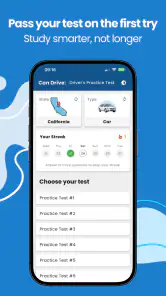
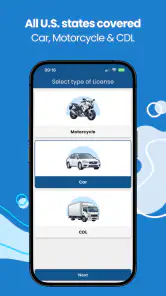
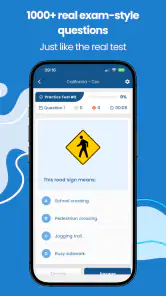
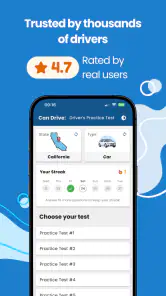
Analysis by Reviewed
Preparing for a driving test is less about memorizing a few signs and more about building a reliable decision-making habit. Driver's License Practice Test, an education app from Rall Softwares, takes a focused approach: it gives you a portable place to rehearse the kind of knowledge you need before sitting behind the wheel or entering the exam room. I found its main appeal in how quickly it turns spare minutes into useful revision, although its lasting value depends heavily on whether you use it as a study routine rather than a one-time quiz.
The app is free to download and is suitable for Everyone, which makes it approachable for teenagers, new learners, and adults returning to driving after a long break. It has reached over 100K installs and holds a 4.7 average from around 8.1K ratings, so it is clearly not an obscure experiment. Still, popularity alone does not make a practice tool effective. What matters is whether the questions help you understand road rules, whether mistakes become learning opportunities, and whether the app remains useful once the initial curiosity wears off.
What the first week feels like
During the first week, the strongest feature is convenience. I can open the app while waiting for an appointment, during a commute as a passenger, or at the end of a study session and complete a short round without preparing a desk full of notes. That low starting effort matters. Many learners intend to study but postpone it because a textbook feels too formal or a long video lesson demands uninterrupted time. A practice-test format removes much of that friction.
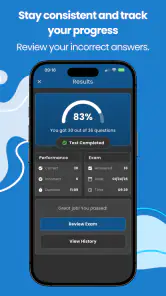
The store summary presents it as a way to approach the driving test with confidence, but I would describe the real benefit more carefully. It is best used to expose gaps in your knowledge. Answering a question correctly feels encouraging, but an incorrect answer is often more valuable because it points to a rule that needs attention. I recommend resisting the temptation to rush through questions simply to see a high score. The useful question after every mistake is not only “What was the right answer?” but also “What clue in the situation should have led me there?”
A practical first-week routine is to begin with a short session, note the subjects that repeatedly cause hesitation, and then review those subjects outside the app before returning for another attempt. For example, if signs, right-of-way decisions, or safe following distances keep causing errors, treat those as separate study topics instead of mixing everything into one endless quiz. This turns the app from a guessing game into a diagnostic tool.
One non-obvious advantage of this workflow is that it helps reveal false confidence. I often remember a rule in isolation but hesitate when two rules appear to compete in the same road situation. Practice questions can expose that difference. A learner who gets many easy questions right may still need work on exceptions and wording. In that sense, the app is more useful when your results feel slightly uncomfortable: uncertainty tells you where real revision is needed.
The interface is also suited to people who dislike heavy study materials. You do not need to carry a printed manual everywhere, and you can repeat a difficult area instead of waiting for a scheduled lesson. That makes the opening week feel productive even when your available time is fragmented. It is particularly helpful for someone who has already read the basics and now needs frequent recall practice.
More From Our News Desk

Clash of Clans Is Won Between the Battles

Android Auto Makes the Case for Quieter Car Software

MobiOffice: Transforming Mobile Productivity with Seamless Integration

EA SPORTS FC™ Mobile Soccer: Redefining Mobile Sports Gaming

How Microsoft OneDrive Became a Mobile Productivity Giant

How Google Translate Breaks Language Barriers Effortlessly
Who benefits most at the beginning
I would recommend starting with this app if you are a learner driver who needs repetition, a busy adult fitting study around work, or someone who wants to check readiness before booking a test. It can also help a family member support a new driver by providing a simple way to identify topics worth discussing during supervised practice.
It is less suitable as your only resource if you are starting from zero and do not yet understand the language of road rules. A quiz can show that an answer is wrong, but it cannot replace an instructor explaining a confusing junction or correcting what you do physically in a vehicle. The app prepares the knowledge side of driving; it does not teach steering, observation, hazard management, or calm behavior in live traffic.
That distinction is important in the first week. A strong quiz result should not be treated as proof that you are ready to drive independently. I would pair each study session with reading the official rules for your location and, where possible, practical instruction. The app is a rehearsal space, not a substitute for the complete licensing process.
Why it can remain useful after the novelty fades
The first few days are easy because every question feels new. The more meaningful test comes later, when you have already seen familiar material and need a reason to return. In my experience, the app earns recurring value when it becomes part of a deliberate maintenance plan. Short, repeated sessions are more useful than one long burst followed by weeks of inactivity.
A good month-to-month approach is to divide practice into three modes. Use one session for fresh questions, another for reviewing mistakes, and a third for a timed or uninterrupted attempt when you want to test concentration. Even without treating the score as a final prediction, this rotation prevents you from relying on recognition. Recognizing an answer because you have seen it before is not the same as recalling the rule under pressure.
Another useful habit is to keep a small error log outside the app. Write down the topic, the reason you chose the wrong answer, and the rule you should have applied. This is more effective than recording only the correct choice. If your mistake came from reading too quickly, the remedy is different from a genuine misunderstanding of a sign or priority rule. The app supplies the practice prompt; your notes supply the personal feedback loop.
This approach also answers a common concern: can a free app stay useful once you have completed its questions? It can, but not if you simply repeat the same sequence mechanically. Its continuing value comes from changing how you use it. Alternate between speed and careful reading, revisit weak areas after a few days, and use mistakes to guide study elsewhere. If you only chase a perfect result, the app may become repetitive quickly.
For learners with a test date approaching, I would use it more frequently in the final stretch but keep sessions short enough to preserve attention. The goal is not to cram every rule into one evening. A tired learner may remember patterns without understanding them, which creates a dangerous sense of readiness. Regular review gives your memory more opportunities to settle and makes it easier to notice the wording of a question rather than reacting to familiar phrases.
There is also value for people who are not taking a test immediately. Someone who has recently obtained a license but feels rusty can use practice questions to refresh general knowledge before a long journey or after moving to a new area. However, local rules can differ, so I would never assume that an answer in a general practice app automatically covers every regional requirement. Check the official licensing authority for the rules that apply where you drive.
Where it fits beside traditional study
Compared with a printed handbook, the app is quicker to access and more interactive, but the handbook remains better for carefully studying a complete rule in context. Compared with video lessons, the app demands more active recall and less passive watching, while videos may explain visual situations more clearly. Compared with an instructor, it is inexpensive and available whenever you want, but it cannot observe your driving or adapt its explanation to your personal behavior.
That makes the best comparison less about choosing one winner and more about assigning each tool a job. I would use official material for authoritative rules, an instructor for practical judgment, and Driver's License Practice Test for repetition and self-checking. If you are willing to use it in that supporting role, it fills a useful gap. If you expect it to replace all other preparation, it is the wrong choice.
The developer, Rall Softwares, has kept the basic proposition clear rather than turning the app into a broad general education platform. That focus is helpful when you want driving-test revision without unrelated lessons. At the same time, focused scope means you should not expect a complete driving course, detailed coaching, or a substitute for local official guidance.
Maintenance, fatigue, and the small costs of staying consistent
The maintenance burden is low in one sense: opening a quiz takes little effort, and the app is free to start using. It is available for devices running Android 7.0 or later, which covers many older phones, so access is not limited to people with recent hardware. The current version is 1.6.1, and that gives users a straightforward way to identify the version they are installing when checking compatibility.
There is still a financial detail worth noticing. The app includes optional in-app purchases ranging from $1.90 to $19.99 per item. That does not prevent free use, but it means you should pay attention to what is included before buying anything. I would first establish whether the free experience matches your study needs, then decide whether an optional purchase genuinely improves your routine. Paying is not automatically a shortcut to better understanding.
The larger maintenance burden is mental rather than technical. Practice apps can encourage a narrow loop: tap an answer, see a result, tap again. That rhythm feels efficient, but it can become shallow. To keep the app useful, slow down when a question involves a confusing exception, explain the rule aloud, and connect it to a real road situation. This extra step takes longer, yet it is what turns recognition into usable knowledge.
Fatigue usually appears in three forms. First, repeated questions can make sessions feel predictable. Second, scores can become emotionally distracting, especially if you start treating every low result as a verdict on your ability. Third, studying only the topics you enjoy can leave important weaknesses untouched. I would respond by setting a modest session limit and ending after a meaningful review, not after an arbitrary number of questions.
A particularly useful trick is to stop a session after two or three careless mistakes in a row and ask whether the problem is knowledge or attention. If you are tired, continuing may produce misleading results. If the same concept keeps causing trouble while you are alert, mark it for focused study. This distinction prevents you from blaming yourself for fatigue or, in the opposite direction, dismissing a genuine gap as a bad day.
Another trade-off is portability versus context. The app is excellent for quick recall, but a phone screen can flatten a complicated traffic situation into a small prompt. For visual learners, diagrams, instructor demonstrations, or supervised observation may create a deeper understanding. I would use the app to prepare questions to ask during a lesson: “Why would this vehicle have priority here?” or “What should I look for before entering this road?” That makes mobile practice support real-world learning rather than compete with it.
Privacy, notifications, and other device behavior can influence whether an app becomes a lasting habit, but I would judge this product primarily by your own tolerance for short quiz sessions. If you dislike studying on a phone, a paper workbook may keep you more consistent even if it is less convenient. The best tool is the one you will return to without resentment.
My long-term verdict for serious learners
After the novelty fades, Driver's License Practice Test still has a place, but its value is conditional. It is not a complete driving school, and it should not be used as proof that someone is ready for independent driving. Its lasting strength is narrower and more practical: it gives learners an easy way to rehearse knowledge, find weak topics, and maintain recall between lessons.
I would keep it installed during the preparation period if I were taking a written driving test, especially when my schedule made regular textbook study difficult. I would also keep a separate error log, read the official rules for my location, and use an instructor for anything involving real traffic judgment. That combination gives the app a clear job and prevents it from being asked to do more than a quiz can do.
For a learner who wants instant explanations, extensive visual instruction, or a fully structured course, another option may be better. A handbook or official study platform will usually be the stronger reference, while an instructor remains essential for practical skills. Someone who already knows the material thoroughly may also find repeated quizzes less rewarding unless they use them for occasional maintenance rather than daily study.
For everyone else, the free entry point, broad accessibility, and focused format make it an easy recommendation with sensible limits. The app is most effective when you treat each wrong answer as a study lead, not as a score to hide. Its real long-term value comes from disciplined repetition, not from simply collecting high marks.
That is why I see it as a dependable companion rather than a complete solution. Use it in short sessions, return to difficult subjects, verify important rules through official sources, and connect the questions to supervised driving practice. If you follow that routine, this education app from Rall Softwares can continue earning space on your phone well beyond the first week, helping you arrive at the test with better recall and a more honest sense of what you still need to learn.
Driver's License Practice Test Frequently Asked Questions
What devices can run Driver's License Practice Test?
Driver's License Practice Test is an education app for Android, and its current version is 1.6.1. It requires Android 7.0 or later, so check your device’s operating system before downloading. The app is free to install, though optional in-app purchases are available. Its Everyone age rating makes it appropriate for a broad audience, including learners starting their driving-test preparation.
Who developed Driver's License Practice Test, and is it a well-established app?
The app is developed by Rall Softwares and is intended to help people prepare for a driving test. It has over 100,000 installs, a 4.7 average from around 8,100 ratings, and 636 written reviews. Those figures suggest that many learners have tried it, although individual experiences can vary. As with any study app, use it alongside the official materials for your licensing authority.
What is Driver's License Practice Test?
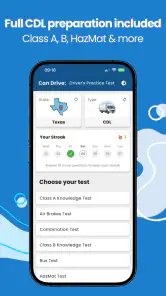
Driver's License Practice Test is a study app designed to help users prepare for written driving exams. It typically includes practice questions based on road signs, traffic laws, safe driving procedures, and state-specific regulations. After trying the available quizzes, I found it most useful as a revision tool for identifying weak areas rather than as a complete replacement for an official driver handbook.
Does the app include questions for my state or country?
The availability of local questions depends on the version of Driver's License Practice Test and the region selected inside the app. Some content may cover general driving rules, while other sections can be organized by state or licensing authority. Before relying on the app, check that your location is supported and compare its material with the latest official handbook, since regulations and exam questions may change.
Can beginners use Driver's License Practice Test?
Yes, the app is suitable for beginners who are learning the basics before taking a learner’s permit or driving theory test. Its practice format makes it easy to review one topic at a time and repeat questions that were answered incorrectly. However, new drivers should first study the official manual, because an app alone may not explain every rule, exception, or local requirement in enough detail.
Pros
- Covers common road signs
- rules
- and situations found on license exams.
- Practice questions are organized for quick study sessions anywhere.
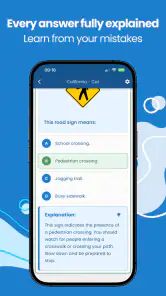
- Immediate answer feedback helps identify mistakes and weak topics.
- Useful for learners preparing before taking an official driving test.
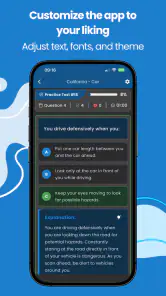
- Simple interface makes navigation easy for first-time users.
Cons
- Question wording may differ from your local licensing authority.
- Some features or question sets may require an in-app purchase.
- It cannot replace supervised driving lessons or real road experience.
- Content may need updates when traffic laws or exam formats change.
- Limited value for users already confident with local driving regulations.
- Category
- Education
- Version
- 1.6.1