Dialysis of Drugs
- 45.00
- 2.1
- Installs
- 10.00K
- Price
- Free

Screenshots
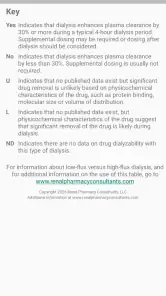
Analysis by Reviewed
Dialysis of Drugs is a medical reference app from Renal Pharmacy Consultants LLC that focuses on one narrow but important question: how dialysis affects medicines. I approached it as a quick clinical lookup tool rather than a general drug encyclopedia, and that distinction matters from the first use. Its purpose is not to replace prescribing information, patient-specific assessment, or a pharmacist’s judgement. Instead, it is aimed at helping a reader check dialyzability information while thinking through medication use in people receiving dialysis.
The app is free to install and is rated for Everyone, but its useful content sits behind an in-app subscription purchase of $21.99 per year. That creates the first practical decision: this is not really a casual free reference once you need the information it is designed to provide. I would consider it mainly for clinicians, pharmacy learners, dialysis staff, and people who regularly discuss renal medication questions with a qualified professional. For someone who only wants occasional general health information, the subscription requirement may make a trusted pharmacist or established clinical reference a better route.
Getting past the first obstacles
The most likely point of friction is the boundary between installing the app and actually using its reference material. The store presents it as a free app, while the summary makes clear that an annual in-app subscription is required. A new user can therefore reasonably expect a simple free lookup, open the app, and then discover that the central function requires payment. I would decide early whether I need repeated access before spending time setting it up.
That payment model also changes how I would evaluate the app. The question is not simply whether it costs anything to download; it is whether the focused dialysis reference saves enough time to justify an annual commitment. If you are studying renal pharmacotherapy or working in a setting where these questions arise often, a dedicated tool may be convenient. If you are checking one medicine for a single situation, the value is less obvious, especially because the app should not be treated as the only source for a medication decision.
The public rating is a 2.1 average from over 100 ratings, with 45 written reviews. I would not use that score alone to judge the clinical usefulness of a specialist reference, but I would treat it as a reason to test the app carefully before relying on it during a busy shift. A low rating can reflect access trouble, outdated presentation, subscription frustration, or limitations in workflow rather than the quality of every individual entry. Still, it is enough to justify a cautious trial rather than an automatic recommendation.
Another important expectation check is the app’s age and platform support. It was released on February 6, 2013, and the current version is 3.51. It requires Android 5.0 or later. Those details suggest that a user should not expect the polish, navigation patterns, or account flow of a newly designed medical platform. On an older phone, I would first make sure the operating system meets that requirement and that the device has a stable connection when opening the app or handling the subscription screen.
Small setup checks that prevent avoidable confusion
My first setup would be deliberately simple. I would install the app from the official store, open it while connected to a reliable network, and look for the point at which the subscription is requested. I would not begin with a time-sensitive medication question. Instead, I would confirm that the application launches normally, that the reference area is reachable after the purchase step, and that the device can display the information clearly.
If the subscription screen does not behave as expected, I would avoid repeatedly tapping the purchase control. I would check whether the store account is the one I intend to use, whether the app is fully updated, and whether the device has enough free space for normal operation. Those are ordinary checks, but they are especially useful here because a failed transaction can look like an app failure when the real problem is the store account or connection.
I would also keep the distinction between installation and access in mind. Installing a free medical app does not automatically mean that its reference content is free. Before recommending it to a colleague, I would explain that the annual in-app purchase is part of the practical cost. That single sentence prevents the most common disappointment and lets the other person decide whether a focused dialyzability reference fits their needs.
Because this is a medication-related tool, I would prepare a second source before using it professionally. That does not make the app pointless. It gives the app a sensible role: fast orientation first, then confirmation through current prescribing information, local protocols, or a pharmacist. If the app and a trusted source appear to disagree, I would stop and resolve the discrepancy rather than choosing whichever answer is more convenient.
A safer way to use a dialysis lookup
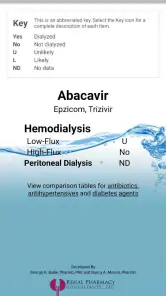
The most useful workflow is to treat each result as one part of a larger medication review. I would identify the exact medicine, confirm the patient’s dialysis context with the care team, and then use the app to inform the question of whether dialysis may remove the drug. I would not jump from a dialyzability result directly to changing a dose, timing, or treatment plan. Dialysis type, schedule, treatment duration, residual kidney function, indication, formulation, and the patient’s overall condition can all affect what action is appropriate.
This is where the app’s narrow focus can be both a strength and a weakness. It may help answer the removal question more quickly than searching through a broad general reference. At the same time, a narrow answer can feel more complete than it really is. Knowing that a drug is dialyzable does not, by itself, tell me the correct supplemental dose or whether administration should be moved around a session. I would use the result to sharpen a clinical question, not to close the case.
For a student, I would use it as a learning checkpoint. After looking up a drug, I would write down what I still need to verify: the dialysis modality, the formulation, the timing of administration, and the current dosing recommendation. That habit turns the app into a prompt for better reasoning instead of a shortcut around it. For an experienced clinician, the benefit is more practical: it can serve as a focused first stop when the question specifically concerns dialysis removal.
Recovering when the workflow breaks
If the app opens but a lookup does not proceed, I would first separate content access from general app failure. I would close and reopen the app, verify the network, and check whether the subscription is active in the store account used for the purchase. If the problem began after changing phones or reinstalling, I would use the same store account and look for a restore or account-recognition option if one is presented. I would not purchase again until I had checked that point.
If the application remains unresponsive, a restart and a current app installation are reasonable first steps. I would also note the exact point of failure: launch, subscription, opening the reference, or searching for a medicine. That detail is far more useful when contacting the developer, Renal Pharmacy Consultants LLC, than a general report that the app “does not work.” It also helps determine whether I am facing an access problem or a limitation in the app’s workflow.
When a medication question is urgent, I would not keep troubleshooting indefinitely. I would move to a pharmacist, a hospital-approved reference, or current official prescribing information, depending on the situation. The app can be useful when available, but a medical decision should not wait for a subscription screen, a slow launch, or an unclear search result. Fast access is helpful; verified clinical judgement remains essential.
A second recovery habit is to record the context of the lookup rather than only the conclusion. I would note the medicine, formulation, dialysis method, and date of the reference check in the appropriate professional record or study notes. This is particularly valuable if the answer later needs to be reviewed. It prevents a vague memory of “the app said it was removable” from being mistaken for a complete dosing recommendation.
When the problem is outside the app
Not every disappointing result means the application is broken. Dialysis pharmacotherapy is complicated, and a user may be expecting the app to answer a broader question than dialyzability. For example, a result about whether a medicine can be removed during dialysis may not resolve whether the patient needs a changed regimen. That gap belongs to the clinical decision, not necessarily to the software.
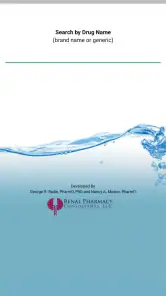
Search wording can also create confusion. A medicine may be known by a brand name, generic name, salt form, or formulation, and a lookup tool may not treat every variation identically. I would try the recognized generic name and confirm the exact product before assuming that a missing or unexpected result is an app defect. If the medicine is a combination product or an unusual formulation, I would be especially careful about applying information from a related product.
There is also a difference between a stable reference question and a current patient-care question. The app may help me orient myself, but clinical recommendations can depend on updated evidence, local practice, and patient-specific factors. I would not use an old-looking interface or a confident-looking entry as proof that the information is current enough for every case. The app’s release history and specialist scope make a second source a sensible part of the workflow.
This is also why I would not recommend the app as a self-treatment guide for patients. Its Everyone content rating describes who may access the app, not who should independently interpret dialysis medication information. A person receiving dialysis could use it to prepare questions for a nephrologist or pharmacist, but I would strongly discourage changing a medicine, skipping a dose, or rearranging timing based on a lookup alone.
Who will benefit and who should choose something else?
I see the clearest fit for users who repeatedly encounter the same specialized question and want a focused reference on hand. A renal pharmacy student could use it while revising concepts. A dialysis professional could use it as an initial check before consulting a fuller resource. A pharmacist might appreciate the narrow focus when the immediate issue is whether dialysis could affect drug removal, provided the app is used alongside current clinical references.
The app is less convincing for a general audience. If your main needs are pill reminders, interaction checking, symptom information, medication histories, or broad dosing guidance, this is the wrong category of tool. It is also not the best choice for someone who wants a completely free reference, because the central experience requires an annual in-app subscription of $21.99 per item. A general drug database or institutional reference may offer a wider range of information for the same workflow.
Compared with a printed handbook, the app should be easier to carry and quicker to consult when a phone is already available. Compared with a broad clinical database, its advantage is focus rather than breadth. A broad database is usually the better choice when I need interactions, contraindications, monitoring, administration instructions, and current dosing in one place. Dialysis of Drugs makes more sense when dialyzability is the starting question and I am prepared to verify everything that follows.
One trade-off I noticed in thinking through everyday use is that convenience can encourage overconfidence. A dedicated app feels authoritative because it addresses a specialist topic directly. I would counter that feeling by making a two-step rule: use it for orientation, then confirm the action in a source appropriate to the patient and dialysis setting. That rule preserves its speed without turning a narrow reference into an unsafe substitute for professional review.
A realistic day-to-day scenario
Imagine a pharmacy trainee reviewing a medication list for a person who receives dialysis. The trainee encounters a medicine they know may be affected by treatment and opens the app during a study session. The lookup helps frame the next question: is the drug likely to be removed, and what information must be checked before discussing timing or dosing with the supervising pharmacist?
In that scenario, the best use is not to copy a single conclusion into the chart. The trainee would confirm the exact medicine and formulation, identify the dialysis schedule and modality, compare the result with the institution’s reference, and then bring the unresolved points to the pharmacist. The app saves a search step, while the professional review supplies the patient-specific interpretation it cannot replace.
A different scenario shows its limits. A patient at home notices a medicine was taken near a dialysis session and wants to know whether to take another dose. I would not direct that person to make the decision from this app. The safer response is to contact the dialysis unit, prescriber, or pharmacist, because the correct advice may depend on the drug, dose, timing, treatment details, and the reason it was prescribed. The app can support a conversation, but it should not become the conversation’s final authority.
My practical verdict
Dialysis of Drugs is a specialized medical reference with a clear purpose, and that focus is its main reason to exist. I like the idea of having a tool dedicated to dialysis-related drug removal rather than searching through a broad database every time. For the right user, that can make an initial check more direct and help organize a medication discussion.
My reservations are equally practical. The free installation does not mean free access to the core reference, the low 2.1 average rating deserves caution, and the app’s older release history makes it sensible to test the experience before relying on it. The subscription is easier to justify for regular professional or educational use than for a one-off question. I would also keep a trusted clinical reference close because dialyzability is only one part of safe medication management.
If you are a renal pharmacy learner or a healthcare professional who frequently needs a focused starting point, I would consider trying it, checking that the subscription and lookup workflow behave properly, and then deciding whether the annual cost fits your routine. If you are a patient seeking immediate dosing advice, or someone wanting a full medication-management app, I would skip it and use direct professional guidance or a broader clinical resource instead.
In short, I see this as a narrowly useful companion rather than a complete dialysis medication solution. Its value depends less on flashy features and more on whether it helps you ask the right next question quickly. Used with that discipline, it may earn a place in a specialist workflow; used alone, it invites more confidence than a single dialyzability reference can safely support.
Pros
- Useful reference for estimating drug removal during hemodialysis.
- Covers dialysis-related pharmacokinetic concepts in a focused format.
- Can support medication review and clinical decision-making.
- Helpful for students learning renal dosing principles.
- Quick access to specialized information without searching textbooks.
Cons
- Should not replace current prescribing guidelines or pharmacist advice.
- Some recommendations may require interpretation by trained professionals.
- Limited usefulness for users without medical or pharmacology knowledge.
- Drug information may need updates as evidence and guidelines change.
- Does not account for every patient-specific factor affecting drug clearance.

- Category
- Medical
- Version
- 3.51