CDL Practice Written Test
- 399.00
- 4.6
- Installs
- 100.00K
- Price
- Free

Screenshots
Analysis by Reviewed
Studying for a commercial driver’s license can feel less like learning one subject and more like sorting through several related exams at once. That is where CDL Practice Written Test makes sense. I used it as an education app focused on written CDL preparation, and its main value is straightforward: it gives me a place to practise questions for commercial driving knowledge instead of relying only on a handbook or a last-minute search through notes.
The app is free, aimed at Everyone, and developed by DMV Written Test. It has reached over 100 thousand installs and holds a 4.6 average from around 4.4 thousand ratings, which suggests that plenty of learners find the format useful. I would not treat popularity as proof that it will suit every learner, but it does make the app feel like a practical starting point rather than an obscure experiment.
One focused capability: practising CDL written-test questions
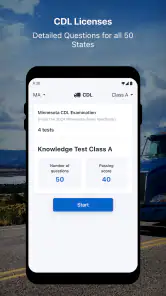
The strongest part of CDL Practice Written Test is its concentration on written-test practice for commercial licenses across the states. That focus matters because preparation is usually more effective when I have to recall an answer, choose between similar options, and immediately notice where my understanding is weak. Reading a manual can build familiarity, but answering questions exposes uncertainty much faster.
I see this app as a companion to official study material, not a replacement for it. A practice tool can help me recognise the wording and rhythm of test questions, while the official handbook remains the better authority for exact rules, local requirements, and the details attached to a particular license or endorsement. The app’s role is to turn passive reading into active checking.
That distinction is important for anyone searching for a CDL written practice test. The useful question is not simply whether an app contains many questions. It is whether practising with it helps me identify what to study next. When I miss a question about a technical topic, I can return to the relevant section of my manual with a specific goal instead of rereading everything from the beginning.
The state-oriented scope is another meaningful advantage. Commercial licensing rules and test expectations are not something I want to treat as completely interchangeable from one place to another. A practice app designed around all states can be more convenient than a generic driving quiz, particularly when I am trying to prepare for a written exam rather than a standard passenger-car permit.
What the format changes in everyday study
In real use, the main benefit is flexibility. I can open the app during a short break, answer a small group of questions, and stop without setting aside an entire evening. That makes it easier to create repeated contact with the material. Short sessions are especially useful when my attention is limited, because the app gives me a concrete task instead of the vague instruction to “study the CDL manual.”
More From Our News Desk

Clash of Clans Is Won Between the Battles

Android Auto Makes the Case for Quieter Car Software

MobiOffice: Transforming Mobile Productivity with Seamless Integration

EA SPORTS FC™ Mobile Soccer: Redefining Mobile Sports Gaming

How Microsoft OneDrive Became a Mobile Productivity Giant

How Google Translate Breaks Language Barriers Effortlessly
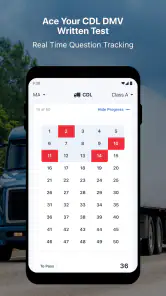
I found the question-and-answer approach more useful when I treated wrong answers as study prompts rather than as a score to chase. If I guessed correctly, I still considered whether I understood the reasoning. If I answered incorrectly, I noted the subject and checked the handbook. This workflow prevents a common practice-test mistake: memorising the position of an answer without understanding the rule behind it.
Another practical use is separating confidence from readiness. I may feel comfortable after reading a chapter, but that feeling can disappear when a question uses different wording. Repeated practice gives me a more honest picture. I can ask myself whether I know the concept, whether I am confusing two similar rules, or whether I am simply rushing through the question.
Because the app is free, it is easy to keep available alongside other preparation resources. I do not have to choose between buying a study guide and trying the app. That makes it suitable for a learner who wants an additional practice layer before deciding whether a paid course or instructor-led program is necessary.
How I would use it without turning practice into guessing
My preferred routine would be simple. I would first read the relevant official material, then use the app to test recall. After a session, I would write down the subjects behind the mistakes, not just the selected answers. For example, a note such as “review vehicle inspection sequence” is more useful than recording that I missed question seven.
I would also avoid repeating the same short session until every answer feels familiar. That can create false confidence. A better approach is to return later, mix practice with handbook reading, and explain the rule aloud in my own words. If I cannot explain why an answer is correct, I would count that topic as unfinished even if the app marked my choice as correct.
A less obvious benefit of this workflow is that it helps reveal whether my problem is knowledge or attention. If I repeatedly miss questions from the same subject, I probably need to study that subject. If my mistakes are scattered and happen after rushing, I may need slower reading and shorter sessions. The app cannot make that diagnosis for me, but its repeated question format makes the pattern easier to notice.
I would keep the app on my phone for low-energy moments rather than making it the only study tool. A few questions while waiting for an appointment can maintain momentum, but serious preparation still deserves uninterrupted time with the appropriate handbook and state-specific material.
Where the app fits best
The best scenario is a learner who already knows which state and CDL path they are preparing for, has access to the relevant official material, and wants frequent written practice. That person can use the app as a checkpoint between study sessions. It is also a good fit for someone who has studied before but wants to rebuild confidence after a long gap.
Imagine a driver working a full schedule and preparing for a written exam in the evenings. Reading a long manual after a tiring shift may be difficult, but a focused practice session can still be manageable. The driver could answer questions on a break, mark the subjects that caused trouble, and use the weekend to review those sections in depth. In that situation, the app’s value is not replacing study time; it makes small pockets of time more purposeful.
It can also help someone who has failed to retain information from ordinary reading. Some learners need to retrieve an answer before the material sticks. For them, practice questions provide a more active route into the subject. I would particularly recommend trying this approach when the manual seems familiar but test-style questions still produce hesitation.
New applicants can benefit too, although I would start with the handbook rather than jumping straight into random practice. Without basic context, a wrong answer may be hard to understand, and the learner could memorise a correction without learning the underlying principle. Used after an initial reading, the app becomes much more valuable.
For a person preparing several written components, the app’s broad CDL orientation may be more convenient than a basic driver’s permit app. It keeps the study goal connected to commercial driving. That said, I would still verify that the practice path I am using matches the license and endorsements I actually need, rather than assuming every CDL question applies equally to every applicant.
Questions I would check before relying on it
One natural question is whether the app costs anything. It is free, which removes a major barrier for learners who simply want to test the format. Free access also makes it reasonable to use the app alongside a printed manual, a library resource, or another preparation method without committing money before knowing whether the question style helps.
Another question concerns device compatibility. The current version is 2.2.4 and requires Android 6.0 or newer. In practical terms, most relatively recent Android phones should be covered, but I would check the operating system of an older spare phone before planning an entire study routine around it.
Some readers will wonder whether it is suitable for younger users. Its content rating is Everyone, but the subject itself is aimed at people pursuing commercial driving credentials. The rating describes general content suitability, not whether the material is relevant to a child or casual learner.
I would also ask whether the app alone is enough to pass. My honest answer is no responsible learner should assume that. Practice questions are useful evidence of progress, but they do not replace official requirements, current state guidance, or the broader preparation needed for commercial driving. I would use the app to find weak areas and confirm recall, then use authoritative material to settle details.
Finally, I would consider whether I need a structured course. If I am starting from zero, struggle to understand the explanations, or need an instructor to organise a study plan, a classroom or paid course may be a better primary resource. This app is strongest as an accessible practice companion, not as a complete teaching relationship.
The trade-off between convenience and authority
The biggest trade-off is the same reason the app is convenient: it compresses study into questions. That is excellent for recall, but it can encourage surface learning if I focus only on getting the next answer right. Commercial driving involves safety decisions and technical knowledge, so I would not want a quiz result to become a substitute for understanding.
State coverage is helpful, but it also means I need to pay attention to relevance. A question that is useful for one applicant may not be central to another applicant’s immediate exam. I would avoid treating a broad question pool as a personalised study plan. My own license goal should determine which subjects receive the most time.
There is also a mental trap in repeated practice: familiarity can feel like mastery. Seeing a question several times may make the answer seem obvious, even when I would struggle with a differently worded version. To counter that, I would space out sessions and explain the reasoning without looking at the choices.
The app’s free availability is a clear positive, but it should not make me careless about source checking. When a rule affects eligibility, documentation, testing procedure, or a safety-critical decision, I would confirm it through the appropriate official source. The app can point me toward topics to investigate; it should not be my final authority on changing regulations.
Compared with a paper manual, the app is faster for self-testing and easier to use in short intervals. Compared with a general driving quiz, it is more directly relevant to commercial-license preparation. Compared with a full course, it is lighter and more flexible, but it offers less personal guidance. I would choose between these options based on the kind of help I need, not on the assumption that one format is universally best.
Who gains the most from this approach
The people most likely to benefit are independent learners who already have a study source and need accountability. The app gives them a repeatable way to check progress, expose weak subjects, and keep preparation moving. It is also useful for experienced drivers who know the road well but need to refresh formal written knowledge before testing.
It may be less suitable for someone who wants detailed lessons before seeing any questions. If I need every concept explained from the ground up, I would begin with a manual, instructor, or structured course and add the app later. Likewise, a learner who dislikes multiple-choice practice may gain more from written notes, guided teaching, and discussion before using quizzes as a final check.
I would recommend it most confidently to someone who can follow a two-source method: use official material to learn, then use the app to practise. That combination turns a free question tool into something more reliable. The app supplies repetition and immediate challenge; the handbook supplies context and authority.
For a friend preparing on a tight schedule, I would suggest using it in three stages. First, take practice questions without trying to protect the score. Second, group mistakes by topic and review those topics carefully. Third, return after a delay and see whether the reasoning remains clear. This is more demanding than endlessly replaying familiar questions, but it gives a much better indication of readiness.
My closing assessment
CDL Practice Written Test succeeds because it concentrates on a real preparation problem: knowing the material is not the same as retrieving it under test conditions. Its state-focused CDL practice, free access, and suitability for short study sessions make it a useful addition to a learner’s phone. I especially like it as a way to turn vague uncertainty into a list of subjects worth reviewing.
I would not use it as my only source, and I would not confuse a comfortable practice score with complete readiness. The best results should come from pairing the app with current official study material and checking that the questions match the license path I am pursuing. Used that way, it offers a practical balance between convenience and discipline.
My recommendation is therefore positive but specific: choose it if you want a free, focused way to practise CDL written-test knowledge and you are willing to verify important details elsewhere. Skip it as your main resource if you need personal instruction, extensive explanations, or a fully organised course. For the independent learner who wants regular recall practice without paying first, it is a sensible tool to keep in the study routine.
The app was released on May 23, 2024, and its continued presence through version 2.2.4 gives it a current place in my preparation toolkit. More importantly, its usefulness depends less on opening it once and more on using it deliberately: answer, investigate mistakes, return later, and let the results guide the next chapter I study.
CDL Practice Written Test Frequently Asked Questions
What devices and operating systems can run CDL Practice Written Test?
CDL Practice Written Test is an education app for Android devices running version 6.0 or later. Before downloading, check your device’s operating system version and available storage, and use the correct app store for your device. Keeping your operating system and the app up to date can also help you access the current version and its study materials.
Who develops CDL Practice Written Test, and how popular is it?
The app is developed by DMV Written Test and is intended to help learners prepare for commercial driver’s license exams. It has an average rating of 4.6 from around 4.4 thousand ratings, with roughly 399 written reviews and over 100 thousand installs. Those figures can offer a general sense of its audience, but they do not replace checking whether its material suits your exam and study needs.
What is CDL Practice Written Test, and who is it designed for?
CDL Practice Written Test is a study and preparation app for people working toward a Commercial Driver’s License. It is intended for beginners preparing for their first written exam as well as experienced drivers reviewing specific endorsements. The app generally focuses on questions related to commercial vehicle operation, road rules, safety procedures, and the knowledge areas commonly covered by CDL testing authorities.
What subjects and CDL endorsements can I study with the app?
The available study material may cover several important CDL topics, including general knowledge, air brakes, combination vehicles, hazardous materials, passenger vehicles, school buses, and other endorsement categories. The exact selection can depend on the app version and your location. Before relying on a particular section, compare its topics with your state’s official CDL handbook and the endorsements listed on your intended exam.
Does practicing with this app guarantee that I will pass the CDL written exam?
No. CDL Practice Written Test can be a useful revision tool, but completing practice questions does not guarantee a passing score. The official test may use different wording, include state-specific requirements, or assess details that are not emphasized in the app. For the best preparation, combine practice sessions with the current official CDL manual, review explanations carefully, and study the areas where you repeatedly make mistakes.
Pros
- Covers key topics commonly included in commercial driver written exams.
- Practice questions help identify weak areas before taking the real test.
- Useful for reviewing signs
- safety rules
- and general knowledge on the go.
- Simple format makes short study sessions easy to fit into a busy schedule.
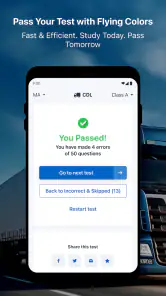
- Can build confidence through repeated practice and immediate answer feedback.
Cons
- Question coverage may vary by state and might not match every local exam.
- Some advanced endorsements may require separate or more specialized preparation.
- Repeated questions can make practice feel predictable after extended use.
- You may need additional resources for detailed explanations of incorrect answers.
- Ads or optional purchases may interrupt studying
- depending on the app version.
- Category
- Education
- Version
- 2.2.4