AudioBooks Unlimited to Kindle
- 125.00
- 4.0
- Installs
- 50.00K
- Price
- Free
Screenshots

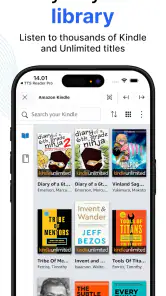
Analysis by Reviewed
I approached AudioBooks Unlimited to Kindle as a practical reading companion rather than a replacement for every audiobook service. Its central promise is appealing: it aims to make Kindle books available as audio, giving readers another way to get through books they already want to read. In my experience, that makes the app most interesting for people who move between quiet reading and listening during a busy day.
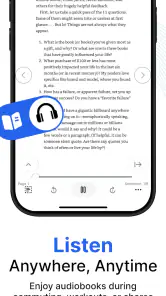
The idea is especially useful when your attention is available but your hands are not. I can imagine using it during a commute, while preparing dinner, or during a walk, then returning to the written version when I want to slow down and take notes. That flexibility is the app’s strongest argument. It is free to download, rated for Everyone, and developed by Cee68, so it feels approachable for casual readers who want to test an audiobook-focused workflow without immediately committing to a traditional subscription service.
How the Kindle-to-audio idea works in everyday use
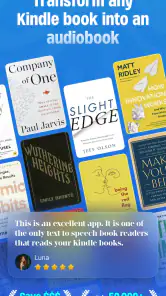
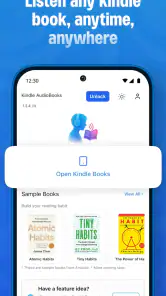
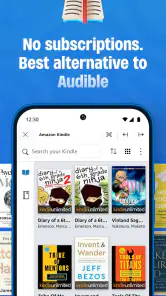
The store summary positions the app as an alternative to Audible and presents a broad ambition: turning Kindle books into audiobooks. That wording matters because it sets an expectation beyond a small catalog of separately produced recordings. The appeal is not simply having another player; it is the possibility of making a larger personal reading library more useful in audio form.
I find that distinction important when comparing it with conventional audiobook platforms. Services built around professionally recorded catalogs generally make discovery simple: choose a title, start listening, and expect a polished performance. This app is more attractive when your priority is access to Kindle material and continuity between formats. If you already organize your reading around Kindle books, an audio companion can reduce the friction of deciding what to listen to next.
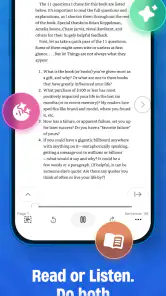
A realistic daily scenario shows where the concept works best. Suppose I begin a nonfiction book at breakfast, read a few pages, and then need to leave for work. Instead of abandoning the book until the evening, I can continue with audio during the journey. Later, I can switch back to text for a section that deserves highlighting or closer attention. That kind of split routine is more valuable than simply having another audiobook player because it connects listening with an existing reading habit.
There is also a useful accessibility angle. Some readers find long periods of screen reading tiring, while others understand difficult material better when they can listen. Audio can make a book feel less demanding during low-energy moments. At the same time, I would not treat it as a universal accessibility solution: the experience depends on how the app handles the individual book and on whether the resulting narration suits the listener.
The app’s current version is 1.6.8, and it supports Android 7.0 or later. That relatively broad operating-system range makes it relevant to people using older Android phones, not only recent devices. I would still check the app on the phone intended for regular listening before building an entire library workflow around it, particularly if that phone is older or has limited storage.
More From Our News Desk

Clash of Clans Is Won Between the Battles

Android Auto Makes the Case for Quieter Car Software

MobiOffice: Transforming Mobile Productivity with Seamless Integration

EA SPORTS FC™ Mobile Soccer: Redefining Mobile Sports Gaming

How Microsoft OneDrive Became a Mobile Productivity Giant

How Google Translate Breaks Language Barriers Effortlessly
Where it stands out from ordinary audiobook services
The clearest strength is the relationship with Kindle books. A normal audiobook service asks me to search its own catalog and accept whatever editions, narrators, and availability it offers. AudioBooks Unlimited to Kindle starts from a different place: the book I already want may be the center of the experience. That can be a better fit for readers who buy or collect digital books first and only later decide they would like to hear them.
This also changes how I would use it for unfinished books. With a standard audiobook app, I might postpone a title because I do not want to purchase another format. Here, the attraction is the chance to make existing Kindle reading more flexible. The trade-off is that the quality and convenience may not feel as uniform as they do in a tightly curated audiobook catalog.
Another practical advantage is experimentation. Because the app is free, I can try it with a book that has been sitting unread rather than treating the decision as a major purchase. That lowers the barrier for occasional listeners. The presence of in-app purchases, priced from $4.89 to $99.99 per item, means the free entry point should not be confused with an entirely cost-free listening library. I would examine what is included before assuming that every Kindle title can be handled without an additional payment.
That pricing range also affects how I judge value. Someone who listens constantly may prefer a familiar audiobook subscription with predictable access and a strong production catalog. Someone who listens irregularly may appreciate paying only when a particular book matters. The right choice depends less on the headline price and more on whether the app saves me from buying a duplicate format or gives me access to books I would otherwise ignore.
Three practical habits that make the app more useful
My first tip is to use it as part of a two-mode reading plan instead of treating audio as a complete replacement for text. I would reserve listening for exposition, routine chapters, or review sessions, then return to the Kindle edition for diagrams, quotations, dense arguments, and passages I want to remember. This approach protects the strengths of both formats and avoids expecting audio to handle material that depends heavily on visual structure.
Second, I would test a short section before committing to a long book. A narration can be perfectly understandable yet still feel wrong for a particular genre. Fiction may depend on rhythm and character distinction, while technical books require careful pronunciation and pacing. A brief trial helps me decide whether the voice and delivery support concentration. This is a more useful test than judging the app only by its store promise.
Third, I would plan around interruptions. Listening while cooking or walking sounds convenient, but real life creates pauses, distractions, and missed sentences. I would keep the Kindle text available for quickly checking a name, definition, or argument rather than rewinding repeatedly. For study, I would jot down the chapter or passage I need to revisit as soon as possible. The app becomes more effective when audio is treated as one stage in a reading workflow, not the only record of what I consumed.
A fourth habit is to separate discovery from commitment. I would first choose books that are already familiar or that have a straightforward structure. That lets me evaluate the app’s usefulness without the added challenge of following a complicated plot or technical argument entirely by ear. Once the routine feels comfortable, I could try more demanding titles.
The main weakness: convenience may not equal a polished production
The biggest limitation is built into the concept. A service that makes Kindle books available as audio is not automatically the same as a studio-focused audiobook platform. When I want expressive acting, carefully balanced sound, multiple character voices, or a performance designed specifically for listening, Audible and similar services may be the safer choice. AudioBooks Unlimited to Kindle is more compelling for flexibility than for the promise of a uniform premium production standard.
That distinction matters most with fiction. A gripping novel can lose some of its energy if the narration feels flat or if dialogue is difficult to follow. In nonfiction, the consequences are different: an uneven pace or unclear emphasis can make a complicated chapter harder to absorb. I would therefore judge each title individually instead of assuming that the same experience will apply across an entire Kindle library.
There is also a possible workflow cost. The more a reader moves between Kindle and audio, the more important it becomes to remember where they stopped and which sections deserve a second look. A dedicated audiobook service may feel smoother because it is designed around listening from the beginning. This app’s advantage is broader format flexibility, but that flexibility can ask the user to manage the transition more actively.
The in-app purchase structure is another point where I would slow down. The app is free, but individual purchases can vary substantially, from $4.89 to $99.99. I would not make assumptions based on the lowest figure, and I would compare the cost of a specific title with the price of buying a professionally produced audiobook elsewhere. For a single favorite book, the expense may be reasonable. For a large listening habit, the higher end of the range could make a subscription-based alternative more predictable.
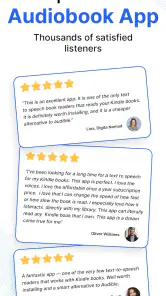
Its rating of 4.0 from around 657 ratings suggests a generally positive reception, but not an overwhelming consensus. I read that as a reason to keep expectations measured. The app has attracted more than 50 thousand installs, enough to show that the idea appeals to a real audience, yet it remains something I would evaluate through my own books and listening habits rather than selecting automatically over established services.
Who should try it, and who should choose something else
I would recommend it first to Kindle-centered readers. If most of your reading decisions begin with digital books and you often wish you could continue them away from a screen, the app addresses a specific frustration. It is also a good candidate for people with irregular listening habits: readers who want audio occasionally, but do not want their entire book routine built around a subscription catalog.
Students and lifelong learners may find the format useful for review, provided they do not rely on audio alone for notes or detailed study. Listening to a familiar chapter while traveling can refresh the main argument before returning to the text. For language learners, hearing a book can support rhythm and comprehension, although I would choose simpler material first and keep the written version close by for unfamiliar vocabulary.
People who switch between devices should think about their preferred routine before installing it. The app is specifically an Android app with a minimum requirement of Android 7.0, so it makes the most sense for readers whose everyday listening device fits that environment. If your reading life is split across platforms and you expect identical progress handling everywhere, a broader ecosystem may be less frustrating.
I would skip it if my top priority were a consistently cinematic audiobook performance. I would also look elsewhere if I wanted a large, clearly defined subscription catalog, extensive editorial discovery, or a listening experience that never asks me to think about the original Kindle edition. Those are not small preferences; they point toward a different kind of service.
Families should note the Everyone age rating, which makes the app broadly approachable from an age-classification perspective. That does not mean every book accessed through it will suit every listener, since the content comes from the reading choices themselves. I would still select titles appropriate for the person using the device.
What I would check before making it my main reader
Before relying on the app for a long commute or a demanding course, I would test three things with one familiar title. First, I would see how quickly I can begin listening and return to the text. Second, I would check whether the narration remains comfortable after twenty or thirty minutes rather than judging it from a brief sample. Third, I would confirm the total cost for the books I actually want, since the free installation does not remove the possibility of item-based purchases.
I would also test it in the environment where I plan to use it. A quiet room can hide problems that become obvious on a noisy street. If I am likely to listen while moving around, I would make sure the controls are easy to reach and that interruptions do not turn a short pause into a lost section. These are simple checks, but they reveal whether the app fits my routine better than a conventional audiobook player.
For readers with limited storage or older hardware, I would begin with one or two books rather than trying to transfer an entire library immediately. The Android 7.0 requirement is helpful for compatibility, but age alone does not guarantee that every older phone will feel equally comfortable during extended audio sessions. Starting small makes it easier to identify performance or organization issues without disrupting the rest of a reading setup.
The developer, Cee68, has given the app a focused identity rather than presenting it as a general-purpose media platform. I see that focus as a strength when my goal is Kindle-related listening, but also as a boundary. The more my needs move toward podcast discovery, music playback, or a broad audiobook marketplace, the less central this particular tool becomes.
My verdict after weighing the trade-offs
AudioBooks Unlimited to Kindle is most convincing as a bridge between digital reading and everyday listening. It does not need to defeat Audible on every measure to be worthwhile. Its value comes from addressing a narrower problem: I may already have a Kindle book, want to continue it without looking at a screen, and prefer not to rebuild my library in a separate format.
The free starting point makes that idea easy to explore, while the Everyone rating and Android 7.0 support keep the basic entry barrier low. The 4.0 average and more than 50 thousand installs indicate that the concept has found genuine interest, but I would still test the exact titles I care about. The in-app purchase range is wide enough that cost should be part of the decision, not an afterthought.
My recommendation is therefore specific. Try it if your reading life already revolves around Kindle books, your listening needs are occasional or practical, and you are comfortable comparing title-by-title value. Choose a conventional audiobook service instead if polished narration, predictable subscription access, and a fully listening-first interface matter more than connecting audio to your existing Kindle collection.
For me, the app’s strongest role is not replacing reading or replacing every audiobook platform. It is helping a book stay present when my schedule changes. The best reason to use it is the freedom to move between page and sound without abandoning the book. That is a focused benefit, but for the right reader, it is a genuinely useful one.
AudioBooks Unlimited to Kindle Frequently Asked Questions
Who develops AudioBooks Unlimited to Kindle, and what kind of app is it?
AudioBooks Unlimited to Kindle is a Books & Reference app developed by Cee68. Its short description is “AudioBooks Unlimited,” and it is presented as an alternative to Audible with the promise that every Kindle book can become an audiobook. If you are considering installing it, think about whether that audiobook-focused approach fits how you use Kindle and what you expect from a reading and listening app.
What is AudioBooks Unlimited to Kindle?
AudioBooks Unlimited to Kindle is designed to help users access and enjoy audiobook content on Kindle-compatible devices or through related reading and listening services. Before downloading, check the app’s current compatibility requirements, supported Kindle models, and regional availability, since features may differ between Android, iOS, and Amazon accounts. It is also important to verify whether the app provides audiobook access directly or works mainly as a companion tool for Kindle users.
Can I listen to audiobooks offline with AudioBooks Unlimited to Kindle?
Offline listening may depend on the specific audiobook service, subscription plan, and app version rather than the Kindle brand itself. In general, users may need to download titles while connected to Wi-Fi before listening without internet access. Downloaded files can also require available storage space and may be protected by usage restrictions. Review the title’s download options and account terms before relying on the app during travel or in areas with limited connectivity.
Is AudioBooks Unlimited to Kindle free to download and use?
The application is free to install, but audiobook access is not necessarily unlimited or completely free. In-app purchases range from $4.89 to $99.99 per item, and access may also depend on a subscription, individual purchases, an Amazon account, or a separate audiobook catalog. Pricing and available titles may vary by country and can change over time. Before subscribing, carefully check renewal conditions, in-app purchase details, and whether cancellation must be completed through Google Play, the App Store, or Amazon.
Which devices and Kindle features are supported?
Support can vary considerably depending on the device, operating system, Kindle generation, and the services connected to your account. Some Kindle models support audiobook playback, while others may only support reading or require Bluetooth headphones or speakers. The app may also work differently on phones and tablets than on dedicated Kindle readers. Confirm the developer’s latest compatibility information before downloading, especially if you expect synchronization between ebook reading progress and audiobook listening.
Pros
- Large selection of audiobooks available for regular listening.
- Simple browsing tools make finding books and authors straightforward.
- Useful playback controls support comfortable listening sessions.
- Works well for commutes
- travel
- and hands-free reading.
- Can help Kindle users enjoy books away from the screen.
Cons
- The subscription may not include every popular audiobook title.
- Audio quality and narration can vary between different books.
- An internet connection may be needed to access some content.
- The catalog and availability may differ by region.
- Frequent listeners may find the ongoing subscription cost expensive.
- Category
- Books & Reference
- Version
- 1.6.8