WheresTheBus
- 1.84K
- 4.8
- Installs
- 100.00K
- Price
- Free

Screenshots
Analysis by Reviewed
I installed WheresTheBus to see whether it could make everyday school-bus travel less stressful, and my overall impression is clear: it is most useful when you want a simple way to check a bus journey rather than manage an entire school routine from one place. It belongs to the education category, but its practical value is really about giving families and students a more informed view of transportation connected with school.
The app is free, rated for Everyone, and developed by WheresTheBus. It has built a strong public response, with an average rating of 4.8 from around 6,200 ratings, while more than 100,000 people have installed it. Those figures suggest that the basic idea is easy for its intended audience to understand: open the app, look for the relevant bus information, and use that information to make a better decision about when to leave, wait, or check again.
What using WheresTheBus is actually like
The most important thing to understand is that this is a focused rider app, not a general-purpose navigation tool. I would not approach it expecting the broad route planning, walking directions, traffic comparisons, and public-transit coverage found in a large mapping service. Its appeal comes from being tied to the school-bus experience, where the question is often much narrower: “Where is the bus I need, and should I be waiting for it now?”
That narrower purpose is also its strongest quality. A general map can be excellent for finding a destination, but it may not reflect the particular information a student or parent needs for a school route. WheresTheBus feels more relevant when the trip is part of the school day and the user already knows the route or service they are meant to use.
I found that the app makes more sense when treated as a quick checking tool rather than something I would leave open continuously. The useful habit is to check before heading outside, then check again if the expected timing changes or the bus does not appear when anticipated. This keeps the app in a supporting role instead of making it the only source of information.
A practical morning routine
Imagine a student getting ready on a rainy morning. Rather than walking to the stop immediately and standing there without context, the student can check WheresTheBus first. If the bus appears to be progressing normally, leaving at the usual time may be sensible. If the information suggests a delay or a changed situation, the student has a reason to wait a little, contact a parent, or prepare for a different plan.
For a parent, the same routine can reduce unnecessary guesswork. A quick check before sending a child outside is more useful than repeatedly asking whether the bus has arrived. It can also make conversations more precise: instead of saying “the bus is late,” a parent can first look at the current information and decide whether the delay seems temporary or whether further action is needed.
More From Our News Desk

Clash of Clans Is Won Between the Battles

Android Auto Makes the Case for Quieter Car Software

MobiOffice: Transforming Mobile Productivity with Seamless Integration

EA SPORTS FC™ Mobile Soccer: Redefining Mobile Sports Gaming

How Microsoft OneDrive Became a Mobile Productivity Giant

How Google Translate Breaks Language Barriers Effortlessly
The best way to use WheresTheBus is as a decision aid, not as an absolute promise of arrival. Real roads remain unpredictable. Traffic, weather, loading time, and local operational changes can all affect a journey. Even when an app shows useful movement or status information, I would still allow extra time and keep a backup plan for important school-day situations.
Why the focused design matters
Many transport apps try to serve commuters, tourists, drivers, cyclists, and pedestrians at the same time. That breadth is valuable, but it can also make a simple task feel crowded. WheresTheBus has a more specific identity. Its developer, WheresTheBus, has built the experience around riders who need school-bus information, so the app is easier to judge by one practical standard: does it help me understand my school transportation at the moment I need it?
That focus makes it especially suitable for families who do not want a child navigating a complicated transit application. A student who only needs school-bus information may find a dedicated tool less distracting than a full map with many unrelated choices. Parents can also introduce it as part of a repeatable routine: check the bus, prepare to leave, and check again only when something seems unusual.
There is a subtle benefit here. A dedicated rider app can encourage better communication between the student and the household because both are looking at the same transportation context. It does not replace a school notice or a parent’s judgement, but it can give everyone a shared starting point when timing becomes uncertain.
Where it is more useful than ordinary alternatives
Compared with checking a school website or relying on a message from another parent, WheresTheBus can be more immediate for the individual rider. Websites may require several taps or may present general announcements rather than the specific situation of one route. Informal messages can be helpful, but they may arrive late or reflect someone else’s stop. A rider-focused app is better suited to the personal question of whether it is time to pay attention to the bus.
Compared with a standard maps app, the advantage is relevance rather than coverage. A maps app is generally better when I need to compare different ways of reaching a destination, estimate a walking trip, or combine several forms of transport. WheresTheBus is the better choice when the school bus is already the central subject and I want a direct check instead of a broad travel-planning session.
That distinction matters for families with mixed routines. If a child sometimes rides a school bus and sometimes walks, cycles, or uses public transportation, WheresTheBus will not replace every other tool. I would use it for the school-bus part of the day and keep a map or local transit app for the alternatives. Its value is strongest when it is paired with the right tool rather than forced to cover every journey.
Small habits that make the app more dependable
One useful habit is to check the app before putting on outdoor clothing, not only after reaching the stop. That gives the information time to influence the decision and avoids turning a delay into an uncomfortable wait. I would also check the route or rider details carefully before acting, especially in a household where several children use different buses.
A second habit is to compare the app’s information with the normal rhythm of the route. If the displayed situation seems unusual, I would not immediately assume that the bus has disappeared or that the app is wrong. I would refresh or check again after a short interval, then use the school’s established communication channel if the problem continues. This is a sensible safeguard for any live transportation service.
A third practical tip is to teach younger users what the app can and cannot answer. It can help them check the bus situation, but it should not encourage them to leave home alone, cross a road without care, or treat an estimated position as permission to rush. For children, the app works best as part of a family routine with clear rules about waiting safely and contacting an adult.
These habits may sound simple, but they address the main risk of any transport tracker: users can become overconfident in a screen that represents a changing real-world situation. WheresTheBus is more helpful when it supports common sense instead of replacing it.
The meaningful limitation: usefulness depends on the local setup
The biggest limitation is not something the interface can solve by itself. A rider app is only valuable when it connects meaningfully with the school-bus service a person actually uses. If a family’s school or transportation arrangement does not provide the relevant service context, the app may not become part of the daily routine at all. This is why I would check local compatibility before encouraging every member of a household to depend on it.
There is also a learning curve in deciding how much confidence to place in the information. New users may expect an exact arrival guarantee, while real transportation rarely behaves that neatly. If the bus is delayed by traffic or circumstances at a stop, the app can help explain the situation without being able to remove the delay. That difference between visibility and certainty should be made clear to children and occasional users.
The focused design can become a weakness for people who need a broader travel solution. A university student planning a complicated trip across town, a parent comparing car travel with public transport, or a commuter who needs several operators in one view will probably get more from a comprehensive navigation or transit application. WheresTheBus is not the right choice simply because the word “bus” appears in the problem.
I also would not use it as the sole emergency communication method. If a bus is seriously late, a child is stranded, or a route changes unexpectedly, the safest response is to follow the school or family’s direct communication plan. The app can be one source of context, but it should not replace a phone call, official notice, or responsible adult.
Who should use it, and who should skip it?
I recommend WheresTheBus most strongly to parents of school-age children who want a quick way to check the school-bus situation before a child leaves home. It is also a good fit for older students who can follow a simple routine independently and need a little more awareness of their daily ride. The Everyone age rating supports its broad family appeal, although younger children still benefit from adult guidance.
It is particularly appealing if your household has experienced uncertainty around waiting at a stop. The app cannot guarantee a perfectly timed journey, but it can make the waiting decision more informed. That is a modest benefit, yet it can matter on cold mornings, during heavy rain, or when a parent is coordinating several school drop-offs and pickups.
I would be more cautious about recommending it to someone who rarely uses a school bus, whose transportation is arranged privately, or who mainly needs door-to-door navigation. In those cases, installing a dedicated rider app may add another step without solving the real problem. A standard map, an official school communication channel, or a local transit service may be more appropriate depending on the journey.
Families should also consider how much independence they want to give a child. The app can support independence, but it should be introduced alongside practical instructions: where to wait, whom to call, what to do if the bus does not arrive, and when not to travel alone. The technology is useful precisely because it fits into those rules; it should not be mistaken for a substitute for them.
Performance expectations and long-term value
WheresTheBus has been available since August 1, 2016, and the current version is 5.2.1. It supports devices running Android 7.0 or later, which gives it a reasonable place on many older Android phones. That matters for families who may not replace devices frequently. A school-bus tool does not need to be installed only on the newest phone to be useful.
The long availability and the public response give me confidence that this is not merely an experimental idea. Still, the number of installs and ratings should not be confused with a guarantee that it will suit every school or route. Transportation tools are highly dependent on local use, so personal relevance matters more than popularity when making the decision.
Because the app is free, trying it carries little financial risk. The more important cost is attention: learning the routine, checking the correct information, and remembering that the app is one part of a larger transportation plan. For a family that will use it several times each week, that small investment can be worthwhile. For someone who only needs occasional directions, it may not earn a permanent place on the phone.
I also appreciate that its purpose is easy to explain. There is no need to persuade a child to learn a large set of travel-planning features before receiving value. The app’s role can be stated plainly: use it to check the school-bus ride, then make a sensible decision. That clarity is one of its strongest advantages over broader alternatives.
My verdict after using it
WheresTheBus succeeds because it concentrates on a real, recurring problem: uncertainty around the school bus. I found it most convincing as a quick morning check for parents and students, especially when weather, timing, or a busy household makes waiting without information frustrating. Its focused approach is more practical than a general map when the school bus is the only journey that matters.
At the same time, I would not describe it as a complete transportation solution. It is not the app I would choose for multi-step trip planning, alternative travel comparisons, or situations where direct communication is essential. Its information should be interpreted sensibly, and families should keep their normal safety and backup procedures in place.
For the right audience, the balance is favorable. The app is free, widely used, rated for Everyone, and maintained in a current version that supports Android devices from 7.0 onward. More importantly, it offers a focused workflow that can turn “Should we leave yet?” into a question with at least some useful context.
My recommendation is simple: choose WheresTheBus if your daily routine genuinely revolves around a school bus and you want a dedicated rider check; skip it if you need broad navigation or your transportation is not connected to its intended use. Used with realistic expectations, it is a practical education app that earns its place through usefulness rather than unnecessary complexity.
WheresTheBus Frequently Asked Questions
Is WheresTheBus suitable for students and families?
WheresTheBus is an education-category app with an Everyone content rating, making it suitable for a broad audience, including students and families. Its focus is practical bus information rather than entertainment, so it may be useful when riders need help checking routes, stops, and expected arrivals. As with any travel app, younger users should follow their family’s guidance when sharing location or using a phone while traveling.
What devices and software versions can run WheresTheBus?
WheresTheBus is available for devices running version 7.0 or later of its supported operating system. Before installing, check that your device meets this requirement and has enough available storage for the app. Keeping the operating system and app updated can also help with compatibility and access to current features. WheresTheBus is the app’s developer, and the current app version is 5.2.1.
What is WheresTheBus and what does it do?
WheresTheBus is a public transportation tracking app designed to help passengers follow buses and plan journeys more confidently. After opening the app, users can typically view nearby stops, check expected arrival times, and see vehicle locations on a map when real-time data is available. Its usefulness depends on whether the local transit agency is supported and actively providing updated information.
Does WheresTheBus provide real-time bus locations and arrival times?
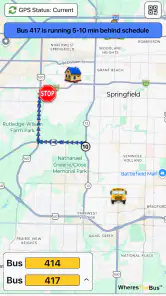
The app is intended to display live or near-real-time bus information, including estimated arrival times and vehicle positions for supported routes. However, the accuracy can vary because the data comes from transportation operators and depends on GPS coverage, service updates, traffic, and network availability. If a bus is delayed or the agency has an outage, the information may be incomplete or temporarily unavailable.
Which cities or transportation systems are supported by WheresTheBus?
WheresTheBus is not necessarily available for every city or bus operator. Coverage depends on the transit systems connected to the service, so users should check the app’s supported locations before downloading or relying on it for daily travel. Search results, routes, stops, and arrival predictions may differ by region, and some features may work only with participating transportation agencies.
Pros
- Live bus locations help reduce uncertainty at stops.
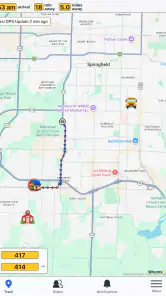
- Simple map view makes route monitoring quick and accessible.
- Useful arrival predictions support better trip planning.
- Can save time by avoiding long waits in poor weather.
- Helpful for regular commuters familiar with local bus routes.
Cons
- Coverage depends on participating transit agencies and supported routes.
- GPS updates may lag when buses lose signal or connectivity.
- Arrival estimates can change suddenly during traffic delays.
- The interface may feel limited outside its supported service area.
- Requires location and internet access for the best experience.
- Category
- Education
- Version
- 5.2.1