ISC2 Official Exam Prep
- 136.00
- 4.3
- Installs
- 50.00K
- Price
- Free

Screenshots
Analysis by Reviewed
Preparing for an ISC2 certification can feel strangely difficult at the beginning. The syllabus is broad, the terminology is precise, and simply reading a study guide does not tell me whether I can recall the material under exam pressure. I found ISC2 Official Exam Prep, developed by LearnZapp, most useful when I treated it as a practice system rather than as a complete course. It gives me a way to turn a vague study plan into a repeatable routine: choose a topic, answer questions, review the reasoning, and use the result to decide what deserves attention next.
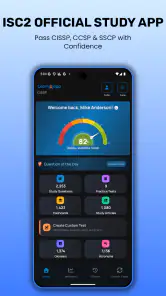
This is a free Education app for Android, aimed at people preparing for CISSP, CCSP, or SSCP exams. Its store summary points to more than 5,000 questions, flashcards, and a readiness score, while the short description presents it as official ISC2 exam preparation. That combination makes the app appealing to both first-time candidates and experienced IT professionals who need a structured way to check their knowledge. My overall impression is positive, but only if I am clear about its role: it is strongest as a practice and diagnosis tool, not as a replacement for understanding the underlying concepts.
From an uncertain starting point to a usable study routine
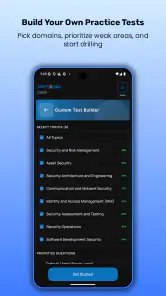
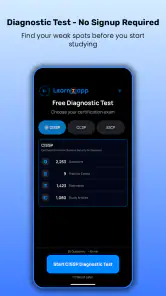
When I first open a question bank, my instinct is usually to start answering immediately. That is not always the best approach here. The app becomes more useful when I first decide what outcome I want from the session. A short diagnostic session can show where my recall is weak. A focused topic session can reinforce one area after reading a textbook. A longer mixed session can test whether I can switch between domains without relying on context clues.
That distinction matters because a high practice score can mean several different things. I may genuinely understand the subject, or I may remember the wording of questions I have already seen. I may also be comfortable with technical details but less prepared for the management, governance, or risk-based thinking expected in certification questions. I use the app most honestly when I regard each answer as evidence about my reasoning, not as a prediction that I am automatically ready to book an exam.
The app is available at no charge, with optional in-app purchases ranging from $4.99 to $139.99 per item. That makes it easy to begin without committing money immediately. I would still check which study material is available in the free experience before building an entire preparation plan around it. The free entry point is valuable for testing the interface and question style, while serious candidates should decide whether the available depth matches the particular ISC2 exam they are targeting.
Choosing the right starting route
The three certifications covered by the app are not interchangeable. A candidate working toward CISSP needs a different level and breadth of preparation from someone beginning with CCSP or SSCP. I would therefore avoid opening random mixed questions on the first day. Instead, I would select the relevant exam path, answer a manageable set, and note not only incorrect answers but also correct answers that felt like guesses.
That last group is one of the most useful signals. If I mark a question correct by eliminating two obviously wrong options, I have not necessarily mastered the concept. During review, I ask myself whether I could explain why the best answer is preferable in a workplace situation. This is especially important for questions where several options sound technically reasonable but one reflects the broader security, governance, or risk perspective expected by the exam.
More From Our News Desk

Clash of Clans Is Won Between the Battles

Android Auto Makes the Case for Quieter Car Software

MobiOffice: Transforming Mobile Productivity with Seamless Integration

EA SPORTS FC™ Mobile Soccer: Redefining Mobile Sports Gaming

How Microsoft OneDrive Became a Mobile Productivity Giant

How Google Translate Breaks Language Barriers Effortlessly
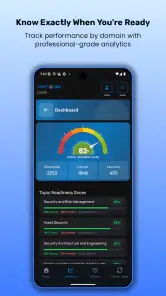
The readiness score can help turn that reflection into a visible target. I would not treat it as a guarantee or as a substitute for official exam guidance. I use it as a trend: is my performance improving across several sessions, and are weak areas becoming more stable? A single strong session after repeated exposure is less convincing than steady results on fresh, mixed practice.
A practical session, step by step
My preferred workflow starts with a small objective. For example, after studying access control, I might use the app to test that subject rather than launching a long general quiz. I answer without looking up terms, flag uncertainty mentally, and resist the temptation to change an answer simply because another option sounds more sophisticated. The point is to capture my first reasoning process, because that is what needs improvement.
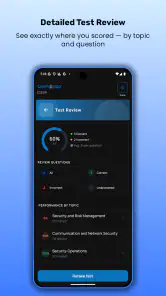
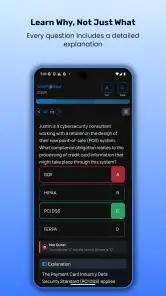
After submitting an answer, I spend more time on the explanation than on the score. When I am wrong, I identify the exact failure: did I confuse two related concepts, miss a qualifier in the question, choose a tactical action when the scenario called for a policy decision, or overlook the order in which a professional should respond? This turns a question into a small lesson. Without that step, a practice bank can become a fast guessing game.
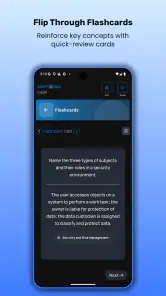
Flashcards are better suited to a different part of the workflow. I use them for short definitions, distinctions, and terminology that must become quick recall. They are useful during small gaps in the day, such as a commute or a brief break, but I would not rely on them alone. Memorizing a definition does not prove that I can apply it to a scenario with competing priorities. I pair flashcards with question practice so that recognition leads to judgment rather than stopping at memorization.
A useful habit is to keep a separate list of “almost correct” topics. These are areas where I repeatedly narrow the options correctly but choose the wrong final answer. That pattern often points to a reasoning problem rather than a knowledge gap. For instance, I may know what a control does but misunderstand who should authorize it, what should happen first, or which business objective takes priority. Reviewing this list is more productive than endlessly repeating questions I already answer confidently.
Turning answers into a handoff for deeper study
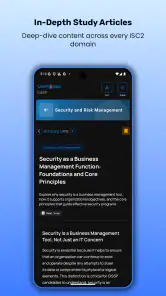
The app works best when it hands information off to another study resource. If an explanation reveals that I do not understand a principle, I stop and consult a trusted textbook, course, official exam outline, or my own notes. I then return to the app later and test whether I can apply the idea without the original explanation in front of me. This loop prevents the common mistake of reading an explanation, feeling familiar with it, and assuming the problem is solved.
I also find it helpful to record the reason for a mistake in plain language. “Confused two terms” is less useful than “I chose the action that fixes the immediate technical issue, but the scenario asked for the first governance step.” That sentence becomes a compact reminder before the next session. Over time, the notes reveal whether my errors are concentrated in vocabulary, question interpretation, prioritization, or broader exam judgment.
This handoff is particularly important because a question app cannot provide every kind of learning experience. It can prompt recall and expose patterns, but it does not replace a conversation with an instructor, a detailed case study, or hands-on work in a security environment. If I am new to the field, I need foundational explanations elsewhere. If I am experienced, I may need the app mainly to adapt practical instincts to the exam’s preferred way of thinking.
For team study, the workflow can also move from the app to a discussion. A colleague and I can compare why we selected different answers, then identify which assumption caused the disagreement. I would be careful not to treat the most confident explanation as automatically correct; the useful outcome is a reasoned interpretation tied to the subject matter. The app supplies prompts, while the discussion supplies the challenge and clarification that solitary practice sometimes lacks.
What the result can tell me
After several sessions, the most valuable result is not a single percentage. It is a map of readiness. I want to know which areas remain unreliable, whether I perform differently in focused and mixed practice, and whether I can explain answers without leaning on familiar wording. The readiness score is helpful as one part of that picture, especially when watched over time rather than celebrated after one session.
I would also compare performance under different conditions. A quiet, untimed session measures learning and reflection. A shorter session after a full workday measures concentration and retrieval when tired. A mixed session measures how well I change mental gears between subjects. These are not identical abilities, and the app becomes more informative when I deliberately use it to test each one.
For a working professional, this creates a realistic daily scenario. I might spend a few minutes on flashcards before work, complete a focused question set during an evening study block, and review only the mistakes afterward. At the weekend, I could use a broader session to see whether the week’s learning transfers outside the original topic. The important part is the handoff between activities: flashcards build recall, questions expose judgment, and notes guide the next reading session.
The app’s audience size also gives me some context when deciding whether to try it. It has passed 50K installs and holds a 4.3 average from 988 ratings, with 136 written reviews. Those figures suggest that it has attracted a meaningful group of learners, but they do not tell me whether its coverage perfectly matches my background or preferred learning style. I would use that social proof as a reason to investigate, not as proof that it will fit every candidate.
Where the workflow becomes frustrating
The biggest limitation is the risk of mistaking practice familiarity for exam readiness. Repeating the same style of question can make me faster without making me more capable. If I remember an answer from a previous session, I need to pause and explain the concept independently. Otherwise, the readiness signal becomes inflated by recognition.
Another friction point is the difference between concise review and complete instruction. A question explanation may clarify why one option is best, but I may still need a broader lesson to understand the surrounding framework. That is not a defect unique to this app; it is the normal boundary of a practice tool. Still, it matters for beginners, who may feel lost if they expect each question to teach an entire topic from the ground up.
The optional purchase model may also affect how I plan my preparation. Starting for free lowers the barrier, but candidates should understand what they need before paying for additional material. Someone with a short deadline may value expanded access, while someone still deciding between certification paths may prefer to explore the free experience first. I would avoid purchasing simply because a low score feels uncomfortable; a weak result may be telling me to study the subject, not to buy more questions.
There is also a mental trap in chasing the readiness score. A number can encourage consistency, but it can also turn study into score optimization. I try to balance it with qualitative checks: Can I explain the principle? Can I distinguish the best answer from a merely acceptable one? Can I apply the idea to a new scenario? If the answer to those questions is no, a rising score should not reassure me too much.
Who should use it, and who should choose something else
I would recommend ISC2 Official Exam Prep to candidates who already have some study material and want a practical way to test retention. It is especially suitable for people who like short, repeatable sessions and want a visible indication of weak areas. The combination of question practice, flashcards, and readiness tracking supports a disciplined routine without requiring every study session to be a long reading block.
It is also a good fit for experienced security professionals who know the subject in practice but need to become comfortable with certification-style reasoning. The questions can expose a mismatch between what I would do immediately at work and what the exam expects as the most appropriate first decision. That is a valuable distinction, not a sign that practical experience is irrelevant.
I would choose a different primary resource if I were completely new to cybersecurity, needed extensive teaching, or learned best through labs and instructor feedback. A video course, structured textbook, classroom, or hands-on environment may provide the foundation that this app cannot supply by itself. Likewise, candidates who dislike multiple-choice repetition may find a project-based approach more motivating, then return here only for final knowledge checks.
The age rating is Everyone, and the minimum operating system is Android 7.0. That makes the app accessible across a broad range of Android devices, including older phones that may not run the newest software. The current version is 32.0.0, so I would keep the app updated when possible, particularly during a long preparation period. These details do not change the study method, but they make it easier to decide whether the app suits the device I plan to use every day.
My final assessment after following the full workflow
ISC2 Official Exam Prep succeeds when I use it as the middle of a larger loop: learn the idea elsewhere, test it here, inspect the reasoning, record the weakness, and return after targeted review. Its strongest contribution is not merely the volume of practice. It is the way questions can convert an unstructured sense of “I should study security” into specific decisions about what to review next.
I would start with the free access, choose the certification that actually matches my goal, and run several honest sessions before deciding whether optional purchases are worthwhile. I would also avoid using the readiness score as a promise of success. The reliable outcome is a clearer study map and better familiarity with exam-style judgment, provided I keep connecting practice questions to real explanations and broader study material.
For me, that makes this a worthwhile companion for CISSP, CCSP, and SSCP preparation. It is not the entire journey, and it can break down when I expect it to teach every concept or measure readiness perfectly. Used with realistic expectations, however, ISC2 Official Exam Prep is a focused way to move from uncertain recall to deliberate, trackable practice. That is exactly the role I would recommend it for.
ISC2 Official Exam Prep Frequently Asked Questions
What devices and operating systems can run ISC2 Official Exam Prep?
ISC2 Official Exam Prep is an education app from LearnZapp, and it supports devices running Android 7.0 or later. Before downloading, check that your device meets that requirement and has enough available storage for the app and any study materials you choose to access. The app is available for Android and iOS, so you can look for the version that matches your device in its app store.
What kinds of study materials does ISC2 Official Exam Prep offer?
The app’s study resources include practice tests, flashcards, and a readiness score, with preparation for CISSP, CCSP, and SSCP among its exam-focused content. These features can help you review terminology, test your knowledge, and notice areas that may need more attention. The available preparation may depend on the certification you select, so check the options in the app before planning your study routine around a particular exam.
What is ISC2 Official Exam Prep, and who is it designed for?
ISC2 Official Exam Prep is a study application intended to help candidates prepare for selected ISC2 cybersecurity certification exams. It is mainly useful for learners preparing for credentials such as Certified in Cybersecurity or other supported ISC2 examinations. The app is best viewed as a revision companion, not a complete replacement for the official exam outline, training courses, practical experience, or broader study resources.
Does ISC2 Official Exam Prep include official questions and up-to-date exam content?
The application is designed around ISC2-aligned preparation material, but users should still check the current exam version, supported certification, and content update information before relying on it. Certification domains and question styles can change over time. I recommend comparing the app’s material with the latest ISC2 exam outline and candidate handbook so that your preparation covers every objective required on the date you plan to test.
Can I use the app without an internet connection?
Offline availability may depend on the specific content, account status, and version of the application. Some study materials or question sets may need to be downloaded first, while progress synchronization and certain features can require an internet connection. Before traveling or studying away from Wi-Fi, open the app, sign in, and verify that your selected materials are accessible offline rather than assuming the entire preparation library is available.
Pros
- Officially aligned with ISC2 certification exam objectives.
- Practice questions help identify knowledge gaps before test day.
- Covers core cybersecurity concepts across multiple exam domains.
- Useful for structured study sessions on Android and iOS devices.
- Trusted source for candidates preparing for ISC2 credentials.
Cons
- Some content may require a paid subscription or in-app purchase.
- Practice questions may not fully match the real exam difficulty.
- Limited value for learners without basic cybersecurity experience.
- Requires consistent self-study; it does not replace hands-on practice.
- Updates may lag behind changes to ISC2 exam objectives.
- Category
- Education
- Version
- 32.0.0