FaithFi: Faith & Finance
- 85.00
- 3.6
- Installs
- 10.00K
- Price
- Free

Screenshots

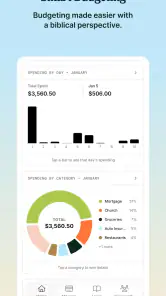


Analysis by Reviewed
I approached FaithFi: Faith & Finance as a finance app first and a faith-oriented tool second: something meant to bring everyday money decisions into a Christian-minded routine. After spending time with it, my main impression is that its value depends less on advanced money management and more on whether you want financial reflection, learning, and practical habits kept close together. The app is free to download, aimed at Everyone, and developed by FaithFi: Faith & Finance.
That combination makes it different from a conventional budgeting app. A typical finance tool starts with accounts, transactions, categories, charts, and alerts. FaithFi approaches the subject from a more personal angle. I found that distinction useful when I wanted to slow down and think about why I was making a financial decision, rather than simply record what had already happened.
How FaithFi handles everyday money through a faith-based lens
The app’s central idea is easy to understand: money management is not treated as an isolated technical task. Instead, it is connected with values, responsibility, generosity, contentment, and intentional decision-making. That makes the experience feel more reflective than a standard expense tracker.
In practical terms, I would use it alongside my existing financial routine rather than automatically replace every other finance service. For example, I might check my bank app for current balances, use a spreadsheet for detailed planning, and then turn to FaithFi when I want guidance or a more thoughtful way to review a spending choice. That division of labor is important because it prevents unrealistic expectations about what a faith-centered finance app should do.
A realistic everyday scenario would be preparing for a month in which several expenses arrive together. Instead of immediately cutting random categories, I could use FaithFi to consider which commitments matter most, where spending has become automatic, and how generosity fits into the plan. The benefit is not necessarily a faster calculation. It is the pause before acting, which can help turn a vague feeling of financial pressure into a more deliberate conversation with myself or my household.
I also think the app suits people who are beginning to take money seriously but feel uncomfortable with highly technical financial software. The tone and purpose are more approachable than a dashboard built around investment terminology. Someone who has never maintained a budget may find it easier to begin with values and habits than with a dense grid of transactions.
Readability and navigation in normal use
FaithFi is at its best when the user’s goal is focused: open the app, read or consider something relevant, and carry one idea into the day. I found that a focused experience can be less intimidating than a finance platform that presents every possible metric at once. The emphasis encourages browsing at a calm pace rather than treating money as an emergency spreadsheet.
More From Our News Desk

Clash of Clans Is Won Between the Battles

Android Auto Makes the Case for Quieter Car Software

MobiOffice: Transforming Mobile Productivity with Seamless Integration

EA SPORTS FC™ Mobile Soccer: Redefining Mobile Sports Gaming

How Microsoft OneDrive Became a Mobile Productivity Giant

How Google Translate Breaks Language Barriers Effortlessly
That simplicity also creates a trade-off. Users who expect a complete financial command center may find the experience less direct for tasks such as reconciling purchases, comparing detailed monthly trends, or building complicated household projections. I would not choose it as my only tool if I needed a precise record of every account and transaction.
For readability, the most helpful approach is to use the app in short sessions. Reading one piece of guidance and writing down one action is more productive than opening it without a question and scrolling indefinitely. I found this especially useful when I paired a session with a concrete prompt: “What expense can I review today?” or “What financial decision am I postponing?” The app becomes easier to navigate when I arrive with a purpose.
The current version is 5.1.3, and the app supports devices running Android 7.0 or later. Those details matter for people using an older phone. Before planning to make it part of a daily routine, I would check that the device meets the minimum system requirement and that the screen remains comfortable for reading. A finance app can be conceptually simple and still feel tiring if the phone is old, slow, or difficult to view.
Its average rating is 3.6 from roughly 160 ratings, with about 85 written reviews. I read that as a mixed but useful signal: there is clear interest, yet the experience will not satisfy everyone equally. In my view, that makes sense because the app serves a narrower purpose than mainstream finance software. People looking for spiritual context may appreciate the approach, while users seeking sophisticated automation may judge it against tools designed for a completely different job.
Motor, visual, and sensory considerations
From an interaction standpoint, a finance app is easier to live with when it does not require constant precision. FaithFi’s reflective use case helps here because I can engage with it in brief moments rather than rushing through a long data-entry session. That is a meaningful advantage for anyone who finds repeated tapping, typing, or detailed form completion tiring.
However, I would not assume that a calm subject automatically means effortless access. Reading financial guidance still requires sustained visual attention, and navigating any mobile interface can be uncomfortable for people with limited dexterity, tremors, reduced reach, or sensitivity to screen brightness. The practical test is personal: can you comfortably open the relevant content, move through it, and stop without losing your place?
One useful habit is to reduce the amount of interaction expected from a single session. Rather than trying to create an entire financial plan on a phone, I would use FaithFi for one decision and move detailed calculations to a larger screen or another tool. This reduces small-screen strain and makes the app’s reflective strength more visible.
For users who rely on enlarged text, screen readers, voice control, captions, or other device-level assistance, the experience should be checked directly on the phone being used. I would not promise that every screen behaves perfectly with every accessibility setting. The sensible approach is to test a short reading session, open the main areas you expect to use, and confirm that text, controls, and focus movement are comfortable before committing to a regular routine.
Sensory context matters too. FaithFi may be more useful in a quiet moment than in a crowded commute. Financial reflection is difficult when notifications, conversation, or movement compete for attention. If you need to use it in noisy or visually busy places, keep the task narrow: review one idea, note one action, and return later for deeper consideration.
Situational access: when the app fits and when it does not
The app fits well into several low-pressure situations. I can imagine using it during a weekly household check-in, before making a significant purchase, or when preparing a personal giving plan. It can also serve as a conversation starter for couples or families who agree on their faith tradition but have different spending habits. In that setting, the app’s greatest contribution is not deciding who is right. It gives people a shared subject for discussing priorities.
It may also help someone recovering from financial avoidance. Opening a full budgeting platform can feel like confronting a wall of bad news. A values-based entry point is gentler. I could begin by identifying one habit, one obligation, or one goal, then connect that reflection to a practical action elsewhere. This is a non-obvious strength: the app can function as a bridge into financial responsibility, even when it is not the place where every calculation happens.
Another worthwhile workflow is to use it before shopping rather than after shopping. A conventional tracker tells me what I spent. FaithFi is more useful when I let its perspective influence the decision while I still have time to change it. I might pause before replacing a working device, review whether the purchase supports a real need, and decide what trade-off I am willing to accept. That makes the app preventive rather than merely descriptive.
Still, situational access has limits. If I need live account balances, automatic transaction imports, tax preparation, investment analysis, or a detailed debt payoff schedule, I would choose a dedicated finance service or a spreadsheet instead. FaithFi should not be judged as a replacement for every financial instrument. Its role is closer to guidance and intentional habit-building.
The app is free, which lowers the barrier to trying it. There are also in-app purchases ranging from $3.99 to $11.99 per item. I would treat those purchases carefully and decide whether the additional material supports a real need before paying. The free starting point is helpful for exploration, but anyone building a long-term routine should understand which parts of the experience require extra spending.
Where the experience still creates barriers
The biggest barrier is expectation. The name and category may lead some people to expect a full personal finance manager, but the app’s distinctive value is its faith-and-finance perspective. If I wanted a precise ledger, advanced reporting, or extensive automation, I would probably feel constrained. That is not a flaw in the concept, but it is a mismatch for users who arrive with the wrong comparison.
A second barrier is theological and personal fit. The app is designed around a Christian understanding of money. For someone who wants a neutral budgeting tool, a different religious tradition, or no faith framing at all, the material may not feel relevant. Even a well-written reflection becomes less useful when its underlying worldview does not match the reader’s needs.
There is also a risk of replacing action with reflection. I found it easy to agree with a thoughtful financial principle and then postpone the practical step. To avoid that, I would end each session with a visible action: cancel a forgotten subscription, set a spending limit in another tool, schedule a household discussion, or write down a giving intention. FaithFi works better as part of a workflow than as a passive source of inspiration.
People with more complex financial lives may need a second system from the beginning. Multiple income sources, shared accounts, irregular bills, business expenses, or detailed debt tracking can quickly exceed what I would want from a faith-centered companion app. In those cases, the best arrangement is usually to keep the technical records elsewhere and use FaithFi for the values-based review.
Accessibility can be another personal barrier if reading on a small screen is difficult or if the device does not respond comfortably to the user’s preferred controls. I would test the app with the phone’s accessibility settings enabled, not just with default settings. That trial should include opening content, moving between sections, and completing the exact routine I expect to follow. A tool is only inclusive in practice when it works for the individual using it.
Who should use it, and who should skip it
I would recommend FaithFi to a person who wants faith to influence everyday financial choices and who appreciates guided reflection more than a wall of numbers. It is especially promising for beginners, couples starting money conversations, and users who need a gentler entry point into budgeting habits.
I would also recommend trying it if you already use a bank app or spreadsheet but feel that those tools answer “What happened?” without helping with “What matters?” That gap is where FaithFi makes the most sense. It can add a values check to an otherwise mechanical routine.
I would skip it as a primary finance solution if my priority were automatic account management, detailed reporting, investment tools, or highly structured cash-flow forecasting. In that situation, a dedicated budgeting or financial-planning app would be more efficient, while FaithFi could remain optional rather than central.
Families should decide together whether the faith framing is genuinely helpful. For one household, it may create a respectful shared language around spending and giving. For another, it may make money conversations feel less neutral or less practical. I would not force it into a family routine simply because the concept sounds appealing; the people using it need to feel comfortable with the approach.
My inclusive verdict after using it
FaithFi is a free finance app with a clear identity, and I appreciate that it does not try to imitate every conventional budgeting platform. Its strongest feature is the way it encourages me to connect financial actions with personal convictions. That can make a difference when the real problem is not arithmetic but inconsistency, avoidance, or disagreement about priorities.
Its accessibility story is best understood through flexibility of use rather than grand promises. Short sessions, a focused question, and support from the phone’s own display and control settings can make it easier to approach. At the same time, screen comfort, motor demands, sensory surroundings, and individual compatibility still matter. I would test it in the conditions where I actually plan to use it.
The developer, FaithFi: Faith & Finance, has created something more specialized than a general-purpose money tracker. That specialization is both the reason to try it and the reason some people should look elsewhere. The app has over 10K installs, so it has reached a modest audience, but its usefulness will depend more on worldview and workflow than popularity.
My final recommendation is straightforward: try FaithFi if you want a Christian perspective woven into practical money reflection, and pair it with a conventional finance tool when you need detailed records or calculations. Use it as a companion for better decisions, not as a substitute for every financial system. That is the fairest way to judge it, and in that role I found it thoughtful, approachable, and genuinely useful—provided its faith-based purpose matches what you are looking for.
FaithFi: Faith & Finance Frequently Asked Questions
Who is FaithFi: Faith & Finance designed for?
FaithFi is designed for people who want to bring Christian beliefs into everyday money management. Its faith-based approach may appeal to users looking for encouragement alongside practical financial learning, whether they are beginning to build better habits or seeking fresh ways to think about stewardship. It is a finance app, so it may be less suitable for someone looking only for a conventional account-tracking tool.
What is FaithFi: Faith & Finance?
FaithFi: Faith & Finance is a personal finance app designed to help users manage money through a Christian, faith-based perspective. It typically combines budgeting guidance, financial education, devotional content, and practical tools intended to encourage responsible stewardship. The app is aimed at people who want financial planning to reflect biblical principles rather than focusing only on spending, saving, or investing numbers.
What features does FaithFi: Faith & Finance offer?
The app may include access to faith-centered financial articles, podcasts, videos, devotionals, budgeting resources, and educational material about topics such as saving, debt, generosity, and wise money management. Depending on the current version and subscription plan, some lessons or tools may be available only after signing in or subscribing. Users should review the in-app feature list before assuming every resource is included for free.
Is FaithFi: Faith & Finance free to download and use?
FaithFi: Faith & Finance is free to download, but availability of content may vary. Some resources may be free, while premium courses, exclusive media, or additional financial tools could require an in-app purchase. Purchases range from $3.99 to $11.99 per item. Before paying, check the purchase details and any applicable terms so you know what access you are getting.
Is FaithFi suitable for professional financial advice or investing decisions?
FaithFi can be useful for general financial education, encouragement, and developing healthier money habits, but it should not replace personalized advice from a licensed financial adviser, tax professional, attorney, or debt counselor. Financial recommendations depend on individual circumstances, goals, income, and risk tolerance. Always verify important information independently and carefully consider your situation before making investment or major financial decisions.
Pros
- Combines biblical principles with practical budgeting tools.
- Helps users connect financial goals with personal values.
- Simple interface makes routine money check-ins easy.
- Encourages mindful spending instead of focusing only on saving.
- Useful prompts can support regular reflection and accountability.
Cons
- Faith-based guidance may not appeal to users seeking secular finance tools.
- Advanced investment and tax-planning features may be limited.
- Some content or features may require a paid subscription.
- Financial advice may be too general for complex personal situations.
- Requires consistent manual engagement to deliver the most value.
- Category
- Finance
- Version
- 5.1.3