Austin News from KVUE
- 668.00
- 4.2
- Installs
- 100.00K
- Price
- Free

Screenshots




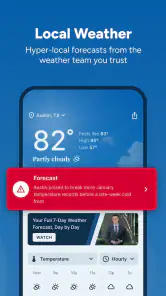



Analysis by Reviewed
When I want a quick sense of what is happening around Austin, I would rather open a local news app than sort through a national feed filled with stories that have little to do with my day. Austin News from KVUE is built for that exact purpose. It brings together Central Texas news, weather and traffic in one place, and its strongest quality is not the amount of information on screen but the local focus. I can open it with a practical question—whether a developing story affects my area, whether the weather may change my plans, or whether traffic deserves a different route—and get a more relevant starting point than I usually get from a general news reader.
This is a free News & Magazines app from TEGNA, with an Everyone age rating. It has been available since December 17, 2010, and the current release is version 50.21.0 for devices running Android 7.1 or later. Those details matter because the app is aimed at a broad audience: it is not a specialist tool for journalists or weather enthusiasts, but a straightforward local companion for people who live in or regularly travel through the Austin area.
Local context is the feature that makes the app useful
The central capability here is the combination of Central Texas news, weather and traffic. That may sound simple, but the combination changes how I use the app. Instead of checking a separate national news service, a weather app and a traffic tool before leaving home, I can begin with one local source and decide what deserves a deeper look. The value is less about replacing every other app and more about reducing the first few steps of a routine.
That local emphasis also changes the way headlines feel. A national app may tell me that a major weather system is moving through the region, while a local news app is more useful for understanding what that means in and around Austin. The same is true for traffic: a broad map can show congestion, but a local newsroom can help put an incident or disruption into a wider community context. I would not treat the app as a complete substitute for navigation or a dedicated weather service, but it is a sensible place to begin when the question is specifically, “What is happening here?”
In my experience, this makes the app especially practical during short checking sessions. I do not need to commit to a long reading session. I can scan the latest local headlines, look for an update relevant to my route, and move on. That is a better fit for a morning routine or a quick pause during the day than a magazine-style app that expects me to browse broadly.
What the local focus changes in everyday use
The most useful habit is to treat the app as a local filter rather than as my only source of information. I use it to identify the Austin-area stories that might affect me, then open the stories that deserve attention. This prevents a common problem with general news feeds: spending time on interesting articles while missing a smaller local development that has a direct effect on travel, school plans, work or errands.
There is also a useful trade-off in the app’s narrow purpose. People who want international coverage, business analysis from many markets or a large selection of opinion pieces may find the experience limited. That is not a flaw in the local approach itself, but it does mean I would pair it with another news source if I wanted a complete daily briefing. Its strength is relevance to Austin, not breadth across every subject.
More From Our News Desk

Clash of Clans Is Won Between the Battles

Android Auto Makes the Case for Quieter Car Software

MobiOffice: Transforming Mobile Productivity with Seamless Integration

EA SPORTS FC™ Mobile Soccer: Redefining Mobile Sports Gaming

How Microsoft OneDrive Became a Mobile Productivity Giant

How Google Translate Breaks Language Barriers Effortlessly
How I would use it during a normal day
My preferred workflow starts in the morning. I would open Austin News from KVUE before leaving, scan the local headlines, and check the weather information alongside any traffic-related updates. If I were driving across Central Texas, I would use what I learn as an early warning rather than as turn-by-turn guidance. Then I would switch to a navigation app for the actual route. This division of labor is important: the news app helps me understand the situation, while navigation software is better suited to live directions and route changes.
At lunchtime, I might return to see whether a developing local story has changed. The benefit of revisiting a local app is that the subject matter remains close to home. I am not starting from a feed dominated by unrelated national events. Instead, I can quickly see whether there is a new angle, an update or another story connected to the area.
In the evening, the app works well as a way to catch up without trying to reconstruct the entire day. I can focus on local developments that I missed while working. For someone who does not watch local television regularly, this provides a convenient mobile route to the same general kind of regional awareness, without requiring a fixed viewing schedule.
A realistic Austin scenario
Imagine that I am planning to leave work and cross town for an appointment. The sky looks unsettled, and I have heard that traffic may be difficult. I open the app to check the local weather and scan the traffic and news coverage for anything that could affect the trip. If there is a significant local development, the app may give me context that a traffic map alone would not. I then use a dedicated navigation tool to choose the route and keep the local app available for broader updates.
The important insight is that the app is most helpful before the journey, not necessarily as the journey itself. It supports a decision—leave earlier, postpone an errand, choose another route or allow extra time—rather than replacing every tool involved in that decision. That makes it more useful than a simple headline reader, but less suitable than a navigation app when I need precise, continuously changing directions.
Small habits that improve the experience
I would avoid opening the app with the expectation of reading everything. A better approach is to decide what I need first: local headlines, weather context or traffic awareness. That keeps the session focused and makes the app feel quicker even when there is plenty to browse. It also reduces the temptation to treat every headline as equally urgent.
For traffic, I would check before setting off and again if plans change, rather than relying on one glance from much earlier in the day. Conditions can shift, and a news app should be considered a source of local awareness rather than a promise that a road will remain clear. For weather, I would use the app to understand the local picture and then make practical choices about clothing, timing and travel.
Another useful habit is to read beyond the first headline when a story could affect my plans. The headline may tell me that something is happening, but the article can provide the context needed to judge whether it matters to my neighborhood, route or schedule. This is where a local newsroom has an advantage over a bare alert: it can help turn an event into something understandable.
Where the app fits beside familiar alternatives
Compared with a general news aggregator, Austin News from KVUE feels more focused and less distracting for Austin-area information. An aggregator is better when I want to compare many publishers or move quickly between national and international topics. The local app is better when relevance matters more than variety.
Compared with a dedicated weather app, it is not the tool I would choose for detailed forecasting or constant weather monitoring. A weather specialist usually makes it easier to study conditions over time. The local news app earns its place by connecting weather with other regional developments, which is more useful when I want context rather than a long list of forecast details.
Compared with a navigation app, it serves a different purpose. Navigation software is the better choice for route planning, live directions and immediate driving decisions. This app is more helpful for understanding the local situation before I start moving. Keeping both available is not wasteful; they answer different questions.
Compared with watching local television news, the mobile format is more flexible. I can check it when my schedule allows, without waiting for a broadcast. The trade-off is that a phone screen may encourage quick scanning, so I need to slow down and open the full story when the subject is important. I also prefer not to judge a developing event from a single headline, regardless of the source.
The compromises I noticed
The first limitation is scope. Because the app is designed around Austin and Central Texas, it is not a strong choice for someone who mainly wants national or international coverage. A person moving between cities may also find a single-market news app less useful than a broader service. I would skip it as a primary news app if local Austin information is not part of my regular life.
The second compromise is that a combined news, weather and traffic experience cannot offer the depth of three highly specialized tools at once. I appreciate the convenience, but I would still use a navigation app for directions and may prefer a dedicated weather service when I need detailed forecasting. The app’s role is to give me a connected local overview, not to win every category separately.
The third is the possibility of information overload during a busy news cycle. Local relevance is valuable, but several updates about one event can make a quick check feel less simple. My solution is to identify the one or two stories that could affect me and leave the rest for later. The app works best when I use its local concentration deliberately rather than scrolling without a purpose.
There is also a personal trade-off in how much attention I want to give to news. If I am trying to reduce headline exposure, a local news app can still become a habit that invites repeated checking. I would keep my visits intentional: once in the morning, before an important trip, or when I specifically want a local update. That makes the app useful without letting it dictate my day.
Who will get the most from it
I think the app is a good match for Austin residents who want a convenient local check-in, commuters who cross Central Texas, and people who prefer reading news on demand rather than following a broadcast schedule. It is also useful for anyone who wants weather and traffic considered alongside local reporting instead of isolated in separate places.
Visitors may find it helpful when they are spending enough time in Austin to care about local conditions. It can provide a better sense of what is happening around them than a general national feed. Still, a short-term visitor who only needs directions or a forecast may be better served by navigation and weather apps alone.
People who should skip it are readers looking for a broad, highly customizable national news experience, detailed specialist forecasting or full navigation features. They may find a general aggregator, dedicated weather app or map service more appropriate. The local focus is the reason to install this app, so it is also the reason not to install it if Austin-area coverage is irrelevant.
What the public response suggests
The app has an average rating of 4.2 from around two thousand ratings, with hundreds of written reviews, and it has passed one hundred thousand installs. I read those figures as evidence that it has found a real audience, but not as a guarantee that every user will have the same experience. Local news needs vary widely: one person may want traffic context, another may care mostly about weather, and another may open the app only during a major regional event.
Its free price lowers the barrier to trying it, and the Everyone rating makes it suitable for a wide household audience. I would still encourage each person to decide how much news they want in their routine. Free access is useful, but the real question is whether the Austin focus matches daily needs.
My recommendation after using it
I recommend Austin News from KVUE as a practical local companion, especially when I want one place to begin checking Austin-area news, weather and traffic. Its best feature is the connection between those subjects: it helps me move from “What is happening?” to “Could this affect my plans?” without starting with several unrelated apps.
I would not present it as a complete replacement for a national news service, a dedicated forecast tool or a navigation app. Its value is more specific and, in the right situation, more useful: it gives Austin-focused context quickly. If I lived in or regularly traveled through Central Texas, I would keep it installed and use it as part of a small information routine rather than as my only source.
My bottom line: choose it for local awareness, not for maximum breadth. When the question is about Austin and the surrounding area, that focus is exactly what makes the app worth opening.
Austin News from KVUE Frequently Asked Questions
Can I read KVUE news without watching live television?
Yes. Austin News from KVUE is a local news app focused on Austin, Texas, and surrounding communities. It brings together breaking news, weather updates, traffic information, sports coverage, investigative reports, and video content from the KVUE newsroom. The app is designed for users who want quick access to regional stories and live updates without relying only on television broadcasts or a desktop browser.
What is Austin News from KVUE?
Austin News from KVUE is a local news app focused on Austin, Texas, and surrounding communities. It brings together breaking news, weather updates, traffic information, sports coverage, investigative reports, and video content from the KVUE newsroom. The app is designed for users who want quick access to regional stories and live updates without relying only on television broadcasts or a desktop browser.
What type of content can I find in the KVUE Austin News app?
The app typically includes local and regional headlines, developing stories, weather forecasts, radar information, severe weather alerts, traffic reports, community news, sports, entertainment, and video clips. Coverage may also include live streams or special reports when important events are happening. Available sections and features can vary depending on your location, app version, and current newsroom programming.
Does Austin News from KVUE provide weather and emergency alerts?
Yes, weather is one of the app’s most useful features for people in the Austin area. Users can generally check current conditions, forecasts, radar imagery, and severe-weather coverage. Notifications may also be available for breaking news or dangerous conditions, although you must grant permission for alerts. It is worth reviewing notification settings so you receive important warnings without being overwhelmed by routine updates.
Is the Austin News from KVUE app free to download and use?
The app is free to download and offers access to a substantial amount of KVUE news, weather, videos, and local information without a subscription. However, it may contain advertising, and some content or features can depend on internet connectivity, regional availability, or the app’s current policies. Standard mobile data charges may apply when using cellular data, especially for video and live coverage.
Pros
- Covers local Austin events
- weather
- traffic
- and community updates.
- Push alerts help users stay informed about breaking local news.
- Live video and newscasts provide quick access to developing stories.
- Easy navigation makes it simple to browse headlines by category.
- Includes useful weather forecasts and radar for the Austin area.
Cons
- Some articles may contain frequent advertisements or sponsored content.
- Breaking-news notifications can feel excessive without careful settings.
- Video playback may use significant mobile data on cellular networks.
- Coverage is mainly Austin-focused
- limiting its value outside Central Texas.
- Some content may require a strong connection for smooth loading.
- Category
- News & Magazines
- Version
- 50.21.0