Poker Heat™ Texas Holdem Poker
- 52.30K
- 4.4
- Installs
- 5.00M
- Price
- Free

Screenshots







Analysis by Reviewed
I approached Poker Heat™ as a quick-play Texas hold’em game rather than a substitute for sitting at a real poker table. That distinction matters. The app is built for short sessions, familiar card rules, and the social pull of playing against other people, while its free-to-start model makes it easy to try without paying upfront. My first impression was that it wants to keep the pace moving: you make decisions, watch the table develop, and move on to the next hand without much ceremony.
That makes it a natural fit for a commute, a television break, or a few spare minutes when I want something more interactive than a puzzle but less demanding than a full strategy game. It is also a game that can become more financially tempting than it first appears, because optional purchases range from $0.99 to $200.00 per item. I would recommend approaching it as entertainment with a firm spending limit, not as a way to win money or prove poker skill.
How the current version feels to play
Playtika’s card game has been available since August 14, 2012, and its current version is 4.71.0. That long lifespan is useful context: this is not a new experiment trying to discover whether mobile poker works. It is an established product that has had time to settle into a recognizable format. The store audience reflects that maturity, with an average rating of 4.4 from around 388 thousand ratings and more than 5 million installs.
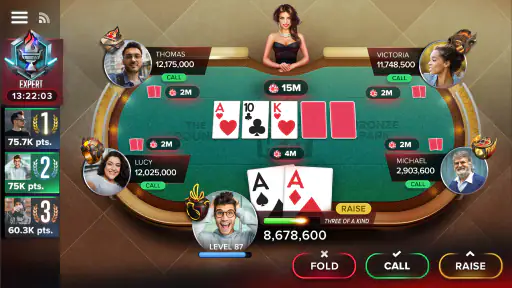
In practical terms, I found the central loop easy to understand. You join a Texas hold’em table, assess your hand and the shared cards, then decide whether to continue, raise, or fold according to the situation presented. The rules are familiar enough that a casual player can begin quickly, but the decisions still reward attention. A weak starting hand can become useful after the flop, while a promising pair can become dangerous when the board gives opponents stronger possibilities.
The most enjoyable part is the rhythm between hands. I can play cautiously for several rounds, then take a calculated risk when the table conditions look favorable. That flexibility gives the game more staying power than a purely automatic card app. I am not simply tapping through a fixed sequence; I am constantly deciding how much confidence to place in incomplete information.
At the same time, the mobile format changes the experience. A phone screen encourages fast choices, and the surrounding presentation pushes the game toward a lively, accessible style rather than a quiet poker study. Players who enjoy the atmosphere of a casino-themed game may find that appealing. Players who want a stripped-down interface focused only on probabilities and tournament discipline may prefer a more serious poker client.
A good match for short, repeatable sessions
My favorite use case is a short break where I have enough time for several hands but not enough time to commit to a long campaign. I can open the game, play conservatively while I get comfortable at a table, and stop after a small run without losing the thread of a larger story. That makes it more convenient than many strategy games, which often punish interruptions or require long stretches of concentration.
More From Our News Desk

Weather by Xiaomi Review: Clear at a Glance, Less Clear Up Close

X Under Pressure: Can It Recover When Posting Goes Wrong?

Clash of Clans Is Won Between the Battles

Android Auto Makes the Case for Quieter Car Software

MobiOffice: Transforming Mobile Productivity with Seamless Integration

EA SPORTS FC™ Mobile Soccer: Redefining Mobile Sports Gaming
It also works for players who want to practice reading situations rather than memorizing complicated rules. I would not treat the app as a complete poker course, but it can help a newcomer become more comfortable with hand strength, betting pressure, and the emotional discipline of folding. The important lesson is not to chase every hand. A player who learns to leave a bad situation early will usually have a more enjoyable time than someone who treats every deal as an obligation to bet.
There is a useful social angle as well. The game is presented as a way to play Texas hold’em with friends, so it suits people who enjoy comparing decisions and sharing the table experience. I would still check the available social options directly on the device before organizing a group session, because the quality of a friend-focused experience depends on how easily everyone can find or join the same game. The core appeal is clearly stronger when the people at the table feel like real opponents rather than anonymous obstacles.
What the version history tells existing players
The move to version 4.71.0 suggests that the game is still maintained as an active product rather than being left untouched after its original release. That is reassuring for someone returning after a long break. A current build is generally a better starting point than an old installation, especially on a modern phone, because compatibility and everyday stability matter just as much as the card rules.
However, I would separate that observation from a promise about any particular update. A version number alone does not tell me that a specific feature has been added or that every older complaint has been fixed. What I can say from using the current release is that the game remains centered on its established poker experience. It does not feel like a completely different genre wearing the same name.
For existing users, that continuity is both a strength and a limitation. Returning players should recognize the basic flow quickly, which reduces the learning curve. They should not expect the newest version to erase every source of friction associated with free-to-play mobile games. The fundamental relationship between playing, progressing, and considering optional purchases remains something to evaluate with clear eyes.
My practical advice for a returning player is to spend the first session observing rather than immediately spending. Relearn the table flow, see how quickly your available resources change during ordinary play, and decide whether the free experience feels satisfying on its own. This small pause can prevent the common mistake of buying something simply because the game creates a moment of pressure.
Where the poker decisions become interesting
The game is at its best when I treat each hand as a small exercise in risk management. I look at position, the strength of my starting cards, the possible draws on the board, and how much other players appear willing to commit. Even without advanced statistics, this approach makes the experience more thoughtful. It also helps separate a genuine decision from a reflexive tap on the most aggressive option.
One non-obvious habit that improved my sessions was setting a personal stop point before I began. I might decide to play for a fixed number of hands or stop after a bad run instead of trying to recover immediately. That rule is especially useful in a game with optional purchases, because frustration can make a player confuse continued play with better play. Folding, stopping, and returning later are all legitimate choices.
Another useful approach is to treat the first few hands at a table as information-gathering rounds. Rather than trying to dominate immediately, I watch for players who call frequently, players who raise only when confident, and players who create pressure regardless of their cards. I do not assume those patterns are permanent, but noticing them gives each decision more context than simply reacting to the size of the current bet.
I also recommend resisting the urge to judge a session by one dramatic hand. Texas hold’em includes unavoidable swings, and a strong decision can still lose when later cards go against it. If I evaluate every outcome as proof that my choice was right or wrong, the game becomes emotionally exhausting. Looking at the decision before the result produces a calmer and more useful way to play.
Free access, purchases, and everyday boundaries
The game is free to download, which lowers the barrier for trying it with friends or testing whether its style suits you. That does not mean the entire experience is free from commercial pressure. In-app purchases are present, and the upper end of the listed range is substantial. I would therefore recommend disabling or protecting purchase confirmation on a shared device, particularly if younger family members might open the game.
The age guidance is Everyone 10+, so I would place it in the category of accessible entertainment rather than a mature gambling product. Even so, the presence of poker themes and paid items makes a short conversation about spending worthwhile. I would explain that the game is for play, not a source of income, and that virtual progress should never justify an unplanned purchase.
A realistic evening scenario shows where the app works well. Suppose I am waiting for dinner while a friend has a few minutes free. We can play a handful of hands, discuss whether a fold was sensible, and stop without arranging a full-length gaming session. In that situation, the quick format is an advantage. If I instead want a serious match with a fixed beginning, middle, and end, a dedicated poker room or an in-person game may offer better structure.
The biggest trade-off is control. Free access makes experimentation easy, but the presence of purchases means I need to manage my own boundaries. Players who dislike any game that repeatedly reminds them about optional spending may become irritated even if they enjoy the poker itself. For those users, a paid card game with a single upfront cost could be a better fit, provided its rules and multiplayer options meet their needs.
How it compares with other ways to play poker
Compared with a basic offline card app, this game feels more social and more animated. An offline alternative is preferable when I want quiet practice, no connection concerns, or a completely predictable environment. The trade-off is that it may lack the sense of a living table and the motivation that comes from facing other players.
Compared with a dedicated competitive poker platform, Poker Heat is easier to approach casually. I do not need to begin with a serious tournament mindset, and the presentation is friendlier to someone who mainly wants quick entertainment. A specialist platform may be better for players who care about formal tournament structures, detailed hand analysis, or a more restrained interface.
Compared with playing poker in person, the app wins on convenience and loses on atmosphere. It is always close at hand, and I can fit it around ordinary errands. It cannot fully reproduce the physical tells, conversation, and shared tension of a table with friends in the same room. I see it as a convenient companion to real-world play, not a complete replacement for it.
Limitations I would consider before installing
The first limitation is that the free-to-play design may not suit everyone. If I am already tired of games that connect progress with optional purchases, the poker mechanics may not be enough to offset that annoyance. The listed purchase range makes it particularly important to decide in advance whether I am willing to spend anything at all.
The second is that mobile poker can encourage rushed decisions. A notification, conversation, or moment of distraction can make me act before properly reading the board. I get better results when I play in a quiet enough setting to follow the hand, even if the session itself is short.
The third is that casual accessibility can feel shallow to advanced players. Someone who wants deep statistical tools, a study database, or a highly formal competitive environment should look elsewhere. This app’s appeal comes from making poker easy to pick up and repeat, not from turning every hand into a technical research project.
Device compatibility is relatively broad: the listed minimum is Android 7.0. That helps people using older Android hardware, although the experience can still vary with screen size, performance, and connection quality. I would install it on the device I actually plan to use and spend a little time checking responsiveness before deciding whether it belongs in my regular rotation.
Who should try it and what to watch next
I would recommend it to a casual poker fan, a newcomer learning the flow of Texas hold’em, or a group of friends looking for a convenient shared activity. It is especially suitable for players who enjoy making repeated decisions in short sessions and are comfortable treating virtual poker as entertainment.
I would skip it if I want a completely purchase-free experience, a rigorous poker-training environment, or the social atmosphere of physical cards. I would also avoid it if I tend to chase losses or make impulse purchases when a game puts pressure on me. No amount of good card play makes that pattern worthwhile.
Looking ahead, I would pay attention to how future versions preserve the quick table flow while handling the needs of returning players. The most valuable improvements would be the ones that make sessions clearer, fairer-feeling, and easier to control without distracting from the cards. I would also watch whether the friend-oriented side remains convenient, because social play is one of the strongest reasons to choose this title over a solitary poker app.
My final view is positive but measured. Playtika has built a recognizable mobile poker experience that is easy to start, flexible enough for spare moments, and more engaging than a simple automated card game. Its long-running development and current version give it the feel of an established title, while its free entry keeps experimentation painless. The best way to enjoy it is to set spending and session limits before the table starts, then focus on making sensible decisions rather than chasing every hand. With that mindset, it is a fun choice for casual Texas hold’em; without it, the commercial pressure may outweigh the convenience.
Poker Heat™ Texas Holdem Poker Frequently Asked Questions
What kind of game is Poker Heat™ Texas Holdem Poker?
Poker Heat™ is a mobile card game centered on Texas Hold’em, with online matches and a competitive poker theme. The game is presented as a free poker experience and is aimed at players who enjoy playing at tables and testing their decisions against others. If you are looking for a traditional card game rather than a broad collection of unrelated mini-games, its focus is firmly on poker.
Who makes Poker Heat™, and how popular is it?
Poker Heat™ is developed by Playtika, and it has been available since August 14, 2012. It has passed 5 million installs and has an average rating of 4.4 from around 388,000 ratings. That kind of reach can make it appealing if you want an established online poker game, while individual experiences can still vary depending on your play style and expectations.
Is Poker Heat™ Texas Holdem Poker free to download?
Yes, Poker Heat™ is free to download, so you can try its Texas Hold’em tables without paying an upfront price. The game does offer optional in-app purchases, with items ranging from $0.99 to $200.00. Those purchases are not required to play, but it is worth checking device purchase settings before handing your phone or tablet to a child.
What age is Poker Heat™ suitable for?
Poker Heat™ has an Everyone 10+ content rating. It is a card game built around Texas Hold’em poker, so younger players and families may want to consider whether poker-themed competition is appropriate for them. The game uses virtual chips in its matches rather than offering standard real-cash poker play, while optional in-app purchases can be restricted through your device’s settings.
What is Poker Heat™ Texas Holdem Poker?
Poker Heat™ Texas Holdem Poker is a free-to-play mobile poker game focused on Texas Hold’em tournaments and competitive online play. It lets you join poker tables, compete against other players, earn chips, and progress through different leagues or locations. The game is designed for entertainment and uses virtual currency rather than real-money gambling, although optional in-app purchases may be available.
Pros
- Fast-paced Texas Hold’em matches with short sessions.
- Large variety of tables
- leagues
- and competitive events.
- Smooth controls make betting and folding easy on mobile.
- Social features let you interact and compete with other players.
- Free chips allow casual play without an initial purchase.
Cons
- Progression can feel slow without regular play or extra chips.
- In-app purchases may become tempting during longer sessions.
- Random matchmaking can create uneven skill-level matchups.
- Requires a stable internet connection for most game modes.
- Frequent events and rewards may encourage extended play sessions.
- Category
- Card
- Version
- 4.71.0