 About Children's doctor: Dentist
Children’s Dentist Games Make Care Feel Easy, but Not Meaningful
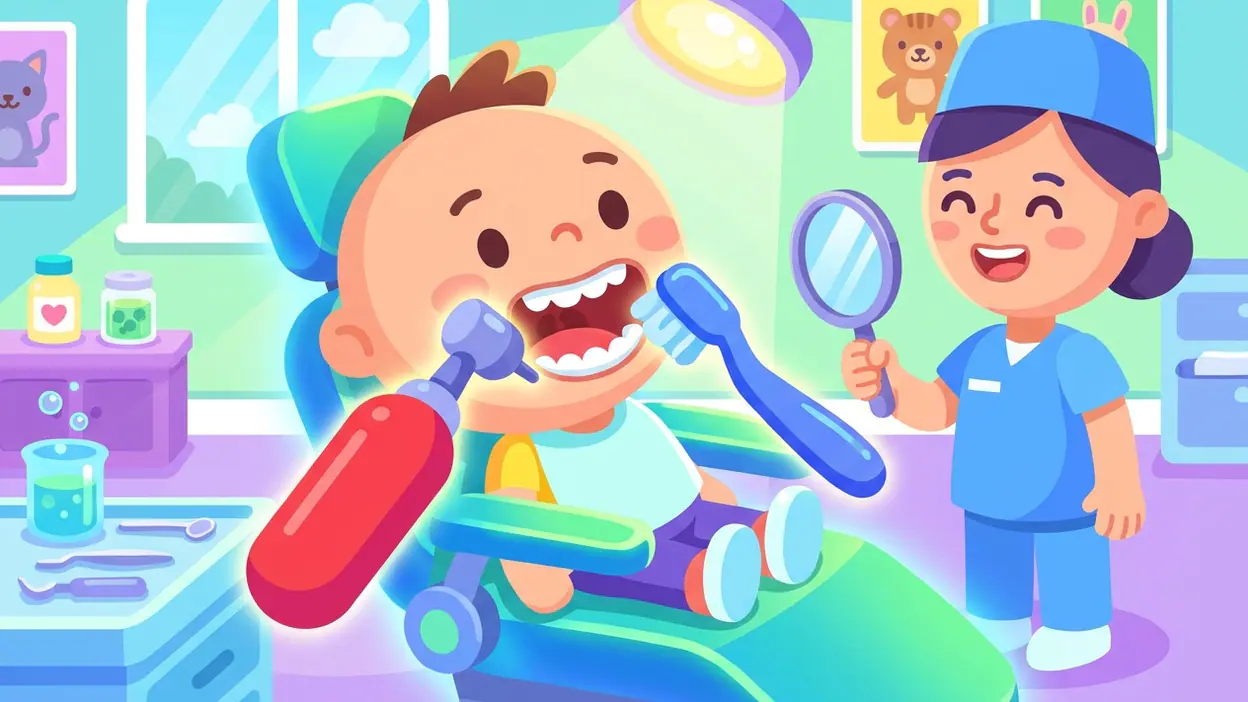
A child taps a tooth, picks a tool and gets to work: that simple promise has carried dentist games for years. The harder question now is whether a cheerful clinic can do more than turn treatment into a sequence of satisfying cleanups. Children's doctor: Dentist is a useful measure of the educational-game category precisely because it understands the comfort of that familiar loop, yet reveals how thin the experience can feel when comfort is mistaken for learning.
The category’s best work does not need to simulate a real dental appointment in clinical detail. It does need to make care feel understandable, give each action a reason, and let a child feel in control. This game’s central appeal is its approachable make-believe: a patient arrives with a dental problem, the player chooses from a set of tools, and the tooth is gradually restored. The rhythm is immediate and friendly. But the current standard for children’s games is moving beyond “tap the problem until it disappears.” Players increasingly expect a little agency, a little context and a reason to return.
The new baseline for educational play
For a mobile educational game, the baseline is no longer simply bright colors and large touch targets. Children expect interactions to respond clearly, instructions to be easy to follow, and mistakes to feel safe. Parents, meanwhile, want to see some connection between play and a useful idea: what a tool does, why brushing matters, or what might happen during a checkup. A game can keep the tone silly, but it should not make every action feel interchangeable.
That expectation has grown alongside mobile games in other categories. Super Stylist Fashion Makeover, for instance, builds its appeal around choices that visibly shape a final look. The player can read the result of a decision in the character’s outfit. The lesson is not that a dentist game should become a fashion game; it is that children notice when their choices matter. In a clinic, that might mean selecting the right tool for the problem or seeing a clear consequence after each step.


Children's doctor: Dentist meets the accessibility side of the baseline well. Its premise is instantly legible, and the clinic setting gives children a familiar role: they are the helper, not the patient. The treatment sequence supplies a tidy beginning, middle and end. That matters for younger players who may be anxious about real appointments. A game that lets them approach teeth through pretend care can make the subject less intimidating before a visit.
The strongest signal here is not a complicated mechanic, but the way the game turns a potentially frightening subject into hands-on play. Dental tools become things to explore rather than objects to fear. Each touch advances the treatment, and the visual payoff of a cleaner, healthier-looking mouth gives the loop a simple sense of progress. For a short session, that clarity is a genuine strength: a child can understand what to do without reading a long tutorial or navigating a crowded menu.
Comfort is useful, but it is not the whole lesson
This is also where the game follows the category’s most established convention. Dentist games commonly frame the patient as a problem to fix and the player as a caretaker with a tray of tools. The routine is satisfying because it makes care tangible: inspect, treat, clean, finish. Familiar actions lower the barrier to play, and the tidy transformation at the end offers an uncomplicated reward.
Latest News

That convention can be helpful, but it gets stale when the tools work like magic buttons. If a child can drag any instrument across any tooth and receive the same sort of response, the game teaches only that touching things makes them better. A meaningful educational loop needs small distinctions. A mirror can help inspect; a brush can clean; a tool can be used for a specific treatment. Even a gentle, simplified explanation would give those actions more substance than visual feedback alone.
The convention this game challenges, at least in spirit, is the idea that dental play has to dwell on discomfort to feel authentic. Its soft, playful approach makes the clinic a place for curiosity. That is a worthwhile choice, particularly for children who are wary of dentists. Yet the challenge remains incomplete if the game removes the anxiety without giving players language or context to carry into real life. Reassurance is strongest when a child can connect the pretend procedure to what a dentist actually does.
Other mobile products help clarify the broader shift. UNO! keeps a familiar card game accessible while making turns and outcomes easy to read; its appeal depends on the player understanding how one move changes the table. Google Maps makes its value legible through live routes and clear next steps, while Google News - Daily Headlines organizes a stream of information into a form people can scan. These are not direct rivals, but they demonstrate a shared expectation across mobile design: interaction should produce understandable consequences, not just motion on screen.
That principle applies even more sharply to games for children. The best educational play makes feedback do double duty: it rewards the action and quietly explains it. A tooth that looks cleaner is satisfying, but a brief cue about brushing away plaque would make the result more memorable. A checkup that reveals a problem could invite the child to inspect before treating it. The goal is not to turn play into a lecture. It is to make the play itself carry the idea.
What an emerging standard would look like
The category’s emerging standard is a compact blend of choice, consequence and replay. A child should be able to take a small decision, see what it changes, and try another route or patient without having to repeat an identical sequence. The loop can remain short; it simply needs enough variation to make another visit feel different. A few distinct cases, tool-specific feedback and a closing recap could create more educational value without burying the game beneath text.
Children’s doctor games still lag in two places. First, they often treat dental care as a one-time rescue rather than an everyday habit. Brushing, checkups and prevention are less dramatic than a tooth emergency, but they are the ideas children most need to retain. Second, many experiences offer little sense of progression beyond finishing the current patient. There is rarely a growing clinic, a new challenge or a reason to revisit an earlier lesson with more confidence.
For users, the consequence is straightforward. A child can enjoy a quick round and may feel more comfortable with the idea of dental tools, but the game’s value depends on what adults do around it. A parent or caregiver can turn the play into a conversation—what the child cleaned, what a real dentist might check, and why regular brushing matters. Without that bridge, the session is pleasant but easy to forget.
That does not make the game a failure. Its gentle premise and clear treatment rhythm suit the short, exploratory sessions that define children’s mobile play. Its limitation is that it leans on the category’s oldest reward: watch a messy problem become neat. The next step is not more elaborate graphics or a longer list of instruments. It is better feedback, purposeful choices and a light touch of explanation.
Children’s dentist games will remain appealing because they let young players rehearse care from a position of control. The category’s future, though, belongs to games that respect that appeal while asking more of the interaction. Children's doctor: Dentist gets the welcome and the basic loop right; it also makes clear that a friendly clinic is only the starting point. The stronger standard is play that leaves a child not just entertained, but a little more ready to understand the real appointment.