Draw Bridge Puzzle: Brain Game
- 768.00
- 4.2
- Installs
- 50.00M
- Price
- Free
Screenshots
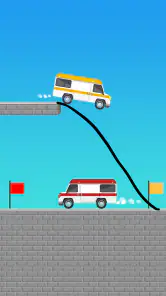
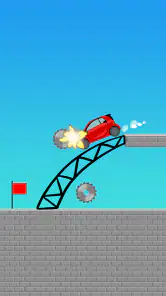
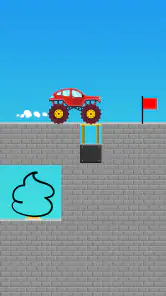
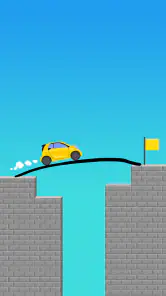
Analysis by Reviewed
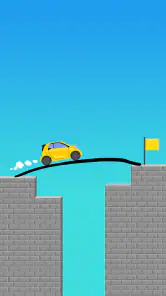
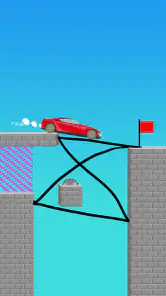
The first thing I notice about Draw Bridge Puzzle: Brain Game is how quickly it makes its central idea clear: a car needs a safe route, and I have to create one by drawing. That simplicity gives each puzzle an inviting, hands-on feel. I am not choosing from a menu of road pieces or steering through a conventional driving course; I am looking at a gap or obstacle and deciding what kind of line might get the car across. It is an easy game to understand, but a successful sketch still takes a little thought.
That makes it a good fit for the small breaks when I want something more engaging than scrolling but do not have the time or patience to settle into a long game. A puzzle can be approached as a quick experiment: draw, see whether the route works, and rethink the shape if it does not. The pleasure comes less from a grand destination than from watching a simple line turn into a practical solution. If you enjoy tactile problem-solving, that premise has a satisfying immediacy.
From a bare sketch to a playable little world
How the visual language supports the puzzle
The drawing mechanic gives the presentation its strongest purpose. A road is not just scenery around the car; it is the mark I make to change what the car can do. That keeps the visual language closely connected to the puzzle itself. I can focus on the shape of the route, judge the gap, and consider whether a straightforward bridge or a more careful curve is likely to help. The screen’s basic premise stays legible even when I am weighing different approaches.
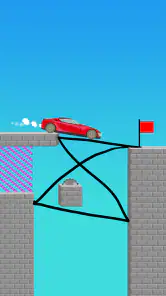
There is a pleasant contrast between the simplicity of making a line and the consequences of getting its shape wrong. Drawing a bridge feels casual, but the car has to use it, so the sketch becomes a small bit of engineering rather than decoration. I find that distinction important: this is not a free-drawing toy where the result is judged only by appearance. The line has a job to do, and that gives each attempt a clear focus.
Brave Labs has made a puzzle game whose visual idea is also its main instruction. That is useful when I return after a few days away: I do not need to remember a complicated control scheme before I can start thinking. The game’s world is built around a car, a route, and the challenge of getting across safely. It is a compact setup, and the drawing interaction does most of the work of making it feel active.
One practical tip is to think about the route before drawing a long, elaborate shape. A short line can be easier to judge because its purpose is obvious; extra bends may make a sketch look clever without making the car’s path more dependable. I try to identify the actual problem first—where the car must cross, and what kind of support the line needs to provide—then draw only what seems necessary. This makes trial and error feel more like reasoning than random scribbling.
The sound and the pace of trying again
The game’s mood is best approached as a light puzzle session rather than a dramatic driving adventure. The focus stays on the small cycle of looking, drawing, and seeing what happens. That gives the play a stop-and-start rhythm: I can pause over a layout, make a quick attempt, then decide whether I want another go. It suits the premise, because the interesting moment is the decision about the bridge, not a long stretch of driving that asks me to stay alert continuously.
I would not pick it primarily for a rich soundtrack or a detailed fictional setting. Its appeal is more practical and immediate: the puzzle gives me a problem to solve, and the car makes the outcome easy to understand. That can be a strength when I want low-pressure play, though it also means the experience may feel modest to someone who expects a strong narrative atmosphere, a memorable cast, or a deep sense of place. The game’s mood comes from its simple physical challenge, not from elaborate world-building.
The pacing also makes it easy to fit around ordinary interruptions. I can play while waiting for a drink, sitting through a short commute stop, or taking a quick break between tasks. In those situations, a puzzle that presents one clear visual problem is easier to pick up than a game that expects me to remember a story thread or manage a lengthy run. I would still avoid starting when I have only a few seconds: even a short puzzle is more enjoyable when I can watch the result and think about why a drawing worked or failed.
Sound can help make a game feel more expressive, but it is not the reason I would recommend this one. Its central feedback is visual and mechanical: the car meets the road I drew, and that outcome tells me whether my idea was sound. That emphasis keeps the play understandable, including in settings where I do not want to rely on audio. It also means players seeking a sound-led arcade experience should look elsewhere.
Why the drawing mechanic works—and where it can frustrate
Among mobile puzzle games, this sits closer to a physics-flavored sketch challenge than to a conventional logic grid. In a grid puzzle, I usually work through fixed rules and discrete moves. Here, the shape I draw matters, and I have to make a judgment about how a road might function when the car encounters it. Compared with a standard driving game, the emphasis is reversed: I am not mainly reacting to the road; I am designing a route before the car uses it.
That difference is the game’s main strength, but also its main limitation. If a drawing does not work, I may need to rethink its shape rather than simply choose a different answer from a list. That can be satisfying when I understand what went wrong. It can be less satisfying when I feel that I am testing small variations without learning much from each one. My best approach is to change one aspect of the sketch at a time, so the next attempt teaches me something instead of becoming a completely different guess.
A useful trade-off is that free-form drawing encourages personal solutions, but it may not suit someone who prefers one clearly signposted answer. I enjoy puzzles more when I can explore a route that makes sense to me, even if it is not the most elegant drawing. If you want carefully staged logic problems with explicit clues and a single obvious chain of deduction, a traditional brain teaser may be a better choice. If you like spatial reasoning and seeing an idea tested in motion, the bridge premise offers a more physical kind of problem-solving.
For younger players, the basic action is approachable, and the game carries an Everyone age rating. That does not mean every puzzle will be effortless; understanding why a route needs a different shape still takes patience. I would use it as a casual puzzle to solve together or independently, rather than assume that a child will breeze through every challenge. Its simple premise lowers the barrier to entry, while the drawing itself leaves room for trial and improvement.
It is free to start, which makes it easy to try before deciding whether its style suits you. Optional in-app purchases are listed at $2.99 per item, so anyone who prefers not to spend can make that preference before playing and pay attention to purchase prompts. I would not treat the free price as a promise that every part of the experience is free of friction; it is simply a low-commitment way to see whether drawing routes is enjoyable for you.
Who should try it, and who may prefer another puzzle
I would recommend it to someone who likes to solve problems with their hands, enjoys quick experiments, and does not mind a failed attempt if it helps clarify the next one. It is especially suitable for short sessions because the core idea needs little explanation. The store shows an average rating of 4.2 from around 47,000 ratings, and the game has passed 50 million installs, a sign that its straightforward hook reaches a broad audience. Those figures suggest popularity, but they cannot tell me whether its particular drawing-based puzzles will click with you.
I would be more cautious recommending it to a player who needs a strong story, a carefully developed setting, or sustained progression as the main reason to keep playing. Someone who wants a more conventional driving challenge may also find the focus on drawing a road too indirect. And if you dislike retrying a puzzle after a sketch behaves differently than you expected, a turn-based logic game with clearly defined moves may feel fairer and more relaxing.
One way to get more out of each level is to treat a failed route as a clue, not just a loss. Ask whether the crossing itself was the issue, or whether the line was more complicated than it needed to be. Then try a smaller adjustment. This habit is particularly useful in a game where drawing is the solution: learning to make the next sketch more deliberate can be more rewarding than trying to produce the perfect bridge on the first attempt.
A measured verdict on its atmosphere
The strongest part of the experience is the way the drawing mechanic, car, and route all serve the same clear mood: curious, casual problem-solving. It does not need an elaborate setting to make a puzzle understandable, and its modest scale makes it easy to return to when I have a few spare minutes. The atmosphere is more about the satisfaction of trying an idea than being transported into a detailed world.
The drawback is that the same focus can make the experience feel narrow if I want more variety in tone or a stronger sense of progression. The pace invites small bursts of play, but the game is not my pick for a long, story-rich evening. I would think of it as a handy puzzle break: open it when I want a quick spatial challenge, give each drawing a reason, and stop when the trial-and-error cycle stops feeling useful.
Draw Bridge Puzzle: Brain Game is currently at version 1.8.5 and supports Android 7.0 or later. Brave Labs released it on July 21, 2022, and it remains a free puzzle game for anyone curious about the draw-a-route idea. My recommendation is straightforward: try it if sketching a practical solution sounds more fun than following a fixed set of moves. Skip it if you need rich storytelling or dislike experimenting. For the right player, its simple visual language and hands-on puzzles make an easy little game to keep nearby.
Draw Bridge Puzzle: Brain Game Frequently Asked Questions
What is Draw Bridge Puzzle: Brain Game?
Draw Bridge Puzzle: Brain Game is a casual puzzle game built around drawing paths that help vehicles cross gaps and reach their destinations. Each level presents a small obstacle course, and you use your finger to sketch a bridge or other supporting route. The main challenge is figuring out how your design will hold up once the vehicle starts moving, rather than simply drawing the shortest line.
How do you play Draw Bridge Puzzle: Brain Game?
You examine the level, draw a line or bridge across the dangerous section, and then start the vehicle to see whether your solution works. A successful route must connect the relevant points while avoiding hazards and allowing the vehicle to reach the goal. Some stages call for a straightforward bridge, while others reward experimentation with angles, shapes, and more carefully placed supports.
Is Draw Bridge Puzzle: Brain Game suitable for children?
The game’s simple controls and visual puzzles may make it approachable for children, and it can encourage basic problem-solving and spatial reasoning. However, suitability also depends on the child’s age and tolerance for repeated attempts. Before installing, check the current store listing for its age rating, advertising, in-app purchases, and privacy details, since these can vary by platform, region, and version.
Does Draw Bridge Puzzle: Brain Game require an internet connection?
The drawing puzzles may be playable without a constant connection, but features such as advertisements, rewards, updates, or other online services may need internet access. Offline availability can also differ between versions and devices. If you plan to play while travelling or without mobile data, check the app’s store description and test a level with connectivity turned off before relying on it.
Is Draw Bridge Puzzle: Brain Game free, and does it include ads or in-app purchases?
The price and monetization can depend on the version and the app store in your region. Free-to-download puzzle games may display advertisements or offer optional purchases, such as removing ads or unlocking content. Review the listing before downloading, and check purchase settings on your device if children will play. The store page is the best source for current pricing and purchase details.
Pros
- Simple one-finger drawing controls are easy to learn.
- Short levels make it convenient for quick play sessions.
- Physics-based challenges reward experimenting with different bridge shapes.
- The central rescue objective is easy to understand.
- Suitable for players who enjoy casual logic puzzles.
Cons
- Some solutions may depend on trial and error.
- Later puzzles can feel repetitive if you play for long sessions.
- Drawing precision may be frustrating on smaller screens.
- Ads may interrupt the flow between levels.
- The casual format may not satisfy players seeking deep strategy.
- Category
- Puzzle
- Version
- 1.8.5