Angry Birds POP Bubble Shooter
- 51.10K
- 4.5
- Installs
- 10.00M
- Price
- Free

Screenshots
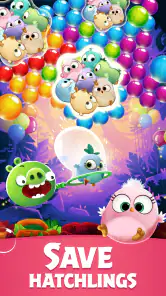
Analysis by Reviewed
Some mobile games are easy to understand but surprisingly difficult to judge fairly. Angry Birds POP Bubble Shooter is one of them: it looks like a simple casual game, yet the quality of each short session depends on timing, planning, and how much patience you have for a level that refuses to cooperate. I spent time with it as the kind of game I would open while waiting for an appointment, taking a short break, or relaxing at the end of the day. My overall impression is positive, provided you want a familiar bubble-shooter format with an Angry Birds presentation rather than a deep strategy game.
The basic idea is immediately approachable. You aim colored bubbles, match groups, and clear obstacles while trying to complete the current challenge. That makes it suitable for quick play, and the Everyone age rating reinforces how accessible the concept is. At the same time, the later experience is not completely mindless. A careless shot can leave the board in an awkward state, while a well-planned bounce can open a much better route. The game is free to start, but optional purchases range from $0.99 to $99.99 per item, so I would approach it with a clear spending limit.
What playing it actually feels like
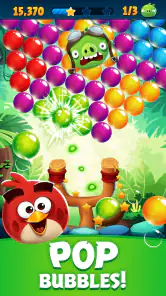
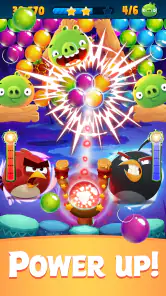
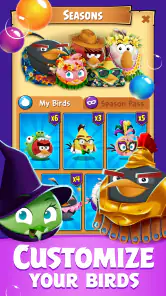
Rovio Entertainment Oy keeps the Angry Birds identity visible without turning the game into a complicated adaptation. The characters, sounds, and visual style give the bubble-shooter format more personality than a plain collection of colored balls. I found that helpful during short sessions because the presentation makes repetition feel less anonymous. You are not simply clearing a board; you are doing it inside a recognizable world with a playful tone.
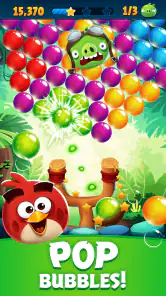
The controls are the kind that need almost no explanation. You generally point toward a target and release, then watch the bubble travel, bounce, and connect with matching colors. That simplicity is a strength when you want to begin quickly, but it also means precision matters. On a small phone screen, a slightly different finger position can change the angle enough to affect the result. I recommend slowing down before difficult shots instead of treating every turn as something to fire immediately.
One of the most useful habits is to look beyond the first obvious match. A shot that removes a small cluster may feel satisfying, but it can also leave important bubbles hanging in a less convenient arrangement. I often get better results by checking which connection supports the largest section of the board. This is a small distinction, but it separates random tapping from deliberate play.
Another practical tip is to use the walls as part of your plan. Direct shots are easy to read, while banked shots can reach areas that are blocked from a straight line. The trade-off is that a bounce gives you less room for error. I treat it as a tool for opening a route, not as a trick to use constantly. If the target is already exposed, the direct option is usually easier to judge.
The game works particularly well in short bursts. A typical everyday use might be opening it on public transport, completing a few attempts, and closing it before reaching your stop. The levels are easy to understand without a long tutorial session, and the casual format does not demand the commitment of a full action or role-playing game. If you prefer games that can be paused mentally and resumed later, this is a comfortable fit.
More From Our News Desk
Weather by Xiaomi Review: Clear at a Glance, Less Clear Up Close

X Under Pressure: Can It Recover When Posting Goes Wrong?

Clash of Clans Is Won Between the Battles

Android Auto Makes the Case for Quieter Car Software

MobiOffice: Transforming Mobile Productivity with Seamless Integration

EA SPORTS FC™ Mobile Soccer: Redefining Mobile Sports Gaming
Where players are most likely to get stuck
The first common sticking point is assuming that every shot should maximize immediate matches. That approach works on uncomplicated boards, but it becomes unreliable when the layout contains several colors or when clearing one area affects access to another. I learned to identify the real objective first: sometimes the important move is not the largest visible group, but the one that removes a supporting connection or creates a better angle for the next turn.
Players can also get stuck by firing too quickly after a previous shot. The board may look familiar, but the useful angle can change once bubbles disappear. Waiting a moment to inspect the new arrangement costs nothing and often prevents a needless attempt. This is especially valuable when the remaining target is near an edge, where a direct shot may be less effective than a controlled bounce.
A less obvious source of frustration is color management. When several colors are available, it is tempting to use the current bubble simply because it has a possible match. I prefer to ask whether that match improves the board or merely consumes an opportunity. If the current shot cannot make meaningful progress, I look for a safe place where it will not block a more important area. That decision is not always glamorous, but it reduces the number of boards that become messy for no good reason.
There is also a psychological trap in replaying a failed level with exactly the same plan. If the opening shot produced a poor position, repeating it without changing the angle or target usually gives you the same problem. I find it more productive to change one variable at a time: aim at a different support point, use the wall instead of a direct line, or prioritize access over the biggest match. This turns failure into information rather than simple repetition.
Setup checks before blaming the game
Because this is a mobile title, a frustrating start is not always caused by the game itself. Before judging the experience, I would check whether the device meets the minimum requirement of Android 6.0. That is an older operating-system threshold, but compatibility still matters if you are using a device that has not been updated for a long time. A supported operating system does not guarantee perfect performance on every phone, yet it removes one obvious source of trouble.
I would also make sure the installation has completed properly and that the device has enough free storage for normal app operation. I am not assigning a specific storage requirement here; the practical point is simply to avoid installing or updating while the phone is nearly full. If the game closes during setup, freeing space and restarting the device are sensible first steps before changing anything more complicated.
Network conditions can matter during installation, updates, account-related processes, or any part of the experience that needs an online connection. If the game appears stuck, switching between a stable Wi-Fi connection and mobile data can help identify whether the problem is the app or the connection. I would avoid repeatedly tapping buttons while a request is still processing, since that can make a temporary delay feel like a larger failure.
It is also worth checking that the game has been updated through the normal app store on your device. The current version is 3.160.0, and using an older build can create avoidable inconsistencies after an operating-system update. I would close the game fully, reopen it, and then try the same action again after updating. That simple sequence is safer than immediately deleting the app.
One detail I appreciate is that the title is free to download and play, which makes testing it low-risk. However, free access does not mean every player will enjoy the same spending pressure. In-app purchases are available, with individual items priced from $0.99 to $99.99. I recommend reviewing purchase controls on the device before handing it to a child, even though the content rating is Everyone. That is a practical family step, not a criticism of the game’s age suitability.
Recovering from a bad session or a stuck screen
When a level goes badly, my first recovery method is simple: stop treating the current attempt as something that must be rescued at any cost. If the board has become awkward, restarting the attempt mentally is often better than forcing weak shots. The useful lesson may be that the opening needs a different priority, not that the game is unfair.
If the interface itself seems unresponsive, I would wait briefly, avoid repeated taps, and then close and reopen the app. On a phone that is handling many other tasks, closing unused apps can also help. These are ordinary troubleshooting steps, but they are preferable to changing several settings at once because they make it easier to identify what fixed the issue.
A failed update or incomplete installation deserves a slightly different approach. I would confirm the connection, check available storage, restart the device, and try the update again through the official store. If the problem continues, reinstalling becomes a reasonable last resort, but I would only do that after considering whether any local progress could be affected. I would not remove the app casually just because one session behaved badly.
For gameplay recovery, I use a three-step routine. First, I identify the part of the board that actually prevents progress. Second, I check whether a bounce can reach it without creating a worse blockage. Third, I choose the shot that improves the next turn, even if it does not produce the largest immediate match. This routine is more reliable than chasing every available combination.
Another useful workflow is to reserve special opportunities for moments that change the board meaningfully. The exact options available can vary by situation, so I avoid assuming that every helpful tool should be used as soon as it appears. I wait until it either opens a blocked route or prevents a near-certain failure. That conservative approach makes limited resources feel more valuable and reduces the temptation to spend simply because a level is annoying.
When the app is not the real cause
It is easy to blame a game when progress feels slow, but some frustration comes from the mismatch between the chosen game and the player’s expectations. This is a casual bubble shooter, not a game built around long-form exploration, complex character development, or competitive depth. If you want a story-heavy adventure, a large strategic system, or a completely skill-based experience without optional purchases, this probably is not the right choice.
It may also be a poor fit if you dislike repeated attempts. The appeal depends partly on learning from a board, trying a different angle, and accepting that not every shot will work. Someone looking for a game where every session delivers constant novelty may find the matching structure repetitive, even with the Angry Birds theme layered over it.
On the other hand, players who usually find traditional bubble shooters visually plain may prefer this one because the characters and presentation give the format a stronger identity. Compared with a basic match-and-pop alternative, the main advantage here is the combination of familiar aiming mechanics and a lively branded world. Compared with a more demanding puzzle game, its advantage is accessibility: you can understand the goal quickly and focus on one board at a time.
The trade-off is that the themed presentation does not transform the underlying genre. If you already own a bubble shooter whose physics, progression, or visual style you prefer, switching may not feel necessary. I would choose this game specifically for the Angry Birds atmosphere and the convenience of short sessions, not because it replaces every other puzzle option.
Its audience is broad. Families can understand it quickly, casual players can use it as a short distraction, and experienced puzzle fans can still find small decisions in angle selection and board management. The Everyone rating makes it approachable, while the optional purchase range means adults should set expectations around spending before a child plays independently.
What the store figures mean in practical terms
The game has been available since March 11, 2015, and its longevity is reflected in the community around it. It holds a 4.5 average from around 681 thousand ratings, with roughly 51 thousand written reviews, and it has passed 10 million installs. Those figures suggest that the format has reached a substantial audience, but they do not replace personal testing. A popular casual game can still be wrong for someone who dislikes its pacing or purchase model.
The developer is Rovio Entertainment Oy, a name strongly associated with the Angry Birds universe. That connection matters here because the theme is not a minor label placed on an unrelated puzzle. It shapes the visual tone and gives the game a recognizable reason to exist beside other bubble shooters. I still recommend judging the actual aiming and level rhythm rather than assuming the brand alone guarantees a perfect fit.
For a new player, I would begin without buying anything. Play enough to learn whether the controls feel comfortable on your phone, whether the retry cycle suits your patience, and whether the visual effects remain pleasant after several sessions. Since the entry price is free, there is little reason to decide about purchases before you know how often you will return.
My practical verdict after using it
I would recommend Angry Birds POP Bubble Shooter to someone who wants a friendly, easy-to-start puzzle game that works in short sessions. Its best qualities are the clear controls, recognizable presentation, and the small amount of planning hidden inside an apparently simple format. The most satisfying moments come from preparing a route, using an angle carefully, and clearing more of the board than a quick match would have managed.
I would not recommend it to a player who wants deep progression, uninterrupted novelty, or a game completely free from optional purchase considerations. I would also suggest skipping it if you know that repeated attempts make you impatient. The game asks you to accept small failures and adjust your approach, and that is central to its rhythm rather than an occasional inconvenience.
For everyone else, the sensible way to try it is to treat it as a compact pastime, not a commitment. Install it, check that your device and connection behave normally, play without spending at first, and pay attention to whether you enjoy planning the next shot. My strongest advice is to stop aiming only for the biggest immediate match. Look for the move that improves the board’s future shape. Once that habit becomes natural, the game feels less random and much more rewarding.
In the end, this is a polished-feeling casual bubble shooter with a strong personality and a low barrier to entry. It does not need to be more complicated than that. If you want quick puzzle sessions with room for careful aiming, it is an easy game to recommend; if you want depth beyond the board, choose something built for that purpose instead.
Angry Birds POP Bubble Shooter Frequently Asked Questions
What should I know about the game’s age rating before downloading it?
Angry Birds POP Bubble Shooter has an Everyone content rating, making it broadly suitable for players of different ages. Its bright cartoon presentation and bubble-popping puzzles are approachable, but the game also offers in-app purchases. If a child will be playing, consider reviewing purchase controls on the device and talking about optional spending before they start.
How much space and device compatibility should I consider before installing?
The game is available for Android and iOS, and Android devices need version 6.0 or later. It is sensible to check your device’s available storage before downloading, since the game and later updates need room to install. If you are using an older phone or tablet, confirm that it meets the operating system requirement before proceeding.
Can I play Angry Birds POP Bubble Shooter on my phone or tablet?
Angry Birds POP Bubble Shooter is available for Android and iOS, so it can suit players who want a casual puzzle game on a compatible phone or tablet. On Android, it requires version 6.0 or later. Before downloading, check that your device meets the operating system requirement and has enough available storage for the game and its updates.
Who developed Angry Birds POP Bubble Shooter, and how popular is it?
The game is developed by Rovio Entertainment Oy and has the recognizable Angry Birds characters at its center. It has an average rating of 4.5 from around 681,000 ratings, with about 51,000 written reviews and more than 10 million installs. Those figures suggest that it has reached a broad audience, though whether its puzzle style suits you depends on your own preferences.
What is Angry Birds POP Bubble Shooter?
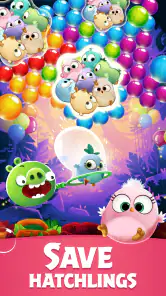
Angry Birds POP Bubble Shooter is a colorful puzzle game that combines the familiar Angry Birds characters with classic bubble-shooting mechanics. You aim and match bubbles of the same color to clear them from the board, rescue hatchlings, defeat enemies, and complete level objectives. The game is easy to understand at first, but later stages introduce obstacles, limited shots, and more demanding strategies.
Pros
- Simple controls make it easy for new players to start shooting bubbles.
- Colorful bird characters and polished animations make levels enjoyable to watch.
- Special boosters can help clear difficult bubble formations more quickly.
- Short levels fit well into quick gaming sessions during commutes or breaks.
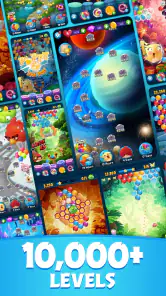
- Frequent events and challenges add variety beyond the standard level progression.
Cons
- Some levels rely heavily on luck
- especially when bubble layouts become difficult.
- Energy or waiting systems may interrupt longer play sessions.
- Extra moves and powerful boosters can become expensive through in-app purchases.
- The game can feel repetitive after extended sessions of matching similar bubbles.
- Notifications and promotional offers may be distracting for some players.
- Category
- Casual
- Version
- 3.160.0