 About Clash of Clans
Clash of Clans Makes Every Quick Raid a Test of Long-Term Strategy
A raid in Clash of Clans can be over before your coffee cools, but the decision that makes it memorable happens in the few seconds before you deploy your first troop. Where is the air defense? Can a Wall Breaker open the route you need? Is the prize worth risking your army? That mix of snap judgment and long-term planning is why this mobile strategy game still earns attention: it makes a small attack feel like a test of everything you have learned.
Plenty of mobile games promise a kingdom to build or a timer to beat. This one has a clearer identity. You shape a village, protect its resources and send an army into someone else’s carefully arranged defenses. Then you return home with loot, lessons and another upgrade to consider. The loop is easy to understand, but good attacks ask you to read the battlefield rather than simply tap the biggest unit.
A village, a raid, and the urge to try again
The opening hook
The early game gets moving quickly. You place a Gold Mine, an Elixir Collector and the first defenses, then watch your tiny settlement start to resemble a real base. The tutorial introduces the basic rhythm without making you study a manual: gather resources, build, train troops and attack. Soon, the Goblins are marching, Cannons are firing and the village is no longer just a collection of buildings. It is yours to solve and yours to defend.
That sense of ownership matters. A base is not merely a level selected from a menu; it is a layout you have arranged, a set of upgrades you have waited for and a target other players may test while you are away. The first successful raid brings the other half of the appeal into focus. You scout, choose a point of entry and commit troops. The battle keeps moving, so hesitation has a cost.


How the core loop feels
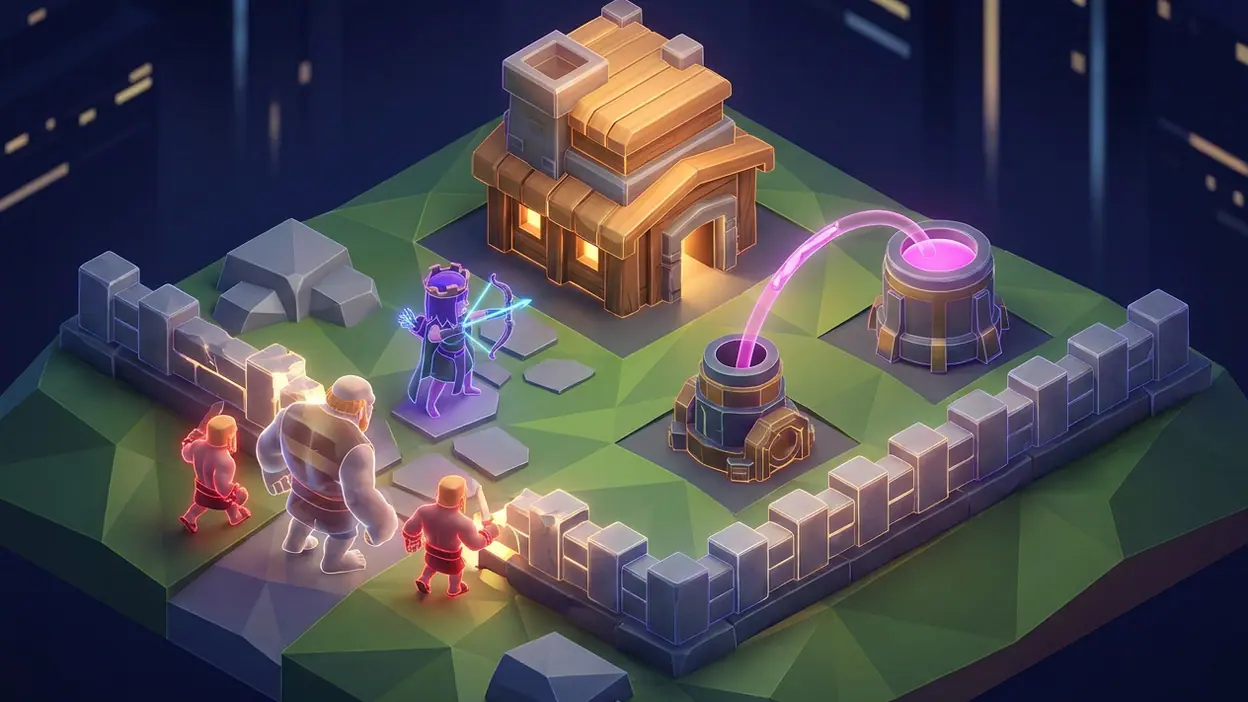
Attacking is more like directing a brief operation than controlling individual fighters. You choose where units enter, deploy spells and hope your plan holds once the defenses begin responding. Barbarians rush into the nearest structures. Archers fire from range. Giants lumber toward defenses, soaking up damage while the rest of the force works. Troops do not always follow the path you imagined, and that is part of the puzzle: a clever plan has to account for what the units actually do.
The strongest attacks have a satisfying shape. A few troops draw fire, Wall Breakers crack a route through the walls, and the main force pushes into the exposed base. A Healing Spell can keep the assault alive; a badly timed deployment can leave your army scattered around the edge, picking off buildings while the clock runs down. You are not just watching numbers fall. You are seeing a plan either hold together or unravel in public, one defense at a time.
That simplicity also makes the game readable on a phone. Buildings are distinct, troops have clear silhouettes and a raid’s changing priorities are easy to follow at a glance. The controls are generous enough for a quick session, but the challenge comes from timing and placement, not from wrestling with a crowded interface. Winning feels earned when you can identify the moment your choices made the difference.
Latest News



Progression that keeps the village personal
Every successful attack feeds the village’s next step. Gold and Elixir fund buildings, defenses and troop upgrades; builders turn those plans into timers. The reward is both practical and visible. A new defense changes the shape of your base. A stronger troop gives an old army composition fresh potential. A Town Hall upgrade opens new possibilities while raising the stakes of how you defend what you have built.
The timers create a patient rhythm rather than a constant stream of instant rewards. You might log in to collect resources, set a builder to work, train an army and leave. Later, there is a new upgrade to claim and a fresh reason to raid. It can feel good to make a clear plan for the next day, especially when you are saving for one expensive improvement. It can also feel slow when several of the most interesting upgrades sit behind long waits. Progress is satisfying, but it asks for patience.
Clan membership gives that progress a social purpose. Clanmates can share advice, donate troops and join Clan Wars, where preparation and coordination matter more than squeezing in a solitary loot run. A war attack carries a different kind of pressure: your contribution affects other people, and a well-executed plan is worth more than simply turning up with a large army. For players who enjoy friendly coaching and shared goals, the clan layer helps the village feel like part of a living game rather than a personal checklist.
Why one more session is tempting
The game is good at giving a short session a natural endpoint and then placing another tempting step just beyond it. You finish a raid, claim the loot and notice that your next upgrade is nearly affordable. You train another army while a builder works. Perhaps a clanmate has requested reinforcements, or a Clan War needs one more attack. Each task is small; together, they form a chain of reasons to stay.
There is also a useful learning loop. A failed raid is not always a waste. You may discover that a hidden trap broke your entry, that an Air Defense punished your flying troops or that a spell went down too late. The next base offers a chance to apply that lesson immediately. The game rewards better judgment, not merely more time, and that gives repeat attacks a sense of momentum even when your village’s biggest upgrades are still counting down.
Of course, the same structure can turn into routine. If you log in only to collect resources and start timers, the village may feel like a maintenance job. The battles are where the game’s personality lives, so players who do not enjoy scouting, planning and repeating attacks may find the long-term loop thinner than its busy menus suggest.
A style with its own comic bite
The art is bright, chunky and deliberately easy to read. Elixir glows pink, Gold shines against green fields, and the buildings look like toys built for a siege. Troops are expressive without being fussy: the Barbarian’s determined charge, the Archer’s focused aim and the Giant’s heavy stride all communicate their roles before a player checks a stat. Battles have enough spectacle to feel lively, but the clean silhouettes keep the action legible.
That visual identity gives the game a friendly surface without making its strategy feel weightless. Your village can be attacked, your resources can be taken and your war performance can disappoint your clan. Yet the comic scale keeps setbacks from becoming grim. A defense collapsing under a swarm of troops is readable, occasionally funny and usually a useful lesson for the next layout.
Who should build a village?
This is a strong fit for players who like planning in layers: a base today, an army for the next raid and a longer upgrade target beyond that. It suits people who enjoy short, repeatable battles but still want a reason to return tomorrow. It is especially rewarding if you like tinkering with layouts, learning troop behavior or sharing strategies with a clan.
It is less suited to anyone who wants a complete campaign that can be played through in a weekend, or who dislikes timers and resource management. You can make meaningful decisions in a few minutes, but the larger arc is intentionally gradual. Spending can speed some parts of progression, so players who want everything quickly may feel the game nudging them toward purchases. The most satisfying route is to treat upgrades as a long game, not a race.
How it compares with familiar strategy games
Plants vs. Zombies™ is the more immediate tactical snack: its fixed lanes make each level a compact puzzle, with little village upkeep between attempts. Clash of Clans trades that tight, one-stage structure for an evolving home base and raids against human-designed defenses. It asks you to learn a broader system, then rewards that knowledge in battles that rarely unfold exactly the same way.
Lords Mobile: Kingdom Wars leans harder into a sprawling kingdom and its wider roster of systems. Last War:Survival Game and Whiteout Survival put their own emphasis on survival-flavored progression and layered management. The appeal here is more focused: the village, the army and the raid remain the center of attention. That focus keeps the core easy to return to, even as years of updates have expanded the game around it.
Why install it now
The best reason to start is not that the game has no wait or grind; it does. It is that the central pleasure remains unusually clear. You can open the game, improve one part of your village, pick a target and test a plan. A new player also gets the satisfaction of seeing a settlement grow from a handful of structures into a base with real defensive shape. Joining a welcoming clan turns that progress into a shared activity, with advice and war plans arriving alongside your own experiments.
Go in expecting a steady strategy game rather than an endless string of instant wins. Keep your early goals simple, learn what your troops target, and pay attention to why a defense stopped your last attack. The game becomes more rewarding as you move beyond deploying everything at once and begin treating each battle as a small design problem.
Clash of Clans is worth installing because its loop still works at both scales: a quick raid gives you an immediate thrill, while the village gives that victory somewhere to go. It can be slow, and its timers will not charm every player, but the moment when a carefully planned army breaks through a base remains as satisfying as ever. If you want mobile strategy with readable battles, visible progress and a reason to return, this is still an easy game to recommend.