 About Word Search Quest - Puzzles
Word Search Quest Turns a Simple Grid Into Focused Play
The best thing Word Search Quest - Puzzles does is give your attention one clear job. A grid fills the screen, a set of words waits to be found, and the rest of the day can briefly fall away. That simplicity is not a lack of design; it is the game’s central feature. Its word-search format turns a familiar paper pastime into a small, repeatable pocket of concentration, though the pleasure depends on how much variety the puzzle stream can sustain.
This is a feature-focused game rather than a story-heavy adventure. The appeal sits in the act of scanning: follow a letter sequence across a row, check a column, then sweep diagonally when the obvious answers are gone. Each discovery brings a modest burst of certainty. You are not racing through a complicated ruleset or managing a sprawling collection of systems. You are looking closely, making a match, and clearing the board one answer at a time.
A familiar grid, tuned for short sessions
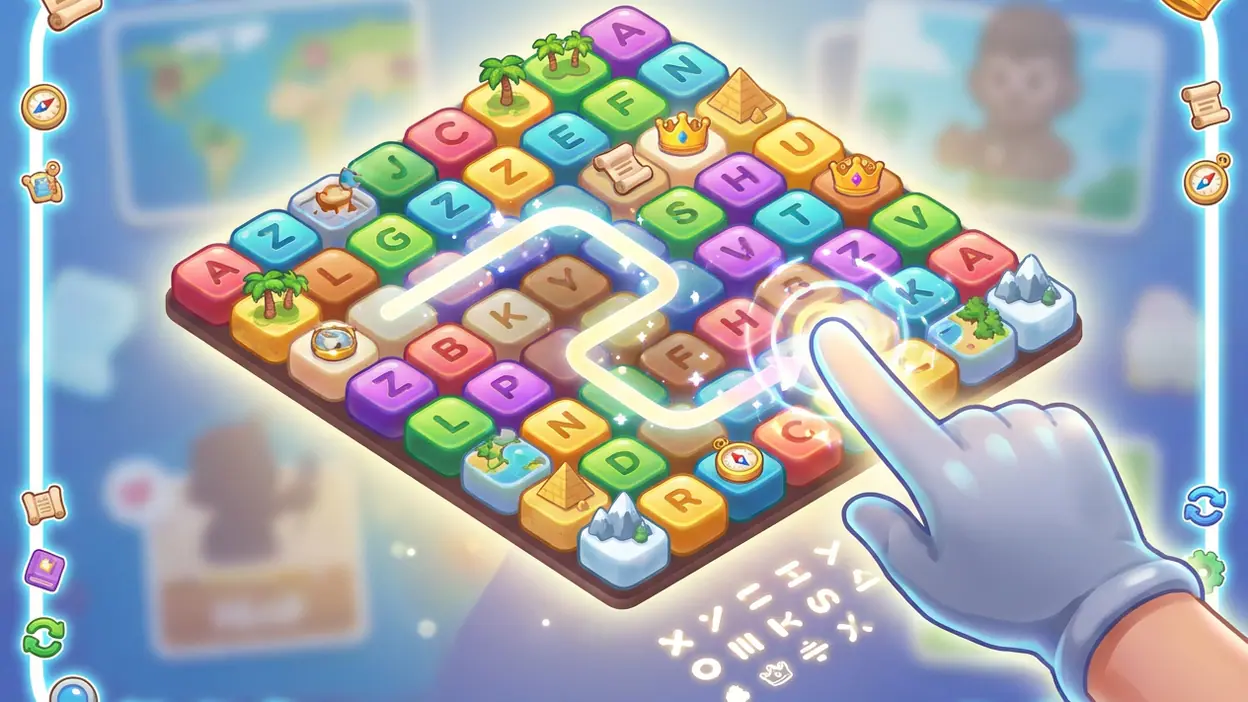
At its core, Word Search Quest - Puzzles presents the standard word-search challenge: locate target words hidden among letters that also form distracting noise. The game digitizes the pencil-and-paper routine, letting you trace a found word directly on the board rather than circle it by hand. That small change matters. Recognition and action happen in one continuous gesture, so the satisfying moment of spotting a word is immediately followed by the clean feedback of marking it complete.
The loop has a tidy rhythm. First, you read the target list and look for distinctive letter patterns. Then you scan the grid, testing likely starts and directions. A match reduces the remaining list and narrows the field; the last few words often demand a slower, more deliberate pass. The puzzle ends with a clear sense of completion, and the next board gives you a fresh arrangement without asking you to relearn the rules.


That makes the game easy to pick up in the gaps that rarely suit a more demanding title: a short break, a quiet wait, or a few minutes before bed. There is little setup and no need to remember a plot or a chain of objectives. The board itself supplies the context, and the target list gives your eyes somewhere useful to begin.
Why the small act of searching matters
Word search looks passive until you notice how actively it uses attention. The grid offers many plausible routes, but only a few letter sequences belong to the target list. You move between broad scanning and close inspection, switching from pattern recognition to patient verification. The task is simple enough to feel relaxing, yet structured enough to keep your mind from drifting completely.
That balance is the feature’s real value. A game can demand focus without demanding intensity. Here, progress does not depend on reflexes, timing windows, or memorizing a complicated combination of moves. The challenge is perceptual: notice the right sequence and confirm its direction. For players who want an activity that occupies their hands and eyes without raising the stakes, that is a meaningful distinction.
Latest News



It also gives the game a useful stopping point. A completed puzzle is a natural boundary, unlike an endless feed that quietly serves up one more item. You can finish a board and put the game down without feeling that you have abandoned an urgent objective. That contained rhythm makes the experience unusually easy to fit around daily life.
The best setting for the game
The strongest real-world use is a brief, interruption-friendly break. If you have five minutes and want something more engaging than scrolling but less involved than a full game session, a word-search board is a good fit. You can make progress in small stretches, and a pause does not usually erase the logic of what you were doing. When you return, the remaining target words and the visible grid make it straightforward to resume.
It is especially well suited to moments when sound and quick reactions would be unwelcome. The pleasure comes from visual attention, not from a soundtrack or a timed performance. That makes the format feel calm in a waiting room or during a quiet evening, provided you can give the screen a few uninterrupted glances. It is not a substitute for a deep puzzle that rewards long-term planning; it is better understood as a compact mental reset.
The game changes behavior by replacing aimless phone checking with a finite task. Instead of opening an app and letting time disappear into an endless sequence, you can choose a board, solve it, and stop. That does not make every session productive, nor should a casual game need to justify itself that way. But the boundary between “one puzzle” and “done” is welcome in a category of mobile entertainment that often encourages automatic continuation.
Where the design is smart—and where it runs out
The smart design choice is the transparency of the interaction. The rules are legible as soon as the grid appears: find a listed word, select its letters, and move on. There is no elaborate tutorial standing between the player and the first satisfying match. The board also does the useful work of making progress visible. Each found answer reduces the list, so a puzzle feels closer to completion even when the last few words are proving stubborn.
That low-friction design is also the source of the game’s main limitation. Once you understand the scanning routine, novelty depends heavily on the quality and range of the puzzles. A different arrangement of letters can refresh the search, but it does not radically alter the task. If the game leans too hard on repeating the same level of challenge or familiar word patterns, the calm loop can slip into routine. The feature is dependable, not endlessly surprising.
Difficulty is therefore important. A board that yields every answer at a glance offers little more than a quick completion check; a board that hides its words too thoroughly can turn a relaxing break into tedious hunting. The most satisfying puzzles sit between those extremes, letting early finds come quickly and making the final search feel earned. Where the game keeps that balance, its simplicity feels considered. Where it does not, the grid can feel like a longer version of the same exercise.
There is also a ceiling to the game’s emotional range. Finding a word creates a small click of satisfaction, not the dramatic payoff of a story reveal or a hard-won strategic victory. That modesty is part of its usefulness, but it means players looking for character, world-building, or sharply escalating stakes should look elsewhere. The game is strongest when judged as a focused word puzzle, not as a broad mobile adventure.
How it compares with other ways to use a phone
Other mobile products make different claims on attention. Google Play Books & Audiobooks can provide a longer, more immersive reading session, while Microsoft SwiftKey AI Keyboard works in the background as a practical typing tool. PayPal - Pay, Send, Save is built around concrete financial tasks, and Gallery helps you revisit or organize images. Those apps are not direct competitors, but the contrast clarifies what this game offers: a self-contained activity with a clear beginning, a visible task, and a satisfying end.
Among word games, the familiar paper-style search is less about creating a new mechanic than making an old one easy to reach. Its advantage over a physical puzzle book is convenience and immediate feedback; its disadvantage is that a screen can make a quiet pastime feel more repetitive if the content does not keep changing. The format’s success rests less on novelty than on whether each board gives you a pleasant reason to keep looking.
That is why the feature works best for a particular kind of player. If you enjoy scanning for patterns, like puzzles without timers, or want a low-pressure game that can be paused between other tasks, Word Search Quest - Puzzles makes a persuasive case. It can also suit players returning to word games after a break, since the basic rules need no ramp-up. People seeking rich progression, competitive pressure, or a constantly evolving set of mechanics may find its narrow focus limiting.
My assessment is straightforward: the game’s word-search loop is its strongest reason to play, and it succeeds because it respects the value of a small, finished activity. It turns a familiar puzzle into an accessible screen-sized ritual, with enough structure to hold attention and little friction between one board and the next. Its weakness is just as clear: repeated searching needs fresh, well-balanced puzzles to stay lively. The grid is at its best when it gives you a calm challenge, then lets you leave on your own terms.