Truck Parking Club
- 290.00
- 4.0
- Installs
- 1.00M
- Price
- Free
Screenshots
Analysis by Reviewed
Finding a legal place to stop a truck is a very different problem from finding a nearby car park. Space, access, vehicle size, timing, and local restrictions all matter, and a wrong turn can cost much more than a few wasted minutes. That is where Truck Parking Club earns attention. I approached it as a practical truck parking app, not as a general navigation replacement, and that distinction shaped my opinion of it.
The app is free, aimed at Everyone, and sits in the Maps & Navigation category. It comes from Truck Parking Club, has passed the one-million-install mark, and holds a 4.0 average from around one thousand seven hundred ratings. Those figures suggest that it has moved beyond being a curiosity for a small group of drivers. The more important question, though, is whether it remains useful after the first few searches and becomes part of a driver's regular planning routine.
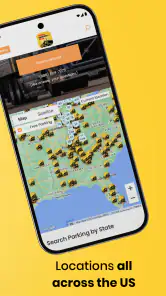
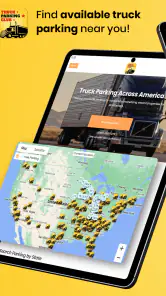
In my experience, its strongest appeal is simple: it focuses attention on truck parking across America instead of making a professional driver filter through information designed mainly for ordinary motorists. That focus can save mental effort. It does not mean every result will suit every rig or every schedule, so I would still treat it as a planning aid rather than a promise that the first option will be perfect.
What makes the first week useful
The first time I used the app, I found the focused purpose more valuable than a long list of extra features would have been. A general map can show parking symbols, fuel stations, rest areas, and businesses, but it often leaves the driver to work out whether a location is genuinely practical for a large vehicle. A truck-specific service starts from the more relevant question: where might a truck driver actually be able to stop?
That narrower approach is especially helpful before a trip. Instead of waiting until the current parking area is nearly full, I would search ahead, note several possible stopping areas, and keep a backup in mind. This is one of the habits that makes the app more useful: use it before fatigue and time pressure turn parking into an emergency, not only when every obvious option has already failed.
A realistic example is an evening delivery that finishes later than planned. A driver leaving the customer may not want to drive around blindly looking for a suitable place. I would open the app while safely parked, check the surrounding area, compare the available possibilities with the route, and decide whether to stop nearby or continue toward another location. The app cannot remove uncertainty from a busy night, but it can make the decision more deliberate.
Another early benefit is the way it can support route preparation without replacing the main route planner. I would use a regular navigation app for turn-by-turn directions and use Truck Parking Club for the parking question. That division of labor is sensible. General navigation remains better suited to traffic, road changes, and the actual journey, while this app is more relevant when the destination is a place to leave a truck safely and legally.
More From Our News Desk

Clash of Clans Is Won Between the Battles

Android Auto Makes the Case for Quieter Car Software

MobiOffice: Transforming Mobile Productivity with Seamless Integration

EA SPORTS FC™ Mobile Soccer: Redefining Mobile Sports Gaming

How Microsoft OneDrive Became a Mobile Productivity Giant

How Google Translate Breaks Language Barriers Effortlessly
The free price lowers the barrier to trying it. A driver can test it on a familiar route, compare the results with places already known, and decide whether it deserves a permanent spot on the phone. Since the app is rated for Everyone, it is presented as a broadly accessible tool rather than something restricted to a narrow age group, although its practical audience is clearly people dealing with truck parking.
How I would test it before trusting it
I would not begin with an unfamiliar overnight trip. I would first search a route I already know and check whether the app surfaces places that make sense for the vehicle and the timing. That test reveals more than simply seeing a map open. It shows whether the results fit the driver's real habits and whether checking them feels quicker than using familiar alternatives.
I would also test the app at different planning stages. Search once while preparing the trip, again when approaching the likely stopping area, and once more if the original plan changes. This exposes a practical trade-off: an app can be excellent for finding possibilities in advance but less helpful if the driver expects it to solve every last-minute problem automatically.
The most useful early workflow is to create a small mental shortlist rather than fixating on one result. Look at the nearest suitable option, identify a second possibility farther along, and leave enough time to change course. That approach treats the app as a source of options. It also protects against the common mistake of assuming that a location shown on a screen will necessarily have space when the truck arrives.
Why it can earn a place month after month
Novelty fades quickly in navigation apps. After the first week, the real test is whether the service helps with recurring decisions. Truck Parking Club has a reasonable chance of doing that because parking is not a one-time problem. Drivers repeat routes, face changing arrival times, and regularly need alternatives when a preferred stop is full or inconvenient.
For a regional driver, the app can become part of a pre-trip checklist. Before leaving, I would identify likely stopping areas near the end of the workday, then keep the search available for changes. For a long-haul driver, the value is more about reducing the number of unknowns along an unfamiliar corridor. In both cases, the benefit comes from repeated preparation rather than from opening the app once and expecting a perfect answer.
It is also useful for drivers who are still learning a territory. Familiar drivers often carry a mental map of dependable stops, but that knowledge may not cover every route or every change in schedule. The app gives newer drivers a starting point for building their own list of practical locations. Over time, the best result is not blind dependence on the app; it is a combination of the app's search coverage and the driver's personal experience.
There is a subtle advantage in using it as a backup tool even when a driver already knows the usual stops. A preferred location may be unavailable, too far away, or poorly timed for the current load. Having a dedicated parking search ready can shorten the time spent switching between unrelated map categories. That recurring convenience is more meaningful than a flashy first impression.
Still, I would not call it a complete logistics system. It is focused on parking, not every part of a driver's working day. It should sit beside route planning, delivery scheduling, vehicle checks, and the driver's own knowledge of operating limits. If someone wants one app to manage the entire journey, this is not the right expectation. Its lasting value comes from doing one job with a clearer purpose.
Three habits that improve the experience
- Search earlier than you think you need to. Planning while calm gives you time to compare possibilities instead of making a rushed choice when the day is already running late.
- Keep a backup location in mind. A parking search is more useful when it produces a fallback, not just one preferred destination.
- Pair it with your normal navigation app. Use this app to investigate parking and the other tool to handle the live route, traffic, and road guidance.
These habits also clarify who benefits most. The app suits drivers who regularly cross unfamiliar areas, independent operators who want a dedicated parking reference, and anyone tired of searching through car-oriented map results. It is less compelling for a driver who travels one short, familiar route and already knows reliable parking options along it.
The maintenance burden behind a parking directory
Any parking app has a maintenance challenge that users feel even when they never see the work behind it. Locations change, availability changes, access conditions change, and a place that was convenient on one visit may be unsuitable on the next. That means the app's long-term usefulness depends not only on having many entries, but on how confidently a driver can interpret them.
I would therefore build a verification step into every serious use. Before committing to a location, check whether it fits the truck, the planned arrival, and the reason for stopping. If the app points toward a possibility that seems questionable, I would compare it with current road signs, local instructions, or another navigation source. This is not unnecessary caution; it is part of using any parking directory responsibly.
The current version is 2.0.5, which tells me the app is an actively versioned product rather than a frozen one-off download. That is encouraging for maintenance, but an update number alone does not remove the need for judgment in the field. I would keep the app updated through the normal store process and pay attention to whether its searches continue to feel relevant on routes I use often.
Maintenance also affects the driver's phone. A parking app is most valuable when it is easy to open, search, and understand during a short planning stop. If the interface becomes cluttered, slow, or difficult to read, the practical advantage of specialization starts to shrink. I found that the best way to reduce friction is to decide what I am looking for before opening it: a stop near a route, a backup for a known location, or a place suitable for an overnight break.
There is a difference between app maintenance and personal maintenance, too. I would not rely on a result saved mentally months earlier without checking it again. A location may still appear in the app while the driver's circumstances have changed. Rechecking the route and the parking choice is a small recurring task, but it is what keeps the tool from becoming outdated inside the driver's own routine.
Where repeated use can become tiring
The main source of fatigue is the gap between finding a possible parking location and knowing that it will work at the exact moment you need it. A map can narrow the search, but it cannot guarantee an open space, a smooth arrival, or a stress-free departure. Drivers who expect certainty may become frustrated quickly, especially after a long shift.
Another limitation is that truck suitability is not a single yes-or-no question. A location may be close but awkward for a particular trailer, convenient for a short break but poor for an overnight stop, or reachable by route but impractical at the end of a difficult day. I would avoid treating proximity as the deciding factor. A slightly farther option may be the better choice if it makes the final approach simpler and leaves more room for adjustment.
There is also the risk of app switching. Because I would still use a general navigation tool for directions and traffic, the process is not completely contained in one screen. Some drivers will see that as a reasonable specialization; others may find it annoying. If your priority is a single all-purpose navigation experience, a conventional mapping app may feel smoother even if its truck-parking information is less focused.
Drivers who rarely need truck-specific parking may not gain enough from installing another tool. Someone making short local trips with dependable private parking has little reason to build a new habit around it. The same applies to users who need detailed fleet management, dispatch coordination, or comprehensive commercial routing. Truck Parking Club should not be judged as though it were designed to replace those systems.
Finally, the app can encourage overconfidence if used carelessly. A dedicated parking search feels authoritative, but the driver remains responsible for checking the situation and making a safe decision. I would never search or read details while moving. The best routine is to plan before departure or pull over safely, then use the app with enough time to consider alternatives.
My long-term verdict
After the first-week appeal wears off, I think Truck Parking Club can earn lasting space on the phone of the right driver. Its strongest quality is not excitement; it is focus. It addresses a recurring problem that general map apps often handle indirectly, and it can make parking preparation feel more organized.
I would recommend it to long-haul and regional drivers who regularly need to investigate truck parking across America, especially those who travel unfamiliar routes or want a backup to their usual stops. The free price makes it easy to test, and the broad Everyone rating keeps the app straightforward to approach. Its one-million-plus install base also shows that it has practical reach beyond a tiny specialist audience.
I would not recommend treating it as a guarantee, a complete navigation replacement, or a substitute for checking conditions yourself. Drivers who already have a dependable parking routine may find only occasional value, while those seeking traffic-aware commercial routing or full fleet tools should look elsewhere for their main system.
My final judgment is positive but practical: keep it if it repeatedly helps you plan earlier, find alternatives, or reduce the stress of an unfamiliar stop. Remove it if your routes never require that help or if checking its results takes more effort than your existing method. For me, its lasting value comes from a disciplined habit—search ahead, keep a backup, verify the choice, and let the app support rather than replace professional judgment.
Truck Parking Club Frequently Asked Questions
Is Truck Parking Club free to download, and what devices can run it?
Truck Parking Club is free to download and is intended for truck drivers looking for parking through a mobile app. On Android, it requires version 6.0 or later. The app is rated for Everyone, though the parking services and listings are aimed at commercial drivers. Check that your device meets the system requirement before installing, then use the app to explore parking options that fit your trip.
Who is Truck Parking Club designed for, and where can it be used?
Truck Parking Club is geared toward commercial drivers who need parking across America, including people planning routes and those searching for a place to stop along the way. It is a Maps & Navigation app, but its focus is finding truck parking rather than general turn-by-turn navigation. Drivers should assess individual locations against their route, schedule, and vehicle needs before booking.
What is Truck Parking Club?
Truck Parking Club is a platform designed to help truck drivers find and reserve private parking spaces for semi-trucks, trailers, and other commercial vehicles. Listings may include spaces on farms, lots, warehouses, and other private properties. Availability, pricing, parking rules, and vehicle-size limits can vary by location, so drivers should review each listing carefully before making a reservation.
How do I find and reserve a truck parking space?
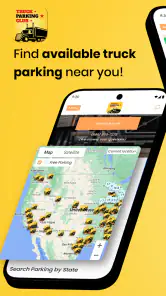
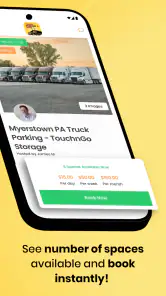
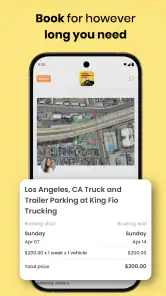
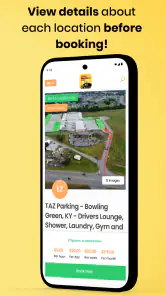
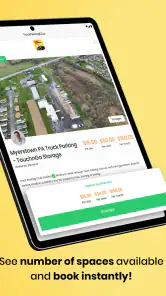
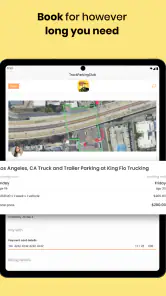
After opening Truck Parking Club, enter your desired location and travel dates to search for available spaces. You can compare listings, check photos and amenities, review the host’s rules, and select a suitable parking option. Once you provide the requested booking details and complete payment, the reservation information should be available in your account for reference.
What types of trucks and vehicles can use the listed spaces?
The types of vehicles accepted depend on the individual property. Some locations are suitable for tractor-trailers, while others may only accommodate bobtails, straight trucks, trailers, or smaller commercial vehicles. Before booking, check the listing’s dimensions, access information, turning space, surface conditions, and restrictions. Contacting the host in advance can help prevent arrival problems.
Pros
- Helps truckers find parking options before reaching crowded areas.
- Listings can make overnight planning more organized and less stressful.
- Useful for comparing available spaces near routes and destinations.
- May reduce time spent searching for safe truck parking after driving.
- Convenient mobile access for checking parking options while traveling.
Cons
- Availability may vary greatly by location
- especially in rural areas.
- Some listings may require advance booking or additional fees.
- Parking details and amenities can differ between individual locations.
- The app’s usefulness depends on accurate
- up-to-date user listings.
- Drivers may need a backup plan if a reserved space becomes unavailable.
- Category
- Maps & Navigation
- Version
- 2.0.5