Learn Stock Trading - Finrise
- 43.00
- 4.6
- Installs
- 50.00K
- Price
- Free

Screenshots


Analysis by Reviewed
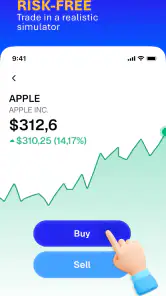
Finrise caught my attention because it approaches investing education through practice rather than asking me to absorb a long stream of theory first. It is an education app from Deep Flow Apps, built around simulated market activity and strategic stock-trading decisions. That makes it easier to explore ideas that can feel abstract in a book or video, especially when I want to see how a choice might play out without putting real savings at risk.
My first impression was positive: the app is approachable enough for someone who has never placed a trade, yet its value depends on whether the simulation encourages thoughtful decisions instead of quick tapping. The store listing presents it as free, with optional purchases ranging from $6.99 to $59.99 per item. It is rated for Everyone, runs on Android 7.0 or later, and the current release is version 1.1.0. Those details make it broadly accessible, although the optional spending deserves attention before using it as a regular study tool.
What the first week feels like
The strongest part of the first week is the low-pressure setting. I can experiment with buying and selling concepts without treating every mistake as a financial emergency. That is particularly useful for learning the difference between having an opinion about a company and having a repeatable reason for entering or leaving a position. A market simulation gives those ideas somewhere to live: I can make a decision, watch the result, and think about whether the decision itself was sensible.
For a complete beginner, this is more inviting than opening a brokerage app and immediately facing real balances, unfamiliar order language, and the emotional discomfort of seeing money move. Finrise gives the learning process a safer starting point. I would recommend beginning with one simple question for every simulated trade: what information made this decision attractive, and what would prove the idea wrong? That habit is more valuable than trying to produce a perfect result.
The app also works well for a person who already understands basic investing but wants to test a strategy without committing capital. Someone might use it to compare a patient approach with a more active one, or to examine how much their decisions depend on short-term market movement. The important point is to treat the simulation as a laboratory, not as a prediction machine. A successful virtual outcome does not automatically prove that the same approach will work with real money.
One useful first-week exercise is to keep a short decision journal outside the app. I would note the reason for each simulated purchase, the time horizon I had in mind, and the condition that would make me reconsider. This turns Finrise from a sequence of isolated actions into a learning record. It also exposes a common weakness in beginner trading: changing the explanation after the result is known.
That workflow is a more meaningful test than simply asking whether the app is entertaining. A market simulation can feel exciting during the first few sessions because every decision produces feedback. The deeper question is whether the feedback helps me improve my process. Finrise has the right educational premise for that, but the user has to supply discipline. If I only chase the most encouraging outcome, I am practicing excitement rather than investing judgment.
More From Our News Desk

Clash of Clans Is Won Between the Battles

Android Auto Makes the Case for Quieter Car Software

MobiOffice: Transforming Mobile Productivity with Seamless Integration

EA SPORTS FC™ Mobile Soccer: Redefining Mobile Sports Gaming

How Microsoft OneDrive Became a Mobile Productivity Giant

How Google Translate Breaks Language Barriers Effortlessly
The app’s audience appears to be broad. Its Everyone content rating makes it suitable for general audiences, but suitability is not the same as financial readiness. Younger users and absolute beginners should understand that simulated success is not a promise of real-world returns. I would use it to learn vocabulary, patience, and decision structure, not to decide where to put actual savings.
How to use the simulation as a learning routine
My preferred first-week routine would be short and deliberate. I would spend one session learning how the simulated market behaves, another making only a small number of decisions, and a later session reviewing why those decisions were made. The goal is not to fill every available moment with trading activity. It is to notice whether the app encourages analysis or merely rewards constant interaction.
A particularly useful trade-off appears when I separate “market knowledge” from “personal behavior.” The simulation can help me think about prices and strategy, but it can also reveal whether I become impatient, overconfident, or reluctant to accept a poor idea. That behavioral information is one of the less obvious benefits of practice. A person who discovers these tendencies in a virtual environment has a chance to address them before real money is involved.
I would also avoid changing several variables at once. If I switch strategy, holding period, and decision frequency together, I will not know what caused a different result. Keeping the experiment narrow makes the app more educational. This is the kind of use that gives Finrise lasting potential beyond its initial novelty.
What remains useful after the novelty fades
The month-to-month value depends on whether I return with a question. Without a specific learning goal, a simulated trading app can become repetitive. With a goal, it can serve as a practical notebook for comparing decisions over time. I might use one month to examine patience, another to study how often I act without enough reasoning, or another to test whether a written plan keeps me from reacting impulsively.
This is where Finrise compares favorably with passive alternatives such as articles or introductory videos. Reading can explain what a strategy means, but it cannot reproduce the moment when I must choose between waiting, buying, or changing my mind. The simulation supplies that decision point. On the other hand, a book or structured course may provide more complete explanations, stronger context, and a clearer progression from basic concepts to advanced topics. Finrise is better as a practice companion than as my only source of investing education.
It also differs from a real brokerage account in an important way: the emotional stakes are lower. That is an advantage for learning mechanics, but a limitation for learning emotional control under genuine financial pressure. I can become more comfortable with a plan in Finrise, yet I should not assume that comfort will transfer perfectly to a real portfolio. Anyone moving from simulation to actual investing should reduce the size of the decision and continue using written rules.
A practical monthly review would focus on process rather than the final virtual balance. I would ask whether I followed my stated reasons, whether I changed course because of evidence or because of discomfort, and whether I could explain each action in plain language. This approach prevents the app from becoming a scoreboard. A poor outcome can still represent a good decision, while a profitable outcome can come from a weak one.
Another non-obvious use is to practice doing less. Many people approach trading simulations assuming that frequent activity demonstrates skill. I think the opposite experiment is more revealing: set a rule to wait unless a clearly defined reason appears. If the experience feels unbearable, that discomfort is useful information about the user’s relationship with activity. Finrise can therefore help identify whether someone is suited to a patient investing style, even when the app itself cannot settle that question.
Its audience size suggests that the concept has already attracted meaningful interest, with an average rating of 4.6 from around 1.5 thousand ratings and more than 50 thousand installs. I see those figures as signs of a healthy initial reception, not proof that the app will remain useful for every learner. Ratings often reflect first impressions, while lasting value comes from whether the app continues to support a deliberate routine after the first week.
The cost of keeping it in your routine
The maintenance burden is fairly light if I use the app in focused sessions. I do not need to turn it into a daily obligation. Two or three purposeful check-ins can be more useful than constant monitoring, especially for a beginner who is trying to understand strategy rather than imitate market noise. The real maintenance task is keeping my learning objective visible.
That said, the app can create a subtle habit of checking for movement simply because movement is available. This is a genuine friction point. If I already spend too much time watching financial news or refreshing investment accounts, a simulation may reinforce that pattern rather than correct it. I would set a time boundary before opening it and stop when the planned exercise is complete.
The optional purchases are another part of the maintenance question. The app is free to start, but individual in-app items cost between $6.99 and $59.99. I would not pay immediately just to extend the novelty. First, I would decide whether the free experience supports a repeatable learning routine. If it does, I would then judge any purchase by a specific educational need rather than by the promise of more activity.
This matters because the most valuable feature of a simulation is not necessarily additional content. Sometimes the better investment is a notebook, a clear set of rules, or a reliable educational reference that explains why a strategy behaves as it does. Finrise can provide the practice environment, but it should not encourage me to confuse more simulated transactions with deeper understanding.
Version 1.1.0 gives the app a relatively focused identity rather than the feeling of a huge all-purpose finance platform. That can be a strength for someone who wants a straightforward starting point. It may also mean that experienced investors looking for detailed analysis, portfolio administration, or professional-level research will outgrow it quickly. I would choose a dedicated finance platform for those tasks and keep Finrise in the educational role.
Where fatigue starts to appear
The main source of fatigue is repetition without reflection. Buying and selling in a virtual setting can be engaging at first, but the actions lose meaning if every session follows the same pattern. The remedy is to change the question, not simply to increase the number of trades. Reviewing a decision journal, comparing patience with activity, or testing a single rule gives each session a purpose.
Another source of fatigue is the gap between simulation confidence and real-world complexity. A clean practice environment can make investing look more manageable than it feels when taxes, personal goals, emergencies, and genuine losses enter the picture. Finrise is useful precisely because it removes some of that pressure, but that removal also limits what it can teach. I would not use it as evidence that I am ready to manage a full portfolio independently.
Beginners may also become frustrated if they expect immediate mastery. The app can let me practice decisions, but it cannot replace careful study of diversification, risk tolerance, time horizon, and the difference between speculation and long-term investing. If I want a guided curriculum with extensive explanations, a structured course or a well-reviewed investing book may be a better primary resource.
Experienced traders have a different reason to skip it. If I already have a tested process and need real-time information, advanced charting, order controls, or portfolio reporting, this app is unlikely to be the right center of my workflow. Its strength is the learning gap between “I have heard of stock trading” and “I can explain the reason behind a simulated decision.” It is less compelling once that gap has been crossed.
I also think users should guard against treating the average rating as a substitute for personal fit. A 4.6 average is encouraging, but a person who dislikes simulations, wants formal lessons, or needs real account management may still find the app frustrating. The best question is not whether other people enjoyed it, but whether the practice format matches the way I learn.
Who gets the most from Finrise?
I would recommend it to a curious beginner who wants to learn by making controlled mistakes, a student exploring financial concepts, or an aspiring investor who needs to slow down and articulate decisions. It is also useful for someone who has read about strategies but has never tested the discipline those strategies require. In each case, the app works best when paired with notes and a clear boundary between practice and real investing.
I would be more cautious about recommending it to a person seeking direct financial advice. A simulation can show consequences inside its own environment, but it cannot know my income, obligations, time horizon, or tolerance for loss. It should not be treated as a personalized recommendation service. Anyone using it with children or teenagers should frame it as education and discuss the difference between a game-like market exercise and actual money.
The developer, Deep Flow Apps, has chosen a useful middle ground between theory and action. I like that positioning because it gives the learner something to do, but I would still supplement the app with trustworthy reading. The combination is stronger than either option alone: explanations provide context, while Finrise gives me a place to test whether I understood the idea.
For an everyday scenario, imagine someone commuting home after work and wanting to learn about investing without risking the money reserved for rent or bills. A short session could involve reviewing one simulated decision, writing down the original reason, and deciding whether the next action should be patience rather than activity. That is a realistic, manageable use. By contrast, opening the app repeatedly during a stressful workday to chase every virtual movement would probably build the wrong habit.
The download requirements are welcoming for people using older Android devices, since Android 7.0 or later is supported. The free entry point also makes it easier to test the learning style before spending anything. Still, I would check my own tolerance for optional purchases and avoid assuming that payment is necessary for competence. The educational value should come from the quality of the practice, not from pressure to unlock a larger experience.
After spending time with it, my view is that Finrise earns a place as a recurring practice tool, not as a complete investing education system or a replacement for a brokerage account. Its lasting value comes from turning vague market curiosity into a repeatable decision-review habit. That is a narrower promise than becoming an expert trader, but it is also a more credible one.
The app is at its best when I use it slowly: choose a question, make a limited number of simulated decisions, record the reasoning, and review the process later. It becomes less useful when I chase constant activity, judge myself only by virtual results, or expect it to explain every part of personal finance. That distinction determines whether it remains helpful after the initial excitement disappears.
Overall, I would recommend Learn Stock Trading - Finrise to beginners who want a practical introduction to strategic stock trading and to intermediate learners who need a safe place to examine their habits. I would skip it as a primary tool if I wanted advanced market research, real portfolio management, or a fully structured course. For the right user, though, it can keep earning its space month after month—provided the user brings a learning plan, limits unnecessary checking, and remembers that simulated confidence is only the beginning of responsible investing.
Learn Stock Trading - Finrise Frequently Asked Questions
What age rating does Learn Stock Trading - Finrise have, and what does that mean for families?
Learn Stock Trading - Finrise is rated Everyone, so its listed content is considered suitable for a broad audience. Since the app focuses on learning about investing and strategic stock trading, parents may still want to discuss the difference between financial education and making real-money decisions with younger users. Learning about markets can be useful, but it does not remove the risks involved in investing.
Who develops Learn Stock Trading - Finrise, and what kind of app is it?
Learn Stock Trading - Finrise is an education app developed by Deep Flow Apps. Its stated focus is helping users learn about investing and strategic stock trading through realistic market simulation. That makes it relevant to people exploring financial concepts in an app format, while the learning experience should be viewed as educational rather than as a substitute for independent research or professional financial guidance.
What is Learn Stock Trading - Finrise, and who is it designed for?
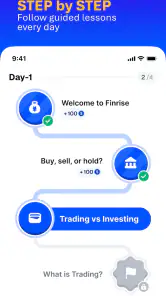
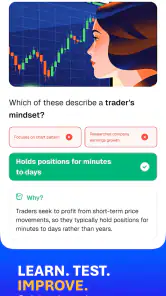
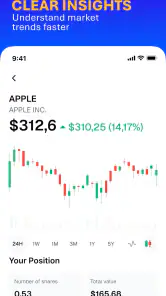
Learn Stock Trading - Finrise is an educational app aimed at people who want to understand stock-market investing and trading. Its lessons are generally structured for beginners, covering concepts such as market terminology, charts, strategies, risk, and portfolio decisions. It may also be useful for more experienced users who want a convenient refresher, but it should not be treated as a replacement for professional financial advice.
Can I use Finrise to buy or sell real stocks?
No, Finrise is primarily a learning and information tool rather than a brokerage platform. The app can help explain how markets work and may use examples, simulations, or educational exercises, but it does not automatically open a trading account or execute orders with a stock exchange. To invest real money, users need a separate regulated broker and should carefully review fees, security, and local legal requirements.
Is Learn Stock Trading - Finrise suitable for complete beginners?
The app is generally suitable for complete beginners because it presents stock-trading ideas in a guided, mobile-friendly format instead of assuming extensive financial knowledge. New users can learn at their own pace and revisit difficult subjects when needed. However, learners should still verify important information from reliable financial sources, since investing involves uncertainty and no educational app can guarantee profitable results.
Pros
- Beginner-friendly lessons explain stock market basics in simple language.
- Short learning modules make it easy to study during spare moments.
- Covers investing concepts before users risk real money.
- Progress tracking helps learners stay motivated and consistent.
- Useful for building financial vocabulary and understanding market terminology.
Cons
- Some advanced trading topics may be covered only at a basic level.
- Educational content cannot replace personalized financial advice.
- Features or lessons may require a subscription or in-app purchase.
- Market information may not always reflect the latest conditions.
- Users need to verify app claims before applying strategies with real funds.
- Category
- Education
- Version
- 1.1.0