Glimr Dating App: Meet & Chat
- 2.55K
- 4.1
- Installs
- 500.00K
- Price
- Free

Screenshots


Analysis by Reviewed
I approached Glimr Dating App: Meet & Chat as a lifestyle app for people who want to meet singles nearby without treating dating like a polished advertising exercise. Its central idea is easy to understand: start conversations, look for genuine local connections, and present yourself honestly. That sounds simple, but the quality of a dating app usually depends less on its slogan than on how much useful activity you find when you open it, how comfortable the conversations feel, and whether the cost stays reasonable once you become invested.
My overall impression is that Glimr is worth trying if you prefer a focused dating experience and are willing to judge it by the people available in your area. It is free to download, which removes the first barrier to experimenting with it. At the same time, it carries a Mature 17+ age rating and offers in-app purchases ranging from $0.99 to $499.99 per item, so I would not approach it casually without keeping an eye on spending. The free starting point is attractive; the paid side deserves much more caution.
How Glimr Works as a Dating and Lifestyle App
Glimr is developed by InfiniteIntel Limited and sits in the Lifestyle category rather than presenting itself as a game or a general social network. That distinction matters. I would open it with a dating goal in mind, not expecting the broad public posting, entertainment feed, or long-form community tools associated with a social platform. The experience is built around meeting, chatting, and deciding whether an online interaction has enough promise to continue.
The app was released on January 13, 2025, and the current version is 1.4.1. It supports devices running Android 7.1 or later, which makes it accessible to people using older Android hardware. That does not guarantee identical performance on every phone, but it does mean you do not need a recent flagship simply to test the service. I appreciate that kind of accessibility because dating apps are more useful when they are not limited to the newest devices.
Its public reception is reasonably encouraging: Glimr has a 4.1 average from around 21 thousand ratings, alongside roughly 2.6 thousand written reviews. It has also passed the half-million-install mark. Those figures suggest that the app has attracted a meaningful audience, but they should not be mistaken for proof that your own town will have a busy pool of compatible people. A dating service can feel lively in one location and thin in another.
That local variation is the first important thing I would tell a friend. The promise of meeting singles in your area is useful only when the area has enough active members. Before investing time in a detailed profile or considering any purchase, I would browse the available discovery experience and ask myself whether the people shown seem relevant, recent, and close enough for a realistic meeting. A large overall user base cannot solve a weak local match pool.
The free starting point and the real cost question
Glimr is free to use at the entry level, so you can install it, understand its general approach, and decide whether the atmosphere suits you without paying immediately. That is the right way to evaluate it. I would not buy anything during the first session, because the most important value test is not how attractive the interface looks but whether you can find conversations you genuinely want to continue.
More From Our News Desk

Clash of Clans Is Won Between the Battles

Android Auto Makes the Case for Quieter Car Software

MobiOffice: Transforming Mobile Productivity with Seamless Integration

EA SPORTS FC™ Mobile Soccer: Redefining Mobile Sports Gaming

How Microsoft OneDrive Became a Mobile Productivity Giant

How Google Translate Breaks Language Barriers Effortlessly
The paid layer changes the calculation. Individual in-app purchases are listed from $0.99 up to $499.99, an extremely wide range. The lower end may feel like a small experiment, while the upper end is a serious commitment that should never be treated as an automatic part of dating. Since the purchase range alone does not tell me which option will be useful in a particular situation, I would read every checkout screen carefully and avoid assuming that a larger package guarantees better matches or a faster relationship.
This is where Glimr requires discipline. Free access gives you a chance to assess the community, while paid value depends on what a purchase actually changes for your account and whether that change solves a problem you are experiencing. If your issue is that local profiles do not interest you, spending more will not necessarily fix it. If your issue is limited visibility or difficulty getting conversations started, a modest purchase might be easier to justify, but only after you understand the exact benefit shown in the app.
My practical rule is simple: use the free experience long enough to identify a specific obstacle, then consider the smallest relevant purchase rather than buying based on excitement. Set a personal spending limit before opening the payment screen. Dating apps can make a quiet evening feel urgent, and urgency is a poor reason to spend. Glimr is much easier to recommend when treated as an optional tool, not as a paid shortcut to a relationship.
What value the app can deliver
The strongest value here is the chance to narrow dating toward people who may be geographically reachable. That sounds obvious, but distance changes the entire rhythm of online dating. A promising conversation with someone nearby can move naturally toward a short coffee or a simple first meeting. Conversations with people far away can be enjoyable, yet they often create uncertainty about whether the connection is practical.
I also like the emphasis on being genuine because it encourages a more useful profile strategy. Instead of trying to sound universally appealing, I would write about the routines and interests that actually shape my week. A specific detail gives another person something to respond to, while a vague list of flattering adjectives usually creates no opening. This is not a hidden technical feature; it is a way to get more value from the app’s basic purpose.
A realistic use case would be someone who has recently moved to a new neighborhood and wants to meet people beyond work. They could use Glimr during a short evening break, review nearby profiles, and begin one or two conversations based on a shared interest rather than sending the same greeting to everyone. The useful workflow is to keep the first exchange light, look for reciprocal effort, and move away from endless messaging if the conversation feels comfortable and local. That makes the app a practical bridge between discovery and an actual social plan.
Another less obvious benefit is that the local focus can help you make better decisions about compatibility early. If someone’s schedule, preferred activities, or idea of a first meeting clearly clashes with your own, the mismatch becomes apparent before you spend weeks chatting. I would use that information positively rather than trying to persuade every interesting profile into becoming a match. The goal is not maximum conversation volume; it is finding a few interactions with enough substance to deserve attention.
Glimr can also be useful for people who dislike the performative feel of larger dating platforms. Some mainstream alternatives can feel like an endless stream of swiping, with users optimizing photos and short prompts for quick reactions. Glimr’s stated focus on real connections gives it a more personal angle, although the actual experience still depends on the local community and on how thoughtfully members present themselves. I would choose it over a broad social network when I want dating intent to be clearer from the start.
Where the experience demands caution
The first trade-off is audience density. A dating app is not a private journal; its usefulness depends on other people being present and responsive. Even with more than half a million installs overall, I would not assume that Glimr has equal momentum everywhere. Someone in a large, active urban area may find the service more rewarding than someone in a small community, where the same profiles may appear repeatedly or new conversations may arrive slowly.
The second trade-off is that “nearby” does not automatically mean “compatible.” Location can make a meeting possible, but it says nothing about communication style, expectations, availability, or safety. I would treat distance as a practical filter, not as evidence of quality. A nearby profile with little genuine information is less useful to me than a slightly less convenient profile that communicates clearly and respectfully.
The Mature 17+ rating is another reason to use judgment. It signals that the app is intended for an adult audience, but it should not be read as a promise that every interaction will be mature, respectful, or suitable for a serious relationship. I would avoid sharing sensitive personal details early, keep initial meetings in public places, and tell a friend where I am going. Those habits matter more than any optimistic description of a dating service.
There is also a natural tension between authenticity and presentation. Encouraging people to be real is worthwhile, but users still decide quickly whether to respond. A completely empty profile may feel honest to its owner while giving everyone else no reason to start a conversation. My compromise would be a small number of accurate details, recent photos that represent everyday appearance, and a clear indication of what kind of connection I am open to. That is more useful than either exaggerating or revealing everything immediately.
The payment range creates the most serious financial friction. A free app can still encourage paid decisions at emotionally vulnerable moments, and a maximum purchase of $499.99 per item is far beyond what I would consider a casual test. I would never interpret a premium option as a guarantee of attention, compatibility, or a successful date. If the free experience does not show enough promise, the sensible response is usually to stop rather than escalate spending.
Tips for getting more from a free trial
I would begin by treating the first few sessions as research. Notice whether the nearby profiles fit your age range and relationship goals, whether conversations receive thoughtful replies, and whether you feel comfortable with the tone. Do not spend simply because the app has made it easy to browse. The free tier is most valuable when it helps you answer whether the community itself is worth your time.
For profile writing, replace broad claims such as being “fun” or “easygoing” with one concrete activity and one realistic preference. For example, mention the kind of weekend you actually enjoy and the sort of first meeting that would feel comfortable. This gives a potential match a natural question to ask. It also filters out people looking for a very different lifestyle without requiring a long explanation.
When chatting, I would look for balance rather than speed. A person who asks questions, answers yours, and respects a reasonable pace is showing more useful information than someone who sends a flood of compliments. If the conversation becomes repetitive, suggest a simple topic connected to your profile. If it remains one-sided, do not try to rescue it with a purchase or endless messages. Attention is a resource, and Glimr works better when you spend it selectively.
Before meeting, confirm basic practical details without turning the conversation into an interrogation. Agree on a public location, choose a short first meeting, and keep your own transport or exit plan. A nearby match does not remove the need for caution. I would also avoid moving immediately to private contact channels if the person pressures me, refuses ordinary questions, or makes the conversation feel rushed.
If you do consider an in-app purchase, write down what you want it to accomplish before paying. “I want more matches” is too vague; “I want to test a particular visibility option for a limited period” is a more controlled reason, provided the purchase screen clearly explains what it provides. Use the smallest available commitment that addresses the specific problem, and stop if the result does not improve your experience. This approach protects the value of the free access and keeps paid spending from becoming the main activity.
Who should choose Glimr, and who should look elsewhere?
I think Glimr is a good fit for adults who want a straightforward dating app with a local angle and who are comfortable putting effort into honest profiles and individual conversations. It is especially appealing if you are tired of broad social platforms where dating intentions are unclear, or if you want to test a newer service without paying at installation. People using older Android phones may also appreciate the relatively modest minimum operating-system requirement.
It may suit someone returning to dating after a break because the free entry lets them explore at their own pace. I would still recommend starting slowly. The right question is not whether the app can produce instant attention, but whether it helps you find respectful, practical conversations that fit your life. That standard prevents the common mistake of measuring an app only by the number of profiles viewed.
I would be more cautious if you live in an area with few active dating-app users, need a highly specialized matching system, or want extensive non-dating community features. A larger established alternative may be better when maximum local reach is the priority. A service built around detailed compatibility tools may be preferable when shared values, long-term goals, or specific preferences matter more to you than a simple nearby discovery experience.
It is also not the right choice for anyone who expects paying more to remove the uncertainty of dating. No purchase can guarantee replies or chemistry, and the upper end of Glimr’s purchase range makes that expectation particularly risky. If you are likely to spend impulsively after a disappointing session, I would skip the paid options entirely or choose a different service with a payment model you understand more comfortably.
My verdict after weighing the value
Glimr earns a cautious recommendation from me as a free dating app to test, not as a service I would blindly pay for. Its local focus can make conversations more practical, its genuine-connections angle encourages better profile habits, and its established presence is reflected in a 4.1 average rating and over 500 thousand installs. Those signs make it reasonable to explore, but they do not replace checking the quality of the community where you live.
The value is clearest when you use the free access to evaluate real activity, improve your profile, and start a small number of purposeful conversations. The value becomes uncertain when you move toward expensive purchases without knowing exactly what problem they solve. With individual items reaching $499.99, I would keep spending firmly optional and modest.
My buy-or-skip decision is therefore straightforward: try Glimr for free if local dating and direct chat match what you want, but skip paid upgrades unless a clearly explained, small purchase addresses a specific need. I would recommend it to a friend who wants another route to meeting nearby singles and is comfortable making careful decisions. I would not recommend it to someone seeking guaranteed compatibility, a very deep matching system, or a reason to spend heavily. Used patiently, it can be a useful starting point; treated as a shortcut, it is much harder to justify.
Glimr Dating App: Meet & Chat Frequently Asked Questions
Does Glimr help me meet singles nearby?
Glimr’s summary describes it as a place to chat and meet genuine singles in your area, with the idea that real connections start with being real. If you are looking for a dating app centered on connecting with nearby people, that focus may suit you. As with any online dating service, take time to review profiles and use good judgment before arranging to meet.
Who develops Glimr Dating App: Meet & Chat?
Glimr Dating App: Meet & Chat is developed by InfiniteIntel Limited. Knowing the developer can help you identify the app when browsing for it and distinguish it from other dating services with similar names. The app is in the Lifestyle category and is presented as a way to chat with and meet singles. Review the app’s permissions and privacy information before creating an account.
Who is Glimr Dating App: Meet & Chat intended for?
Glimr is a dating app for adults who want to meet and chat with other singles. Its mature audience rating means it is not intended for children or younger teens. Before downloading, consider whether you are comfortable using an online dating service and sharing a profile with other members. The app is free to download, though some features may involve purchases.
Is Glimr Dating App: Meet & Chat suitable for everyone?
No. Glimr is intended for adults, and its Mature 17+ rating makes it unsuitable for children and younger teens. It is also best suited to people who are comfortable meeting potential partners through an app, creating a profile, and communicating online. Anyone considering a download should think about their privacy and personal boundaries, and use the service respectfully and cautiously.
What is Glimr Dating App: Meet & Chat, and how does it work?
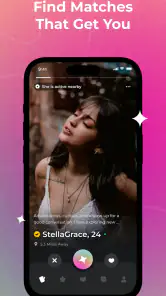
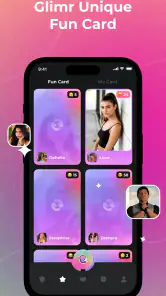
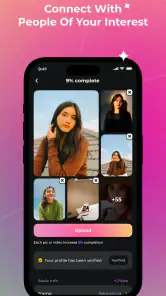
Glimr Dating App: Meet & Chat is designed to help people discover potential matches, view profiles, and start conversations online. After creating a profile, you can usually add photos, write a short introduction, set preferences, and browse other members. Depending on the available features, matching may involve liking profiles or sending messages when there is mutual interest.
Pros
- Quick profile browsing makes discovering potential matches feel effortless.
- Chat tools help keep conversations organized after matching.
- The app has a modern
- visually appealing interface.
- Useful for meeting people beyond your usual social circle.
- Profile-based matching can make introductions feel more personal.
Cons
- The quality of matches may vary depending on your location.
- Some useful features may require a paid subscription.
- Limited profile details can make compatibility hard to judge.
- You may encounter inactive or incomplete profiles.
- As with any dating app
- unwanted messages and fake profiles are possible.
- Category
- Lifestyle
- Version
- 1.4.1