Austin American-Statesman
- 250.00
- 3.1
- Installs
- 10.00K
- Price
- Free

Screenshots

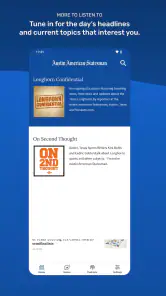





Analysis by Reviewed
I approached Austin American-Statesman as a local news reader rather than as a general-purpose newspaper replacement. Its focus is clear: Austin news, sports, politics, alerts, puzzles, and access to the daily newspaper, all gathered in one mobile experience. That narrow focus is its biggest advantage. If Austin is central to your daily life, the app can make local coverage easier to reach than a scattered collection of browser tabs. If you mainly want national headlines or a broad selection of publications, its local emphasis may feel limiting.
The app is developed by Hearst Newspapers - LLC and belongs to the News & Magazines category. It is free to install, rated for Everyone, and supports Android devices running version 9 or later. The current version is 202608.28, while its history reaches back to March 20, 2013. Those details matter because this is not a newly assembled experiment; it is a long-running local publication app that has continued to receive version updates.
My overall impression is cautious but useful. The app gives Austin readers a practical home for local information, yet its average rating of 3.1 from around 399 ratings suggests that the experience has not been equally smooth for everyone. I would not treat that score as a final verdict by itself, but I would take it as a reason to pay attention to sign-in, subscription, notification, and reading behavior before making it my only news source.
What the app is really for in everyday use
The strongest use case is the person who wants local context without repeatedly searching for it. A national news app may tell you that a major issue is developing, but a local newspaper app is more likely to organize that issue around Austin readers, local politics, nearby sports, and community events. That difference is important when the question is not simply “What happened?” but “How does this affect the place where I live?”
I can imagine opening it during breakfast to scan the main local stories, checking sports later in the day, and returning to alerts when something important changes. The puzzles and daily newspaper access also give it a slower, more habitual side. It is not only a breaking-news tool; it is designed to fit into the routine of someone who still enjoys reading a publication as a whole.
The store summary also makes the app’s scope unusually easy to understand. You are not downloading an anonymous feed filled with unrelated headlines. You are choosing an Austin-centered publication experience. That clarity helps set expectations, although it also means the app is not the right choice for readers who want one place for international reporting, technology news, finance, and several competing viewpoints.
A realistic morning and evening workflow
For a commuter, a sensible routine would be to open the app once on a reliable connection, review the local headlines, and then decide whether alerts are worth keeping active. During the day, sports and politics can be checked separately instead of mixing every subject into one endless stream. In the evening, the newspaper view and puzzles offer a more deliberate reading session than quickly swiping through short updates.
More From Our News Desk

Clash of Clans Is Won Between the Battles

Android Auto Makes the Case for Quieter Car Software

MobiOffice: Transforming Mobile Productivity with Seamless Integration

EA SPORTS FC™ Mobile Soccer: Redefining Mobile Sports Gaming

How Microsoft OneDrive Became a Mobile Productivity Giant

How Google Translate Breaks Language Barriers Effortlessly
That workflow reveals a useful trade-off: the app is more valuable when you want organization than when you want speed alone. A social feed may surface a developing story earlier, but it also brings repetition, commentary, and distractions. Here, the publication structure is the point. I would use a fast general news source for a broad first alert, then use this app for Austin-specific reporting and follow-up.
One practical tip is to separate urgent alerts from routine reading in your own habits. If every notification feels equally important, the useful ones can become background noise. I would begin conservatively, keep only the alerts that genuinely help me, and use the app manually for the rest of the day. That approach gives the local coverage room to work without allowing the phone to dictate my attention.
How it compares with browsers, aggregators, and print reading
Compared with visiting the newspaper website in a browser, the app should be more convenient for repeated mobile reading because it keeps the publication in a dedicated space. The benefit is less about discovering something revolutionary and more about reducing friction: one familiar entry point for local stories, alerts, puzzles, and the newspaper edition.
Compared with a news aggregator, the experience is more focused but less varied. Aggregators are useful when I want several publishers, contrasting headlines, or a quick overview of the wider world. The Statesman app makes more sense when I already know that Austin coverage is the priority. It gives up breadth in exchange for a stronger local identity.
Compared with a physical newspaper, the digital version is easier to carry and better suited to quick checks throughout the day. The trade-off is that reading on a phone can encourage fragmented attention. I would choose the app for convenience and timely updates, while a larger screen or print edition may be better for a long, uninterrupted newspaper session.
Trust, controls, and the moments that deserve attention
What can reasonably be trusted
Trust here begins with knowing what service you are using. The developer is identified as Hearst Newspapers - LLC, and the app presents itself as the Austin American-Statesman rather than disguising its editorial source behind a generic label. That transparency is useful, but it should not be confused with a guarantee that every reader will agree with every article. Publication identity helps me judge where coverage comes from; it does not remove the need to read critically.
The app’s Everyone content rating is reassuring in a basic sense: it is positioned for a general audience rather than a narrowly restricted age group. Still, news itself can cover difficult subjects, political conflict, and upsetting events. I would consider the age label a broad access classification, not a promise that every story will suit every reader.
The public rating is more mixed. An average of 3.1 indicates a middling reception, and the app has around 250 written reviews alongside its ratings. I read that as a signal to test the experience personally, especially if I depend on the app for paid reading or time-sensitive alerts. Ratings can reflect different phones, account situations, expectations, and update periods, so they are a warning light rather than a complete diagnosis.
Account and payment choices
The installation itself is free, which makes trying the app relatively straightforward. The important distinction is that free installation does not necessarily mean every newspaper experience is free. In-app purchases range from $14.99 to $69.99 per item, so a reader should pay close attention to what is being offered before confirming a purchase.
This is where I would slow down. If the app presents a subscription, access pass, or another paid option, I would read the payment screen carefully, check the billing interval, and confirm which account is being charged. I would also avoid assuming that deleting the app ends a subscription. Subscription management normally belongs with the platform account used for the purchase, so I would review that account’s controls directly if I decided to stop paying.
A useful habit is to take note of the exact access promise shown at the moment of purchase. Does it cover the newspaper, articles, puzzles, or another part of the service? I would not rely on the free download label to answer that question. The safest approach is to treat each purchase screen as a separate decision and keep control of it through the device’s account settings.
Permissions and personal data: what I would check
I do not think a responsible review should guess about permissions or data practices that are not visibly documented. Instead, I would inspect the permission prompts on my own device and grant only what makes sense for how I plan to use the app. For a news reader, notifications may be useful, but they are also the clearest example of a choice that should remain in the reader’s hands.
If the app requests access that seems unrelated to reading articles, alerts, puzzles, or newspaper content, I would pause and ask whether the benefit is clear. Android’s permission manager can show what access has been granted, and those settings can be revisited later. That does not prove how information is handled behind the scenes, but it does give me a practical way to limit unnecessary device access.
I would also review the app’s privacy information before creating an account or subscribing, particularly if I am uncomfortable with personalized experiences or account-linked reading activity. The right question is not simply whether the app is from a recognizable newspaper. It is whether the choices presented on the device and in the account screens match my own comfort level.
Data-sensitive moments during normal reading
The most sensitive moments are not necessarily while reading a headline. They are more likely to occur when signing in, enabling alerts, saving account details, or starting a paid purchase. Those are the points where I would slow down, read the wording, and avoid tapping through automatically.
Alerts deserve special care because they can reveal topics on a lock screen or interrupt private situations. I would decide whether previews should appear when the phone is locked, and I would turn notifications off temporarily if I were traveling, working, or sharing the device. This is a small setting, but it has a direct effect on privacy and concentration.
Account access is another practical concern. If I use the app on a shared or borrowed device, I would sign out afterward rather than leaving a newspaper account open. I would also avoid storing payment details casually and would use the platform’s established account controls for purchase history and cancellation. These steps are not unique to this app, but they matter more when a free reader can lead into paid access.
Where the app gives the reader agency
The app’s strongest form of user agency is the ability to decide how deeply it enters your routine. You can use it occasionally for Austin coverage, make it a daily newspaper habit, or keep alerts disabled and open it only when you choose. I prefer that flexible approach because local news is valuable without needing to become a constant stream.
I would begin with a short trial period focused on three questions: Are the local stories relevant to me? Do alerts add useful timing or merely interrupt me? Is the reading and account experience comfortable enough to justify returning? Those questions are more informative than relying only on the store rating, because they test the exact reasons I would install it.
Another useful choice is to keep a second source available. That is not a criticism of this publication; it is sensible news hygiene. A local newspaper app can provide depth and place-based reporting, while another source can offer national or international context. If one app has a temporary technical problem or a story falls outside its local remit, I am not left without information.
Who should use it, and who should skip it?
I would recommend trying it if you live in Austin, follow local government, care about area sports, enjoy puzzles, or want digital access to a daily newspaper. It is especially suitable for readers who prefer a publication with a defined local identity over an algorithmic stream that mixes everything together.
I would be less enthusiastic for someone who wants a completely free, broad news service with no purchase prompts. The in-app purchase range means that cost-conscious readers should inspect access terms carefully. I would also suggest skipping it if your main interest is international news, business analysis, or a multi-publication comparison; a general news aggregator or several specialist sources would suit those needs better.
Readers who dislike notifications should not treat that as a reason to reject the app immediately. The better approach is to disable or reduce alerts and use it as an on-demand newspaper. On the other hand, if you need instant updates from many regions and topics, restricting yourself to an Austin-centered app would be inefficient.
My cautious verdict
I see Austin American-Statesman as a focused local news companion with a clear purpose, not an all-in-one replacement for every source I read. Its coverage areas, newspaper access, puzzles, and alerts make it relevant to Austin residents who want one recognizable place to return to. The free installation lowers the barrier to testing it, while the general-audience rating makes it broadly approachable.
My caution comes from the middling user rating and from the practical questions around paid access, notifications, account security, and device permissions. None of those points automatically disqualifies the app, but they do make a measured setup worthwhile. I would install it, review the permission prompts, keep notifications selective, and examine every purchase screen before committing.
My recommendation is conditional: use it when local Austin reporting is your priority, but keep control of alerts, account settings, and payments. In that role, it can be a convenient daily reader and a useful complement to broader news sources. I would not make it my only window onto the world, and I would not subscribe without first confirming that the content and access terms fit my routine.
Austin American-Statesman Frequently Asked Questions
Who publishes the Austin American-Statesman app, and what is it for?
The Austin American-Statesman app is published by Hearst Newspapers - LLC and is made for readers who want Austin-area news on a phone or tablet. It brings together local reporting and newspaper content, with a focus on keeping up with stories and updates that matter to the community. Its News & Magazines category reflects that central purpose: reading and following news in one app.
Is the Austin American-Statesman app suitable for all ages?
The app has an Everyone content rating, so it is presented as suitable for a broad audience. Its coverage includes news and public-affairs reporting, which may touch on serious or challenging subjects, as is common with a news publication. Parents may still want to consider whether particular stories are appropriate for younger readers and discuss news content with them when needed.
What is the Austin American-Statesman app?
The Austin American-Statesman app is a digital news platform focused on Austin, Central Texas, and nearby communities. After exploring it, I found that it combines local reporting, breaking news, politics, sports, business, entertainment, lifestyle stories, photos, and opinion content in one place. It is designed for readers who want newspaper coverage on a phone or tablet.
Is the Austin American-Statesman app free to download and use?
Downloading the Austin American-Statesman app is generally free, so you can install it and explore available sections without paying an upfront download fee. However, access to the complete article library and certain premium features may require a subscription or account. The app offers in-app purchases, so check the current in-app terms, pricing, and trial conditions before subscribing.
Does the app require a subscription to read all articles?
A subscription may be necessary to read unlimited articles or access premium journalism. Free users can often view selected stories, headlines, and updates, while subscriber-only content may be protected by a paywall. Before downloading, review the available membership options carefully, including renewal terms, introductory pricing, cancellation rules, and whether a digital subscription includes website access.
Pros
- Covers local politics
- courts
- education
- and community issues in depth.
- Offers breaking-news alerts for important Austin-area developments.
- Includes multimedia content such as videos
- photos
- and podcasts.
- Provides access to local sports coverage
- scores
- and team updates.
- Supports personalized news preferences and saved articles for later reading.
Cons
- Many premium articles require a paid subscription to read in full.
- Some content may load slowly on weaker mobile connections.
- Frequent notifications can feel excessive unless carefully customized.
- The app is mainly useful to readers interested in the Austin region.
- Certain features may depend on an active internet connection.
- Category
- News & Magazines
- Version
- 202608.28