Supermarket Idle: Simulator
- 361.00
- 4.4
- Installs
- 500.00K
- Price
- Free

Screenshots


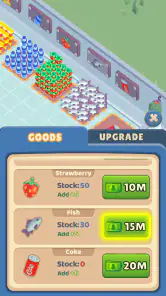





Analysis by Reviewed
I went into Supermarket Idle: Simulator expecting a light simulation game that would fill a few spare minutes, and that is exactly where it makes its best first impression. The idea is easy to understand: I work around a supermarket, keep the shop moving, and gradually turn a small operation into something much larger. Its appeal comes from watching ordinary retail tasks become a simple progression loop rather than from complicated strategy.
That accessibility matters. I did not need a long tutorial or previous experience with management games to understand what I was supposed to do. The game presents itself as a casual supermarket simulation, but the idle structure means I can make progress without treating every session like a serious commitment. For someone who wants a relaxed game to check between other activities, that balance is more attractive than a demanding business simulator.
How the supermarket loop feels during the first week
The opening sessions are built around small improvements that are easy to appreciate. A modest shop gradually feels more productive, and each return gives me a reason to look at what has changed. That sense of visible growth is the strongest part of the early experience. I am not trying to master a large economy immediately; I am simply learning how the store develops and deciding where the next improvement should go.
The worker-and-manager theme also gives the progression a little personality. Instead of watching an abstract number increase, I can imagine that I am responsible for a real shop whose daily performance depends on sensible decisions. The fantasy is simple, but it makes the first few play sessions more satisfying than a completely generic idle counter.
One useful habit is to avoid spending every reward the moment it appears. I found the early game more comfortable when I treated each upgrade as part of a short plan: improve the area that helps the shop feel more productive, then save enough to make the next return meaningful. Even without deep economic complexity, this creates a small decision layer and prevents the game from becoming a sequence of automatic taps.
The free entry point helps the first-week appeal considerably. I can try the full basic experience without paying before deciding whether the routine suits me. The game is rated for Everyone, so it is also an approachable choice for households looking for a gentle simulation rather than combat, frightening themes, or complicated story material.
On the other hand, the opening can give a stronger impression of variety than the later routine may support. Early progress is naturally rewarding because almost every action feels new. Once I understand the basic rhythm, the question changes from “What can I unlock next?” to “Is checking this shop still enjoyable?” That is the point at which the game needs to earn a regular place on my phone rather than relying on first-session curiosity.
More From Our News Desk

Weather by Xiaomi Review: Clear at a Glance, Less Clear Up Close

X Under Pressure: Can It Recover When Posting Goes Wrong?

Clash of Clans Is Won Between the Battles

Android Auto Makes the Case for Quieter Car Software

MobiOffice: Transforming Mobile Productivity with Seamless Integration

EA SPORTS FC™ Mobile Soccer: Redefining Mobile Sports Gaming
A practical way to play without turning it into a chore
For a realistic everyday scenario, I would use it during short breaks: open the supermarket, collect what is ready, make one or two deliberate improvements, and close it again. That approach suits the idle design better than leaving the game open and repeatedly watching the same process. It also keeps the supermarket theme in the background, where it works as a relaxing routine instead of demanding constant attention.
I would not recommend beginning with the expectation of a deep retail-management challenge. The game is better understood as a compact progression experience with a supermarket setting. Players who want detailed supply chains, staff scheduling, customer behavior, or a fully simulated economy may find the concept too light. Those players would probably be happier with a more involved management title, even if it requires more time and concentration.
Another useful first-week choice is to decide what kind of player I am before making the game part of my routine. If I enjoy watching gradual progress and making occasional upgrades, the structure feels pleasant. If I need frequent surprises, story events, or a large number of strategic systems, the novelty may fade quickly. The game does not need to satisfy both groups, but knowing which side I am on prevents disappointment.
What changes after the opening excitement
After the initial learning period, the experience becomes less about discovering the supermarket and more about maintaining momentum. This is normal for an idle game, but it changes the emotional reward. The first upgrades feel like milestones; later returns can feel more like checking a dashboard. I still get satisfaction from seeing the business develop, yet the pleasure becomes quieter and more dependent on whether I enjoy repetition.
This is where the distinction between casual use and long-term use becomes important. As a casual game, it can be effective because I can leave and return without needing to remember a complicated story. As a primary game, it may feel too passive for anyone who wants constant decisions. I would keep it alongside more active games, not necessarily replace them with it.
The developer is Apps Mobile Games, and the game’s presentation fits that straightforward mobile focus. It is designed to communicate its central idea quickly rather than bury the player in instructions. That makes it friendly for newcomers, although experienced simulation players may wish for more layers once they have understood the basic shop-building rhythm.
Does it have enough month-to-month value?
Longer-term value depends on how much enjoyment I get from incremental progress. The game’s central promise is not a dramatic campaign with a final narrative payoff. Its value comes from returning to the store, seeing the results of earlier choices, and continuing to expand the operation. That can be surprisingly pleasant when I want a low-pressure habit, but it is less convincing when I am looking for a strong sense of completion.
The idle format gives it one clear advantage over a traditional supermarket simulator: I do not have to perform every task manually. That makes it easier to fit around daily life. I can play while commuting, waiting for an appointment, or taking a short break, then put it away without feeling that I abandoned a complicated project. For busy players, this is more important than having a large number of mechanics.
There is also a trade-off. The less direct work I perform, the less ownership I may feel over the result. In a hands-on management game, every staffing choice or stock decision can create a story. In an idle game, the satisfaction often comes from accumulation itself. I recommend this one to players who enjoy that kind of steady growth, but not to someone who wants every improvement to reflect a difficult tactical choice.
With an average rating of 4.4 from around 15 thousand ratings, the game has attracted a solid audience for this style of mobile simulation. That does not guarantee that it will suit me personally, but it does suggest that the uncomplicated supermarket loop connects with many players. Its install count is over 500 thousand, which also makes it feel less like an obscure experiment and more like an established casual option.
For month-to-month use, I would judge it by the quality of my own routine rather than by the size of those figures. If I open it only because I feel obliged to collect something, the habit has stopped being useful. If I enjoy setting a modest target, checking the shop, and watching it move closer to that target, the game can remain a comfortable background pastime.
Where it compares well with other simulation games
Compared with a traditional tycoon game, this supermarket experience is easier to enter and less demanding to maintain. I do not need to sit down for a long planning session to get value from it. Compared with a purely decorative idle game, the shop setting gives my progress a clearer context: I am not simply increasing a currency balance, I am imagining a business becoming more capable.
Its weakness in that comparison is depth. A dedicated management simulator usually offers more meaningful consequences and more opportunities to recover from a bad decision. A faster arcade-style game usually offers more immediate interaction. This title sits between those extremes. It is calmer than an active business game and more thematic than a bare progression app, but it may not reach the depth or excitement of either specialist alternative.
That middle position is useful for a particular kind of player. I would choose it for someone who likes the idea of running a supermarket but does not want spreadsheets, long sessions, or a punishing learning curve. I would skip it for a player who regards idle mechanics as passive or who needs a constant stream of new content to stay interested.
How much maintenance does the habit require?
The maintenance burden is relatively light in concept, which is one of the reasons the game works as a spare-time companion. I can return, review the shop’s state, collect progress, and decide whether an upgrade is worth pursuing. The important discipline is knowing when to stop. Reopening the game repeatedly without a meaningful decision can make the routine feel like a task rather than entertainment.
I also recommend separating “progress” from “value.” A larger shop or a faster income stream may be satisfying, but it does not automatically make a session enjoyable. I get more lasting value when I attach a small personal objective to each visit, such as saving for a particular improvement or checking whether a previous choice has changed the pace of development. This turns passive waiting into a simple observation exercise.
Because the game is free, trying this routine costs nothing at the start. There are in-app purchases ranging from $1.99 to $99.99 per item, so I would approach optional spending carefully. I would first play long enough to learn whether I actually enjoy the unhurried progression. Paying to accelerate a loop I already find repetitive would not solve the underlying problem; it would only shorten the waiting.
That is an important consideration for families and younger players. The Everyone rating makes the theme approachable, but the presence of purchases means I would still review device purchase settings before handing the game to a child. The sensible approach is to treat spending as a separate decision, not as a requirement for discovering whether the supermarket simulation is enjoyable.
What causes fatigue over repeated sessions?
The main source of fatigue is repetition without enough personal choice. Once the basic pattern is familiar, a session can become predictable: return, collect, improve, and leave. That is not automatically a flaw, because predictability is part of the relaxation. It becomes a problem only when I am opening the game from habit and no longer caring about the shop’s development.
Another possible friction point is the gap between the theme and the depth of the simulation. The supermarket setting suggests many interesting systems, from customer flow to inventory pressure, but a lighter idle structure cannot explore all of them in detail. Players may enjoy the atmosphere of retail management while still wishing for more consequences behind each decision.
The current version is 1.02.14, and the game was released on January 8, 2026. Those details matter mainly because early versions of a mobile game can shape expectations about longevity. I would keep an eye on how the experience develops over time, but I would not buy anything based on the promise of future improvements. My recommendation rests on the game as it is now: a simple, accessible supermarket progression loop.
Device compatibility is also worth checking before installation because the minimum operating system is 12. For most recent Android or iOS users this may not be an issue, but anyone using an older device should confirm compatibility first. A game that fits my preferred routine is not useful if my phone cannot run the required system version.
Who should keep it installed?
I think it is a good fit for players who want a free simulation game with a clear theme, gentle progression, and short sessions. It can work especially well for someone who enjoys watching a small business grow but does not want to manage every minute of its operation. The supermarket setting is familiar enough to understand immediately, and the idle format makes it easy to fit around work, study, or household responsibilities.
I would be more cautious about recommending it to competitive players, detailed strategy fans, or anyone who needs a strong ending. It is not the right choice if I want complex planning, dramatic failure states, or constant hands-on control. A deeper tycoon game would offer more ownership, while a more active simulation would provide more moment-to-moment engagement.
My best advice is to treat the game as a small daily ritual rather than a major hobby. Give it a short trial, avoid spending until the routine proves enjoyable, and notice whether the shop’s gradual growth still feels rewarding after the first excitement has passed. That test tells me more than the opening tutorial ever could.
My long-term verdict
Supermarket Idle: Simulator earns lasting space only when I want calm, incremental progress. Its first-week appeal is clear, its free entry makes experimentation easy, and the supermarket theme gives the idle structure more character than a completely abstract numbers game. I appreciate that it can be played in short visits and that I do not need to memorize a complicated system every time I return.
Its limits are equally clear. The routine can become mechanical, and the supermarket idea may promise more management depth than the idle format delivers. Optional purchases deserve restraint, especially if the main frustration is repetition rather than slow progress. Players who want a rich business simulation should look elsewhere, while players who enjoy quiet accumulation may find exactly the kind of low-pressure game they were seeking.
After the novelty fades, I would keep it installed only if I still enjoy making small choices about the shop instead of merely collecting rewards. That is the honest dividing line. For me, it works best as a background game for brief breaks, with modest expectations and no pressure to turn every return into a long session. If that sounds like your style, this free supermarket simulation is worth trying; if you need constant discovery or detailed control, its simple loop will probably feel thin before long.
Supermarket Idle: Simulator Frequently Asked Questions
What kind of game is Supermarket Idle: Simulator, and who might enjoy it?
Supermarket Idle: Simulator is a simulation game for players who like building and managing a business at a relaxed pace. Its supermarket theme centers on growing a shop, with idle-style progress suited to people who enjoy checking in, making upgrades, and watching a virtual business develop. It may appeal if you prefer incremental management over action-focused gameplay.
Can I make progress in Supermarket Idle: Simulator in short sessions?
The game is built around gradually growing a supermarket, so it can fit into brief mobile play sessions as well as longer visits. You can check your shop, make management decisions, and invest in improvements as you play. Its idle approach is intended to make the business feel as though it can keep developing between active sessions, which may suit players who do not want constant, hands-on action.
Is Supermarket Idle: Simulator a good choice if I enjoy business and tycoon games?
The central idea is to work as a supermarket employee and manager, then grow an idle shop into a tycoon-style business. That makes it a natural option for players drawn to shop management, gradual expansion, and watching earnings support further growth. If you prefer a more story-driven or competitive game, its focus on running and developing a virtual supermarket may be less appealing.
Is Supermarket Idle: Simulator free to download, and does it offer purchases?
Supermarket Idle: Simulator is free to download, so you can try its supermarket-management gameplay without paying upfront. It also offers optional in-app purchases, with prices ranging from $1.99 to $99.99 per item. These purchases may suit players who want to spend on optional game content, but they are not required just to begin playing. If children use your device, review purchase settings before downloading.
Who developed Supermarket Idle: Simulator, and what do players think of it?
The game is developed by Apps Mobile Games and has attracted a sizeable mobile audience. Its average rating is 4.4 from around 15,000 ratings, alongside 361 written reviews. Ratings can give you a quick sense of how other players respond, while reviews may offer more personal impressions of the experience. As with any game, individual preferences differ, so consider whether relaxed business-management gameplay appeals to you.
Pros
- Simple controls make it easy for anyone to start playing.
- Short sessions work well for quick entertainment during breaks.
- Store upgrades create a satisfying sense of steady progress.
- The supermarket theme offers a relaxing alternative to action games.
- Offline play may let you manage the store without a constant connection.
Cons
- Progress can feel repetitive once the basic store loop becomes familiar.
- Upgrade costs may increase quickly and slow advancement.
- Frequent ads can interrupt gameplay or encourage optional rewards.
- Limited strategic depth may disappoint experienced simulation players.
- Device performance may suffer as the supermarket grows larger.
- Category
- Simulation
- Version
- 1.02.14