Solitaire: Klondike Card Game
- 8.00
- 4.7
- Installs
- 10.00K
- Price
- Free
Screenshots

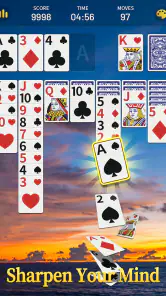
Analysis by Reviewed
Solitaire is one of those games I open when I want something familiar, quiet, and easy to leave whenever real life interrupts. Arkreson’s Solitaire: Klondike Card Game takes that simple idea and keeps the focus on a straightforward card experience rather than surrounding it with a noisy setting or a complicated progression system. After spending time with it, I found its strongest quality is the way its presentation supports short, calm sessions: the cards are the subject, the pace stays readable, and the offline format makes it suitable for moments when I do not want to depend on a connection.
This is a free card game for Everyone, running on devices with Android 8.0 or later. Its current version is 0.2.3, and the game has passed ten thousand installs. Those figures suggest a modest but real audience, while the 4.7 average from around forty ratings shows that the people who have rated it generally respond well to its focused approach. I would not mistake that for proof that it suits every Solitaire player, but it does match my own impression: this is aimed at someone who wants Klondike to feel uncluttered and immediately playable.
A quiet first impression built around the cards
The first thing I noticed is how little stands between me and a game. There is no need to learn a new fictional universe, understand a character roster, or work through a long tutorial before the familiar layout makes sense. That directness matters in Solitaire because the appeal is often the small ritual of starting a hand, scanning the tableau, and deciding whether the next move is worth taking.
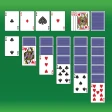
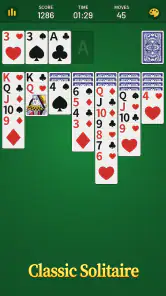
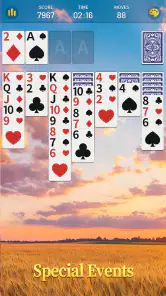
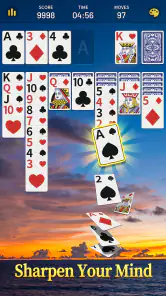
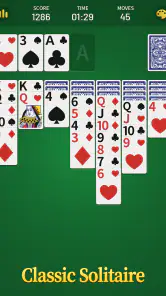
That simplicity also gives the visual design more responsibility. When a game has only a few central elements, poor spacing or confusing card hierarchy becomes obvious immediately. Here, the experience is best understood as a clean digital version of Klondike: the tableau, stock, waste, and foundation areas provide the visual language, and the game does not need to decorate them with unrelated distractions to make a point.
I especially appreciate that the presentation does not fight the game’s natural tempo. A card game like this can be played in a few minutes or revisited repeatedly over a longer break. The interface needs to support both without making a short session feel like a commitment. That makes it a practical choice for waiting rooms, a commute when I am seated safely, or a quiet pause between tasks.
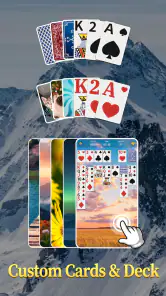
There is a useful distinction between “simple” and “unfinished.” A simple Solitaire game removes unnecessary layers; an unfinished one leaves basic actions unclear or makes the table feel awkward. My experience with this release leans toward the former, although the low version number is worth keeping in mind. Players who expect a deeply expanded package with numerous modes, elaborate customization, or a large reward structure may find the scope restrained.
Why the visual restraint works
The art direction supports concentration because it gives the cards the main role. That may sound obvious, but many mobile card games compete with their own boards through excessive decoration, animated prompts, or persistent requests for attention. A restrained table lets me spend more time reading the position and less time interpreting the interface.
For a new player, this is helpful because the traditional arrangement remains the lesson. The game does not need to explain every decision through spectacle. I can look at the exposed cards, identify possible alternating-color sequences, and think through whether moving a stack will reveal something useful. For an experienced player, that same restraint means the session feels closer to the reason I opened Solitaire in the first place.
One practical tip is to treat the opening layout as a planning exercise rather than immediately making the most obvious move. In Klondike, exposing a hidden card is often more valuable than simply building a visible sequence. I found that the uncluttered presentation makes this kind of scan easier: before touching anything, I can check which moves uncover face-down cards, which cards might become available from the stock, and whether moving a low card to a foundation would reduce flexibility.
The trade-off is that visual minimalism may feel plain if you want a strong theme. This is not the right pick for someone choosing a card game mainly for rich fantasy art, collectible presentation, or a sense of place beyond the tabletop. Its setting is intentionally narrow: the world is the card table, and the mood comes from how calmly that table is presented.
The table as the game’s setting
Although there is no elaborate story world to explore, the setting still has a clear identity. It feels like a digital pause rather than a dramatic adventure. That is important because Solitaire depends on mental space. The game asks me to observe patterns, accept that some hands require patience, and decide when to continue searching or begin again.
I would describe the visual language as functional with a soft, relaxing purpose. It does not turn every card into an event. That makes the game easy to return to after a day away, since I do not have to remember a campaign, a collection, or a set of temporary objectives. I can simply resume the familiar process of sorting, revealing, and building.
For accessibility in everyday use, the clean arrangement is more valuable than decorative detail. Players who prefer a calm screen and recognizable card logic will likely settle in quickly. Players who need extensive visual customization or have specific preferences about card size and contrast should spend a little time with the interface before committing to it as their main Solitaire app.
Sound, rhythm, and the feeling of a short break
Solitaire’s sound design has a difficult job because the game should not overwhelm the player. The ideal audio layer gives actions a sense of completion without turning every move into an interruption. In this game, the overall mood is defined more by the quiet rhythm of play than by any dramatic presentation. Cards move, the board changes, and the player’s attention remains on the next useful decision.
That restrained rhythm fits the subject. Klondike is not a game that benefits from constant urgency. Its tension comes from limited information: I may have several legal moves, but only one of them might reveal the card I need. A calm presentation gives me room to compare those options instead of pushing me toward speed for its own sake.
I found this especially suitable for a short evening session. I could play while winding down without feeling that the game demanded a large block of attention. The lack of an elaborate setting helps here: there are fewer competing signals, so the experience becomes a small mental routine. It is a good match for someone who wants to occupy their hands and sharpen observation lightly, not someone looking for a high-energy challenge.
The rhythm also changes depending on how deliberately I play. A beginner may spend time checking every possible move, while an experienced player can move quickly through familiar patterns. The game accommodates that difference because the core rules create the pacing naturally. I can make a session brisk by committing to obvious moves, or slower by examining the stock and protecting future options.
Using the pacing to improve decisions
One of the more useful habits I developed is delaying foundation moves when they might remove a card needed in the tableau. Building a suit upward feels productive, but Klondike rewards flexibility. If a card can either advance a foundation or help uncover a hidden card through a tableau sequence, I consider the second option first. The quiet pace makes it easier to resist the urge to make every visible improvement immediately.
A second tip is to use the stock as a source of information, not just a pile to cycle through quickly. I watch which ranks and colors appear, then remember what remains unavailable. This matters when the board looks stuck: a move that seems pointless may become valuable because it changes the order in which cards can be reached. The game’s uncluttered rhythm supports this memory-based approach better than a busier card interface would.
There is also a useful stopping point. If I have reached a position where every move only rearranges visible cards without opening new information, continuing can become less satisfying than starting another hand. That is not a flaw specific to this release; it is part of Klondike’s design. Still, players who expect every session to end in a clear victory may find the repetition frustrating. The game is strongest when the process itself is enjoyable, not only the result.
How the mechanics fit the relaxed presentation
The mechanical appeal is immediate because Klondike needs little introduction. Cards are moved to build descending sequences in alternating colors, while foundations grow upward by suit. The challenge comes from sequencing those actions so that face-down cards are exposed and the stock is used intelligently. This familiar structure is a good match for the game’s clean visual identity: the rules generate enough thought without requiring extra systems around them.
I like this fit because the presentation does not promise more than the mechanics can deliver. A hand can be approached casually, but it still rewards planning. When I uncover a hidden card, I get a small moment of progress. When I reveal an unhelpful card, I have to reconsider the order of my next moves. That cycle creates a gentle form of tension that works well for offline play.
The offline nature is one of the most practical strengths. I can use it in places where I do not want to rely on mobile data or an available network, and Solitaire does not need an online opponent to remain meaningful. This makes it different from competitive card games where connection quality, matchmaking, or live events shape the experience. Here, the focus stays on the individual hand and the player’s own decisions.
That same independence is also the reason some players may prefer another option. If you want social competition, ranked ladders, multiplayer matches, or a constantly changing collection of challenges, a more feature-heavy card platform will be a better fit. Arkreson’s game is for the person who sees Solitaire as a personal puzzle and a way to relax, not as a service that needs to keep delivering new content.
Who will get the most from it
I would recommend it to beginners who want a recognizable Klondike layout without a steep learning curve. It is also a good choice for experienced Solitaire players who value a direct table and do not want unrelated features competing for attention. Because it is free, it is easy to try without turning the decision into a purchase commitment, and the Everyone age rating makes its intended audience broad.
It works particularly well in three everyday situations. First, it can fill a short wait when I want something more engaging than scrolling but less demanding than a full game. Second, it suits a quiet break at home because a hand can be paused mentally and resumed without remembering a complicated objective. Third, it can serve as a low-pressure wind-down activity when I want light concentration rather than a competitive challenge.
I would be more cautious about recommending it to players who need a strong sense of progression. The basic satisfaction comes from solving or improving a hand, not from building a long-term account. Likewise, people who prefer fast arcade feedback may find the deliberate card-by-card rhythm too slow. The game asks for patience, and its calmness can feel like a limitation if your idea of relaxation involves constant stimulation.
Small decisions that make the game more enjoyable
My most useful workflow is to begin with the tableau, prioritize moves that reveal hidden cards, and only then decide whether a foundation move is safe. I also try not to empty a tableau column without a clear plan for using the space, since an empty column is most valuable when it can receive a king and help reorganize a blocked sequence.
Another practical approach is to keep the stock order in mind instead of treating each draw as disposable. If a needed card is buried behind several others, I may choose a different tableau move first so that the next pass through the stock becomes more productive. This turns what could feel like random searching into a manageable sequence of choices.
Finally, I recommend changing the goal of a session depending on my energy. When I have only a few minutes, I focus on making clean decisions and learning from the layout rather than forcing a win. When I have more time, I inspect the consequences of each move and try to preserve options. That flexibility is one reason this particular game feels comfortable as a repeatable offline companion.
Where it sits beside other Solitaire choices
Compared with a typical online card platform, this game feels more private and self-contained. There is no need to think about opponents, connection stability, or competitive pressure while playing a hand. Compared with a heavily themed Solitaire title, it is less expressive and probably less rewarding for anyone who wants a decorative world around the cards. Its identity comes from the middle ground: familiar rules, a clean table, and a pace that leaves the player alone with the puzzle.
That middle ground is valuable, but it is not automatically better. A feature-rich alternative may offer more variety for someone who plays for long sessions every day. A minimalist alternative may appeal more to a player who wants an even more stripped-back interface. The deciding question is whether you want Klondike to be the complete experience or merely one activity inside a larger game package.
Arkreson’s release is also still at an early version, which shapes my expectations. I see it as a focused foundation rather than a massive card suite. That is positive if you want a straightforward game that does not bury the rules under extras. It is less convincing if you are choosing a long-term mainstay based on extensive settings, multiple formats, or a broad set of advanced conveniences.
The rating of 4.7 from roughly forty ratings is encouraging, and eight written reviews add some community feedback around the release. I treat those numbers as a useful signal rather than a final verdict, especially for a game with a relatively small audience. My own judgment is similar but more specific: the response makes sense for players who value clarity and offline access, while the limitations will matter mostly to people seeking depth outside classic Klondike.
A coherent atmosphere for classic card play
What stays with me is the consistency between the game’s art direction, setting, sound, and mechanics. Nothing is trying to turn a quiet card puzzle into something louder than it needs to be. The visual language keeps the table readable, the sound and movement support a measured rhythm, and the rules provide enough decisions to make a short session feel worthwhile.
That coherence is the real reason I would suggest trying it. I would not choose it for social competition, elaborate storytelling, or a large progression system. I would choose it when I want a free Solitaire game that starts quickly, works offline, and gives me a familiar puzzle without demanding much emotional or technical attention.
The best way to approach it is as a calm, repeatable card ritual rather than a content-heavy mobile game. If that sounds like what you need, this release from Arkreson is an easy recommendation. If you need constant novelty or a richer set of modes, look elsewhere. For everyone in between, its modest scope is also its strength: the cards remain the focus, and the atmosphere gives the classic Klondike loop room to breathe.
Pros
- Classic Klondike rules are easy to learn and familiar to most players.
- Quick games make it convenient for short breaks or casual play.
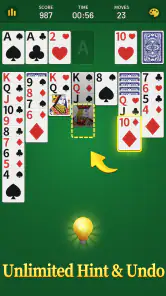
- Helpful hints can assist beginners when they get stuck.
- Offline access lets you play without a constant internet connection.
- Simple controls work well on both phones and tablets.
Cons
- Frequent ads may interrupt the game
- especially between rounds.
- Some features or themes may require in-app purchases to unlock.
- Random deals can occasionally feel repetitive over longer sessions.
- Limited multiplayer options reduce its appeal for competitive players.
- Hints and undo tools may make wins feel less rewarding for experts.
- Category
- Card
- Version
- 0.2.3