My Town : Wedding
- 120.00
- 4.1
- Installs
- 50.00K
- Price
- $4.49

Screenshots

Analysis by Reviewed
Wedding-themed games often promise a cheerful place to dress characters, arrange a ceremony, and turn a special day into a small story. My Town : Wedding takes that idea and presents it as an open-ended play space rather than a tightly scripted challenge. I spent time moving between the wedding locations, changing the characters’ appearance, and setting up scenes at my own pace. The result feels closer to digital dollhouse play than to a traditional game with levels, scores, or a single correct solution.
That distinction matters before you buy it. If you want quick puzzles, competitive progress, or a clear campaign, this is probably not the right fit. If you enjoy creating little stories, arranging rooms, and letting children explore pretend play without pressure, the concept is much more appealing. It is an educational game from My Town Games Ltd, rated for Everyone, and its strongest quality is the freedom to decide what the wedding becomes.
How the current version feels in everyday play
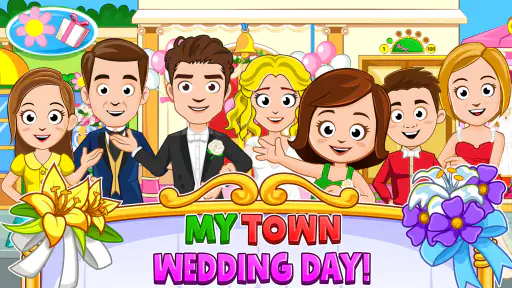
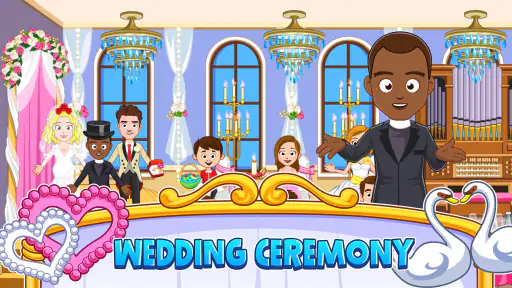
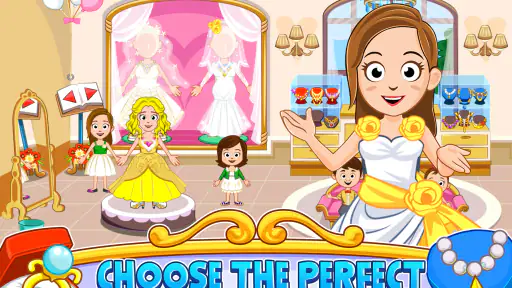
The current version is 7.03.09, and the basic experience is easy to understand. You enter a wedding setting, choose characters, move them around, select clothing and accessories, and build a celebration through experimentation. There is no need to read a long tutorial before starting. That makes it approachable for younger players, while older children can immediately begin inventing their own scenes.
I found the lack of a fixed order both relaxing and slightly demanding. The game does not constantly tell you what to do next, so a child can decide whether to focus on the ceremony, the guests, the outfits, or the surrounding spaces. At the same time, a player who expects a checklist may initially wonder what counts as progress. Here, progress means creating a scene you like, not unlocking a final screen.
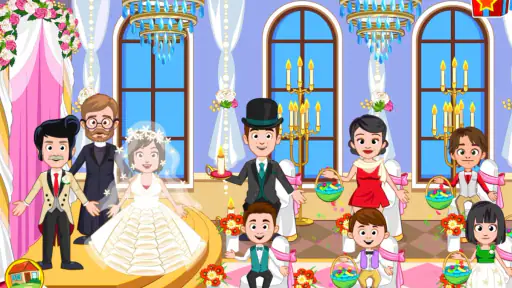
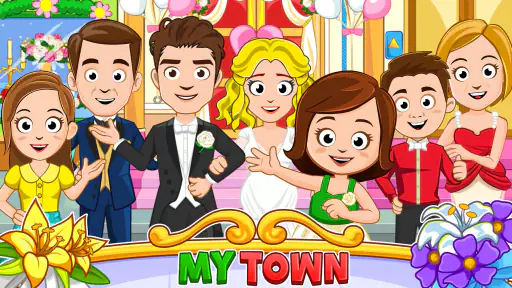
A typical afternoon use case is simple: a child chooses a couple, dresses them differently, places family members nearby, and acts out the arrival, ceremony, photographs, and party. The same setting can be reused for a completely different story the next day. That replay value comes from imagination rather than from a large collection of formal objectives.
The most useful way to approach it is as a storytelling kit, not as a wedding simulator. Once I stopped looking for conventional goals, the open format made more sense. It gives children room to decide who is invited, what happens first, and how the celebration ends. Parents can also join in by asking questions about the characters or helping plan a sequence of scenes.
Exploration works best when the player creates a routine
Young players can get more from the game if they follow a loose routine. I would begin by choosing the main characters, then prepare clothing, place guests, and finally act out the celebration. This does not turn the game into a mission-based experience; it simply gives children a starting structure when the open space feels overwhelming.
Another useful approach is to create short episodes instead of trying to use every available area at once. One session might focus on preparing the characters. Another could center on the ceremony. A later session might tell a story about guests arriving late or helping with the party. These small boundaries make the experience easier to manage and encourage children to explain their choices.
The game also works well for cooperative pretend play, although the quality of that experience depends on the children sharing the device and agreeing on the story. One child may want to choose outfits while another controls the guests. That can lead to negotiation, which is valuable, but it can also cause frustration if both want control at the same time. An adult can help by assigning roles rather than trying to direct every action.
What feels educational without becoming a lesson
The educational value is informal. Children practice sequencing when they decide what should happen before and after the ceremony. They work on vocabulary when describing clothing, relationships, locations, and emotions. They also practice social storytelling by imagining why a guest is happy, nervous, late, or helping someone else.
I would not treat this as a replacement for a structured learning app. It does not appear designed to teach reading, arithmetic, or a defined curriculum. Its value is closer to creative play: making choices, remembering a sequence, explaining a scene, and adapting when the story changes. For a child who learns best through role-play, that can be more engaging than a worksheet-style activity.
Parents can make the educational side more visible by asking open questions rather than giving instructions. “Who is this guest?” or “What needs to happen before the party begins?” encourages the child to build a narrative. Asking the child to retell the wedding afterward can also turn a few minutes of play into a small storytelling exercise.
What has changed, who it suits, and where it still falls short
Reading the current release in context
The game was released on Apr 12, 2016, and the current version shows that it has continued as an established product rather than remaining at its original release point. I would be careful, however, not to assume that a newer version transforms the design into a completely different game. The central appeal remains the same: open-ended wedding role-play with characters, clothing, and spaces to arrange.
That is important for returning users. If you liked the original idea because it offered relaxed, imaginative play, the current release should still feel familiar. If you were hoping for a fundamentally new progression system or a more competitive structure, a version number alone is not a reason to expect that. The product’s identity is built around free-form scenes, so its evolution is best judged by how smoothly that foundation works today.
The store listing shows an average rating of 4.1 from 676 ratings, with 120 written reviews, and more than 50 thousand installs. Those figures suggest that the game has found an audience, but they do not change the main buying question: does your child enjoy unstructured pretend play? A well-rated game can still be a poor match for a child who needs clear goals.
At $4.49, this is a paid game rather than a free download that relies entirely on trying it first. There are also in-app purchases priced at $0.99 per item. I would explain that arrangement to a child before handing over the device, especially if the child is used to free games where every part of the experience is immediately available. The initial price and optional purchases should be considered together when deciding whether the package feels worthwhile.
The practical effect on families already using it
For an existing player, the biggest benefit of staying with the game is familiarity. Children can return to a setting they already understand and create new stories without learning a new control scheme or progression path. That makes it suitable for short play sessions, quiet time, or a shared activity before a real family celebration.
The same familiarity can also expose the game’s limits. A child who has already explored the locations and repeated the same types of scenes may eventually need another creative outlet. Because the experience is not built around increasingly difficult challenges, it does not naturally push the player toward mastery. Its longevity depends on whether the child keeps inventing new situations.
I also think the paid format changes the way parents should evaluate it. The advantage is that the game is clearly positioned as something you purchase, rather than an endless stream of free content competing for attention. The trade-off is that the child may expect a larger amount of content or more frequent updates because money was paid upfront. For families who value calm, self-directed play, that exchange may be reasonable. For families seeking a long campaign, it may feel less convincing.
The Everyone age rating makes it broadly accessible, but age suitability is not the same as interest level. A very young child may need help understanding how to move through the setting and organize a story. An older child may enjoy it if they like character-driven role-play, but could find the absence of challenge too limiting. I would judge it by play style rather than age alone.
Three details that improve the experience
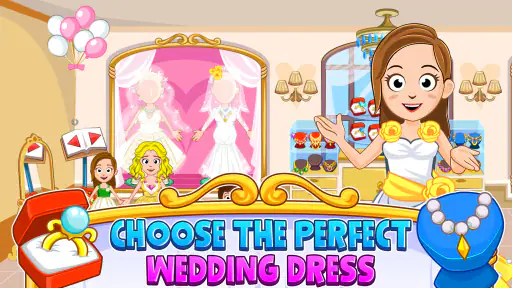
First, I recommend treating character preparation as part of the story instead of a menu task. Choosing clothing before the ceremony gives the child a reason to compare options and explain why a character is dressed a certain way. It also creates a natural sequence that makes the open format feel more purposeful.
Second, use the wedding as a prompt for relationship stories. Rather than moving every character randomly, decide who knows whom, who is helping, and who has a particular responsibility. This turns simple movement into social play and gives children a reason to revisit the same spaces without needing new formal content.
Third, set a stopping point before the session begins. Open-ended games can make it difficult for children to notice when they have had enough, especially when there is no level-ending signal. Finishing after the ceremony, a group photograph, or a short retelling creates a satisfying conclusion and makes the next session easier to start.
A fourth tip is useful for shared play: let one child be the “director” for a few minutes, then switch roles. The director decides what scene is happening, while the other player moves characters or arranges the setting. This reduces arguments over control and makes the game more collaborative than simply passing the device back and forth.
Where the design may frustrate you
The open structure is the main weakness as well as the main strength. Children who want missions, rewards, puzzles, or visible progress may lose interest quickly. There is no obvious pressure to improve, and a player can repeat similar actions without discovering a deeper system underneath them.
Another limitation is that the experience relies heavily on the child’s imagination. That is excellent for creative players, but less effective for someone who wants the game to supply a complete story. Parents should not expect the app to entertain every child independently for a long period. It may work better as a shared prompt than as a digital babysitter.
The wedding theme can also be narrower than a general town or family role-play game. If a child wants many unrelated settings and everyday scenarios, a broader alternative in the same pretend-play category may offer more variety. On the other hand, a focused theme can be helpful when a child enjoys repeating and expanding one type of event instead of jumping between unrelated activities.
The optional purchases deserve attention too. Even though each item is listed at $0.99, small purchases can change how a child views the experience. I would review the purchase setup with the child and use device-level controls where appropriate. The game is easier to recommend when everyone understands what is included in the initial purchase and what may cost extra.
How it compares with familiar alternatives
Compared with puzzle-based educational games, this one offers less direct instruction and more freedom. A puzzle app may be better for practicing a specific skill with immediate feedback. My Town : Wedding is better when the goal is expression, conversation, and imaginative sequencing.
Compared with a general dress-up app, the wedding setting gives clothing choices a narrative purpose. The outfit is not only about appearance; it can be part of preparing for the ceremony or defining a character’s role. The trade-off is that a focused theme may feel repetitive sooner than a broader fashion or lifestyle game.
Compared with a large open-world town game, this experience is easier to understand because its central event is clear. A child can begin playing without learning a complicated economy, map, or progression system. The cost of that simplicity is a smaller sense of discovery for players who want a world that constantly introduces new objectives.
For families choosing between this and a free alternative, I would ask what kind of friction bothers you more. The paid entry price may be less attractive than a free download, while optional purchases may still require attention. But a focused, calmer experience can be preferable to a free game filled with distractions. The right choice depends on whether you value a contained creative activity or a larger stream of content.
Device and purchase questions worth considering
The game requires Android 8.0 or later, so compatibility should be checked before installing it on an older device. That requirement is modest for many current phones and tablets, but it can matter for a child’s hand-me-down device. A quick system check avoids buying first and discovering that the hardware cannot run it.
The price is $4.49, and the additional items are $0.99 each. I see the purchase as easiest to justify for a child who repeatedly returns to role-play games and enjoys making stories without competition. If the child normally abandons an app after a few minutes unless it offers levels and rewards, the upfront cost may not be worthwhile.
The 4.1 average rating gives the game a reasonable public reception, but I would read that number alongside the design rather than treating it as a guarantee. Ratings cannot tell you whether your child prefers free-form play. The more useful test is to watch how the child responds to open choices: do they invent scenes, or do they immediately ask what to tap next?
What I would watch before recommending it
For future use, I would watch whether the current version continues to make returning to the wedding setting feel worthwhile. In a game without conventional levels, small improvements to usability, variety, and scene-building have a large effect on replay value. I would also pay attention to how optional purchases fit into the overall experience, since families need a clear sense of what the initial purchase provides.
I would not buy it expecting a dramatic transformation into a traditional educational curriculum or an action game. Its likely audience is still children who enjoy gentle, character-based storytelling. That is not a criticism; it is a useful boundary. The game works best when its simplicity is treated as a deliberate invitation to create rather than as missing content.
My final recommendation is therefore fairly specific. I would suggest it to families looking for a wedding-themed role-play activity that can be shared, paused, and revisited without pressure. I would skip it for children who need explicit goals, fast challenges, or a broad world with constant new tasks. My Town : Wedding earns its place through accessible creative play, but its value depends on the player bringing ideas to the screen.
After using it, I came away with the impression of a focused digital playset rather than a game designed to keep escalating. That makes it pleasant for short storytelling sessions and useful for conversations about planning, characters, and social situations. It also means parents should buy it with realistic expectations: this is a tool for imagination, not a complete lesson plan or an endlessly expanding adventure.
Pros
- Creative wedding scenarios encourage imaginative role-play.
- Many characters and outfits support varied storytelling.
- Interactive locations make scenes feel lively and engaging.
- Simple controls are suitable for younger players.
- Offline play is convenient when traveling or without Wi-Fi.
Cons
- Some content may feel repetitive after extended play.
- The large number of items can make scenes feel cluttered.
- Limited challenge may not appeal to players seeking structured goals.
- Performance can vary on older or less powerful devices.
- Additional My Town titles may be needed for a broader experience.

- Category
- Educational
- Version
- 7.03.09