Snopes
- 54.00
- 4.4
- Installs
- 10.00K
- Price
- Free

Screenshots
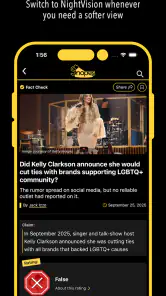

Analysis by Reviewed
When a surprising claim lands in my group chat, I want more than a quick “true” or “false.” I want to know what the claim actually says, where it came from, what evidence supports it, and whether the wording has been twisted along the way. That is the situation where I found Snopes most useful: it turns a vague suspicion into a more deliberate fact-checking routine.
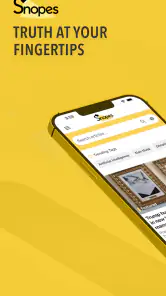
This free News & Magazines app comes from Snopes, Inc and is aimed at people who regularly encounter rumors, viral stories, questionable screenshots, and recycled headlines. Its store summary presents it as a definitive source for fact checking, but I think its real value is more practical: it gives me a place to pause before forwarding something. The app has a 4.4 average from around 190 ratings, with more than 10,000 installs, so it is still a relatively focused tool rather than a massive general news reader.
I tested it with a simple everyday goal: a friend sent me a dramatic claim and asked whether it was real. Instead of searching the entire web immediately, I used the app as the first checkpoint. That workflow revealed both its strengths and its limits. It is good at helping me investigate a claim that already has recognizable wording, but it is not a replacement for broad reporting, local expertise, or careful judgment.
From a forwarded claim to a usable answer
Starting with the right question
The first useful habit is to separate the emotional reaction from the factual question. A post may say that a public figure made a statement, that a new rule has taken effect, or that a photograph proves something alarming. Those are not always one claim. They may contain a real event, an incorrect date, an edited image, and an exaggerated conclusion all at once.
Before using the app, I rewrite the message in plain language. I ask myself what would actually need to be checked. This matters because a fact-checking result can address a narrow statement while the original post uses it to suggest something much larger. Searching the exact dramatic wording is often less useful than identifying the central assertion.
That is one of the less obvious benefits of using a dedicated fact-checking app: it encourages a slower input stage. I am less likely to treat a search result headline as a complete answer when the subject begins inside a fact-checking environment. The best result depends on asking a precise question before looking for a verdict.
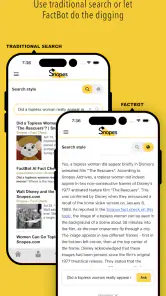
Finding a relevant check
Once I have reduced the message to its main claim, I look for a matching entry. Familiar wording helps, especially when the rumor has circulated widely. A claim that has already attracted attention is more likely to lead to a useful explanation than a vague search for a topic such as “election,” “health,” or “technology.”
I do not stop at the first label I see. I read the surrounding explanation and compare it with the message I received. The key question is whether the app is examining the same wording, the same image, the same person, and the same time period. A similar headline can still describe a different rumor.
This is where the app feels different from a normal news feed. A typical news app is designed to show me what is happening. Snopes is more useful after something has already caught my attention and I need to examine its accuracy. It is not trying to replace my daily headlines; it is a tool for checking the headline, caption, or assertion that someone wants me to believe.
Reading beyond the verdict
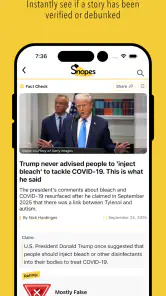
The verdict is the fastest part of the process, but it is not the part I trust on its own. I read the explanation to understand the reasoning. A claim can be partly based on reality while still being misleading because of missing context. Another can be technically accurate but presented in a way that creates a false impression.
I also check whether the evidence discussed actually connects to the conclusion. If a post uses an old photograph to support a current event, the important issue may be the image’s date rather than the event itself. If a quote is circulating, the useful question may be whether the wording came from the person, whether it was edited, or whether it was attributed to the wrong source.
That reading step is especially important for family and group-chat situations. When I pass on a correction, I can explain the reason instead of sending only a label. That makes the handoff more credible and reduces the chance that the conversation becomes a fight over which side I support.
Handing the answer back to another person
My usual workflow does not end when I reach a result. I need to send something back to the person who shared the claim, and that is where many fact-checking attempts fail. A bare correction can sound dismissive. A long technical explanation can be ignored. I prefer to summarize the finding in one sentence, then add the relevant context from the article.
For example, I might explain that the underlying event happened, but the circulating image is from another time. Or I might say that the quotation is not supported in the form being shared, while the person did discuss a related subject elsewhere. This kind of handoff is more useful than simply declaring a post false.
The app works well in this role because it gives me a reference point for the conversation. It does not magically settle every disagreement, but it helps move the discussion away from “I heard this” and toward a specific claim that can be examined. In my experience, that is a more realistic outcome than expecting one app to persuade everyone immediately.
What the result means in practice
The best outcome is not just a verdict. It is a better decision about what to do next. If a claim is unsupported, I do not forward it. If it is missing important context, I avoid repeating it as a simple fact. If the article shows that the claim is accurate, I still look at the date and scope before treating it as relevant to the current conversation.
This makes the app valuable for several kinds of users. Students can use it as a starting point when evaluating a viral assertion, provided they continue to consult original sources. Parents can use it when children bring home alarming online stories. Community moderators can use it to investigate recurring rumors before deciding whether a post needs correction. I can also see it helping anyone who wants to slow down their own sharing habits without becoming a full-time researcher.
There is a useful trade-off here. A general search engine gives me far more material, but it also gives me a mixture of reliable reporting, copied claims, opinion, and search-engine optimization. Snopes narrows the task. That focus saves time when the claim has already been examined, although it also means I may need another source when the subject is new, highly local, or too specialized.
Where the workflow breaks
The first break happens when the claim is too broad. Searching for a whole controversy rather than a specific assertion can produce a result that is related without answering the question I actually have. The solution is to split the message into smaller claims and check them separately.
The second break is timing. A fact-check can be accurate for the version of a story that existed when it was examined, while a later update changes the situation. I therefore treat the publication context as part of the answer. A result about an old image or an earlier statement should not automatically be used to describe what is happening today.
The third break is evidence quality. A fact-checking article can explain why a claim is wrong, but I may still need an official document, a full interview, a court record, or a specialist source for a decision with serious consequences. This is particularly important for medical, legal, financial, and safety questions. I would use the app to identify misinformation, not as my only authority for personal action.
The fourth break is emotional rather than technical. People often share claims because the message confirms what they already believe. Showing a verdict may not change that. I get better results when I address the exact wording calmly and acknowledge any part that is true. The app can support that conversation, but it cannot replace patience or source evaluation.
Who should use it, and who should skip it?
I recommend it to readers who frequently encounter viral claims and want a focused way to investigate them. It is particularly suitable if you prefer an explanation over a simple search snippet. The app also makes sense for someone building a repeatable checking habit: identify the assertion, look for a relevant check, read the reasoning, compare the details, and then decide whether to share.
I would skip it if I mainly want breaking news, personalized headlines, or a broad magazine-style reading experience. A conventional news app will usually be a better fit for following a developing story across many outlets. I would also look elsewhere when I need local reporting, technical research, or an immediate primary-source document.
It is not a shortcut around media literacy. If I search carelessly, accept a matching title without reading, or ignore dates and context, I can still reach the wrong conclusion. The app is strongest as a structured checkpoint, not as an automatic truth button.
Practical details before installing
The app is free to install and carries an Everyone 10+ content rating. It requires Android 7.0 or later, which makes it accessible on many older Android devices. The current version is 3.7, and the listed in-app purchase range runs from $4.99 to $199.99 per item. I would pay attention to the purchase screen before committing to anything, especially if I only need occasional checks.
Because it belongs to the News & Magazines category, I approach it as a reading and research companion rather than a messaging utility. Its usefulness depends on my willingness to open the explanation, follow the reasoning, and carry the conclusion back into the original conversation. That is a little more effort than glancing at a social post, but it is also the point.
The developer, Snopes, Inc, gives the app a clear identity: it is centered on fact checking rather than trying to become an all-purpose news destination. That specialization is its main advantage over ordinary news feeds, while its narrower scope is the main reason I would keep other research tools available.
My final assessment after using the full workflow
I came away viewing Snopes as a practical filter between a suspicious message and an impulsive response. It helped me turn a forwarded claim into a specific question, inspect an explanation, and give another person a more useful answer. The strongest part is not the existence of a verdict; it is the habit of checking whether the verdict actually matches the wording, timing, and evidence in front of me.
Its limitations are real. Coverage will not make every new or niche claim easy to resolve, a verdict can be misapplied when context changes, and serious decisions still deserve primary or specialist sources. Users who want a complete news service may find the focus too narrow, while people expecting instant certainty may find the reading process slower than they hoped.
For me, that slower process is a benefit. I would recommend the app to anyone who wants to share less misinformation and explain corrections more responsibly. Just use it as the first careful step, not the last word: define the claim, read the reasoning, check the date and scope, and escalate to stronger sources when the stakes demand it.
Pros
- Helps verify viral claims before sharing them online.
- Covers politics
- science
- health
- entertainment
- and internet rumors.
- Articles usually explain the evidence behind each verdict.
- Search makes it easy to investigate a specific person
- quote
- or story.
- Useful reference for spotting recycled hoaxes and misleading images.
Cons
- Some fact checks may feel politically biased to certain readers.
- Coverage is stronger for popular U.S. stories than local international claims.
- Articles can be lengthy when you only want a quick verdict.
- The app may rely on an internet connection for most content.
- Not every trending claim has been reviewed by Snopes yet.

- Category
- News & Magazines
- Version
- 3.7