Glimmer: Interactive Fanfics
- 534.00
- 4.6
- Installs
- 10.00K
- Price
- Free

Screenshots
Analysis by Reviewed
I tried Glimmer: Interactive Fanfics as the kind of entertainment app that can turn a quiet evening into a shared story session. It belongs to the entertainment category, but it feels more personal than a typical streaming app because the reader is asked to make choices instead of simply watching events unfold. The central idea is easy to understand: you enter a fan-fiction-style adventure and guide it through decisions. That makes it a natural fit for someone who enjoys fictional worlds but wants more involvement than a standard episode or a passive reading app offers.
My first impression was that Glimmer works best when I treat it as a short, flexible activity rather than something everyone in a household uses in exactly the same way. One person may want to read privately with headphones and make choices without interruption. Another may prefer to pass the phone around and debate what the main character should do next. Both approaches make sense, but they create very different experiences. The app is free to install, carries a Teen content rating, and includes optional purchases ranging from $0.99 to $99.99 per item, so the way it is used matters just as much as the story itself.
How Glimmer Fits Into a Shared Evening
A realistic use case is a family or group of friends sitting together after dinner, with one person holding the phone while everyone votes on a decision. The appeal is not just finding out what happens next; it is arguing over whether a character should trust someone, take a risk, or choose the safer path. Even when the decision is simple, the discussion gives the story a social quality that ordinary fan-fiction reading does not have.
That shared-device style also reveals an important limitation. A choice made for the group becomes part of the current reading experience, and it may not match what another person would have selected alone. I would not treat one shared session as a substitute for separate personal reading. If two people have different tastes, the better arrangement is to let each person use the app independently, then compare reactions afterward. Glimmer is enjoyable as a communal activity, but it is not automatically a multi-user experience just because it is easy to pass around.
For a household, I would decide in advance whether the phone is being used for a private story or a group story. That small boundary prevents the most common frustration: someone making a choice while another reader is away, then returning to find the narrative moving in an unexpected direction. It also helps avoid confusing a shared device with a shared account. The app can be installed on a device used by several people, but that does not mean each person’s reading habits or decisions should be mixed together.
Glimmer is particularly appealing to readers who enjoy fan-fiction communities, branching narratives, and character-focused drama. It gives those readers a more active role than a conventional reading platform. Instead of turning pages at a fixed pace, I have to pay attention to the situation and decide how I want the story to develop. That extra involvement is the main reason I would recommend trying it, especially if standard books or video stories sometimes feel too passive.
What to settle before anyone starts
On a shared phone or tablet, I would first agree on who is using the app and whether the session is meant to be private. This sounds obvious, but interactive fiction depends on continuity. A person who opens the app expecting a fresh personal experience may be disappointed if another reader has already made decisions. The safest routine is simple: one reader at a time, or a clearly announced group session.
More From Our News Desk

Clash of Clans Is Won Between the Battles

Android Auto Makes the Case for Quieter Car Software

MobiOffice: Transforming Mobile Productivity with Seamless Integration

EA SPORTS FC™ Mobile Soccer: Redefining Mobile Sports Gaming

How Microsoft OneDrive Became a Mobile Productivity Giant

How Google Translate Breaks Language Barriers Effortlessly
I would also discuss purchases before handing the device to a younger user. Glimmer is free, but optional in-app items can cost from $0.99 up to $99.99 each. That range is wide enough that a child or teenager should not be left to guess what is acceptable. A household can avoid awkward surprises by agreeing that every purchase needs permission, or by keeping payment decisions with the adult who manages the device. This is not a criticism of the storytelling concept; it is a practical boundary for any free entertainment app with optional paid content.
The Teen rating is another reason to set expectations rather than assuming the app is suitable for every person in the home. Teen-rated entertainment may be perfectly appropriate for one reader and uncomfortable for another, depending on age and family standards. I would preview the experience with the intended reader, talk about the kinds of themes they are comfortable with, and avoid presenting the rating as a universal guarantee for every household.
There is also a useful distinction between a shared device and shared identity. If several people use the same phone, I would not assume that each person’s place in a story will remain separate. Before beginning, I would check whose reading session is active and avoid opening the app in the middle of someone else’s narrative. When a household has only one available device, a small note or a spoken handoff can be enough to prevent accidental changes.
Keeping decisions coordinated without removing the fun
The best group sessions I can imagine with Glimmer are not rigid meetings where everyone has to follow a voting system. They are casual conversations with one useful rule: pause before an important choice and let everyone say what they would do. That preserves the surprise while giving quieter readers a chance to participate. If the group cannot agree, the person whose turn it is can make the final decision. The point is to keep the disagreement entertaining rather than turning the story into a negotiation.
For couples or friends sharing a device, I would recommend ending a session at a natural stopping point and saying clearly whether the next person may continue. Interactive fiction can make a quick handoff tempting, but an unexpected continuation may spoil a moment for someone who wanted to experience it personally. The app works better when readers coordinate around the story’s pace instead of treating it like an ordinary utility that anyone can open without consequences.
One non-obvious advantage of this format is that it creates an easy way to compare personalities. Two readers can face the same fictional situation and choose completely different responses, then discuss why. That makes Glimmer useful for a relaxed conversation starter, not just a solo pastime. It is especially effective when the group enjoys character motivation and moral dilemmas more than fast action.
The trade-off is that interactive choices can make the experience less relaxing for people who prefer complete control over the reading pace. With an ordinary fan-fiction site or ebook, I can skim, reread, pause, or jump backward whenever I want. A choice-driven format asks me to remain mentally present. If I am tired, distracted, or only looking for background entertainment, that extra attention may feel like work rather than fun.
Age, trust, and the right kind of independence
Because Glimmer is rated Teen, I would place it in the category of apps that deserve a conversation before independent use by a younger reader. The rating should guide the decision, not replace it. A teenager who already understands in-app purchases and knows how to stop reading when a theme feels uncomfortable may be a good fit. A younger child who mainly wants bright, simple entertainment is probably better served by an age-appropriate alternative with a clearer household routine.
I would not hand the app to a child simply because it is free. Free installation and paid optional items are separate issues, and the purchase range makes that distinction especially important. A teenager can enjoy the stories while still needing a clear rule about spending. In a shared household, trust works best when the boundary is explicit: reading may be independent, but buying requires approval.
Privacy and account expectations should be handled in the same practical way. I would avoid assuming that a shared device creates separate personal spaces, and I would not let a younger user borrow an adult’s device without first checking what else is accessible on it. These are ordinary digital habits, but they matter more when an entertainment app is passed between people with different ages and preferences.
For adults, the Teen label should not be mistaken for a promise that the app will feel mature or sophisticated. The appeal is interactive fan-fiction entertainment, not a replacement for a carefully edited novel or a serious media platform. I enjoy that lighter, more participatory quality, but readers seeking polished literary structure may find the format too dependent on quick choices and genre familiarity.
Where it stands beside familiar alternatives
Compared with ordinary fan-fiction reading, Glimmer’s clear strength is participation. A traditional story lets the author make every major decision, while this app invites me to influence the direction. That can make familiar fictional ideas feel more immediate because I am not only observing the character; I am temporarily responsible for the response. The downside is that readers who love a specific author’s exact vision may prefer a fixed story with no decision points.
Compared with streaming entertainment, Glimmer is more active and usually better suited to a short conversation. I can stop at a decision and discuss it rather than waiting for a full episode to finish. However, streaming is easier when several people want to relax without concentrating. A show also gives everyone the same sequence of events, whereas an interactive story can create disagreement about what should happen next.
Compared with a conventional game, Glimmer appears more focused on narrative involvement than on mastering controls or systems. That makes it approachable for readers who do not think of themselves as gamers. It may not satisfy someone looking for deep strategy, complex progression, or action-heavy play. The right comparison is closer to interactive reading with fan-fiction energy than to a large-scale console adventure.
That distinction helps me decide who should skip it. If you want a completely passive experience, a normal video or audiobook is likely a better choice. If you want a long-form novel with one authoritative storyline, a book or established fan-fiction platform may suit you more. If you want to debate fictional decisions with friends or guide a story according to your instincts, Glimmer has a more convincing reason to exist.
Practical habits that make the app easier to enjoy
I would begin with a short personal session before introducing it to a group. That lets me understand the rhythm of the choices and decide whether the writing style matches my taste. It also prevents the first shared session from becoming a technical or organizational experiment. Once I know how I want to read, I can invite someone else into the experience with clearer expectations.
For a shared device, I would use a simple handoff routine: announce whose turn it is, stop at a decision when possible, and never assume that the next person wants the previous reader’s choices. This is more useful than trying to force every household member into one common profile or routine. The app’s interactive nature rewards a little coordination.
I would also keep purchases separate from storytelling decisions. A reader may feel emotionally invested in what happens next and become more willing to buy an optional item in the moment. Agreeing on a spending rule before reading protects the fun from becoming a disagreement. Since the app is free to start but includes optional purchases, this is one of the most important practical habits for families.
Another useful approach is to treat the app as a conversation prompt rather than a competition. There is no need to prove that one reader made the “correct” choice. The interesting part is seeing how different people interpret the same fictional situation. That mindset works particularly well for a household where adults and teenagers want to share entertainment without pretending they have identical preferences.
Performance expectations and basic app details
Glimmer is developed by Glimmer Fics Inc. and currently appears as version 1.0.41, with Android support beginning at version 7.0. Those details make it accessible to people using older Android devices, although the actual comfort of reading will still depend on the screen, battery condition, and general performance of the device. On a phone shared by several people, I would also make sure there is enough room for the app and that the device is not already struggling with background applications.
The app has a 4.6 average from around 4.5 thousand ratings and more than 500 reviews, while its install count has passed 10 thousand. I read those figures as a sign that the concept has found an interested audience, not as proof that every reader will enjoy it. Interactive fiction is unusually dependent on personal taste: the same choice-based structure that makes one person feel involved can make another person miss the freedom of ordinary reading.
Its free entry point is helpful because I can test the format without paying upfront. Still, the optional purchase range means I would not describe the complete experience as automatically cost-free for every reader. Anyone who is comfortable staying within free content may find the starting point attractive; anyone who dislikes purchase prompts or wants a single predictable price should consider that trade-off before settling in.
My household verdict
I recommend Glimmer to readers who want fan-fiction entertainment with a more active role, especially when the goal is to discuss choices with a friend, partner, or teenager. Its strongest quality is the way it turns reading into a small shared decision-making activity without requiring the group to learn complicated game controls. That makes it approachable, but it still demands attention and works best when everyone understands whose story session is in progress.
For household use, I would keep the boundaries simple: respect private reading, coordinate before changing a shared story, and agree on purchase rules before anyone starts. The Teen rating means adults should use their own judgement with younger readers rather than relying on the app’s label alone. Those precautions do not weaken the experience; they make it easier for different people to enjoy the app without stepping on one another’s preferences.
My final view is that Glimmer is worth trying if you already like fan-fiction and want your choices to matter inside the reading experience. I would skip it for a child-focused household looking for uncomplicated content, for readers who want a fixed author-led narrative, or for anyone who finds optional purchases distracting. For the right audience, though, it offers a pleasant middle ground between reading and gaming: personal enough for solo use, conversational enough for a shared evening, and flexible enough to make one fictional situation feel different depending on who is holding the device.
Glimmer: Interactive Fanfics Frequently Asked Questions
Who develops Glimmer: Interactive Fanfics, and what kind of app is it?
Glimmer: Interactive Fanfics is an entertainment app developed by Glimmer Fics Inc. Its focus is interactive fiction, giving readers a way to follow stories and make decisions as they go. If you enjoy narrative experiences more than action-focused games, this format may suit you. The app is free to download, with optional in-app purchases available.
What devices can run Glimmer: Interactive Fanfics?
Glimmer: Interactive Fanfics is available for Android devices that run Android 7.0 or later. Before downloading, check your device’s operating system version and make sure you have enough available storage for the app. The current version is 1.0.41. If you use an iPhone or iPad, check the relevant app store for compatibility information before installing, since device requirements can differ between platforms.
What is Glimmer: Interactive Fanfics?
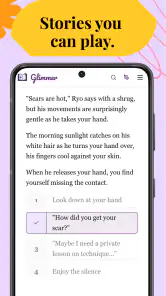
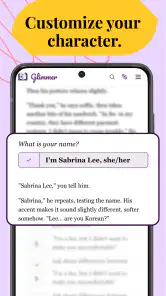
Glimmer: Interactive Fanfics is a mobile reading app built around interactive fictional stories. Instead of only scrolling through a fixed narrative, you follow fanfic-inspired episodes and make choices that can influence conversations, relationships, and the direction of the plot. It is aimed at readers who enjoy romance, drama, fantasy, and character-driven storytelling with a more participatory experience than traditional fanfiction.
How does the interactive story system work in Glimmer?
Stories in Glimmer generally present you with dialogue, scenes, and decision points where you select how the main character responds. These choices may affect relationships, reveal different reactions, or lead the story toward alternative moments and outcomes. The impact of each decision can vary from episode to episode, so the app is best enjoyed as an evolving narrative rather than a game with a single traditional win condition.
Is Glimmer: Interactive Fanfics free to download and use?
Glimmer is free to download, but the experience may include optional in-app purchases or other limits connected with progressing through stories. In-app purchase prices range from $0.99 to $99.99 per item, so check the purchase details before confirming anything. Depending on the story and available options, spending may be relevant to accessing certain content or choices, making it sensible to review purchases with care.
Pros
- Branching choices make fanfiction feel personal and replayable.
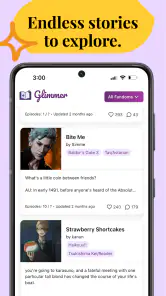
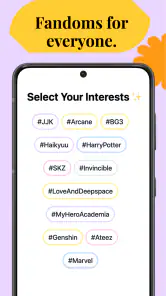
- Large selection of stories across popular fandoms and genres.
- Short chapters suit quick reading sessions on mobile.
- Interactive format keeps readers engaged beyond standard text.
- New episodes can make following favorite stories feel rewarding.
Cons
- Story quality may vary considerably between different writers.
- Some content or choices may require in-app purchases.
- Frequent decisions can interrupt the flow of longer stories.
- The app may feel limited if your favorite fandom is not supported.
- Offline reading options may be restricted for some stories.
- Category
- Entertainment
- Version
- 1.0.41