Screw Out 3D: Nut Sort Jam
- 3.46K
- 4.7
- Installs
- 1.00M
- Price
- Free

Screenshots

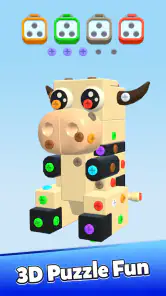

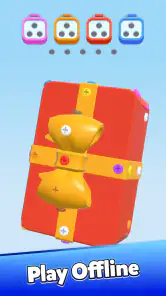

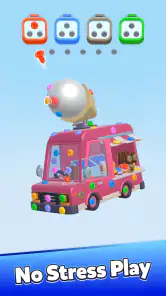
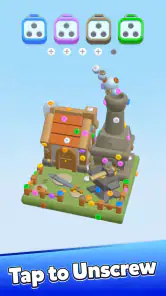
Analysis by Reviewed
I like puzzle games that make their point quickly: show me a problem, let me try a move, and give me a reason to solve one more. Screw Out 3D: Nut Sort Jam is built around that kind of immediate appeal. It is a free 3D puzzle game from Unico Studio, and its focus on screws and sorting gives each challenge a tactile, visual feel rather than the abstract look of a grid-based brainteaser. It suits brief breaks particularly well, though its strongest moments depend on whether you enjoy repeating a clear puzzle pattern.
Quick puzzles with a satisfying visual hook
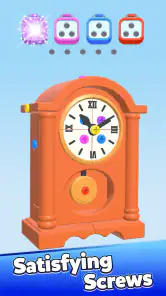
The central pleasure is easy to grasp: inspect a three-dimensional arrangement, work out how to sort or move its parts, and try to untangle the puzzle. The objects make the task feel more physical than matching colored squares. I found that the first useful step is often not to move immediately, but to scan the whole layout and identify what appears to be blocking progress. That small pause turns a quick tap-fest into an actual planning exercise.
The 3D presentation is a good fit for this premise because depth and placement are part of what you are reading. It also creates a trade-off: a puzzle can look busier than it really is, and visual inspection may take longer when several pieces overlap. If you prefer clean, flat boards where every option is visible at once, this style may feel less direct. I would approach each layout by checking the accessible pieces first, then considering which move opens up the next useful choice.
This is a casual sorting puzzle, not a story-led adventure or a deep strategy game. That distinction matters when deciding whether to install it. The appeal is the small satisfaction of resolving a compact knot, not following characters, exploring a world, or mastering a large rule set. The store’s short name, Screw Out 3D, captures the basic idea; the fuller title, Nut Sort Jam, points toward the sorting challenge that gives the game its identity.
A good fit for the gaps in a day
I can see this working during a commute, while waiting for food, or in the few minutes between tasks. The puzzle premise is understandable without a long setup, so it does not ask for the kind of uninterrupted attention a lengthy logic game might demand. A realistic way to use it is to play a level while waiting for a meeting to start, stop when you need to focus, and return later when you have another short window.
That convenience does not mean every puzzle will feel effortless. A layout that initially looks obvious can require some thought about move order, and a rushed attempt may leave you with fewer useful choices. If you are playing in a noisy setting, the visual nature of the task is helpful because you can follow the board without relying on dialogue or a plot. On the other hand, anyone looking for a game that can be enjoyed almost without looking at the screen will be better served by a simple audio or word-based diversion.
It is especially suited to players who like to keep a small game ready for moments that are too short for a substantial activity but long enough to feel restless. I would use it while a kettle boils or in a waiting room, where I can give the board proper attention without needing to remember a story or a multi-step objective from a previous session. It is less suitable for a crowded walk or any situation where glancing at a screen is unsafe; the spatial layout rewards looking carefully, not playing by touch alone.
More From Our News Desk

Weather by Xiaomi Review: Clear at a Glance, Less Clear Up Close

X Under Pressure: Can It Recover When Posting Goes Wrong?

Clash of Clans Is Won Between the Battles

Android Auto Makes the Case for Quieter Car Software

MobiOffice: Transforming Mobile Productivity with Seamless Integration

EA SPORTS FC™ Mobile Soccer: Redefining Mobile Sports Gaming
Why the session rhythm works—and where it can snag
The game’s short-form structure encourages a satisfying loop: look, choose, see what changes, and decide whether another move makes sense. I like that this creates a natural stopping point after a solved puzzle. There is no need to set aside a long block of time just to feel that a session has gone somewhere. For a quick mental reset, a single challenge can be enough.
The same loop can become a source of friction when a puzzle does not click. Since the central activity is sorting and untangling, a difficult moment is likely to come from choosing the wrong order or failing to notice a useful opening, rather than from learning a complicated new system. My practical tip is to pause before repeating a move: look for what changed in the arrangement, and use that information to test a different sequence. Blindly tapping faster rarely makes a spatial puzzle easier.
That makes the game more engaging than a purely automatic matching exercise, but it also means it is not ideal for every mood. If I want a calm activity that asks almost nothing of me, even a small sorting problem can feel like work. If I want a brisk puzzle that gives me a clear thing to inspect and solve, the same demand is exactly the point.
For a short session, I would decide in advance whether I am aiming to finish one puzzle or simply take a few thoughtful turns. That small expectation helps when a layout takes longer than it first appears: I can stop after a natural point rather than feeling that a brief break has turned into an obligation. It also makes the game easier to fit around a busy day, because the value of opening it does not depend on clearing a long sequence.
Pausing is easy; returning depends on the puzzle
For an interruption-friendly game, the important question is whether I can put the phone down without losing the thread. Here, the board itself is the thread: when I come back, I can look at the current arrangement and work out what I was trying to free or sort. That visual continuity is more useful than a long explanation, especially when a break is interrupted by a call or a quick errand.
I would still avoid starting a puzzle if I know I may need to stop in the next few seconds. A half-finished arrangement can be harder to read after attention has shifted, particularly if I had been relying on a mental plan rather than the visible state. A useful habit is to stop after completing a level when possible, or take a moment to inspect the board before leaving mid-puzzle. This is a small adjustment, but it makes the game easier to pick up again without turning a casual break into a memory test.
The game is best treated as a collection of bite-sized attempts rather than a demanding session that requires a perfect streak of concentration. That is a strength for people who play in fragments. It is less compelling for players who want long-form progression to pull them back into a game after an interruption; the enjoyment here comes primarily from the puzzle in front of you.
If you are interrupted halfway through, I would leave the screen with a quick look at the remaining arrangement rather than mentally rehearsing a whole solution. On return, start by identifying what is still accessible and what has changed since your last move. That is a more reliable reset than trying to reconstruct the exact intention behind every tap. For players who often need to respond to messages or switch tasks, this visual restart is a practical advantage, though it does not remove the need to study the board again.
Replay value and the limits of a focused idea
Sorting puzzles can be replayable because each arrangement asks you to notice relationships and make choices in sequence. The satisfying part is not simply reaching the end, but recognising the move that clears the way. I recommend taking a second to understand why a solution worked, rather than treating each level as a sequence to rush through. That makes the activity feel more like practice in visual planning and less like tapping until the board happens to cooperate.
There is also a natural limit to this kind of focused design. If you quickly tire of sorting pieces or prefer games that constantly introduce unrelated mechanics, the core loop may start to feel familiar. This is not the title I would choose for a varied puzzle anthology, a narrative campaign, or a competitive challenge. Its replay value is strongest when you enjoy returning to the same basic kind of problem and getting better at reading the layout.
One way to keep the repeated loop interesting is to treat a solved puzzle as a small lesson: ask which piece was the real bottleneck and whether you spotted it early. That changes the focus from simply clearing the board to improving how you inspect it. It will not create a different genre of activity, but it can make repeated sorting feel more deliberate for someone who enjoys noticing patterns. If you would rather have every session introduce a new rule, this kind of self-set challenge may not be enough.
Compared with familiar match-three games, it asks for more attention to arrangement and move order, and offers less of the immediate color-combination spectacle. Compared with a traditional logic puzzle on a flat board, it makes spatial inspection more prominent and may feel less transparent at a glance. Neither approach is universally better: choose this one if you like manipulating a tangible-looking tangle, and choose a word puzzle or a grid-based logic game if you want rules and possibilities laid out more plainly.
That comparison also helps explain when I would reach for another game instead. If I want a quick burst of obvious visual feedback, a match-three title is the easier choice; if I want to reason through a neat set of written clues, a conventional logic puzzle is clearer. This one occupies the middle ground: it gives me a visible object to inspect, but asks me to reason about access and sequence rather than simply match identical symbols. Its appeal is therefore specific, not a substitute for every kind of casual puzzle.
Practical details before you play
The game is free to download and is rated Everyone, so it is positioned for a broad audience. It has a 4.7 average rating from around 216,000 ratings, with over one million installs. Those figures suggest that the basic concept has found a sizable audience, but they cannot tell you whether its sorting rhythm matches your own taste; the key question is whether you enjoy visually working through a compact arrangement.
In-app purchases range from $0.99 to $99.99 per item, so it is worth being mindful of purchase prompts if you are trying to keep a game completely free. I would check the screen before confirming any optional purchase and avoid assuming that “free” means every item or convenience is included. The current version is 2.9, and the game requires Android 7.0 or later. If you are choosing between devices, those are the practical compatibility details to check before downloading.
For a first-time player, the best way to judge whether it suits you is to focus on the first few decisions rather than on how quickly you finish. Notice whether you enjoy inspecting the layout and thinking ahead, or whether the depth makes the task feel fiddly. That distinction matters more than a general preference for puzzle games: someone who loves word riddles may still prefer a clean text-based challenge, while a fan of spatial sorting may find this format immediately comfortable.
It is also worth being clear about what “free to download” means for your own habits. If you prefer never to encounter optional spending in a game, take care around purchase prompts and make sure any device settings you use for purchases suit your needs. If you are comfortable trying a free puzzle and ignoring extras, the basic decision is simpler: see whether the core sorting activity holds your attention before deciding whether you want anything beyond it.
Unico Studio has made the game’s central activity easy to understand, but the experience is still a better match for some players than others. I would recommend it to someone who likes hands-on sorting puzzles, wants a quick challenge between daily tasks, and is happy to replay a focused mechanic. I would skip it if I needed a deep campaign, a wide rotation of puzzle genres, or a completely low-effort way to pass time.
My casual verdict
Screw Out 3D: Nut Sort Jam earns its place as a short-session puzzle by making its main task immediately legible and visually engaging. Its best quality is the small moment when a cluttered arrangement starts to make sense; its main limitation is that the same sorting focus may grow repetitive if you want constant novelty. For me, it works best as a quick thinking break: open it when I have a few minutes, study the layout instead of tapping at random, and stop when I have had my fill. If that sounds like the kind of low-commitment challenge you enjoy, it is an easy one to try.
Screw Out 3D: Nut Sort Jam Frequently Asked Questions
What is Screw Out 3D: Nut Sort Jam?
Screw Out 3D: Nut Sort Jam is a casual puzzle game built around sorting and removing colorful screws, nuts, or similar pieces from 3D arrangements. Each level asks you to work out which pieces to move and where they belong, while avoiding a board that becomes difficult to manage. Its simple controls make it easy to start, but later puzzles can call for more careful planning.
How do you play Screw Out 3D: Nut Sort Jam?
The main goal is to clear or sort the pieces shown in each puzzle by tapping them and placing them into the available slots or matching groups. Since space can be limited, moving a piece too soon may block a useful option. Look over the whole arrangement before acting, and consider which pieces must be removed first. The exact layout and objectives can vary from level to level.
Is Screw Out 3D: Nut Sort Jam free to download and play?
The game may be available as a free download, but the store listing for your device is the best place to confirm its current price and any in-app purchases. Free puzzle games can also include advertisements, such as ads between levels or optional ads that offer a bonus or another attempt. Check the listing and in-game purchase details before downloading, particularly if you plan to limit spending.
Can I play Screw Out 3D: Nut Sort Jam offline?
Offline access can depend on the version of the game and the feature you want to use. Basic levels may work without a steady connection, while advertisements, rewards, events, or other online features might require internet access. If playing offline matters to you, try opening the game in airplane mode after installation and check whether your progress and the levels you want remain available.
Is Screw Out 3D: Nut Sort Jam suitable for children, and what should parents check?
The game’s sorting puzzles are generally more about observation and planning than reading a story or using complex controls, which can make them accessible to a range of ages. However, suitability depends on the version’s age rating, advertising, and available purchases. Parents should review the app-store rating and privacy information, then consider enabling purchase restrictions or supervision if a child will be playing.
Pros
- Clear 3D visuals make nuts and screws easy to distinguish.
- Simple tap controls are quick to learn.
- Short levels suit brief play sessions.
- Sorting mechanics offer a satisfying puzzle challenge.
- No complex rules or lengthy tutorials to master.
Cons
- Later stages can feel repetitive.
- Some layouts may require trial and error.
- Small screen details can be harder to see on phones.
- Progress may depend on using hints or boosters.
- Ads or in-app purchases may interrupt the experience.
- Category
- Puzzle
- Version
- 2.9