jns.org
- 15.00
- 4.4
- Installs
- 10.00K
- Price
- Free

Screenshots


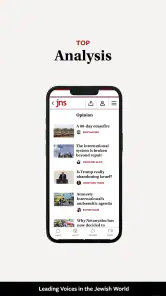



Analysis by Reviewed
I spent time with jns.org as a mobile news app focused on Israel and the Jewish world, and my first impression was that it knows exactly what audience it wants to serve. This is not a broad, everything-for-everyone news reader. It is a focused way to follow stories connected to Israel, Jewish communities, politics, culture, and related international developments from one place.
The app is developed by JNS.org and sits in the News & Magazines category. It is free to use, which makes the decision to try it very easy: there is no purchase to weigh up before seeing whether its coverage fits your daily routine. That free access is the clearest part of its value proposition. You are choosing it for relevance and convenience rather than for a paid bundle of extra tools.
How jns.org fits into a daily news routine
When I open a specialist news app, I expect it to reduce the time spent searching for a particular subject. jns.org does that by keeping its editorial identity narrow. Instead of asking me to build a collection of searches, websites, or social feeds around Israel-related news, it gives that subject a dedicated home.
That focus is useful in a realistic everyday situation. Imagine checking the news before work, wanting a quick sense of developments in Israel and the wider Jewish world without moving through several general-news apps. A focused reader can be more practical than a large national news app because the relevant stories are less buried among unrelated business, sports, entertainment, and local headlines.
I also see value for readers who want a second perspective alongside mainstream news. General outlets may cover major events only when they become internationally significant, while a specialist publication can make Israel and Jewish-world topics the starting point rather than an occasional section. That does not make it a replacement for every other source, but it gives it a clear role in a broader reading habit.
The app’s store summary, “Israel News | Jewish World,” is brief but accurate as a description of its purpose. Its short description is simply “jns.org,” so the real reason to install it is the subject focus rather than a long list of advertised tools. I would approach it as a dedicated news destination, not as a general-purpose magazine platform.
A free download with a straightforward value question
Because the app is free, the practical question is not whether it is worth paying for. The question is whether its coverage matches what I regularly want to read. For someone already interested in Israel and Jewish-world news, free access lowers the barrier considerably. I can add it to my routine without replacing another subscription or committing to a recurring expense.
That distinction matters. Free access provides an opportunity to test the app, but it does not automatically mean it should become my only news source. The value comes from the time it saves and the relevance of the material it presents. If I rarely read these subjects, even a free app may add clutter rather than usefulness.
I would also avoid judging it by the standards of a paid news service. A paid product may be selected for premium analysis, exclusive archives, or a particular reading experience. Here, the confirmed appeal is simpler: it offers a free, focused route to news associated with Israel and the Jewish world. That is a sensible proposition for the right reader, but it should be evaluated on focus rather than imagined extras.
What the audience response suggests
The app has an average rating of 4.4 from roughly eighty ratings, with about fifteen written reviews. I treat that as encouraging but still limited evidence. It suggests that the people who have rated it generally respond well, while the relatively small review pool means I would not use the score alone to predict every reader’s experience.
Its install count is above ten thousand, which shows that it has reached a real audience without suggesting that it is a mass-market news platform. That scale fits the app’s specialist identity. A focused publication does not need to compete with the largest general-news applications to be useful; it needs to serve its intended readers consistently.
For me, the combination of a strong average score and a modest audience points to a product that should be tried personally rather than judged by popularity. If the subject matter is central to my interests, the app’s smaller scale is not a drawback. If I want a huge ecosystem of sections and tools, its focused nature may feel less satisfying.
Where the app earns its place
The strongest benefit is subject concentration. A reader who follows Israel-related developments can open one app with a clear expectation of what it is for. That reduces the friction of repeatedly checking separate sources or relying on social feeds where important context may be mixed with commentary, repetition, and unrelated posts.
A second benefit is routine. I could use it as a morning scan, an evening catch-up, or a dedicated check during periods when Israel or Jewish-world news is especially important to me. The app becomes more valuable when it has a defined job. I would not open it aimlessly alongside several identical news applications; I would use it when I want this particular editorial lane.
A third benefit is discoverability. Readers who are new to the subject may find it easier to browse a focused publication than to construct a personal reading list from scratch. The app can act as a starting point for understanding which topics are receiving attention, after which I can seek additional reporting when a story deserves deeper comparison.
That last point is important because focused coverage should not be confused with complete coverage of every possible viewpoint. I would use the app to identify and follow relevant stories, then compare especially consequential claims with other reputable sources. This is not a criticism unique to jns.org; it is a sensible habit whenever a reader relies on a publication with a defined editorial focus.
Useful ways to make the free app work harder
My first practical tip is to give it a specific place in the day instead of checking it constantly. A short, deliberate reading session helps preserve the app’s advantage: concentrated information. If I treat it like an endless social feed, I lose the benefit of having a focused news destination.
My second tip is to separate scanning from verification. I would use the app to discover the stories that matter to me, save the key points mentally or in my own notes, and then consult another source when a decision, discussion, or important personal conclusion depends on precise context. This workflow respects both the app’s usefulness and the limits of any single publication.
My third tip is to pair it with a broader news reader only when necessary. The two tools serve different purposes. jns.org can cover the specialist part of my routine, while a general app can fill in local, financial, scientific, or international subjects outside that focus. Installing both is more sensible than expecting one focused application to cover everything.
A less obvious trade-off is that specialization changes how I interpret the day’s priorities. A dedicated Israel and Jewish-world app naturally makes those subjects more visible in my routine. That is helpful when I want deeper attention there, but it can also narrow my awareness if I stop checking other news entirely. I would use the app intentionally, not as my sole window onto world events.
What may feel limited in practice
The same focus that makes the app useful can make it feel narrow. Readers looking for a single application covering local headlines, technology, entertainment, sports, finance, and international news may prefer a broad news service. jns.org is better understood as a specialist companion than as a universal replacement.
I would also be cautious about expecting the app to answer every question raised by a headline. News reading often requires background, multiple viewpoints, and follow-up reporting. A focused app can make discovery easier, but I still want to examine complex or controversial subjects beyond one source before forming a firm opinion.
The store information identifies the current version as 2.1.7 and lists Android 7.0 as the minimum operating system. That makes the app accessible to users of older compatible Android devices, while people on very old hardware should still keep normal expectations about performance and modern app behavior. I would check compatibility before installing on an especially dated phone.
The age classification is Everyone, which makes the app broadly suitable from a content-rating perspective. That does not mean every news story will be emotionally light. Israel and international Jewish-world coverage can involve serious events, conflict, and difficult subjects, so parents and younger readers may still want to consider how and when news is consumed.
Another limitation is personal relevance. If I am not interested in Israel or Jewish-world coverage, the app’s specialization gives me little reason to keep it installed. Free access removes financial risk, but it cannot create interest where there is none. In that case, a general news reader would offer better day-to-day value.
Who is most likely to appreciate it
I would recommend trying it to readers who actively follow Israel, Jewish communities, related politics, culture, or international developments. It is also a good fit for anyone who feels that general news apps do not give these subjects enough consistent attention.
It may suit diaspora readers who want a dedicated connection to stories they care about, students or researchers beginning to map the news landscape, and readers who prefer a specialist source alongside their usual newspaper or news aggregator. The free price makes experimentation easy, so these users can decide from actual reading rather than from a description alone.
I would be more selective for people who want deep customization, a huge range of unrelated sections, or one app that replaces every other source. The available information positions this as a focused news app from JNS.org, not as an all-purpose information dashboard. Someone seeking a broad daily briefing may be happier elsewhere.
I would also skip it if my news habit is already overloaded and I am unlikely to give a specialist source a regular slot. Adding another app only helps when it solves a real problem, such as making a subject easier to follow or reducing the time spent searching. Otherwise, it becomes another icon competing for attention.
My final recommendation
After using it as a focused news destination, I see jns.org as an easy recommendation for the audience it serves. The app is free, its purpose is clear, and its concentration on Israel and the Jewish world gives it a role that a general news application may not fill as directly.
My recommendation comes with one condition: I would keep it in a balanced news routine rather than treating it as the only source I need. Its greatest strength is relevance, while its main trade-off is breadth. That is a fair exchange for readers who want this subject area close at hand.
With an average rating of 4.4, more than ten thousand installs, an Everyone age classification, and support beginning with Android 7.0, it is approachable for a wide range of Android users. Those figures are useful context, but my decision would still come down to reading habits. If Israel and Jewish-world news is something I actively seek, I would install it and give it a regular trial. If I want a complete general-news replacement, I would skip it and choose a broader alternative.
My bottom line: jns.org delivers the most value as a free, specialist companion for readers who want Israel and Jewish-world news within easy reach. It is not the app I would use for every category of news, but it has a clear purpose, a low-risk entry point, and enough focus to earn a place in the right reader’s daily routine.
Pros
- Trusted medical information from the Journal of the National Society of Nephrology.
- Covers kidney health
- nephrology research
- and clinical developments.
- Useful for physicians
- researchers
- and healthcare students.
- Professional articles can support continuing medical education.
- Mobile access makes journal content convenient to read anywhere.
Cons
- Content may be too technical for patients and general readers.
- Some articles may require a subscription or institutional access.
- The app’s usefulness depends on regularly published journal content.
- Research-focused material may offer limited practical self-care advice.
- Older devices may provide a less comfortable reading experience.

- Category
- News & Magazines
- Version
- 2.1.7