DMV Written Exam Practice App
- 73.00
- 4.7
- Installs
- 100.00K
- Price
- Free
Screenshots
Analysis by Reviewed
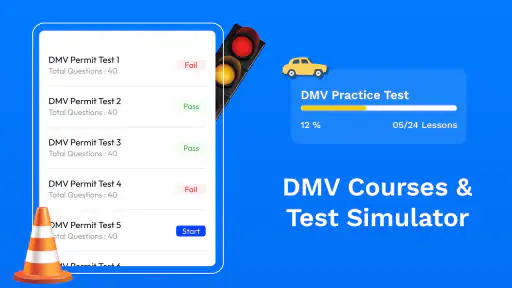
Preparing for a driving permit can feel less like studying and more like trying to remember a pile of rules that only become obvious when you are sitting in front of a test screen. I spent time with DMV Written Exam Practice App to see whether it makes that preparation easier on a phone. It is a free Android app from Epic Apps Studio in the Auto & Vehicles category, aimed at learners working toward a written driving exam in the United States.
My overall impression is that it works best as a practical question-practice companion rather than a complete replacement for an official driver handbook. The app gives you a convenient way to test your recall in short sessions, but the value depends heavily on how deliberately you use it. If you simply tap through questions until the answers feel familiar, you may build recognition without understanding. If you review mistakes and connect them with your state’s official rules, it becomes much more useful.
How the app fits into real permit preparation
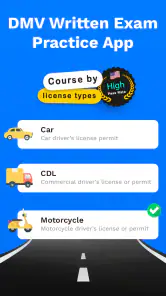
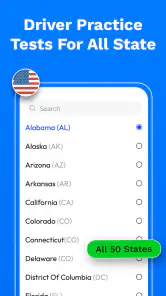
The app’s purpose is immediately clear: it focuses on DMV written exam practice and presents itself as suitable for learners across all states. That broad approach is helpful when you are still deciding how to begin, especially if you do not want to search through several unrelated study tools. It also makes the app approachable for a first-time learner who wants to start with questions instead of reading a long manual from beginning to end.
I would describe the experience as a revision tool. It is not the same as attending a driving course, reading the complete handbook, or learning the judgment needed behind the wheel. Written exams test rules, signs, safe conduct, and local requirements, while actual driving adds timing, observation, confidence, and responsibility. This app can help with the knowledge portion, but it should sit inside a wider study routine.
The free entry point is one of its strongest practical advantages. You can try the central experience before deciding whether it deserves a regular place in your preparation. The app is rated for Everyone, which fits its educational purpose, and it runs on Android devices using version 7.0 or later. That broad compatibility is useful for learners using an older phone rather than a recent flagship model.
Its current version is 2.8, and the app has reached over 100 thousand installs. I also noticed a 4.7 average from roughly 259 ratings, alongside about 73 written reviews. Those figures suggest that many users find the basic study format helpful, although ratings alone cannot tell you whether the questions match your particular state closely enough.
What I would do before answering the first question
I would not begin by treating every question as equally important. First, I would identify the state where the permit exam will be taken and keep that state’s official handbook nearby. The app’s all-states positioning is convenient, but driving regulations can differ in wording, limits, exceptions, and testing emphasis. A question that feels perfectly reasonable in a general practice set still deserves checking against the local source.
My preferred workflow is simple. I would answer a small group of questions without looking anything up, mark the subjects that cause hesitation, and then read the relevant handbook section. After that, I would return to similar questions in the app. This turns the application into a diagnostic tool: it shows where memory is weak, while the official material supplies the exact rule and context.
That approach also prevents a common study mistake. When a learner misses a question, the temptation is to memorize the correct letter or phrase. Instead, I would write down the reason the other choices are wrong. This is especially useful for questions involving right-of-way, road signs, safe following, or unusual conditions, where a small change in wording can alter the best answer.
Short sessions are where it makes the most sense
The strongest use case is the spare-minute session. Imagine waiting for an appointment, sitting on a bus, or taking a short break before work. Rather than opening a social app, you can use that time to answer a few practice questions. Short sessions are easier to repeat than a single ambitious study block, and repetition matters when you are trying to make rules easier to retrieve under pressure.
I would also use it at the end of a study session, not only at the beginning. Reading a handbook can create the feeling that everything is understood, while practice questions expose whether the information can actually be recalled. A quick question round after reading gives you a more honest check than highlighting pages or rereading the same paragraph.
There is a useful trade-off here. A phone makes practice available almost anywhere, but the same phone is full of distractions. If you are studying in a noisy place or switching between messages and questions, your results may reflect divided attention rather than knowledge. I get better value by treating a short round as a focused task, even when the session lasts only a few minutes.
Connectivity changes the convenience
Because this is a mobile study app, the quality of the experience is tied to the conditions in which you use it. I would plan to use it when the phone has a dependable connection, particularly when opening the app, moving between study areas, or accessing content that needs to load. I would not build my entire exam preparation around the assumption that every part of the experience will remain available without network access.
This matters in ordinary situations. A learner may try to study in a basement, on a train, in a crowded school hallway, or in a parking area where reception changes from one moment to the next. If a question or screen takes longer to appear, the interruption can break concentration. The practical answer is to use the app during stable connection periods and keep the official handbook available separately for moments when the phone is unreliable.
I also prefer not to start an important study round while moving between networks. Switching from mobile data to public Wi-Fi can create a small but frustrating pause, and a learner who is already anxious about the exam may interpret that interruption as an app problem. Waiting until the connection is steady makes the session feel more predictable.
Connectivity is not only about speed. It affects whether the app fits spontaneous study into your day. An app that opens smoothly during a spare moment is more likely to become a habit; one that requires repeated retries can be abandoned even if the question material itself is useful. For this reason, I see network stability as part of the practical experience, not merely a technical detail.
Using it without wasting mobile data
If you are studying on a limited mobile plan, I would be selective about when and where I use the app. I would prefer a trusted Wi-Fi connection for longer sessions and reserve mobile data for brief revision when there is no better option. I would also avoid repeatedly closing and reopening the app just to check whether a screen has refreshed, since that adds friction without improving learning.
A sensible data-conscious routine is to keep a small paper note or phone note containing the topics you want to revisit. Then, when you have a stable connection, you can focus on those subjects instead of browsing randomly. This makes each session more efficient and reduces the need to spend extra time loading questions that do not address your current weaknesses.
I would not confuse a low-data routine with an offline guarantee. The safe assumption is simply to prepare for connection-dependent moments. If you know you will be somewhere with poor reception, read the relevant official handbook section beforehand and use the app later to test what you remember. That combination is more reliable than expecting one mobile tool to cover every study condition.
What happens when a session goes wrong
Every learner eventually encounters a failed load, a frozen screen, or a session interrupted by a phone call. My advice is not to keep tapping repeatedly. First, check whether the connection is stable, then return to the app and continue with a smaller session. If the interruption happens during a serious study block, switch temporarily to your handbook and write down the point where you stopped.
This recovery habit has a learning benefit as well. Keeping a simple record of the last topic or question type prevents a technical interruption from turning into a lost study day. It also reveals whether your preparation is too dependent on one tool. I would rather have the app supplement a written plan than allow a short connectivity problem to decide whether I study at all.
Another useful safeguard is to avoid judging your ability from one interrupted round. A broken session can leave you remembering the frustration more clearly than the rules. Restart later, answer a fresh group of questions, and compare the kinds of mistakes you make. That gives you a fairer picture of progress.
Where the app is genuinely helpful
The app’s biggest strength is immediacy. It turns passive preparation into active recall, which is usually more revealing than simply reading. You have to choose an answer, confront uncertainty, and notice which subjects need more attention. That makes it suitable for learners who already have access to a handbook but struggle to organize practice.
It is also helpful for people who dislike long study sessions. I know learners who can answer questions consistently in short bursts but lose focus during a lengthy chapter. For them, a question-based app can act as a bridge into more serious study. The important point is to use those questions as prompts for understanding, not as a shortcut around the rules.
The broad state coverage is another practical benefit for households with more than one learner or for someone who has recently moved. It gives the app a wider role than a narrowly local tool. Still, that flexibility creates a responsibility: the learner must confirm local details rather than assuming that a general presentation automatically reflects every state’s current exam emphasis.
Where I would choose another resource
I would not rely on this app alone if my exam date were close and I still could not explain the rules behind missed answers. In that situation, the official state handbook should take priority, followed by any classroom or instructor support available to me. Practice questions can reveal gaps, but they cannot replace authoritative explanations when a rule is confusing.
I would also look elsewhere if I needed a structured course with lessons that build from basic signs to complex traffic situations. This app is better suited to testing and revising than to replacing a complete curriculum. Someone who learns best through diagrams, video demonstrations, or guided instruction may find a dedicated course more comfortable.
There is also a difference between feeling familiar with an answer and being ready for an exam. Repeated exposure can make a question look easy even when the underlying rule is not understood. I would occasionally cover the choices, explain the situation in my own words, and then select an answer. That small adjustment makes the practice more demanding and more realistic.
Costs, expectations, and the right kind of commitment
The app is free to start, which makes it easy to evaluate without committing money immediately. In-app purchases are listed at $5.49 per item, so I would check what an optional purchase unlocks before paying and decide whether it addresses a specific need. I would not buy anything simply because I felt nervous about the exam; a clearer study plan is often more valuable than extra content chosen in a hurry.
The price structure also means that different learners may reasonably reach different conclusions. Someone who wants only occasional practice may be satisfied with the free experience. Someone who uses the app every day and finds an optional item genuinely useful may consider the purchase worthwhile. I would make that decision after comparing the app with the official handbook and any resources already available, rather than treating payment as a guarantee of exam readiness.
My practical routine for using it
If I were preparing with this app, I would divide the week into three kinds of sessions. The first would be a quick diagnostic round to identify weak topics. The second would involve reading those topics in the official handbook and making a short explanation in my own words. The third would return to practice questions, ideally under a stable connection and without multitasking.
I would keep a mistake log with three columns: the subject, the reason I chose the wrong answer, and the rule that corrected my thinking. This is more useful than recording only a score. For example, the error might come from confusing what is legally required with what is merely safer, or from overlooking a condition in the question. Those distinctions help prevent the same mistake from returning in a slightly different form.
I would also vary the time of day. A learner who only practices when relaxed may be surprised by how different recall feels when tired or distracted. Short, focused rounds in ordinary conditions give a better sense of whether the knowledge is becoming dependable. If connectivity is poor, I would pause the app rather than turning a technical struggle into a test of patience.
Who should download it
I think it is a good fit for a new learner who wants an approachable way to begin, a busy person who needs short revision sessions, or a driver preparing to retake a written permit exam after identifying weak areas. It is especially useful when paired with the correct state handbook and used as a way to expose gaps rather than provide false confidence.
I would be more cautious recommending it to someone who expects a complete driving course, detailed instructor feedback, or a guaranteed match for every local exam question. That person should add official material or choose a more structured educational resource. The app can support preparation, but it should not be asked to do the work of every other resource.
Its Everyone content rating makes it suitable for a broad audience, including younger learners approaching their first permit. Even so, younger users may benefit from an adult helping them verify local rules and understand why an answer is correct. Memorizing an option is not the same as developing safe judgment.
My connectivity verdict
After using it as a revision companion, I see DMV Written Exam Practice App as a convenient and accessible way to turn spare moments into active practice. Its usefulness is highest when the connection is steady, the sessions are short, and every mistake leads back to an explanation in the appropriate state handbook.
The main limitation is not that it is mobile; it is that mobile convenience can encourage shallow repetition. A learner who taps through questions without checking local details may feel prepared too early. Network interruptions can add another layer of friction, so I would keep a backup study method ready instead of assuming the app will cover every location and situation.
For a free Android tool from Epic Apps Studio, it offers a sensible starting point for permit preparation, particularly for people who want practice rather than another long document to read. I would recommend trying it, using it deliberately, and judging progress by whether you can explain the rules—not merely whether familiar answers feel easy. That is the difference between a useful practice aid and a substitute that promises more than it can responsibly deliver.
DMV Written Exam Practice App Frequently Asked Questions
Is this app suitable for someone studying for a first learner’s permit?
Yes. The DMV Written Exam Practice App is aimed at people preparing for a driver’s license or learner’s permit knowledge test, so it can help new drivers get comfortable with common written-test topics. It is listed for Everyone and falls under Auto & Vehicles. Use it as a study aid alongside the rules and guidance from your local licensing authority.
What is the DMV Written Exam Practice App used for?
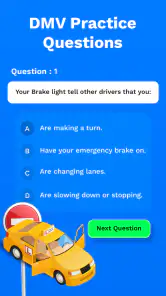
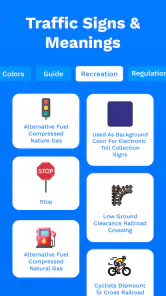
The DMV Written Exam Practice App is designed to help learners prepare for the written knowledge test required for a driver’s license or learner’s permit. It typically includes practice questions based on traffic laws, road signs, safe driving rules, and licensing requirements. The app is useful for reviewing key topics and becoming familiar with the style of questions used on official exams.
Does the app include questions for my state or country?
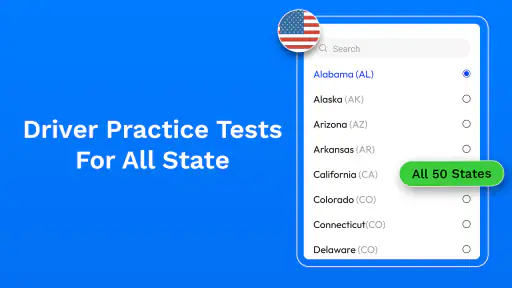
Coverage can vary, so users should check the selected location before relying on the app for exam preparation. Many DMV practice apps organize questions by U.S. state, while some may provide more general driving-test material. Make sure the chosen state matches the location where you will take the test, because speed limits, penalties, road rules, and licensing requirements may differ.
Can I use the app without an internet connection?
Offline availability depends on how the application stores its practice material. Some sections may remain accessible after installation, while features such as advertisements, progress synchronization, updates, or additional question packs may require an internet connection. Before studying offline, open the app while connected and confirm that the quizzes and explanations you need are available without mobile data or Wi-Fi.
Is completing the practice quizzes enough to pass the official DMV test?
The app can be a helpful study companion, but it cannot guarantee a passing result. Practice quizzes are most effective when combined with the official driver handbook published by your DMV or licensing authority. Pay close attention to explanations, review incorrect answers, and study topics rather than memorizing question patterns, since the real exam may use different wording or present unfamiliar situations.
Pros
- Covers state-specific questions for more focused exam preparation.
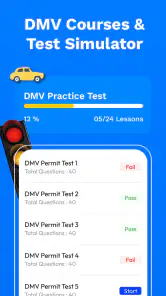
- Practice tests help identify weak topics before the real DMV exam.
- Simple interface makes it easy to study during short sessions.
- Useful explanations clarify why an answer is correct.
- Progress tracking helps users monitor their preparation over time.
Cons
- Question coverage may vary depending on the selected state.
- Some features or study tools may require a paid upgrade.
- Practice questions may not match the wording of the official exam.
- Requires regular updates to keep pace with changing DMV rules.
- Ads can interrupt study sessions in the free version.
- Category
- Auto & Vehicles
- Version
- 2.8