Word Fusion: Association
- 1.00
- 3.8
- Installs
- 10.00K
- Price
- Free
Screenshots



Analysis by Reviewed
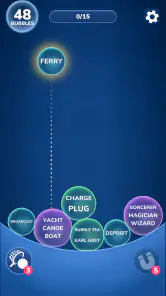
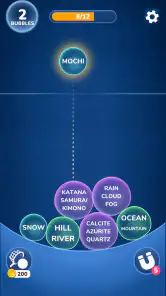
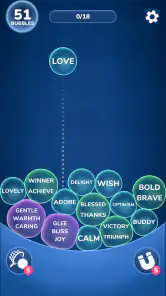
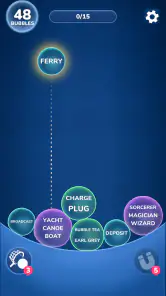
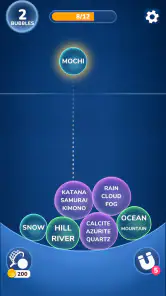
I approached Word Fusion: Association as a quick word game rather than a traditional spelling challenge, and that distinction matters from the first round. Its basic idea is easy to understand: bubbles appear on the board, and I connect words that belong to the same category. The goal is to make sensible associations while clearing the play area. It feels more like sorting ideas under time and space pressure than simply finding hidden words.
That makes it a welcoming choice for someone who wants a casual brain game without a long tutorial. I do not need to learn a complicated control scheme before playing. At the same time, the category-based design gives each move a little more thought than a basic matching game. I am not only looking for identical letters or colors; I am deciding which words naturally belong together and which tempting options should wait.
Getting comfortable with the word-and-bubble board
The first useful thing to know is that the game’s appeal comes from the combination of two tasks. I have to recognize relationships between words, but I also have to manage the visible board. A correct association is satisfying because it solves a language puzzle and creates progress in the play area at the same time. That combination keeps the experience more active than a simple list of category questions.
For a first-time player, I would begin slowly and read every visible word before making a move. It is easy to grab the first pair that seems related, but a better approach is to scan for the strongest group. If several words clearly point toward one subject, those are usually safer than a pair connected only by a loose interpretation. This habit helps prevent the board from becoming confusing later.
The game is free to start, which makes it straightforward to try without committing money immediately. It is rated for Everyone, so its presentation is aimed at a broad audience rather than a narrowly defined age group. Fugo Games is the developer, and the current version is 1.6.0. The game runs on Android 8.0 or later, a useful detail for anyone installing it on an older phone or tablet.
Its store summary describes the central loop in a few words, but the practical experience is about judgment. Categories may feel obvious in one moment and surprisingly debatable in the next. I found that the most reliable way to make progress is to treat the board as a set of relationships, not as isolated bubbles. Looking for the larger pattern reduces random taps and makes each successful clear feel earned.
The first launch and what I would do before playing
After installing, I would keep the first session focused on learning the board rather than trying to play quickly. I would check how words are selected, whether the game responds to a tap or a drag, and how a completed association is shown. Those small details affect how confidently I play, especially when several bubbles are close together.
I would also avoid spending anything during the opening rounds. The game is free, but it includes optional in-app purchases ranging from $1.99 to $29.99 per item. A new player can learn the basic rhythm before deciding whether any paid option is worthwhile. That is particularly important here because the main question is not whether the game can be opened, but whether its category puzzles remain enjoyable over repeated sessions.
The audience size suggests that this is still a relatively modest title, with over 10 thousand installs and an average rating of 3.8 from 39 ratings. I would read that as a reason to approach it with realistic expectations: it is a focused word game to sample, not an established giant with a huge community around it. The rating also points to a mixed but broadly workable experience, so I would give the controls and puzzle style a fair trial before forming an opinion.
The release date is June 19, 2026, and that places the game in a relatively recent stage of its life. For a first-time user, the practical takeaway is to judge it by the actual clarity of the current version rather than by assumptions about a long history of updates. If the opening interaction feels natural on your device, the short-session format makes it easy to continue without setting aside a large block of time.
How to reach the first meaningful success
My recommended first move is not necessarily the most visually convenient one. I would read all the available words, identify a clear category, and select the members that fit it most directly. For example, if several terms obviously describe the same type of object or activity, I would prioritize that group over words that merely share a vague association. The aim is to establish the game’s logic with a clean success.
That first successful clear teaches three things at once: how the game recognizes a category, how the board changes after a correct choice, and how much attention is needed to avoid accidental selections. Once I understand those points, later decisions become less intimidating. I can then experiment with less obvious relationships without feeling that every uncertain move will derail the session.
A useful tactic is to separate certainty from possibility. I mentally place words into two groups: those that have an unmistakable connection and those that could belong to more than one theme. I resolve the unmistakable group first. This is more than a beginner’s trick; it protects against a common puzzle error in which one flexible word is used too early and leaves a stronger category incomplete.
Another practical tip is to pause between clears instead of immediately choosing the next visible words. The board may look simpler after a successful action, but the remaining terms can form new relationships that were hidden by the earlier clutter. Taking a brief scan after every clear helps me avoid carrying an old assumption into the next decision.
When I play in a short break, I treat one successful association as a complete mini-goal. That makes the game suitable for waiting rooms, a commute, or a few quiet minutes before bed. I do not need to promise myself a long session. If I have more time, I can continue; if not, the game still gives me a clear sense of progress from a small interaction.
Where new players may hesitate
The main source of confusion is the difference between a word that is related and a word that is intended to belong. Natural language is flexible, so two terms can share a connection without being part of the same category. I found it helpful to ask, “Would I normally place these together under one label?” rather than merely asking whether one word reminds me of the other.
Another point of friction is the temptation to solve by pairs. The game’s concept may look like a simple matching exercise, but category thinking is stronger than one-to-one matching. A pair can seem correct while a larger group reveals the intended relationship. Before committing, I would look for the category that explains the greatest number of words with the fewest exceptions.
If a selection does not work, I would not immediately assume that the word itself is strange or that the game is malfunctioning. I would reconsider the category, look for a more specific connection, and check whether another word fits better. This mindset is important because association puzzles often test precision, not just creativity. The best answer is usually the one that makes the board feel organized afterward.
There is also a trade-off between speed and accuracy. Moving quickly can make the game feel energetic, but rushing increases the chance of locking onto a weak association. I prefer a measured pace during unfamiliar rounds, then speed up once I recognize the type of categories being used. Players who enjoy rapid reactions may find the deliberate reading slightly slow, while word-puzzle fans may appreciate that the game rewards thought.
Because the game uses bubbles as its visual language, players coming from conventional crossword or anagram apps should expect a different kind of concentration. A crossword usually gives me fixed clues and a grid; an anagram game focuses on rearranging letters. Here, I am interpreting meaning and organizing a changing board. That makes it a better fit for someone who enjoys vocabulary and classification than for someone seeking pure spelling practice.
Small strategies that make later rounds clearer
I would keep an eye out for words with multiple possible homes. These are often the most useful and most dangerous items on the board. Instead of assigning one immediately, I leave it mentally uncommitted until I have found a group with stronger evidence. This prevents a flexible word from disguising the real structure of the puzzle.
I also recommend reading categories broadly before reading them narrowly. First I ask what general subject connects the words; then I ask whether the connection is specific enough to separate it from another group. This two-stage process is quicker than repeatedly guessing and undoing a choice. It also makes the game feel more like reasoning than trial and error.
A further insight is to use the board’s changing layout as information. When a correct group disappears or is cleared, the remaining words should be reconsidered from the beginning. I do not treat the new board as merely a smaller version of the old one. The removal can reveal a category that was previously obscured, so a fresh scan is often more valuable than continuing with the same plan.
For families or friends, the game can work as a quiet shared activity even though each person may interpret associations differently. One player can explain why a group seems coherent while another challenges the weakest word. That conversation is part of the fun, but it also exposes a limitation: people who dislike subjective word relationships may find disagreements frustrating rather than entertaining.
I would also be careful about using it as a serious educational tool. It can encourage vocabulary awareness, grouping, and flexible thinking, but it is not a replacement for structured language study. Someone preparing for an exam, building a vocabulary list, or practicing a specific language skill would probably get more measurable progress from a dedicated learning app. This game is better as an informal mental exercise.
Who should try it and who should choose something else
I think Word Fusion: Association suits players who like short word puzzles, visual boards, and the satisfaction of finding a hidden organizing principle. It is especially approachable for someone who wants a game that can be understood quickly but still asks for more than reflexes. The Everyone age rating also makes it a reasonable candidate for a broad household audience, provided each player enjoys category-based reasoning.
It is less suitable for anyone looking for a deep story, competitive multiplayer structure, or a long-form progression system. It is also not the ideal choice for players who want exact, objective answers in every situation. Association-based puzzles depend on how words relate, and that can feel less precise than a crossword clue with a clearly defined solution.
Compared with a standard word search, this game asks me to think about meaning rather than scanning for letter sequences. Compared with an anagram game, it offers less emphasis on spelling manipulation and more on recognizing themes. Compared with a crossword, it removes the need to manage a large grid of intersecting answers. I would choose this one when I want a lighter, more visual alternative that still gives my brain a genuine sorting problem.
The free entry point is helpful for testing that fit. I would play several sessions, notice whether the categories feel satisfying, and only then consider an in-app purchase. The available purchase range means spending can become meaningful, so I would recommend setting a personal limit before buying anything. For me, the game’s value depends on the quality and variety of the puzzles, not on simply having more content available.
My recommendation after learning the rhythm
Once I understood that the best move is the group with the clearest shared identity, the game became much more relaxing. I stopped treating every bubble as an urgent choice and started reading the board as a collection of possible structures. That shift is the key to enjoying it. The first few minutes are about learning how to see the puzzle, while later play is about trusting that method.
My strongest recommendation is to use it in short, intentional sessions. Open it when you want a small mental reset, scan carefully, and aim for one clean clear before deciding whether to continue. That approach keeps the game from becoming a rushed tapping exercise and makes its word-association design stand out.
The best reason to try it is the satisfying moment when several ordinary words suddenly make sense as one group. The main caution is that the same flexibility can frustrate players who prefer rigid rules or fast action. With its free starting price, broad age rating, and accessible controls, I think it is worth a trial for casual word-game fans, while dedicated crossword or spelling players should see it as a change of pace rather than a replacement.
After my first successful round, I would keep playing if I wanted a compact vocabulary puzzle that rewards observation. I would skip it in favor of a conventional crossword, anagram, or language-learning tool if my priority were structured study, highly precise clues, or a more substantial game world. For the right player, though, Word Fusion: Association offers a simple path from installation to a meaningful little victory: read the board, find the strongest category, clear it, and let the remaining words reveal what comes next.
Pros
- Simple word-association gameplay is easy to learn.
- Short rounds make it suitable for quick breaks.
- Increasing difficulty keeps the puzzles engaging.
- Clean interface makes clues easy to read.
- Offline play is useful when traveling or without data.
Cons
- Some associations may feel subjective or unclear.
- Later puzzles can become repetitive for frequent players.
- Limited variety may reduce long-term replay value.
- Hints can make challenging levels feel less rewarding.
- Ads may interrupt the experience between puzzles.
- Category
- Word
- Version
- 1.6.0