Sequence® World
- 22.00
- 3.6
- Installs
- 10.00K
- Version
- 2.1.1

Screenshots







Analysis by Reviewed
I like board games that are easy to explain but still leave room for a clever decision, and Sequence® World is built around that appeal. It brings the familiar Sequence-style experience to a phone or tablet, giving me a convenient way to play when setting up a physical board is impractical. The central attraction is not a complicated campaign or a large collection of modes; it is the simple pleasure of placing cards, claiming spaces, and trying to connect a winning line before the other side does.
That focus makes this a particularly approachable board game for casual sessions. I can understand the basic idea quickly, yet a careless move can still change the direction of a match. The app is free to install, is suitable for Everyone, and comes from Goliath BV, the company behind the official digital version. Its store summary presents it as a way to play the board game anywhere, and that is the right way to view it: a portable interpretation of a recognizable tabletop activity rather than a completely new strategy game.
Why the digital Sequence experience works
The key capability here is portability. With the physical game, I need the board, cards, playing pieces, and enough table space for everyone to sit comfortably. On a mobile device, the whole play area is available immediately. That changes the rhythm of the game in a useful way. A short wait, a quiet evening, or a few minutes before leaving the house can become an opportunity for a match without the preparation that normally comes first.
That convenience matters because Sequence is naturally suited to interrupted attention. A turn is usually understandable at a glance: inspect the cards in hand, decide where a useful card can be played, and consider how that placement affects a line. I do not need to memorize a long ruleset before making a meaningful decision. The digital format therefore preserves the game’s strongest quality: it is welcoming to newcomers while giving experienced players reasons to look ahead.
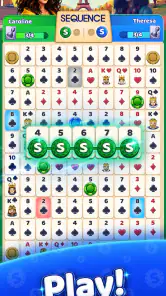
I also found that the app’s value depends less on visual novelty and more on reducing friction. A physical board gives the game a satisfying presence, but it can be awkward when players are not in the same room or when the table is already being used for something else. Sequence® World is most appealing when I want the recognizable structure of a board game without treating the setup itself as part of the evening’s activity.
The current version is 2.1.1, and the minimum operating-system requirement is Android 7.1. That makes the app accessible on a broad range of older compatible devices, although the experience will still depend on the screen size and general performance of the phone or tablet. I would choose a larger screen when possible because a board with many spaces is easier to read and plan around when it is not compressed into a small display.
Reading the board instead of chasing the first line
In practice, the most important adjustment is learning to treat each move as both an attack and a defense. A beginner may look only for the nearest way to build a line. I get better results when I first check whether the opponent is one move away from completing a sequence, then decide whether my card can block that threat without creating a larger problem elsewhere.
This is one of the useful differences between a quick digital match and a purely automatic puzzle. The app may make the mechanics convenient, but it does not remove the need to scan the whole board. A move that appears to extend my own pattern can be weaker than a blocking move, especially when it leaves an open route for the other side. I recommend taking an extra moment before confirming a turn, particularly when several spaces appear playable.
Another practical habit is to avoid spending a flexible card simply because it produces an immediate connection. In Sequence, a space can be valuable for more than one possible line. If I place too early in a central or strategically useful area, I may gain a small advantage now while giving up the chance to create a stronger threat later. The compact screen can encourage quick taps, so deliberately slowing down is surprisingly important.
The app is also a good setting for learning the difference between visible progress and actual pressure. A nearly completed line is not always safe if the opponent can interrupt it. Conversely, a scattered group of placements may be strong if it creates two threats that cannot both be answered. That is the kind of insight I would use when introducing the game to someone new: ask them not only what they can complete, but how many problems their move creates for the other player.
A realistic everyday match
Imagine having a short break while waiting for an appointment. A physical board game would be unrealistic because it requires space, pieces, and another person ready to begin. With this app, I can open a match and use the time for a focused game instead. If I need to stop, the important question is whether the particular play session supports the interruption in a convenient way; I would not assume that every match can be paused or resumed exactly like a tabletop game. For a dependable stop-and-start routine, I would test that behavior early rather than relying on it during an important match.
At home, the app works differently. Two people can use one device as a shared board, passing it between turns, which is useful on a sofa or during travel. The trade-off is that a physical set feels more social because everyone can reach across the same table and handle the cards and pieces. The digital board is cleaner and faster, but it can also make the interaction feel more like taking turns with a screen than gathering around a game.
That distinction helps me decide when to use it. If I want a spontaneous match with minimal preparation, the app is the better fit. If I am hosting friends and want an object everyone can see and touch, the boxed game may create a warmer atmosphere. Neither format replaces the other completely; they solve different practical problems.
Where the app is strongest
The best scenario is a player who already enjoys accessible strategy games and wants a portable version for casual play. It is especially suitable for families or mixed-experience groups because the core idea is straightforward. Someone who rarely plays board games can follow the visible objective, while a more experienced player can focus on timing, blocking, and preserving useful options.
I would also recommend it to people who like games with a moderate decision load. Sequence is not the right choice if you want a deep rules engine, a long campaign, or a constant stream of new systems to master. Its pleasure comes from repeated tactical situations: recognizing threats, managing the opportunities in hand, and deciding when to commit to a line. That simplicity is a strength for relaxed play, but it can feel limited to players who need substantial variety in every session.
One of my favorite ways to approach it is as a teaching tool. Rather than explaining every possible tactic at once, I would let a new player play a few turns, then point out one missed defensive opportunity. The board makes those lessons concrete. For example, I can show how blocking a nearly complete sequence may be more valuable than adding to a line that is still several spaces away. This keeps the introduction friendly instead of turning a family game into a lecture.
It can also work well as a low-pressure alternative to more demanding mobile strategy games. There is enough thought to prevent the experience from becoming mindless, but not so much complexity that I need a long uninterrupted session. That balance is valuable when I want something interactive without committing to an elaborate rules system.
The costs behind a free download
The app is free, but it includes in-app purchases ranging from $1.99 to $49.99 per item. That is the main point I would ask a reader to consider before installing. A free entry point is convenient, yet the possible purchase range means I would review any payment prompt carefully and use device-level purchase controls if children might access the app.
For me, the presence of purchases changes how I evaluate the experience. I am comfortable trying a free board game when I can enjoy its basic play without immediately paying, but I do not want the decision to feel rushed by repeated prompts. Since the game’s appeal is based on a focused board system, optional spending should be judged by whether it genuinely improves convenience or presentation for that particular player, not by fear of missing out.
The public response is reasonably mixed rather than universally enthusiastic: the game has a 3.6 average from around 66 ratings, with around 22 written reviews. I read that as a reason to keep expectations measured. The concept is appealing, but a digital adaptation has to satisfy people who may expect the same ease and social warmth as the tabletop version. If the interface, turn flow, or purchase experience bothers someone, the simplicity of the underlying game may not be enough to overcome that friction.
The install figure is over 10 thousand, which suggests a smaller audience than the biggest mobile board-game releases. That is not automatically a weakness, but it does affect what I would expect from the surrounding ecosystem. I would choose this primarily for the core Sequence experience, not because I expect a huge online community or a constantly expanding competitive scene.
How it compares with the physical game and other mobile choices
Compared with the physical board game, Sequence® World wins on availability and setup. There is no need to find a flat surface, sort pieces, or remember where everything was placed after a break. It is also easier to carry than a box. The physical version wins on atmosphere, shared ownership of the board, and the tactile satisfaction of placing a piece by hand.
Compared with more complex digital board games, this one is easier to enter but offers less room for layered strategy. A heavy strategy title may reward long planning, asymmetric abilities, or a larger variety of systems. Sequence instead gives me a compact tactical puzzle that I can understand quickly. I would pick it for a relaxed family session or a short break, while I would choose a deeper alternative when I want a game that demands sustained study.
Compared with a simple card game, the board creates more spatial tension. The location of a placement matters, and a move can influence several possible routes at once. That makes it more thoughtful than a purely luck-driven card exchange. Still, the cards influence what options are available, so anyone looking for complete control may prefer an abstract strategy game with fewer random elements.
There is also a social trade-off. A shared physical board naturally keeps everyone’s attention in one place. A mobile device can introduce distractions, notifications, or the temptation to rush. I get the best results when I treat the screen as the game table: silence unrelated alerts, use a comfortable display, and agree that players will examine the board rather than tap through turns casually.
Who should install it
I think the strongest audience is someone who already knows the appeal of Sequence or wants a friendly introduction to it without buying a physical set first. Families, casual players, and people who enjoy short tactical decisions are likely to get the most from it. The Everyone rating also makes it a natural candidate for shared household use, provided an adult manages purchases appropriately.
I would be more cautious if you need a rich solo experience, a large collection of variants, or a highly competitive online environment. The verified store information identifies it as a board game from Goliath BV, and the central promise is clear, but I would not install it expecting it to behave like a sprawling strategy platform. Its value comes from doing one recognizable thing in a portable form.
Before committing to it as a regular game-night replacement, I would test three practical details: whether the board is comfortable to read on your device, whether the turn flow suits the way you want to play, and whether the free version feels acceptable alongside its purchase prompts. Those checks matter more here than raw technical specifications because the game’s rules are easy to learn; the quality of the experience depends on how smoothly the digital presentation supports them.
My final view is positive but specific. Sequence® World is best understood as a convenient digital table for a familiar tactical board game, not as a substitute for every kind of mobile entertainment. I like it when I want quick access, clear objectives, and enough strategy to make each placement matter. I would choose the physical set for a full social gathering and a deeper mobile game for long-term variety, but for an accessible match during an ordinary day, this version makes a convincing case for keeping Sequence close at hand.
Pros
- Easy-to-learn rules make it accessible for new players.
- Supports strategic thinking and planning ahead.
- Works well for relaxed family game nights.
- Bright
- clear visuals make cards and spaces easy to read.
- Offers replay value as each board setup can feel different.
Cons
- Matches can become lengthy when players take time to plan.
- Luck from card draws can affect otherwise strong strategies.
- The interface may feel crowded on smaller phone screens.
- Some advanced strategies take time to understand.
- Online play may be less enjoyable with slow or inactive opponents.