Hexa Crush
- 915.00
- 4.9
- Installs
- 1.00M
- Price
- Free
Screenshots
Analysis by Reviewed
I tried Hexa Crush as the kind of puzzle game you open when you want something simple to understand but still active enough to hold your attention. It is a free 3D hexagonal block puzzle from Kiwi Fun, built around placing pieces, matching colors, and keeping the board under control. The basic idea is easy to pick up, yet the shape of the board gives each move more weight than a standard square-grid puzzle.
My first impression was that it sits between a relaxing sorting game and a more traditional placement challenge. You are not learning a complicated rulebook, managing a story, or waiting for a long match to unfold. Instead, the appeal comes from looking at the available blocks, spotting useful combinations, and deciding whether to clear space now or prepare a better move later. That makes it suitable for short breaks, although the later decisions can become surprisingly absorbing.
How to decide whether Hexa Crush fits your play style
The central loop is easy, but the board still asks for attention
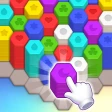
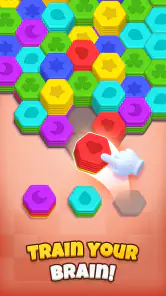
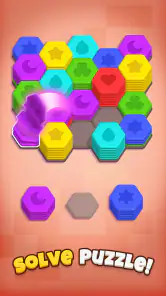
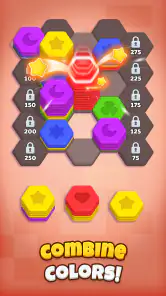
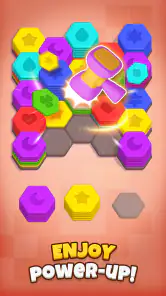
The most important question is whether you enjoy puzzles that rely on spatial planning rather than speed. Hexa Crush presents 3D hexagonal blocks that need to be stacked and matched by color. The hexagonal layout changes the way pieces connect, so I had to stop thinking in ordinary horizontal and vertical lines. Openings can disappear quickly, and a placement that looks harmless from one angle can make the next few moves awkward.
That is where the game earns its place among casual puzzle games. It does not demand a large time commitment, but it rewards players who pause before acting. I found myself checking which spaces would remain available after a match, rather than simply dropping the most obvious piece. This small habit makes a real difference when the board starts filling up.
The color-matching rule also makes the game approachable for people who do not usually play strategy titles. I could explain the basic objective in a few seconds, and the visual language is much friendlier than a puzzle filled with menus, text, or complicated abilities. The Everyone age rating fits that accessible presentation, making it a reasonable choice for families who want a straightforward game to share.
What I look for before choosing a puzzle game
For me, a good mobile puzzle game needs three things: a clear first move, enough decision-making to avoid feeling automatic, and a comfortable pace for sessions of different lengths. Hexa Crush handles the first two well. I could begin immediately, and the hexagonal board created enough uncertainty to make planning worthwhile. The pacing feels more suitable for thoughtful play than for frantic tapping.
The third point depends on how you use it. If you want a game that fills a few minutes while waiting, this format works well. If you want a deep campaign with a strong sense of progression, it may feel light. There is no need to learn a large world or remember a complicated narrative, but that also means the pleasure comes almost entirely from the board itself.
More From Our News Desk

Clash of Clans Is Won Between the Battles

Android Auto Makes the Case for Quieter Car Software

MobiOffice: Transforming Mobile Productivity with Seamless Integration

EA SPORTS FC™ Mobile Soccer: Redefining Mobile Sports Gaming

How Microsoft OneDrive Became a Mobile Productivity Giant

How Google Translate Breaks Language Barriers Effortlessly
I would also consider how much tolerance you have for optional spending. The game is free to start, while its in-app purchases range from under a dollar to amounts approaching a hundred dollars per item. That does not automatically make the experience unsuitable, but it is worth remembering before handing the device to a child or treating the game as a completely cost-free hobby.
A practical way to play during an ordinary day
A realistic use case is a short break between tasks. I might open it while waiting for a meeting, play a few careful turns, and stop without feeling that I had abandoned a story or interrupted a team. The game’s structure supports that kind of stop-and-start routine better than puzzle adventures that expect longer sessions.
Another useful situation is winding down in the evening. The matching concept is familiar enough to feel calming, but the board still gives my mind something specific to work through. I found that the most relaxing approach was to treat each turn as a small planning exercise rather than chase a perfect result. When I played too quickly, I created avoidable blockages and made the experience more frustrating than it needed to be.
Three habits that improve the experience
My first useful habit was to protect flexibility. I tried not to fill every convenient opening immediately, especially when a move would leave only one narrow route for future pieces. In a hexagonal arrangement, a little empty space can be more valuable than an early match. Preserving several possible placements gives me more ways to recover when the next block is not ideal.
The second was to separate a good match from a good turn. Clearing color can feel satisfying, but it is not always the best decision if the remaining pieces become difficult to place. I started asking what the board would look like after the match, not just whether the match was available. That change made the game feel less like reflex sorting and more like controlled planning.
The third was to use the outer area carefully. The edge can look safe because it appears less crowded, yet placing pieces there may reduce the directions from which later blocks can be connected. I learned to treat the perimeter as a resource rather than a dumping ground. This is a small insight, but it helps prevent the slow buildup that eventually leaves no comfortable move.
Where Hexa Crush wins, and where another puzzle may fit better
The strongest part is the balance between calm and consequence
Hexa Crush works best when I want a puzzle that is visually simple but not completely mindless. The blocks and colors communicate the goal quickly, while the 3D hexagonal arrangement adds enough friction to stop every move from feeling interchangeable. That balance is its clearest strength.
Compared with a basic color-matching game, it asks more from spatial awareness. Compared with a traditional falling-block puzzle, it feels less dependent on speed and more dependent on choosing a safe location. Compared with a large logic game, it is easier to enter and less demanding to remember. Those differences make it a useful middle option for players who want some strategy without turning a break into a serious mental workout.
The game’s popularity also suggests that this accessible formula has found an audience. It has an average rating of 4.9 from around twenty-three thousand ratings, and it has passed one million installs. I would not treat those figures as a guarantee that every player will enjoy it, but they do indicate that the simple block-and-color structure has broad appeal.
Where the experience may feel limited
The same simplicity that makes the game approachable can become a weakness for players who need variety. If you prefer puzzle games with a story, character development, elaborate objectives, or a large collection of distinct mechanics, Hexa Crush may feel narrow after the initial novelty of its board wears off. Its appeal depends on whether repeating the placement-and-matching loop remains satisfying for you.
It is also not the best choice if you want a highly competitive puzzle environment. I approached it as a personal planning game, not as a head-to-head contest. Players who enjoy timed battles, ranked ladders, or direct competition may be happier with a different category of puzzle altogether. Likewise, anyone looking for a pure relaxing experience should know that poor planning can still create pressure when the board becomes crowded.
The three-dimensional presentation adds character, but it may not suit everyone. Some players find layered or angled boards less immediately readable than flat grids. I needed a little time to judge how pieces related to one another, especially when several colors were close together. If you prefer perfectly flat, instantly legible layouts, a conventional match game may feel more comfortable.
What switching from another puzzle game really involves
Moving from a familiar square-grid game to Hexa Crush is not difficult, but it does require changing your visual habits. In a square layout, I naturally scan across rows and columns. Here, I had to think in connected directions around a hexagonal space and pay more attention to the gaps between pieces. The rules are not complicated; the adjustment is mostly about learning to read the board.
The cost of switching is therefore time rather than money. Since the game is free, trying it does not require an upfront purchase, but optional items can change the financial side if you choose to buy them. I would begin by playing without spending and decide whether the core loop remains enjoyable on its own. That is especially sensible for younger players, because the available purchase range extends from $0.99 to $99.99 per item.
Device compatibility is another practical consideration. The current version is 2.1.4 and requires Android 7.0 or later. For someone using an older phone or tablet, checking the operating system before planning a switch is worthwhile. Players on a compatible device should find the entry barrier much lower than with a game that requires learning a complex control scheme.
Who should choose it, and who should keep looking
I would recommend Hexa Crush to someone who enjoys color sorting and spatial puzzles, wants short sessions, and likes making careful decisions without learning a long set of rules. It is particularly suitable for a player who finds ordinary match games too automatic but finds advanced logic games too demanding. The board gives enough room for personal strategy while keeping the objective understandable.
I would be more cautious about recommending it to someone who dislikes repeating a central mechanic. If your ideal puzzle game constantly introduces new systems, characters, or environments, this may not provide enough change. I would also point competitive players toward a game designed around rankings or direct challenges, since the main attraction here is the individual board-solving process.
For parents, the Everyone rating is reassuring from an age-category perspective, but I would still pay attention to the purchase settings. Free installation and optional transactions are not the same as a completely purchase-free experience. Setting expectations before a child plays is a sensible part of using any free game with in-app purchases.
My final recommendation after weighing the trade-offs
After spending time with it, I see Hexa Crush as a focused casual puzzle rather than an all-purpose mobile game. It succeeds because the rules are welcoming, the hexagonal board gives familiar matching a different shape, and the pace leaves room to think. I especially liked that a short session could still contain a meaningful decision: clear now, preserve space, or risk a tighter arrangement for a better future move.
Its limitations are equally clear. The experience may not satisfy players who need a story, constant novelty, or competitive features, and the optional purchase range deserves attention. The 3D layout can also take a little practice before it feels completely natural. None of those points ruin the game, but they matter when choosing between this and a more specialized alternative.
My recommendation is to try it if you want a free, approachable hexagonal block puzzle for quiet breaks and thoughtful short sessions. Start by protecting open space, look at the board after each possible match, and avoid spending until you know the basic loop holds your interest. For the right player, that combination makes it an easy game to return to without demanding a large commitment.
Kiwi Fun has kept the concept direct, and that directness is the reason I would suggest it to a friend who wants something relaxing but not entirely passive. Hexa Crush is not the deepest puzzle option available, yet it offers a pleasant middle ground: more planning than a simple sorting toy, less pressure than a competitive challenge, and enough spatial character to make its familiar color-matching idea feel distinct.
Hexa Crush Frequently Asked Questions
Does Hexa Crush require a lot of storage or battery power?
Hexa Crush is a puzzle game centered on arranging and matching 3D hexagonal blocks, so its main appeal is straightforward, pick-up-and-play sessions. Before installing, make sure your device has enough free storage for the game and any updates. Battery use can vary with your device and how long you play, so shorter sessions are a sensible way to see how it performs on your phone or tablet.
Is Hexa Crush suitable for quick sessions or longer play?
Hexa Crush’s block-placement puzzles can suit either a brief break or a longer stretch of play, depending on your pace. You can focus on arranging the available shapes and sorting colors, then stop when you are ready. If you enjoy puzzle games that are easy to pick up without needing extensive gaming experience, its simple central idea makes it approachable for casual play.
Can I play Hexa Crush on my device?
Hexa Crush is a puzzle game for devices running Android 7.0 or later. Before downloading, check that your device meets this minimum system requirement and has enough available storage for the installation. The game is designed around placing and matching 3D hexagonal blocks, so a compatible device will let you enjoy its central color-sorting puzzle experience.
What is Hexa Crush and how is the game played?
Hexa Crush is a casual puzzle game built around arranging and matching hexagonal pieces on a compact board. After installing it, players generally drag or place available shapes into open spaces, aiming to complete lines, groups, or other required patterns to clear the board and earn points. The simple controls make it easy to start, while limited space and increasingly difficult layouts add challenge over time.
Is Hexa Crush free to download and play?
Hexa Crush is free to download, making it accessible to casual players who want a quick puzzle experience. It offers optional in-app purchases, with individual items priced from $0.99 to $99.99. These extras may provide convenience or additional benefits, but they are not usually essential for enjoying the core gameplay. Review the purchase options before playing, particularly if children use the device.
Pros
- Simple hexagon-matching rules are easy to learn.
- Short rounds make it suitable for quick breaks.
- Colorful visuals keep the board easy to read.
- Gradual challenges help maintain interest over time.
- Offline play is convenient when no connection is available.
Cons
- Some levels may feel repetitive after extended play.
- Difficulty can increase suddenly in later stages.
- Small hexagons may be harder to tap on compact screens.
- Limited gameplay variety may reduce long-term appeal.
- Ads can interrupt the experience in the free version.
- Category
- Puzzle
- Version
- 2.1.4